
AUTO
Mahindra Roxor Top Speed: How Fast the HD Models Go
Mahindra Roxor top speed on the September 2025 US brochure is 52 mph. Towing stays at 15 mph, and flat towing is 55 mph only with a locking-hub kit.

You are checking a Mahindra Roxor because the shape reads like an old work Jeep and the job in front of you is chores, not a dune race. It is a two-seat side-by-side with a steel body, a boxed steel frame, a small turbodiesel, and a manual gearbox instead of the belt drive common on sport machines.
Mahindra sells that truck for off-road use only. Highway pace is the wrong yardstick. The maker prints a modest driven top speed, a much lower cap while you are towing, and a separate figure for when another vehicle is flat-towing the Roxor.
The Mahindra Roxor top speed below is that printed limit, followed by the diesel and gears behind it, the HD base and all-weather models, what changes your pace on a trail, and the price on the maker’s site.
The Job This Side-by-Side Is Built For
Mahindra Automotive North America conceived the Roxor, and the company builds it in Pontiac, Michigan. Steel body panels sit on a boxed steel frame, which is the contrast Mahindra draws with plastic-bodied sport side-by-sides. Two people ride, each with a three-point belt, under a roll-over protection system.
The company ties the truck to its run of rugged vehicles going back to 1947. A straight front axle, leaf springs, and a simple transfer case keep the parts count down, which Mahindra says makes the truck tougher and easier to fix on a trail than an independent front suspension. The brand’s own introduction shows the steel body, the upright stance, and the kind of ground it is aimed at.
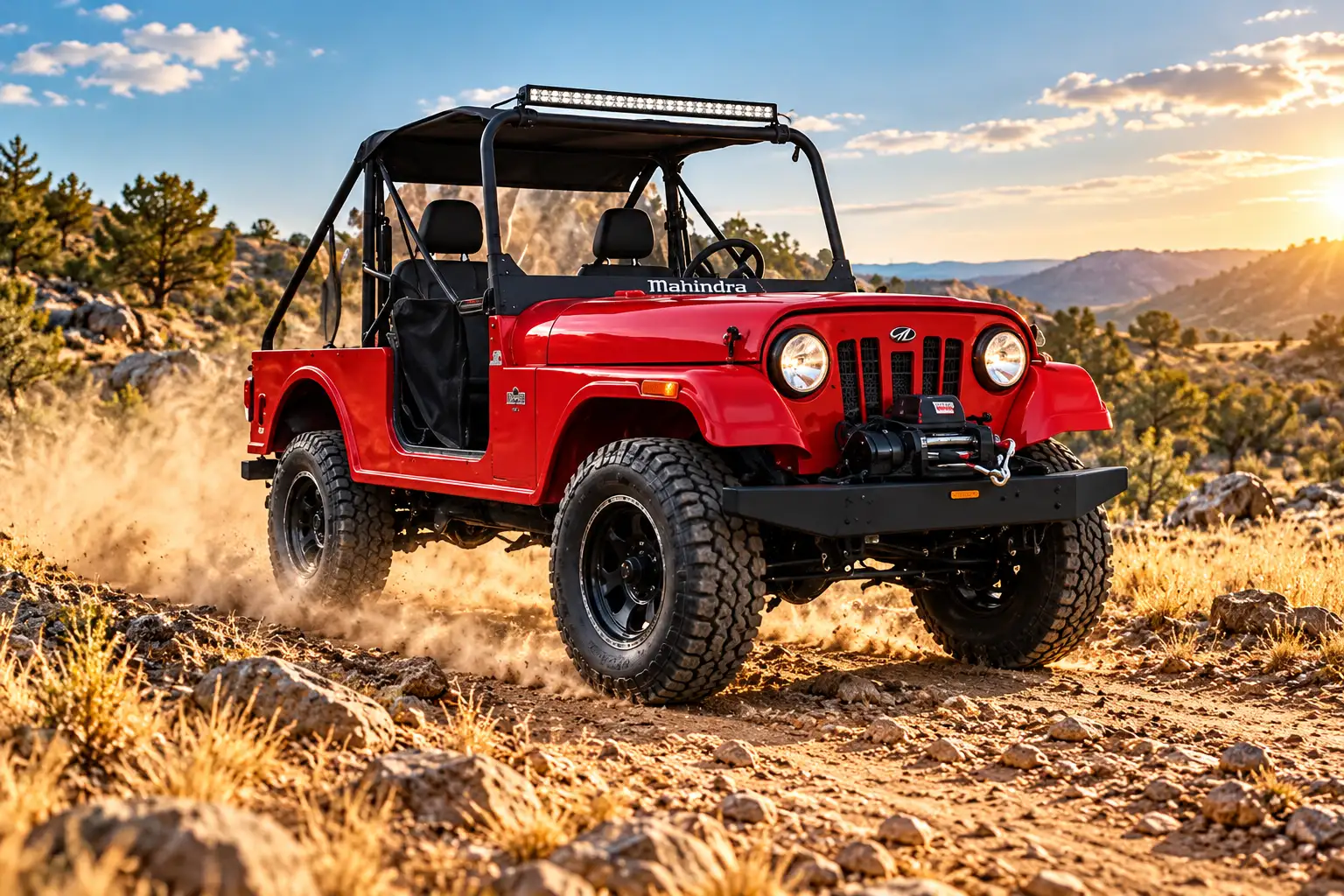
Mahindra Roxor Top Speed on the US Brochure
Read the three speed lines as different jobs, not as one number written three ways. The September 2025 Roxor HD brochure is the US sheet for both HD models.
THREE PRINTED SPEED LIMITS
- Driven top speed: Both HD models are listed at 52 mph (84 km/h).
- Towing speed: Keep the pace at 15 mph (24 km/h) while you pull a trailer of up to 3,500 lb.
- Flat-tow speed: 55 mph (88 km/h) applies only with an aftermarket locking-hub kit, when another vehicle is pulling the Roxor.
A fluid spec sheet for 2023 and 2024 Roxors calls that 52 mph maximum rpm-limited, and the 2025 brochure still lists a maximum engine speed of 2,700 rpm beside the same 52 mph. Mahindra Canada Roxor specifications still print a driven max speed that matches the US flat-tow line rather than the lower driven line. When a dealer listing and the brochure disagree, use the sheet for the model year parked in front of you.
Mahindra still offers operator’s guides for the 2018, 2019, 2020, and 2023 through 2025 model years. Early trucks used a 2.5-liter diesel rated at 62 horsepower, so the HD figure is the wrong one to borrow for those years. The guide that matches your model year is the speed to follow.
The 2.7-Liter Diesel and Five-Speed Gearbox
The HD engine is a four-cylinder turbodiesel of 2,730 cc, which Mahindra lists as 2.7 liters. Bore and stroke are 88.9 mm by 110.0 mm, compression is 18.7:1, and the fuel system is Mahindra common-rail diesel. The brochure states there is no diesel particulate filter, no regen cycle, and no diesel exhaust fluid.
- Power: 55 horsepower arrives at 2,300 rpm, and the engine is allowed up to 2,700 rpm.
- Torque: 144 lb-ft arrives at 1,400 rpm, so a heavy load moves without high revs.
- Gearbox: A five-speed manual has no drive belt, and the clutch is a normal left pedal.
- Transfer case: The two-speed case has a 2.41:1 low range, and you can select two-wheel drive or four-wheel drive.
- Axles: Front and rear gearing is 5.38:1, with a full-floating front axle and a semi-floating rear.
That torque peak is the reason the truck feels stronger as a puller than as a sprinter. Peak horsepower sits at 2,300 rpm, only 400 rpm under the listed maximum, so the engine is already near the top of its permitted revs when road speed runs out. Mahindra’s published fuel mileage puts the average at 32 to 34 mpg, with a range of about 350 miles, and real use moves with speed and terrain. The tank holds 16 gallons (60.5 liters).
Low range is for slow or hard ground. It multiplies torque at the axles and lets the engine stay in its useful rev band while the truck creeps. It does not raise the top speed. Come to a full stop, with the engine running, before you select four-wheel-drive low, or you risk the gears. With the clutch down and the drivetrain unloaded, you can move between two-wheel drive and four-wheel-drive high at any speed.
Roxor HD Base and All-Weather Compared
Both HD models share the diesel, the gearbox, the 4,600 lb gross vehicle weight rating, and the 3,500 lb tow rating. The split is cab, weight, and how much load is left.
HD BASE AND ALL-WEATHER
- Payload: The Roxor site lists 1,525 lb for the base and 1,303 lb for the all-weather, a gap of 222 lb.
- Dealer sheets: Many listings still pair a 3,075 lb base curb weight with 1,525 lb of payload, and a 3,415 lb all-weather curb weight with 1,185 lb, which is 118 lb under the site’s all-weather payload.
- Size: Wheelbase is 96 inches, length is 144 inches, width with no mirrors is 60.7 inches, and ground clearance is 9 inches.
- Height and mirrors: The base stands 75 inches tall, and the all-weather stands 77 inches, with a listed width of 64 inches when its side mirrors are closed.
- Cab: The all-weather adds a hard cab with heat and air conditioning, a glass windshield, and synchronized wipers.
- Rolling gear: Both ride on 235/70R16 all-terrain tires, steel wheels on the base and polished aluminum on the all-weather, with 11-inch front discs and 11-inch rear drums.
Pick the base when you want the higher payload and you can live with weather. Pick the all-weather when the day is long and you want heat, air conditioning, and a windshield, and accept that the cab equipment has already used part of the same 4,600 lb gross rating. If the site’s 1,303 lb and a dealer’s 1,185 lb do not match, the sheet for that vehicle identification number is the one to trust. Payload also varies with accessories.
Leaf springs and shock absorbers hold the axles, with a stabilizer bar on the front. Steering is hydraulic-assist. The brochure lists a 90-amp alternator and a 12-volt absorbed-glass-mat battery on the base electrical spec. None of that hardware changes the 52 mph line. It changes whether the truck is tolerable for a full workday.
What Changes Speed on the Trail?
The 2026 Roxor operator’s guide treats speed as something you manage with the gearbox, not something you chase. Its general rule is a shift about every 10 mph.
- Clutch and revs: Press the clutch fully before each shift, then release it as you bring idle up to about 1,500 rpm.
- One gear at a time: Move a single gear for about every 10 mph you gain or lose, and do not skip.
- Reverse: Stop completely before you go from a forward gear into reverse, or the other way.
- Low range: Stop completely before four-wheel-drive low, and save that range for slow or extreme ground.
Stock tires are 235/70R16. Owners who move to a taller all-terrain size find the speedometer and a following vehicle’s reading no longer match, and the engine still runs out of revs in the mid-50s rather than turning the truck into a highway machine. A taller tire changes the indicated number. It does not rewrite the rev limit.
The same guide tells you not to cross an obstacle taller than the 9 inches of ground clearance, and to meet an obstacle head-on while you still have momentum. With a trailer on the hitch, skip steep hills and side-hill traverses. A load or a trailer lengthens the stop and changes how the truck leans, so the safe pace is lower than the empty number on the brochure. Maximum tongue weight in that guide is 350 lb, and tongue weight counts against payload.
Can You Drive a Roxor on a Public Road?
The maker’s own answer is blunt, and it is the answer to use when a listing makes the truck sound like a small pickup.
NOT FOR PUBLIC HIGHWAYS
- Maker’s rule: Mahindra states the Roxor is an off-road vehicle only and is not legal for use on any public street or highway.
- Design standard: It is built to off-highway rules such as those from ANSI/ROHVA, which is not the same as a passenger-vehicle approval.
- Pavement: The operator’s guide tells you to avoid paved surfaces, and to slow down and steer gently if you must cross one.
The appeal of a steel, manual, diesel machine in the shape of an old CJ is real, and so is the wish for a version you could register and drive home. The company still sells this one as an off-road vehicle, and the guide still tells every operator to hold a proper driver’s license under local law. A county off-highway rule, where one exists, is a separate permission you have to read yourself. It does not turn the brochure into a highway rating.
The guide also says higher speed raises the chance of losing control, of a collision, and of injury or death, and it bars jumps, slides, and donuts. Power and traction are what the guide tells you to value off-road. The 52 mph figure is a ceiling, not a target for rough ground.
Roxor Prices as of November 2026
On the Roxor site, the HD base starts at an MSRP of $22,550 and the HD all-weather starts at $30,902, which is $8,352 more. Tax, title, dealer charges, freight, and registration are extra, and dealers set the selling price. The same site is advertising 0% financing for 36 months or up to $4,000 cash back on select models.
The September 2025 brochure lists a two-year limited warranty and points you to the operator’s guide for the full terms. A price or a rebate can move without a change to the 52 mph line, the 15 mph towing cap, or the off-road-only rule. Treat the window offer as dated, and treat the speed lines as the spec to confirm on the sheet for that truck.
Frequently Asked Questions
Can You Flat-Tow a Roxor for a Long Trip?
For a long flat-tow, the 2026 operator’s guide prefers that you remove the front and rear propeller shafts, and it requires a front locking-hub kit, sold separately, before you flat-tow or use a dolly. Attach the tow gear only to the four bolts on each side that hold the front bumper, tie down loose cargo, and check local rules, since the guide notes that some states want the towed vehicle licensed and may require a brake system.
Does the Current Roxor HD Have an Automatic?
The HD base and the HD all-weather in the September 2025 brochure both use a five-speed manual gearbox with a clutch pedal. A separate lever runs the two-speed transfer case. That brochure does not list an automatic for these models.
What Counts Against the Roxor Payload?
The driver, the passenger, cargo in the bed, accessories you add, and trailer tongue weight all come out of one maximum vehicle load. A winch or a set of heavier tires is not extra capacity on top of that number, and the all-weather model starts with less payload left because its cab equipment is already counted.
How Should You Break In a New Roxor?
Keep the accelerator inside three quarters of its travel during break-in, skip long hard acceleration, and change your speed instead of sitting at one cruise. The operator’s guide also asks you to shift between two-wheel drive and four-wheel-drive high at 1 to 5 mph in that period. Always stop completely before you select four-wheel-drive low.
That 55 mph flat-tow line applies only while another vehicle is pulling the Roxor, with the locking-hub kit fitted, and the operator’s guide would rather you pull the propeller shafts for a long haul. The pace you drive to yourself remains the lower figure on the same brochure page, and it drops again as soon as a trailer is on the hitch.
Disclaimer: This article is an educational guide to published Mahindra Roxor specifications and is informational only. It is not driving instruction, a registration opinion, or advice on changing a speed limiter. Confirm the operator’s guide for your model year, and confirm local off-highway rules with the agency that governs them, before you ride or tow. Prices, offers, and spec sheets reflect those sources at the time of review and can change.

Kering’s Growing Houses Cannot Outrun a Shrinking Gucci

Studio Staff and Bitcoin Buyers Built the Eminem Leak Case

A Mutated H1N1 Strain Is Hitting Younger Immunity First

Albert Heijn Returns at One-Third as Rivals Take Share

Art Basel Paris Ends After One Public Day

Thameslink Will Pad 60,000 Ironing-Board Seats From 2027

How Tall Was Adolf Hitler?

U.S. Forces Clear Hormuz Mines, Then Hit Minelayers Again

Micron Sells the Memory Shortage as Five-Year Contracts

Royal Caribbean Sends Los Angeles Ships to Singapore and Brisbane
-
 NEWS2 months ago
Thameslink Will Pad 60,000 Ironing-Board Seats From 2027
-
 HISTORY3 years ago
How Tall Was Adolf Hitler?
-
 BUSINESS3 months ago
U.S. Forces Clear Hormuz Mines, Then Hit Minelayers Again
-
 NEWS3 months ago
Micron Sells the Memory Shortage as Five-Year Contracts
-
 NEWS3 months ago
Royal Caribbean Sends Los Angeles Ships to Singapore and Brisbane
-

 NEWS2 months ago
Twenty Controllers Closed Norwich Airport for a Bank Holiday
-

 BUSINESS2 months ago
Sweetmore Bakeries Buys Fantasy Baking for Bar Work
-

 BUSINESS2 months ago
L Catterton Installs a Kraft Heinz Operator at Kettle Cuisine