
BUSINESS
The Pentagon Oil Stake in Venezuela Runs Through One Man
A Pentagon office takes 35% of a Barbados oil firm holding 100-year rights to 17 Venezuelan fields.

Venezuela’s National Assembly on Tuesday approved a U.S. oil pact that grants a Pentagon office a 35% stake in a private company holding century-long rights to 17 fields. Energy Secretary Chris Wright landed in Caracas the same day and said output could more than double in the next few years.
The White House calls it the biggest oil deal in world history, majority control of about 65 billion barrels at no cost to U.S. taxpayers. The operator is Alejandro Betancourt, a 46-year-old Venezuelan still under investigation in Switzerland and Spain.
A Pentagon Stake in a Barbados Oil Firm
The vehicle is North American Blue Energy Partners, a privately held producer based in Bridgetown, Barbados, and described by the White House as Venezuela’s second-largest private oil company. Interim authorities granted NABEP 100-year concessions for 17 oil fields holding about 65 billion barrels of proven reserves. In return, NABEP assigned the Pentagon’s Office of Strategic Capital a 35% equity stake in its corporate parent.
Secretary of State Marco Rubio and Secretary of War Pete Hegseth signed the pact. The State Department received a right to buy 20% of NABEP’s current and future output at production cost, plus a right of first refusal on the remaining 80%. A majority of the board must be U.S. citizens, Washington holds a veto over appointments, and the U.S. agreement is governed by U.S. law and U.S. courts.
THE WHITE HOUSE TERMS
| Term | What the fact sheet grants |
|---|---|
| Fields and barrels | 17 fields, about 65 billion proven barrels |
| U.S. equity | 35% of NABEP’s parent, Office of Strategic Capital |
| Oil at cost | 20% of output to the State Department |
| First refusal | Remaining 80% of production |
| Capital plan | Up to $100 billion in new oil kit |
| Cash to Caracas | $200 billion in royalties and tax over 25 years |
NABEP now pumps about 200,000 barrels a day. Interim President Delcy Rodríguez has put the venture’s production target at 1.5 million barrels a day and said $19 from each barrel would go to the Venezuelan state. Officials involved in the talks have described Venezuela’s take as 16% to 40% of production, depending on the field, plus income tax, and have put production cost near $30 a barrel against crude near $90.
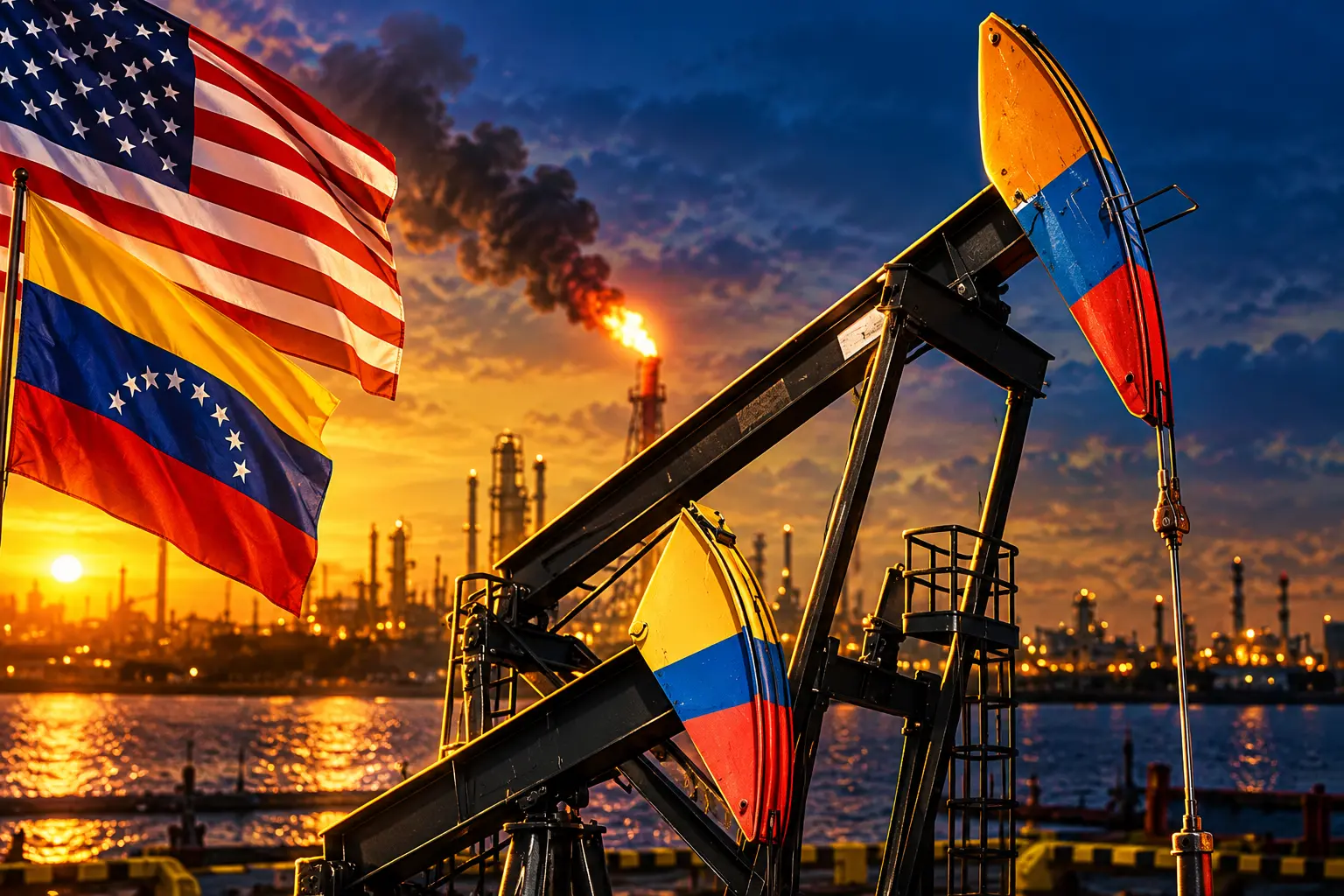
65 Billion Barrels, and a 25-Year Dispute
President Donald Trump announced the pact on August 28 and wrote that it more than doubles American oil reserves. That math only works if the 65 billion barrels are booked as U.S. inventory. The Energy Information Administration put 46 billion barrels of proved U.S. crude and condensate on the books at the end of 2024, matching the White House’s own figure of roughly 46 billion. Sixty-five billion is 1.4 times that total, not a second copy of it. Add the two and you get 111 billion, which is 2.4 times the U.S. number, but only on paper and only if Venezuelan rock counts as American.
Venezuela still reports about 303 billion barrels of proven crude, the largest total on earth, so the 17 fields are about one-fifth of the country’s certified stock. Earlier talks had cited 90 billion barrels across a dozen fields. The signed fact sheet is 65 billion. The political audience is already treating that number as proven U.S. supply. The contract grants equity in an operator and cheap offtake, not a deed to the reservoir.
The length of the grant is already in public conflict. The White House fact sheet lists 100-year concessions. Rodríguez had described a 25-year deal. David L. Goldwyn, chairman of the Atlantic Council’s Energy Advisory Group and a former U.S. special envoy for international energy affairs, wrote that a century-long concession appears to stretch what Venezuela’s constitution allows, because the state owns the resource and may contract for its use, not sell it. He also asked what legal authority the Office of Strategic Capital has to hold this kind of foreign equity at all.
Alejandro Betancourt Holds the Keys
Betancourt is the architect, the broker, and the private beneficiary. A U.S. official put it without decoration.
No Betancourt, no energy-security deal.
U.S. official, on the oil talks
The same official said Maduro might still be in power without him. Another said no other oilman can claim the Pentagon on his side. Betancourt, Rodríguez, and officials from State and the Office of Strategic Capital had a handshake on the structure by mid-August. Venezuela’s National Assembly chief, Jorge Rodríguez, announced the vote on Tuesday: support for the binational energy treaty was approved.
BETANCOURT’S RECORD
- The power plants: His firm Derwick Associates won at least 11 no-bid contracts, worth about $5 billion, to build thermoelectric plants during a Chávez-era electricity emergency, despite having no prior experience in that work.
- The probes: He has been investigated in the United States, Switzerland, and Spain over alleged money laundering and an alleged scheme that prosecutors say drained more than $1 billion from PDVSA. He has not been charged, and his lawyer has denied the claims.
- The vehicle: He cofounded NABEP in April 2024, then became sole shareholder after Harry Sargeant III sold a minority stake for $300 million under pressure from the U.S. Treasury.
- The output: NABEP lifted production from a much smaller base to about 200,000 barrels a day and has discussed raising that toward 1 million, including with new debt.
U.S. officials have allowed him into the country for meetings even as a Swiss warrant sat outstanding. In Venezuela he is still known as a bolichico, one of the well-connected young contractors who got rich on state work while much of the country still loses power for hours a day. Thor Halvorssen, a Venezuelan-born critic who runs the Human Rights Foundation, has called him a once-a-generation blight. Betancourt, in a statement on the deal, said Venezuela is blessed with natural resources, hardworking people, and untapped potential.
Goldwyn’s objection is commercial as much as moral. The structure is, he wrote, profoundly unconventional in a century of oil contracting. Majors want competitive bids, clear lease terms, and a buyer who pays a market price. A U.S. offtake at cost, for decades, turns the producer into a captive seller. That is a gift to Washington. It is a problem for anyone asked to put up the $100 billion.
Prior Oil Sales Still Lack a Public Ledger
The new royalties are supposed to rebuild Venezuela. The last eight months of oil cash have not produced a public accounts book. After U.S. forces captured Nicolás Maduro on January 3, Washington took control of the country’s oil sales. Rodríguez, his former vice president, became interim president. Output recovered from the post-raid slump. The International Energy Agency put July production at 1.12 million barrels a day, against a 1990s peak near 3.5 million.
Roxanna Vigil, a Council on Foreign Relations fellow and former Treasury sanctions official, added up tanker-tracking and price discounts and found that in the first four months almost 100 million barrels, worth an estimated $8 billion, moved through a process with no public ledger. January exports were about 380,000 barrels a day, worth about $600 million. April was about 1.1 million barrels a day, worth about $3.7 billion. The largest buyers were the United States at 43%, India at 26%, and Spain at 8%.
WHAT WE KNOW
- Qatar account: Rubio told Congress in January that $300 million had moved through a short-term Qatari account to Venezuela and that $200 million was still sitting there, with a retroactive audit promised.
- Later transfer: Wright said in February that the full $500 million had been sent to Venezuela and that U.S. Treasury accounts would be used from then on.
- April testimony: A State Department witness told Congress the department had authorized about $3 billion in disbursements to Venezuela and did not know how much remained in Treasury accounts.
- Trump’s tally: In late July the president said sales had generated more than 13 billion dollars since January 3, money he said had paid for the operation many times over.
WHAT IS UNCONFIRMED
- The Qatar audit: No public accounting of that account, or of the safeguards against theft, has been released.
- The written contracts: Rubio and Treasury Secretary Scott Bessent told Congress they would share the agreements with traders and banks. Copies have not been made public.
- The KPMG clock: The State Department said KPMG would run quarterly audits, including a look back to the start. No date for the first report was given.
Traders Trafigura and Vitol, which Rubio had called a short-term fix, were still in the flow five months later, joined by GE Warren. PDVSA has not published oil-revenue figures since 2016. The White House now says U.S. audit rights and payment monitorship will make sure NABEP’s $200 billion in royalties and tax is spent for Venezuelans. That promise is being made over a cash system Congress has already failed to see.
The Wrong Crude for the Salt Caverns
Trump has said Venezuelan barrels will refill the Strategic Petroleum Reserve, a gift from Venezuela to the American people. The reserve held 308 million barrels in emergency storage as of July 24, the lowest level since 1983, in caverns with 714 million barrels of capacity. That is 43% full. The Biden administration sold 180 million barrels in 2022 after Russia invaded Ukraine. The Trump administration then authorized 172 million barrels when the Strait of Hormuz closed.
THE RESERVE AS IT STANDS
- Current stock: 308 million barrels on July 24, less than half of working capacity.
- Legal origin: Congress wrote the 1975 law that created the reserve after the 1973 embargo, to cover a short supply shock, not to warehouse extra-heavy crude.
- Where it sits: Sixty-one salt caverns at four Gulf Coast sites in Texas and Louisiana, filled with lighter U.S. grades.
- What Venezuela pumps: Heavy and extra-heavy sour crude from the Orinoco Belt, the kind Gulf Coast cokers were built to run, not the kind those caverns were filled with.
Helima Croft, head of global commodity strategy at RBC Capital Markets, said the pact is not a near-term fix for the Iran-driven draw on the reserve. Gulf Coast plants can use the barrels. Asphalt, diesel, and jet fuel run better on this grade than on light shale. That is the industrial logic. It is not the SPR speech. Wright, in Caracas, said U.S. gasoline prices should ease in coming weeks because of steps to loosen rules on refiners, a separate track from the NABEP offtake.
The White House says most of the incremental fields were previously run by Russian or Chinese firms, or by Maduro-era insiders, and that the pact reasserts the Monroe Doctrine. Beijing has said its interests in Venezuela must be protected. Goldwyn’s plainer point is that many of the listed fields still lack power, processing kit, and pipe to an export dock, and that earthquakes this June made the rebuild harder. Rystad Energy has said any recovery will be gradual and has put a ten-year rebuild cost around $180 billion, well above NABEP’s $100 billion plan.
Will Venezuela Leave OPEC?
Caracas is considering a walk from the producer group it helped found, people familiar with the talks have said, and the idea has come up with U.S. officials. No decision has been taken. Venezuela is already exempt from OPEC quotas because output collapsed. Leaving would not free a single extra barrel tomorrow. Over time, investors who put capital into a 1.5-million-barrel target will not want a quota waiting at the other end.
THE CARTEL’S RECENT BREAKS
- September 1960: Venezuela, Iran, Iraq, Kuwait, and Saudi Arabia found OPEC in Baghdad, with Venezuelan oil minister Juan Pablo Pérez Alfonzo among the architects.
- April 28, 2026: The United Arab Emirates announces it will leave, effective May 1, after years of fighting production caps.
- June 25, 2026: Iraq warns it could reconsider membership if a capacity review does not raise its quota; the oil ministry later denies an imminent exit.
- August 27, 2026: People familiar with the matter say Venezuela is weighing a departure in conversations that have included U.S. officials.
An exit by a founder, four months after the UAE walked, would wound the group’s claim to speak for producers even if Venezuelan volumes stay modest. Iraq has already grumbled. The United States, now a part-owner of a Venezuelan operator with cheap offtake, has an interest in barrels that are not throttled by a committee in Vienna.
Caracas Voted as Wright Landed
Wright’s Tuesday stop was his second since the January raid, a one-day visit timed to the Assembly vote and to a round of other company deals he said would be signed on Wednesday. He told reporters those contracts, from U.S. and other firms, would more than double crude output in the next few years. Rodríguez has said Venezuela keeps ownership and sovereignty over the resource. The White House fact sheet still lists U.S. courts, U.S. auditors, a U.S.-majority board, and a Pentagon veto.
The Rodríguez government is interim. Goldwyn noted that the opposition has already called the concession a land grab, and that protests were reported in Caracas over the weekend from both regime opponents and Chavistas. The White House says it is sponsoring talks between the 2015 National Assembly and the interim authorities, that hundreds of political prisoners have been released, and that judicial reforms are under way. Vigil wrote that more than 400 prisoners remain, that there is still no public roadmap with election dates, and that Rubio himself told Congress in January the glue holding the old system together was graft.
NABEP is now the private face of a U.S. claim on one-fifth of Venezuelan reserves, under a lease the two capitals cannot describe with the same number of years, for crude that Gulf Coast refiners can run and the emergency caverns cannot hold. Wright left that argument in Caracas as the Assembly’s yes vote went on the record.

Kering’s Growing Houses Cannot Outrun a Shrinking Gucci

Studio Staff and Bitcoin Buyers Built the Eminem Leak Case

A Mutated H1N1 Strain Is Hitting Younger Immunity First

Albert Heijn Returns at One-Third as Rivals Take Share

Art Basel Paris Ends After One Public Day

Thameslink Will Pad 60,000 Ironing-Board Seats From 2027

How Tall Was Adolf Hitler Really? Debunking the Myth of his Height

Micron Sells the Memory Shortage as Five-Year Contracts

Royal Caribbean Sends Los Angeles Ships to Singapore and Brisbane

U.S. Forces Clear Hormuz Mines, Then Hit Minelayers Again
-
 NEWS2 months ago
Thameslink Will Pad 60,000 Ironing-Board Seats From 2027
-
 SCIENCE3 years ago
How Tall Was Adolf Hitler Really? Debunking the Myth of his Height
-
 NEWS2 months ago
Micron Sells the Memory Shortage as Five-Year Contracts
-
 NEWS2 months ago
Royal Caribbean Sends Los Angeles Ships to Singapore and Brisbane
-
 BUSINESS2 months ago
U.S. Forces Clear Hormuz Mines, Then Hit Minelayers Again
-

 BUSINESS2 months ago
Sweetmore Bakeries Buys Fantasy Baking for Bar Work
-

 BUSINESS2 months ago
L Catterton Installs a Kraft Heinz Operator at Kettle Cuisine
-
 NEWS2 months ago
CISA’s 100 Water System Hacks Hit One-Operator Plants