
AUTO
Gatik’s $200 Million Follows Grocery Contracts Already Signed
Gatik’s $200 million Series D scales driverless grocery runs PepsiCo, Walmart and Kroger already booked, while the fleet still trails January’s hundreds promise.

Gatik has raised $200 million to put more driverless box trucks on grocery and snack runs that large shippers have already contracted. Qatar Investment Authority and Koch Disruptive Technologies led the Series D, the largest round in the Santa Clara company’s history.
The checks follow paper, not a lab breakthrough. PepsiCo, Walmart, Kroger and Tyson Foods already pay Gatik to haul goods from distribution centers to stores, and the backlog sits above $600 million.
Qatar and Koch Scale Booked Grocery Runs
Gatik set out the round on August 25. Millennium Management, ARK Invest and Intact Private Capital joined, taking total funding to about $500 million since the company came out of stealth in 2019. It would not give a valuation, and chief executive Gautam Narang would not say whether the business is profitable.
The company’s own release lists more than $600 million in contracted revenue, 85,000 fully driverless orders completed, and 99% on-time delivery. Narang said the new backers are the kind of long-term financial investors who “usually get involved when the business is proven out and the economics are proven out.” He added, “It’s less about building a business. It’s more about scaling the business that we have today.”
That is the tell. QIA and Koch are not underwriting a prototype. They are paying to copy a middle-mile product grocery and CPG companies have already signed, on high-frequency regional networks that run from docks to store doors.
THE ROUND IN FOUR FIGURES
- The check: $200 million in Series D capital, the largest raise in Gatik’s history.
- The backlog: more than $600 million in contracted revenue, after $400 million of take-or-pay deals landed in the second half of 2025.
- The work done: 85,000 fully driverless orders at a 99% on-time rate across current routes.
- The headcount: about 350 people today, with engineers and operations staff still to hire.
Abdulla Al-Kuwari, head of industrials at QIA, said the fund is backing firms “shaping the future of freight infrastructure.” Byron Knight, president of Koch Disruptive Technologies, said autonomy is moving “beyond a promising technology into real-world commercial operations.” Celeste Dauner, a managing director at Koch, noted the firm first backed Gatik in 2021 and has watched it “build scale around a focused, highly practical application of autonomy.”
Narang posted the same day that customers such as PepsiCo are already relying on the service and that demand is accelerating. The company account put the video on the record.
Gatik has raised $200M in Series D financing.
Led by Qatar Investment Authority, co-led by Koch Disruptive Technologies, with participation from ARK Invest, Millennium Management, Intact Private Capital and others.
More than $600M in contracted revenue. Driverless trucks… pic.twitter.com/fAKMM4cf7t
— Gatik (@Gatik_AI) August 25, 2026
Three days later Gatik put the round on the Nasdaq tower in Times Square. The advertising is new. The freight contracts are not.
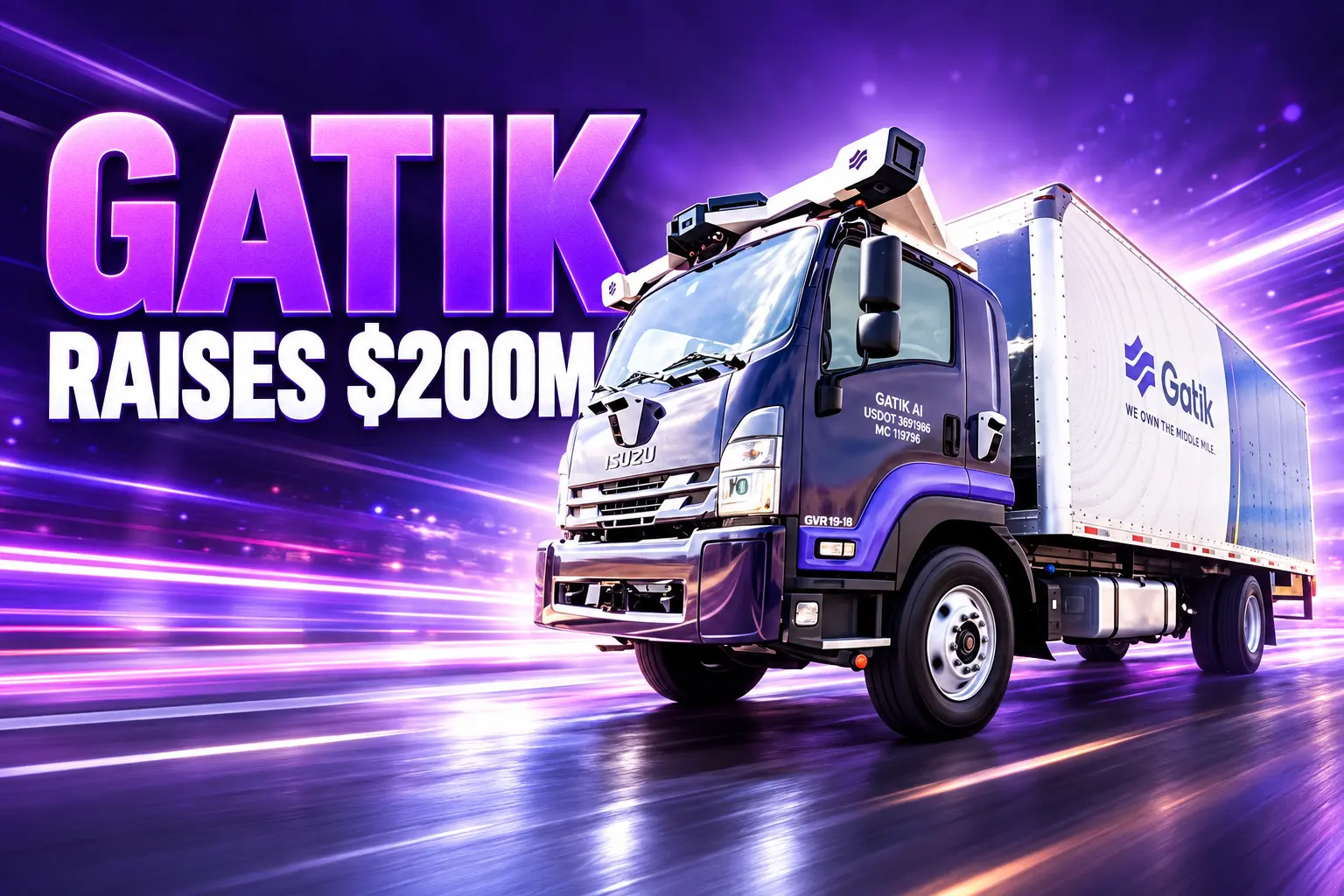
PepsiCo’s 41 Snack Trucks Came First
The largest public customer deal is PepsiCo’s, signed on June 8, two months before the raise. Gatik already runs for the snack and drink maker across Texas, Arizona and Arkansas, and the companies called it the largest commercial autonomous freight deployment to date.
Forty-one driverless Isuzu box trucks now move Frito-Lay products, including Cheetos and Doritos, plus drinks such as Gatorade, between plants, warehouses and stores. The split is lopsided on purpose, clustered where the network is densest.
WHERE THE 41 PEPSICO TRUCKS SIT
- Arizona: 35 trucks on public roads around Phoenix, the heaviest single-state count.
- Texas: 5 trucks on Dallas-area runs between plants, storage and stores.
- Arkansas: 1 truck in the Northwest Arkansas grocery belt.
Those 41 trucks already serve about 250 retail stops, including Walmart and Dollar General, on both highways and surface streets. Gatik first rolled with PepsiCo in 2022 with people in the cab, then pulled the drivers on those routes in June 2025. PepsiCo’s own notice puts on-time performance on Gatik’s work at more than 98%.
Serving our vast network of customers requires a supply chain that is safe, reliable, and built for the future. Gatik is already operating inside our networks and brings the autonomous freight technology, commercial experience, and scale we need to strengthen service, add capacity, and move products more consistently for our customers.
Jim Farrell, Senior Vice President of Supply Chain, PepsiCo
Farrell’s shop is not buying a science fair. PepsiCo said the partnership is aimed at high-demand regional networks that are hard to staff, the short multi-stop runs that keep shelves stocked. Dynamic routing lets the shipper add or drop stops as warehouse activity shifts, without rebuilding the network.
Walmart was the first named customer, disclosed in 2019. Kroger and Tyson Foods followed. Loblaw in Ontario is the Canadian grocer on the list, still with a person in the seat. Gatik says its customers are Fortune 50 retail, grocery and CPG companies. It will not name the full roster.
How Many Driverless Gatik Trucks Run Now?
Gatik says it has dozens of driverless trucks on the road today and wants thousands in the years ahead. A spokesperson put the 2026 year-end target at more than 100. That is a live commercial fleet, and it is also a long way from the forecast Narang gave when the $600 million backlog first became public.
In late January he said the company had 10 fully driverless, revenue-generating trucks on public roads, expected 60 in the coming weeks, and expected to “end the year with hundreds of driverless trucks” across multiple U.S. markets. By August the public count was “dozens,” with more than 100 as the December goal. PepsiCo’s 41 trucks already sit inside that “dozens” band, which means the snack account is most of the empty-cab fleet.
THE FLEET COUNT VERSUS THE PROMISE
| Checkpoint | Driverless trucks stated | Orders stated |
|---|---|---|
| January 27, 2026 | 10 on the road; 60 “in the coming weeks”; hundreds by year-end | 60,000 fully driverless orders since mid-2025 |
| June 8, 2026 | 41 on PepsiCo routes alone (35 Arizona, 5 Texas, 1 Arkansas) | Not restated |
| August 25, 2026 | Dozens running; more than 100 by the end of 2026; thousands later | 85,000 fully driverless orders |
The order book did grow. Sixty thousand fully driverless orders in January became 85,000 by the raise, a gain of 25,000 in about seven months. In January Gatik also said it had logged more than 2,000 hours and over 10,000 driverless miles on public roads, on routes up to 400 miles, after launching freight-only operations in mid-2025. Those runs use 26- and 30-foot trucks almost around the clock, moving ambient, refrigerated and frozen goods, with no human driver or safety observer in the U.S. cabs.
Short, repeatable dock-to-store work is a narrower problem than a robotaxi in mixed city traffic, which is why paid freight showed up here first. The January-to-August gap still matters for anyone reading “thousands” as a 2026 event. It is not. The $200 million is the cash to close that gap, not proof it has closed.
An Insurer Tripled Its Gatik Stake
Intact Private Capital is easy to skip on a cap table that opens with Qatar and Koch. It should not be. Intact Ventures sat in the 2021 Series B that Koch Disruptive Technologies led at $85 million, when Gatik had just over $114 million in total funding and was still putting most of its box trucks on the road with a driver in the cab. The same insurance-backed firm is now back at a larger size.
We are no longer debating the potential of autonomous trucking. This category will be led by the companies that have proven technology, rigorous safety standards and the commercial discipline to operate at scale. Gatik has built that foundation over years of operating inside complex customer supply chains. We have tripled our commitment with this latest round, driven by the conviction that Gatik has the execution record, customer traction and technical maturity to be the leader in autonomous freight across North America.
Justin Smith-Lorenzetti, Managing Director, Intact Private Capital
An insurer that triples down is underwriting the claim that these routes are insurable as daily work, not as a demo. Tasha Keeney of ARK Invest said autonomous trucking “should meaningfully lower the cost of transporting goods.” Cathie Wood, ARK’s founder, called the category an inflection as AI and robotics meet commercial execution. Those lines are the public case for the round. Intact’s repeat check is the quieter one, because a writer of policies has to live with the wreck if the model is wrong.
The 2027 Chassis Isuzu Has Not Built Yet
Today’s fleet is Isuzu medium-duty metal with Gatik’s driving system, the Gatik Driver, bolted on. That is a workable way to run dozens of trucks. It is a clumsy way to run thousands. In May 2024 Isuzu put $30 million into Gatik and agreed to design a redundant chassis built for a Level 4 stack, with a new chassis aimed at mass production in 2027.
Hiroshi Sato, then an Isuzu executive officer, tied the work to the maker’s mid-term plan, which named autonomous driving as one of three new business pillars, and said Isuzu wanted to be “operation ready in 2027.” In January, after Gatik went driver-out at scale on current trucks, Sato, by then senior executive officer and vice president of engineering, said Isuzu was “contributing reliable vehicle platforms” while still preparing “future autonomous-ready vehicle programs.”
Narang said the new money funds more trucks, more customers and more cities, plus hiring on top of the 350-person staff, and deeper work inside markets Gatik already serves. The Series D therefore has to stretch a retrofit fleet for a few years until the factory truck exists. NVIDIA and Ryder sit around that plan as compute and upkeep partners. The OEM clock is the constraint the raise does not erase.
Grocery Restocking No Longer Waits on a New Hire
Gatik does not do long-haul tractors, robotaxis or sidewalk robots. It started on fixed routes under ten miles and now runs dynamic routes with dozens of pick-up and drop-off points, covering up to 400 miles on surface streets and motorways. Third-generation trucks, Narang has said, run around the clock and can handle light rain and snow. The job is the middle mile between a warehouse and a store, the slice of trucking that grocery and snack companies have to hit several times a day or the shelf goes empty.
PepsiCo wrote that aim down in plain language: add capacity where regional networks are hard to staff and still keep people growing with the business. That is the labor swap the $200 million finances. A driverless box truck on a four-mile Phoenix run to Walmart does not replace a coast-to-coast team driver. It replaces the short, multi-stop, time-sensitive shift that private fleets struggle to fill when volume spikes.
Gatik pulled safety drivers from U.S. commercial routes last year after an independent review of its safety case and briefings with the Federal Motor Carrier Safety Administration, the National Highway Traffic Safety Administration, and state agencies in Texas, Arizona and Arkansas. It also ran first-responder training. Those steps are what let empty cabs carry Cheetos at 2 a.m. They are also why sovereign and industrial money showed up after the grocery contracts, not before.
A Safety Driver Remains on Canadian Routes
Gatik’s site lists Texas, Arizona, Arkansas, California, Michigan, Nebraska, Iowa and Ontario. Driverless commercial work is concentrated in Dallas-Fort Worth, Phoenix and Northwest Arkansas. Canada is the exception that still needs a person in the cab, on Loblaw routes in Ontario. Gatik has not said when that seat goes empty. Narang has talked about cities outside North America as a later chapter. No European route has been named.
WHAT WE KNOW
- The raise: $200 million Series D closed, led by QIA and Koch Disruptive Technologies, with ARK, Millennium and Intact in the round.
- The work: 85,000 fully driverless U.S. orders, 41 PepsiCo trucks across three states, Walmart, Kroger, Tyson and Loblaw as named customers.
- The chassis plan: Isuzu’s $30 million 2024 investment and a Level 4 production target of 2027.
WHAT IS UNCONFIRMED
- Valuation and profit: Gatik declined both, and the securities were sold in a transaction exempt from registration.
- Exact fleet size: “Dozens” now and “more than 100” by December, against January’s “hundreds” forecast, with no public unit count.
- Ontario and Europe: No date for removing Loblaw’s safety driver, and no first market outside North America.
The release itself flags forward-looking language around revenue targets, the customer base and fleet plans. Narang said this week that the $600 million backlog has grown since January and would not say by how much. Until those figures move from contracted revenue to a public fleet count, the $200 million is a scale-up check on grocery routes that are already sold, running, and still smaller than the story the company told in January.

Nvidia RTX Spark Laptops Make Local AI a RAM Bill

A Drone Strike in Bulgaria’s EEZ Leaves NATO Idle

Sharma Unwinds Game Pass After Xbox Hit Freefall

Shawn Layden Says Sony’s Disc Cut Hits the Faithful 20 Percent

The EU Cabin Bag Law Frees Only a Personal Item

Thameslink Will Pad 60,000 Ironing-Board Seats From 2027

Micron Sells the Memory Shortage as Five-Year Contracts

How Tall Was Adolf Hitler Really? Debunking the Myth of his Height

Royal Caribbean Sends Los Angeles Ships to Singapore and Brisbane

U.S. Forces Clear Hormuz Mines, Then Hit Minelayers Again
-
 NEWS2 months ago
Thameslink Will Pad 60,000 Ironing-Board Seats From 2027
-
 NEWS2 months ago
Micron Sells the Memory Shortage as Five-Year Contracts
-
 SCIENCE3 years ago
How Tall Was Adolf Hitler Really? Debunking the Myth of his Height
-
 NEWS2 months ago
Royal Caribbean Sends Los Angeles Ships to Singapore and Brisbane
-
 BUSINESS2 months ago
U.S. Forces Clear Hormuz Mines, Then Hit Minelayers Again
-
 NEWS2 months ago
Twenty Controllers Closed Norwich Airport for a Bank Holiday
-

 BUSINESS2 months ago
Sweetmore Bakeries Buys Fantasy Baking for Bar Work
-

 BUSINESS2 months ago
Burger King Rebuilds Chicken Nuggets After Calling Them Rubbery