
BUSINESS
U.S. Forces Clear Hormuz Mines, Then Hit Minelayers Again
CENTCOM said U.S. forces cleared Iranian mines from Strait of Hormuz lanes, then struck new minelayers as tanker traffic stayed depressed.

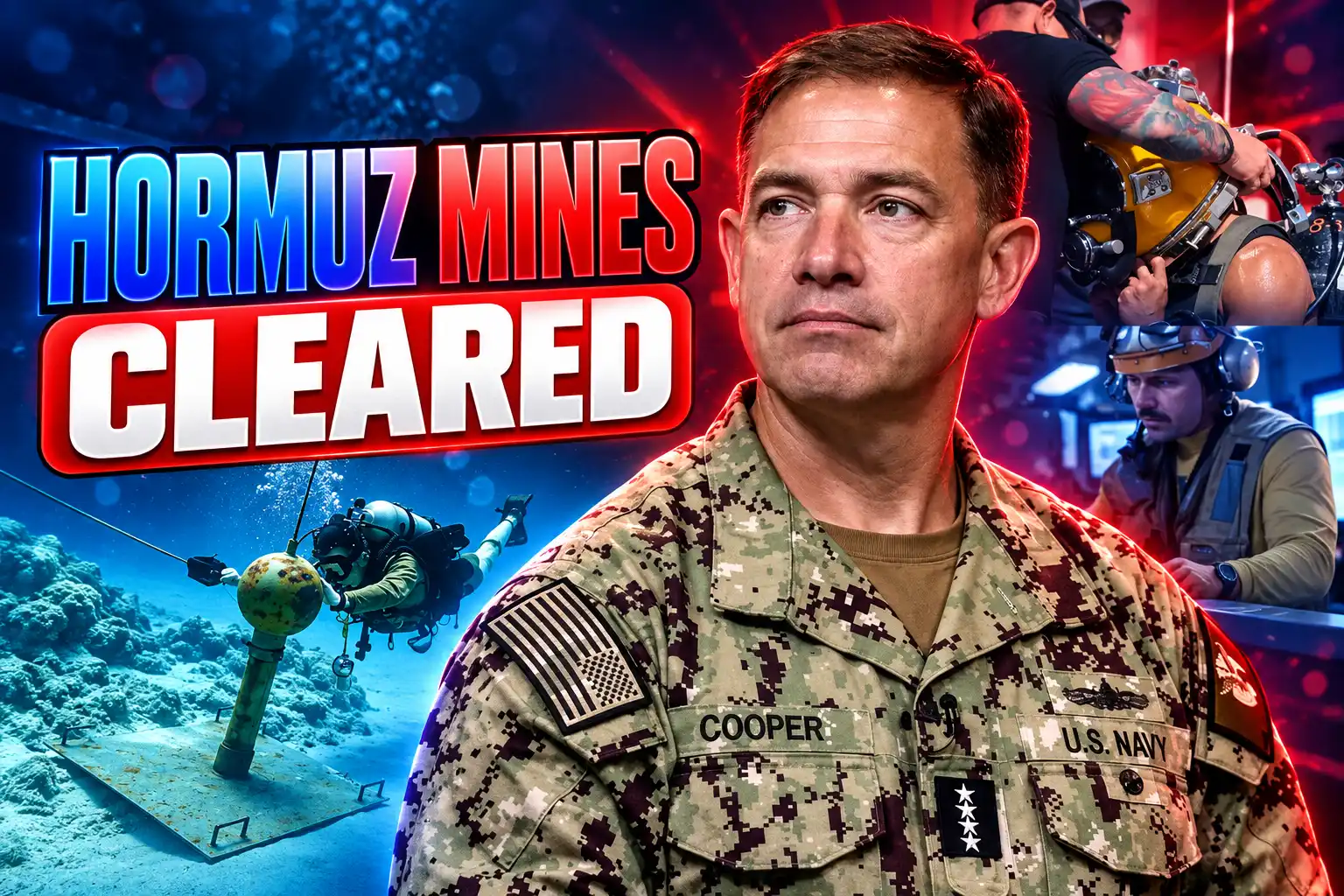
Adm. Brad Cooper said U.S. forces had cleared Iranian mines from the Strait of Hormuz last week, then struck minelayers on Larak Island three days later. The Central Command chief called the sweep a major milestone in a three-and-a-half-minute video. The lanes he named are open under guard. The mine war is not finished.
That is the same sequence the Navy learned in 1987 and 1988, when the first escorted tanker hit a mine on day one and a U.S. frigate was nearly lost eight months into the escort mission. Cheap mines go back in faster than divers can certify a channel. Cooper’s video did not change that math.
Cooper Said the International Lanes Are Open
Cooper, who leads U.S. Central Command, posted the operational update late on August 27. He said the Islamic Revolutionary Guard Corps had laid the mines months earlier in the strait’s Traffic Separation Scheme, the paired inbound and outbound lanes commercial ships are meant to use. Navy divers, Navy SEALs, and aircraft from the Army, Navy, Air Force, and Marine Corps did the clearing, he said, quietly and over several months.
The circumstances were challenging and dangerous to say the least, but we got the job done.
Adm. Brad Cooper, commander of U.S. Central Command
He showed a chart of the scheme and said internationally recognized transit routes are now free of Iranian sea mines. President Donald Trump had already said on August 25 that mines in international waters had been removed or detonated, and that any boat caught laying new ones would be destroyed. Some U.S. allies had questioned that earlier claim. Cooper’s video was the command’s own confirmation, aimed at the lanes themselves rather than every inch of the Gulf.
Update from CENTCOM Commander: pic.twitter.com/osPbltjJ1C
— U.S. Central Command (@CENTCOM) August 28, 2026
The clip leaned on generic tanker footage more than a live transit, which is a poor way to prove a waterway is busy again. The figures Cooper attached to the mission are still the ones that matter, because they describe what the force has been doing while the sweep ran.
THE SWEEP, AS COOPER DESCRIBED IT
- The lanes: The long-standing Traffic Separation Scheme, not every cove and anchorage in the Gulf.
- The lift: Nearly 1,500 commercial vessels given coordinated protection in recent months.
- The cargo: Almost 750 million barrels of crude moved to world markets on those ships.
- The blockade: Iran has exported zero oil from its shores since the naval blockade resumed in mid-July, with 75 vessels turned back and three disabled.
Cooper did not say how many mines were found or destroyed. People briefed on the work described more than 200 mine-like objects in the main lane, 11 of them actual mines, and only a few set as they were supposed to be. If those counts hold, the danger was never a dense field. It was the time it takes to prove a horned object on the seabed is scrap, and the ease with which a few live mines can close a lane that normally handles nearly 20 million barrels a day.
A $1,500 Mine Nearly Sank the Samuel B. Roberts
The United States has done this job in these waters before, and it did not stay done. Operation Earnest Will ran from July 24, 1987, to September 26, 1988, the largest U.S. naval convoy effort since World War II, built to walk reflagged Kuwaiti tankers through Iranian attacks in the Iran-Iraq War.
On the first Earnest Will convoy, the tanker Bridgeton struck an Iranian mine west of Farsi Island. The ship was huge enough to absorb the blast and keep going. Her U.S. escorts fell in behind her, using the damaged tanker as a sweeper because the Navy had almost no minesweepers in the Gulf. Iran kept laying. In September 1987, U.S. forces caught the landing craft Iran Ajr in the act and sank her. Mining still continued.
THE LAST TIME IRAN MINED THESE WATERS
- July 24, 1987: Bridgeton, on the first U.S. escort run, hits an Iranian mine about 20 miles west of Farsi Island.
- September 1987: U.S. forces seize and sink Iran Ajr, a minelaying landing craft, and recover mines that later match serial numbers on other weapons in the Gulf.
- April 14, 1988: USS Samuel B. Roberts, a two-year-old guided-missile frigate, strikes a mine about 65 miles east of Bahrain while trying to back out of a field.
- April 18, 1988: The United States launches Operation Praying Mantis against Iranian oil platforms and naval units in reply.
- September 26, 1988: Earnest Will ends, 14 months after the first convoy, only after a wider ceasefire halted the Iran-Iraq War.
The mine that wrecked Roberts was an old contact design in the M-08 family, the kind of spiked ball that costs about $1,500 and sits on a cable. Ten sailors were hurt. The repair bill later ran above $90 million. The ship’s keel was broken badly enough that damage-control crews were credited with saving her. Navy divers later found nearby mines with serial numbers that matched the Iran Ajr load. One cheap weapon, laid after a public U.S. seizure of a minelayer, was enough to force a day of battle.
Bahrain’s Last Minesweepers Were Already Gone
The 2026 sweep had to be done without the wooden-hulled Avenger-class ships that spent decades in Bahrain for exactly this fight. The Navy decommissioned the last of those forward-deployed hunters in September 2025 and sent them home in January, weeks before U.S. and Israeli strikes on Iran opened the war on February 28. Their replacements were Independence-class littoral combat ships fitted with mine packages, helicopters, and unmanned craft. When the first mines went in, that force was thin in the Gulf.
Cooper’s account fills the gap with people. Divers and SEALs in the water, plus air power, did work the retired hunters would have done from a fiberglass hull. Retired Vice Adm. Kevin Donegan, who once led the 5th Fleet and was not part of this operation, has described how a clearance is declared. Surface and underwater vehicles, including unmanned ones, find likely objects. Divers, SEALs, or autonomous systems then destroy what is real. Crews keep scanning so a mine is not left behind.
“In simplest terms, they have to conduct enough sweeps of the lanes to drive the probability of detection of mines to virtually 100% in the model,” Donegan said. The model weighs sensors, the water, and the seabed. It does not claim the rest of the Gulf is clean. He also noted a leftover risk that never fully dies in these waters: drifting mines from this war or older ones, usually pushed out of the lane by current, still able to wander.
That is why a video about the Traffic Separation Scheme can be accurate and still leave shipowners unconvinced. The Joint Maritime Information Center, in an advisory dated August 25, still rated the strait SEVERE, warned that mine-danger areas remained active, and said clearance and survey work were continuing. That notice predated Cooper’s video. No public downgrade had followed by the end of last week.
Two Days Later the U.S. Hit Minelayers on Larak
On August 30, U.S. forces struck two Iranian launchers on Larak Island after IRGC crews were seen preparing to fire rockets loaded with sea mines into the strait. Capt. Tim Hawkins, a CENTCOM spokesman, confirmed the hits. The command called the raid limited, precise action against an imminent threat, and the first acknowledged U.S. strike inside Iran since late July.
“In essence, Iran created the threat and the U.S. military eliminated it to protect civilian mariners, commercial shipping, and the free flow of global commerce,” the command said. Hawkins added that U.S. forces are watching the area and remain ready to protect traffic through the waterway. The IRGC said the attack killed and wounded soldiers and civilians, gave no firm toll, and promised punishment. IRGC-linked reports described a drone strike.
Rocket-delivered mines are the part of this week that 1988 did not have to solve in public. A boat caught on a dark sea can be boarded. A launcher on an Iranian island can throw mines onto the southern track, the route ships have used to stay closer to Oman, without a minelayer ever leaving the beach. If those rockets had flown, Cooper’s cleared scheme would have been a chart, not a path. Congress has already logged months of U.S. attacks on mine-laying vessels, missile sites, and other tools used to choke the strait. Larak fits that list. It also fits the older one: you do not keep a channel open by sweeping it once.
Commercial cover has not moved with the video either. The same hesitation shows up in insurers still pricing Hormuz war risk after the sweep and after the follow-on raid on the minelayers.
A False Mine Strike, Denied in 24 Hours
On August 31, Iranian state television, citing the IRGC, said a supertanker had hit two mines on a southern route, caught fire, and been forced to stop. The Guards framed the ship as a rule-breaker and warned that other vessels would face the same end. The claim spread because it was simple: the Americans said the water was clean, and a tanker was burning.
CENTCOM answered the same day. “No ships have hit mines in the Strait of Hormuz,” the command said. “This is yet another IRGC attempt to intimidate regional commercial shipping through disinformation.”
🚫 CLAIM: Iran’s Islamic Revolutionary Guard Corps (IRGC) claims that a supertanker passing through the southern route of the Strait of Hormuz struck two mines and was brought to a complete stop. This is FALSE.
✅ FACT: No ships have hit mines in the Strait of Hormuz. This is… pic.twitter.com/spkaogBx81
— U.S. Central Command (@CENTCOM) August 31, 2026
Projectile attacks on tankers are a different file. Ships have been hit above the waterline near Oman in late August, with fires that crews put out and, in earlier cases, at least one seafarer killed. Those strikes do not prove Cooper’s lanes still hold live mines. They do prove that a mine-free TSS is not a safe strait. Iran’s deputy foreign minister, Kazem Gharibabadi, had already rejected Trump’s clearance claim by saying only Iran knows where the mines are. The command’s denial and Iran’s story now sit side by side, which is how a mine war is fought on radios as well as on the seabed.
WHAT WE KNOW
- The TSS claim: Cooper says the internationally recognized lanes have been cleared of Iranian mines laid months ago.
- The Larak raid: U.S. forces destroyed two launchers on August 30 that CENTCOM says were being readied to fire mine-carrying rockets.
- The tanker story: The IRGC said a supertanker hit two mines on August 31. CENTCOM calls that false.
WHAT IS UNCONFIRMED
- The haul: CENTCOM has not published a mine count. Informal U.S. figures of 11 live mines among 200-plus objects have not been confirmed by the command.
- The leftover field: Early outside estimates of 80 to 150 mines were rejected by American officials as outdated. How many remain outside the TSS is not public.
- The death toll on Larak: The IRGC has not issued a firm number of dead and wounded.
Yesterday the fight widened again. At 12 p.m. ET on September 1, CENTCOM said U.S. forces began striking IRGC targets in Iran after attempted attacks on commercial shipping in the strait and on American troops in the region. The pause that followed the late-July strikes lasted about a month. It ended the week the lanes were declared open.
Oil Through Hormuz at 4.9 Million Barrels a Day
The reason any of this shows up on a loading screen in Houston or a refinery gate in India is volume. The strait, at its narrowest, is 29 nautical miles across, with 2-mile inbound and outbound channels and a 2-mile buffer. Before this war it carried about 20 million barrels a day of crude and products, around 25 percent of seaborne oil trade, with about 80 percent of that oil headed to Asia. The U.S. Energy Information Administration has long treated those flows as one-fifth of global oil consumption. In 2024, Saudi crude alone was 5.5 million barrels a day, 38 percent of the crude that used the strait.
The International Energy Agency’s 2025 country split shows who loses first when the lanes clog.
OIL THAT USED THE STRAIT IN 2025
| Origin | Crude, million b/d | Products, million b/d | Total, million b/d |
|---|---|---|---|
| Saudi Arabia | 5.43 | 0.80 | 6.23 |
| Iraq | 3.32 | 0.31 | 3.63 |
| United Arab Emirates | 2.02 | 1.22 | 3.24 |
| Iran | 1.69 | 0.72 | 2.41 |
| Kuwait | 1.40 | 0.97 | 2.37 |
| Qatar | 0.73 | 0.69 | 1.43 |
| All Hormuz | 14.95 | 4.93 | 19.87 |
Those 2025 totals are the baseline. In the second quarter of this year, with the war on and mines in the scheme, the Energy Information Administration put Hormuz oil flows at 4.9 million barrels a day, about a quarter of the usual load. Saudi Arabia and the UAE can push some crude around the strait on pipelines, perhaps 3.5 to 5.5 million barrels a day if the lines and Red Sea and Fujairah ports all work. Iraq, Kuwait, Qatar, Bahrain, and Iran have little or no such option. Qatar’s LNG, almost all of it, also has to use the strait.
Cooper’s 750 million barrels under U.S. protection is a large number next to a closed waterway and a small one next to a normal year. The blockade half of his brief is cleaner. If Iran is exporting nothing from its own shore, the 2.41 million barrels a day it sent through Hormuz last year is sitting in storage, on idle tankers, or not being pumped. That is leverage against Tehran. It is also a reminder that “lanes open” can describe other people’s oil moving under American guns while Iranian barrels stay boxed in.
How Long Did the Last Hormuz Mine War Last?
Earnest Will did not end when Bridgeton’s hole was patched, and it did not end when Iran Ajr went down. It ran 14 months, through the Roberts blast and Praying Mantis, and stopped when the wider war stopped. The United States spent that year learning, late, that it had too few sweepers and that a public warning to minelayers did not keep mines out of the next channel.
This time the warning came with a video, a Space Force boast from the president, and a strike on Larak three days after the job-done line. The tools are newer. The cheap mine is not. A command can be right that the Traffic Separation Scheme is clear at dusk on a Thursday and still be back in the strike business by Sunday because a rocket on an island can put the field back overnight.
Cooper said momentum is building. Yesterday’s strikes on the IRGC say the other side is still in the minelaying business. The last U.S. mine war in this Gulf ended on a calendar, not on a chart.

Nvidia RTX Spark Laptops Make Local AI a RAM Bill

A Drone Strike in Bulgaria’s EEZ Leaves NATO Idle

Sharma Unwinds Game Pass After Xbox Hit Freefall

Shawn Layden Says Sony’s Disc Cut Hits the Faithful 20 Percent

The EU Cabin Bag Law Frees Only a Personal Item

Thameslink Will Pad 60,000 Ironing-Board Seats From 2027

Micron Sells the Memory Shortage as Five-Year Contracts

How Tall Was Adolf Hitler Really? Debunking the Myth of his Height

Royal Caribbean Sends Los Angeles Ships to Singapore and Brisbane

U.S. Forces Clear Hormuz Mines, Then Hit Minelayers Again
-
 NEWS2 months ago
Thameslink Will Pad 60,000 Ironing-Board Seats From 2027
-
 NEWS2 months ago
Micron Sells the Memory Shortage as Five-Year Contracts
-
 SCIENCE3 years ago
How Tall Was Adolf Hitler Really? Debunking the Myth of his Height
-
 NEWS2 months ago
Royal Caribbean Sends Los Angeles Ships to Singapore and Brisbane
-

 BUSINESS2 months ago
Sweetmore Bakeries Buys Fantasy Baking for Bar Work
-

 NEWS2 months ago
Twenty Controllers Closed Norwich Airport for a Bank Holiday
-

 BUSINESS2 months ago
Burger King Rebuilds Chicken Nuggets After Calling Them Rubbery
-

 BUSINESS2 months ago
L Catterton Installs a Kraft Heinz Operator at Kettle Cuisine