
BUSINESS
Fuel Pushes UK Inflation to 3.1% With Core Unchanged
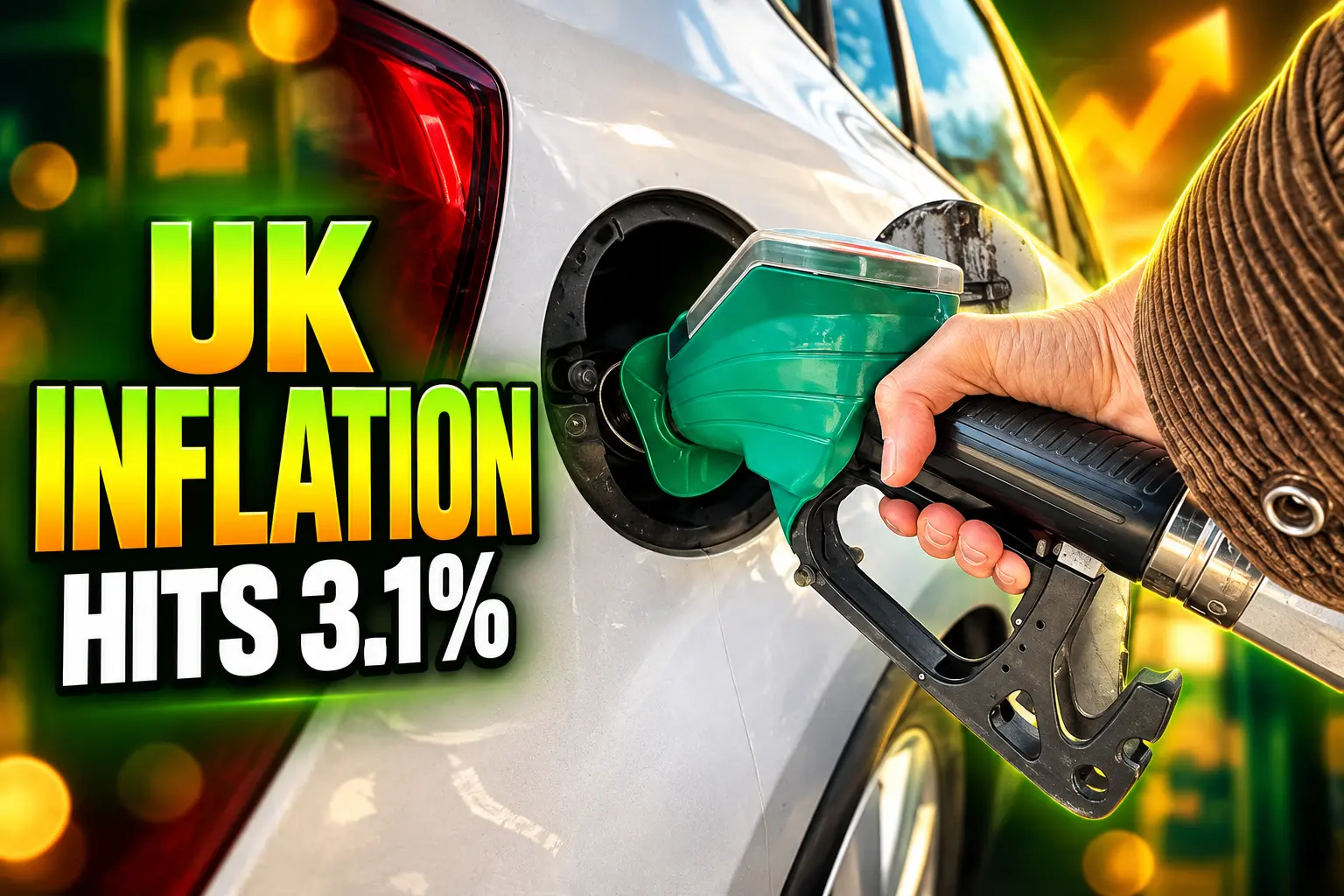
UK inflation rose to 3.1% in August on motor fuel, while core prices held at 2.6% before the Bank of England meeting.

UK annual inflation rose to 3.1% in August as motor fuel prices climbed 23.0%, the Office for National Statistics said on 16 September. Core CPI, which strips out energy, food, alcohol and tobacco, was unchanged at 2.6%, so the Bank of England can look through the print on 17 September even as households pay more at the pump into Christmas.
Gilt yields fell after the figures. Swap markets, on LSEG data, still priced more than an 80% chance that the Monetary Policy Committee holds Bank Rate at 3.75%, with a hike at the 5 November meeting left on the table.
The Consumer Prices Index (CPI) rose by 3.1% in the 12 months to August 2026, up from 2.9% in the 12 months to July 2026.
Read the full article ️➡️ https://t.co/UoPNnjdJpG pic.twitter.com/A0eKj2jq6X
— Office for National Statistics (ONS) (@ONS) September 16, 2026
The 23% Jump in Motor Fuel
The statistics office said CPI rose by 3.1% in the 12 months to August, up from 2.9% in July, and in line with economists’ expectations. Prices rose 0.5% on the month, against 0.3% in August 2025. CPIH, which includes owner-occupiers’ housing costs, rose to 3.3% from 3.1%.
It is the first CPI reading above 3% since March, when the annual rate was 3.3%. June’s 2.6% was the lowest since December 2024. Transport, and motor fuels in particular, made the largest upward contribution to the change in both annual rates, with no large offsetting fall elsewhere in the basket.
Sharp price rises for petrol and diesel pushed inflation up again in August. Higher airfares, particularly for long-haul journeys, also contributed to the increase.
Grant Fitzner, ONS chief economist
Average petrol rose 9.1 pence a litre between July and August, to 161.3p, the highest since November 2022, after a 0.3 pence rise in the same weeks of 2025. Diesel rose 14.2 pence, to 181.8p, after a 0.8 pence rise a year earlier. Those moves took overall motor fuel inflation to 23.0% from 15.5%. Transport prices rose 4.6% in the year, from 3.6%, and 1.5% in the month against 0.4% a year earlier. Air fares added a smaller upward effect, partly offset by vehicle repair and rail fares.
HOW THE BASKET MOVED IN AUGUST
| 12-month rate (ONS) | July 2026 | August 2026 |
|---|---|---|
| CPI | 2.9% | 3.1% |
| Core CPI | 2.6% | 2.6% |
| CPI goods | 2.2% | 2.7% |
| CPI services | 3.4% | 3.4% |
| Food and non-alcoholic drinks | 1.3% | 1.3% |
| Transport | 3.6% | 4.6% |
| Motor fuels | 15.5% | 23.0% |
Electricity, gas and other household fuels rose 0.9% between July and August, taking the annual rate to 6.0%, on price increases for heating oil and for fixed-rate gas and electricity. CPI housing and household services rose to 4.9% from 4.6%.
Core Prices Did Not Follow the Pump
Goods inflation rose to 2.7% from 2.2% because motor fuel sits in the goods basket. Once energy, food, alcohol and tobacco are taken out, the core rate did not budge. Core CPIH held at 2.9%. CPI services stayed at 3.4%, and CPIH services at 3.6%.
Food and non-alcoholic drinks inflation was 1.3% on both CPI and CPIH, unchanged from July, and last lower in September 2021, when it was 0.8%. Food’s contribution to CPIH was 0.11 percentage points, down from a recent high of 0.46 points in August 2025 and the smallest since September 2021. Monthly food prices rose 0.4%, the same as a year earlier.
James Smith, developed markets economist at ING, said there was “nothing in the latest UK inflation numbers that screams a need to hike interest rates.” He asked whether the energy shock was spreading through the rest of the basket, and said there was “very little sign that this is happening.” Categories the statistics office has labelled as high or very high energy intensity, covering items from fruit to air fares and canteens, have seen their inflation rate fall this year, he said, and August did not change that once last year’s water and car tax distortion is stripped out.
That split is the whole of the Bank’s problem in miniature. Headline CPI is being dragged around by oil. The domestic price process the committee has been watching, pay, services and core goods, has not re-accelerated with it.
Why the Bank Can Hold at 3.75% on Thursday
The committee announces its decision at noon on 17 September. Bank Rate has been at 3.75% at every meeting this year. On 30 July the vote to hold was 6-3, with Catherine Mann, Megan Greene and Chief Economist Huw Pill preferring a rise to 4%. The June vote had been 7-2. Governor Andrew Bailey said then that the Bank was not “edging towards a hike,” and two-year gilt yields fell 11 basis points on the day.
In its July Monetary Policy Report the Bank had a central forecast of inflation rising to 3.2% in October and November, staying above 3% until the third quarter of 2027, then averaging 2.7% in 2027 and slipping just below the 2% target in 2028. That path already assumed energy prices from mid-July, after the US-Iran ceasefire broke on 8 July, and limited spillover into pay and price-setting. August’s 3.1% sits under that near-term peak.
Scott Gardner, an investment strategist at J.P. Morgan Personal Investing, said the increase was “unlikely to convince the Bank of England to hike interest rates just yet,” while still raising fresh worries about the outlook. He said higher energy costs were still feeding into business input prices and household spending more than six months after the conflict began, and that industry surveys pointed to renewed cost pressure in manufacturing and services even as private-sector wage growth stayed muted and the labour market stayed soft. His team is watching second- and third-round effects, including food prices after earlier fertilizer cost increases, and extra demand for metals and semiconductors from AI supply chains.
City AM’s Shadow MPC, voting on 15 September, split 6-3 for a hold. Markets on 14 September, before the print, had priced a 30% chance of a quarter-point rise on 17 September and almost a full hike in November. After the figures, LSEG data put the hold chance above 80%. A 3.1% print that matches the forecast does not cancel gilt yields that set a 28-year high a session earlier, and it does not take November off the screen.
THE RATE PATH INTO THE SEPTEMBER MEETING
- 28 February 2026: The US-Iran conflict begins, and UK motor fuels later add 0.6 percentage points to June’s 2.6% CPI rate.
- 1 July 2026: Ofgem’s default energy cap rises 13% for the July to September quarter.
- 8 July 2026: The US-Iran ceasefire collapses and oil and gas prices turn higher again.
- 30 July 2026: The MPC votes 6-3 to hold at 3.75% and publishes the 3.2% near-term inflation forecast.
- 16 September 2026: ONS publishes August CPI at 3.1%, with motor fuels at 23.0%.
- 17 September 2026: The MPC announces its latest Bank Rate decision at noon.
Barclays interest rate strategist Moyeen Islam had told clients a surprise 25-basis-point rise “cannot and should not be ruled out,” given the speed of the oil move. The August core number makes that surprise harder to justify, and it does not make the November meeting a dead letter if oil stays above $100 a barrel.
Almost £5 More to Fill a Family Car
The August averages in the inflation basket are already out of date at the pump. On 15 September the RAC put average unleaded at 170.54p a litre and diesel at 192.86p, with diesel the dearest since 29 July 2022 and petrol the dearest since 23 August 2022. Filling a typical 55-litre family car cost £94 for petrol and £106 for diesel, almost £5 more than at the start of September, as crude traded above $100 a barrel.
Since the start of this month, the cost of filling a family car has already risen by almost £5, to £94 for petrol and £106 for diesel. So the pressure on the Chancellor to act to support households, so many of whom are dependent on the car, is building. Fuel duty is set to start rising from January, but as we’ve said previously, there is a strong argument for leaving it at its current level, at least until the end of the Parliament.
Simon Williams, RAC head of policy
The UK is a net importer of energy, so a Gulf shock hits the forecourt before it hits Threadneedle Street’s core measures. Goran Raven, who owns RJ Raven, an independent Essex filling station, said volumes were “about 20% down on this time last year.” Drivers delay filling when the price is rising, and small retailers feel that in the till before the monthly CPI average does.
The same oil move is already in household bills. Ofgem has set a cap of £1,723 a year from October for a typical Direct Debit dual-fuel household, 4% higher than the last period. Average electricity under the cap moves to 26.32p per kWh from 26.11p, with the daily standing charge down to 54.83p from 57.19p. Gas moves to 7.97p per kWh from 7.33p, with the standing charge at 29.68p from 29.04p. There is no VAT on electricity from 1 October 2026 to 31 March 2027, so the unit rates cannot be lined up cleanly against earlier quarters.
Retailers Enter Christmas With Tighter Baskets
Bogdan Toma, a partner at McKinsey & Company, said gasoline at a four-year high could mean “an uncertain ‘golden quarter’ for consumers and retailers.” Households are absorbing back-to-school costs and face the chance of higher borrowing costs, he said, so demand into the fourth quarter “may remain subdued.” The golden quarter is when many non-food chains, and some grocers, make the year. Toma said competition for fewer and smaller baskets could be intense, squeezing margins from a weak starting point.
Jacqueline Windsor, PwC’s head of retail, said consumer sentiment had just turned positive for the first time since the pandemic, with 25% of shoppers planning to spend more at Christmas, against 22% a year earlier, and 14% already started. She also said that run of confidence “may have come too early for the golden quarter,” with food and fuel inflation due to bite in the autumn and a Budget still to come. The Food and Drink Federation last week put food inflation just below 4% by Christmas, then above 5% through 2027.
Mike Watkins, head of retailer and business insight at NielsenIQ, said one in three households already name the cost of living as their biggest concern, and almost three-quarters expect to be moderately or severely hit as autumn and winter arrive. Total grocery till sales were still up 1.8% in the four weeks to 5 September, but he said September looks like a reset after a hot summer, with more price-checking and heavier promotions as chains chase volume.
WHAT LANDS ON THE HOUSEHOLD BEFORE CHRISTMAS
- The August tank: ONS average petrol was 161.3p a litre and diesel 181.8p, the prices that went into the 3.1% print.
- The mid-September tank: RAC averages on 15 September were 170.54p and 192.86p, or £94 and £106 to fill a 55-litre family car.
- The October bill: Ofgem’s cap rises 4% to £1,723 a year from 1 October, while electricity VAT falls to zero, a cut the government puts at about £45 a year.
- The January duty: Fuel duty is scheduled to start rising in January unless Chancellor John Healey freezes it again at the 28 October Budget.
Great Britain retail sales volumes were 1.1% higher in the three months to July than in the three months to April, but they fell 0.5% in July itself, and fuel volumes dropped as motorists made fewer trips and delayed filling while prices rose. That is the demand channel the Bank will not see in core CPI, and the one retailers will see in November and December.
Burnham’s Cost of Living Pledge Meets a 4% Cap Rise
Andy Burnham took office on 20 July and told his first cabinet that “we need to be a cost of living government and getting that cost of living down.” His first week included removing the 5% VAT on electricity from 1 October, a cut the government puts at about £45 a year for a typical household, funded by dropping the previous digital ID plan. He also set a £2 cap on single bus fares in England outside London from 1 January 2027, replacing the current £3 cap, and a 20% cut in business rates for pubs, clubs and live music venues in 2027/28, worth about £1,100 for a typical pub.
Those measures were meant as “breathing space.” The October cap rise and the 15 September pump prices eat a chunk of it before the VAT cut lands. A House of Commons Library briefing puts the 30.7% rise in prices since 2021 against an 8.7% rise in the previous five and a half years, with food up 39.3% against 3.9% in that earlier stretch. In the ONS’s June opinion survey, 88% of adults said the cost of living was an important issue facing the UK, and that share has been at least 84% in every survey since October 2022.
After the 16 September print, Burnham told reporters the 3.1% rate was “a concern,” described the underlying picture as one of “resilience,” and said the government “will not take risks with people’s living standards” at the Budget on 28 October.
We will take difficult decisions to make sure the economy remains on track.
Andy Burnham, Prime Minister, speaking to reporters
Healey’s room is narrow. The 30-year gilt yield, which on 15 September touched its highest since 1998, was last seen almost 2 basis points lower at 5.907% after the inflation figures. The 10-year yield was nearly 3 basis points lower at 5.365%, after hitting on 14 September its highest since 2007. The pound was flat against the dollar and the euro. Borrowing costs at those levels constrain a chancellor who is being asked, in the same week, to ease fuel duty, protect living standards and satisfy a bond market that spent Tuesday pricing a 28-year high in long rates.
The committee publishes its decision at noon on 17 September. Swap markets still treat a hold at 3.75% as the base case, and a November rise as the live one, while the next CPI release is due on 21 October, a week before the Budget.

Hurricane Nolo Hits a Big Island Still Digging Out

Gaza Families Remain in Buildings Already Cleared to Fall

Sony Polls Publishers Who Cannot Press PlayStation Discs Elsewhere

UN Settlement List Hits 214 as Investors Take Notice

Fuel Pushes UK Inflation to 3.1% With Core Unchanged

Thameslink Will Pad 60,000 Ironing-Board Seats From 2027

Micron Sells the Memory Shortage as Five-Year Contracts

Royal Caribbean Sends Los Angeles Ships to Singapore and Brisbane

Burger King Rebuilds Chicken Nuggets After Calling Them Rubbery

U.S. Forces Clear Hormuz Mines, Then Hit Minelayers Again
-
 NEWS1 month ago
Thameslink Will Pad 60,000 Ironing-Board Seats From 2027
-
 NEWS1 month ago
Micron Sells the Memory Shortage as Five-Year Contracts
-
 NEWS1 month ago
Royal Caribbean Sends Los Angeles Ships to Singapore and Brisbane
-
 BUSINESS1 month ago
Burger King Rebuilds Chicken Nuggets After Calling Them Rubbery
-
 BUSINESS1 month ago
U.S. Forces Clear Hormuz Mines, Then Hit Minelayers Again
-
 NEWS1 month ago
Twenty Controllers Closed Norwich Airport for a Bank Holiday
-

 BUSINESS1 month ago
Sweetmore Bakeries Buys Fantasy Baking for Bar Work
-

 NEWS1 month ago
Frontier Miles Cuts Basic Fares After the Barclays Pact