
NEWS
Smack Omega Compresses a Month of Joint Fires Planning
Omega AI at Smack sequences Joint Fires like last-mile delivery, cutting a month of strike plans to minutes after the Anthropic freeze.

Smack Technologies is moving Omega, its Joint Fires AI, from prototype toward production after showing generals a 14-minute demo that builds a month of strike plans in minutes.
The El Segundo lab already holds contracts with three U.S. military branches and says it expects to reach all six by the end of 2026. The software’s job is less a smarter bomb than a scheduler: which weapon, which shooter, which day, given the inventory still on the pad.
How Omega Sequences a Month of Strikes
Omega is Smack’s command-level planner. A commander feeds it intelligence files, maps, unit lists, and boundaries. The models then spit out courses of action with the risks attached, in a format staff officers already know how to markup. Andy Markoff, the co-founder and chief executive, said the outputs look like what a human would create, generated faster, with the ugly math taken off a whiteboard.
The company says that work is campaign planning from months to minutes, with broken plans repaired in seconds. Markoff walked the same clock in plainer terms. A campaign plan can take people a month. Building the next one to four days still takes one to four days. Figuring out what to do right now only leaves a few seconds, and Omega is built to answer in a few seconds.
THE THREE CLOCKS INSIDE A FIRES PLAN
| Planning horizon | Typical staff time | Omega’s pitch |
|---|---|---|
| Campaign (1 to 6 months) | About a month | Minutes to a first plan |
| Near-term (1 to 4 days) | One to four days | Minutes, then seconds to repair |
| Immediate | A few seconds to decide | A few seconds |
The demo Smack usually reserves for general officers runs the whole Joint Fires chain in one sitting, from long-range planning through the deliberate cycle and into live execution. On September 9, 2026, the company also posted a narrated Omega walkthrough of a dynamic fires scenario on its own journal.
WHAT THE COMMANDER FEEDS IT
- The packet: Intelligence and planning documents go in first, so the model has operational context instead of a blank map.
- The constraints: The user picks units, boundaries, and other factors the plan is not allowed to break.
- The draft: Omega returns high-level plans and detailed workflows a human can edit, not a sealed fire order.
- The repair: During execution, new intel, inventory lists, or weather can force a rewrite on the same clock as the fight.
Under the hood the company describes reinforcement-learning models trained on the physics of a fight, plus outside language models grounded in Smack’s own context graph. Greg Sands, founder of Costanoa Ventures, said you cannot fine-tune a commercial language model, call it defense tech, and expect to win a peer fight. He wants small, physics-based models that still run when the cloud is gone.
Why the Marines and Navy Pressed for Speed
Smack raised a $61 million Series B on August 18, 2026, led by Costanoa Ventures and First In, with Point72 Ventures, Geodesic Capital, Nomi Capital, Felicis, Scribble Ventures, Fortitude Ventures, Bloomberg Beta, and Palumni VC in the round. Combined with a $32 million seed and Series A announced March 2, 2026, total capital is more than $90 million. The new money is meant to push Omega into production and to build hardware for Alpha, the edge kit.
The urgency did not start in a pitch deck. Anthropic said the Pentagon had designated it as a supply chain risk in a March 4, 2026 letter, a fight over how far a model lab can fence off military use. Markoff said the Marine Corps and Navy then pressed Smack that spring to ship faster. A future fight with a peer, as he tells it, will be fought with radios that drop, headquarters that cannot suck every sensor into one room, and munitions that run out.
The next peer-level conflict won’t be won by the side with the most sensors and effectors. It will be won by the side with Decision Dominance, the side that can turn information and capabilities into action the fastest.
Andy Markoff, CEO and co-founder of Smack Technologies, Series B announcement
He added that the Pentagon needs the decision process itself to become more autonomous while still making correct calls, which in his wording means keeping people in the steps where they add ethical and strategic value and taking them out of the rest. Arthur Karell, general partner at First In, put the same idea in one line: the nature of warfare does not change, but its speed does.
By the August round, headcount had gone from 19 people in April to 51, with a target of about 85 by the end of 2026. The Austin office is dedicated to Alpha hardware. El Segundo remains the California base. For a lab founded in 2024 by two MARSOC veterans, that is a steep climb, and it only makes sense if the buyer is no longer willing to wait on a staff shop with whiteboards.
Mosul Taught Him to Hoard Every Munition
In 2016, Markoff deployed to Mosul with U.S. Marine Raiders. As they pushed ISIS fighters along a hundred-mile front, he said they never had enough munitions. Calling in air support cleared ground, but thousands of possible targets sat against a short list of weapons on station. He did the trade in his head: even a quiet target might wake up, and keeping that aircraft available in case it did was its own kind of cost.
“We had to be really careful about saving those munitions,” he said. Omega is the software version of that mental ledger. It is supposed to decide not only which target to hit, but how to sequence hits over a month or two so an opposing force is taken apart on purpose instead of one loud afternoon at a time.
THE MOSUL RATE
- The tally: Brig. Gen. Matthew Isler said the coalition had released 8,700 precision-guided munitions over Mosul from October 17, 2016, through late March 2017.
- The weekly burn: He put the March 2017 rate at more than 500 weapons a week, with one week peaking at 605.
- The mix: Joint Staff officials said at the time that 99.5 percent of strikes in the ISIS air war used precision weapons, the expensive ones that run out first.
The Army’s Mosul Study Group later wrote that speeding the deliberate targeting cycle, and pairing the right weapon to the right target in dense city blocks, would cut munition waste. That is the same pairing problem Markoff is now selling as software. The ISIS fight was not a peer war, and nobody should pretend a Mosul staff cell looks like a fight in the Pacific. It is still the place where a Marine learned that a bomb on the wrong shed is a bomb you do not have for the next one.
A Campaign Scheduler Sits Above the Kill Chain
Smack likes an Amazon comparison. Last-mile delivery is the ugly end of logistics, where vans, weather, and porches refuse to sit still. Markoff said Omega is not only a scheduling problem. It is a pairing of assets and a schedule for those assets, optimized against a longer campaign even as risk tolerance and inventory move.
That is a different layer from the targeting tools the Pentagon is already institutionalizing. Palantir’s Maven Smart System is the substrate a lot of that work already sits on. On June 25, 2026, the Pentagon launched Agent Network, an AI project under Cameron Stanley, the chief digital and AI officer, with U.S. Pacific, Southern, and European Commands. It scans intelligence and operations systems and turns findings into options for commanders within seconds. The release is explicit: Agent Network does not pick or strike targets on its own.
WHO DOES WHICH JOB
| System | What it is for | Who is on it |
|---|---|---|
| Maven / Agent Network | Scan intel, nominate work, hand a commander options in seconds | Pentagon CDAO, with Palantir under Maven |
| Army TITAN | Move sensor data to shooters in the field | Palantir and Anduril, now in production |
| Omega | Sequence a campaign of fires and pair scarce munitions to that plan | Smack, still leaving prototype |
The Army moved TITAN, its Tactical Intelligence Targeting Access Node, into production on September 1, 2026, with initial orders to Palantir and Anduril. That hardware fight is not Smack’s fight. Omega is trying to own the month-long sequence that sits above a single fire mission, including, on the Marine lab contract, models for matching weapons to targets, aerial refueling, and punching holes in air defenses.
After Anthropic’s freeze, the Pentagon has a reason to spread that planning layer across labs that will ship without writing their own red lines. Palantir still owns the sensor-to-shooter pipe. Smack is selling the campaign calendar that pipe is supposed to serve. Markoff is careful in the Alpha interview to say the goal is not for the model to decide. It is to give an operator enough information to decide better. The distance between “options in seconds” and “removing humans from the part where they’re not valuable” is the part a commander will have to live with.
Alpha Puts the Plan on a Wrist
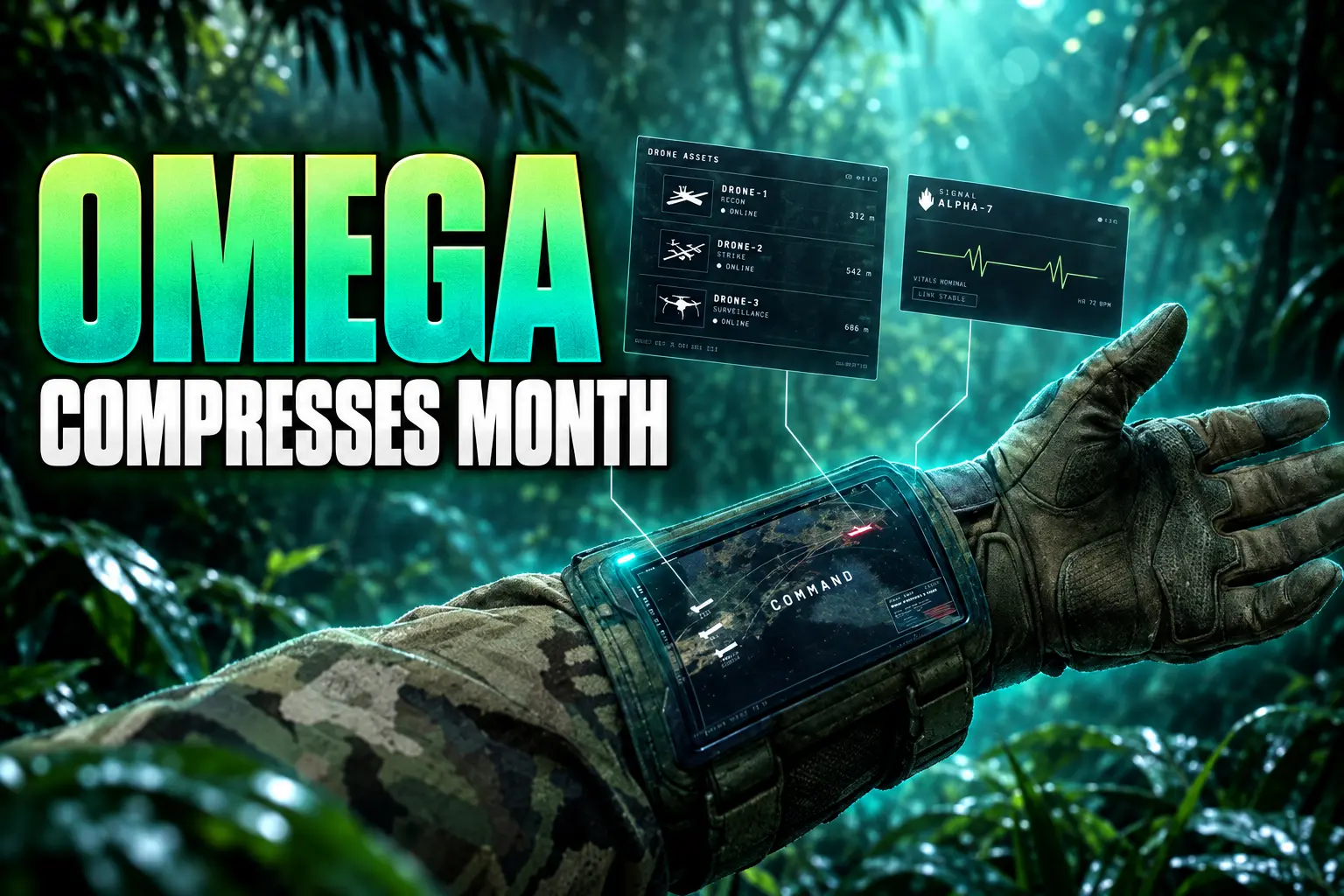
Alpha is the edge half of the same stack. Omega lives at command. Alpha is meant to carry that reasoning to people and machines when comms and compute fall apart, the DDIL case in military shorthand: denied, degraded, intermittent, limited. The kit is a flexible forearm display, a replacement for the improvised whiteboards troops have strapped to their arms. Markoff said the company started with software because it could train models on daily operations. Hardware in the dirt, with little or no connectivity, is the harder problem, and he called it the one that has to be solved for “decision dominance.”
As of a September 1, 2026 interview, Alpha had been in development only about four months. Markoff projected a working prototype within a year and device contracts within two years. From the August round, Smack is targeting 10 to 20 prototype units over the following six months, built out of Austin.
WHAT THE WRIST UNIT IS SUPPOSED TO HOLD
- Local picture: Sensor feeds, raw or processed, plus platform telemetry from whatever the unit is standing next to.
- The plan: Mission files, unit status, partner inputs, and guidance from higher headquarters, cached so the screen still works when the net dies.
- The rules: A light policy layer that is supposed to keep the advice inside rules of engagement, mission goals, and campaign priorities.
- The radio: Type 1 encrypted tactical comms, with periodic secure sync when a link reappears, on a vendor-agnostic architecture meant to plug into gear units already carry.
Markoff described the point as encoding commander’s intent: the theater goal, the constraints, and the contracts with units on the flanks, so a rifleman or a machine at the edge is not improvising against a different war than the one headquarters thinks it is fighting. That is also how Smack talks about steering autonomous systems, not only people. The Series B release says Alpha will push the same reasoning to warfighters and to machines at the tactical edge. The wrist box is the human face of that bet. The payload that can sit on someone else’s drone is the quieter one.
Three Branches Now, and Three More Due
Markoff announced the round himself, in the same language he uses with investors: domain-specific models for the joint force in 2026, plus hardware for the edge.
I’m psyched to announce that Smack has raised a $61M Series B.
This funding accelerates our ability to ship domain-specific AI models that are actually relevant across the Joint Force in 2026, and to build the hardware to deploy it to the tactical edge.
I’m truly grateful for… pic.twitter.com/AniGDR6jQx
— Andy Markoff (@andymarkoff) August 18, 2026
FROM TWO MARINES TO SIX SERVICES
- 2024: Andrew Markoff and Clint Alanis, MARSOC veterans with more than twenty years of combined combat time, found Smack.
- July 22, 2025: Smack announces two prototyping contracts totaling over seven figures with the Joint Fires Network and the Marine Corps Warfighting Lab, and calls itself JFN’s first early-stage startup.
- March 2, 2026: The company announces $32 million in seed and Series A funding, after contracts with multiple branches in 2025.
- March 4, 2026: Anthropic receives the Pentagon’s supply-chain-risk letter; that spring the Marine Corps and Navy press Smack to speed production.
- August 4, 2026: Smack says it is entering the next phase of a Navy prototype on maritime decision-support.
- August 18, 2026: Series B closes at $61 million; Omega is to go toward production, Alpha toward hardware.
- September 2026: Markoff shares the general-officer Omega demo and says the firm is moving from prototyping to production, with three branches on contract and a goal of all six by the end of 2026.
For JFN, the prototype is supposed to line up sensor collection with long-range fires and then score the damage, so the next shot is not waiting on a stale inbox. For the Marine Corps Warfighting Lab, Omega is being pointed at campaign-level choices, with time-and-space simulations on top of the weaponeering, refueling, and air-defense models. The company also says Omega and Alpha have been awarded twice on Tradewinds, the Pentagon’s marketplace for AI tools.
Humanitarian planning is the use case contracts have not funded. Markoff said users are asking for it and that Smack is building it on a longer clock. That is a demand signal, not a fielded product. The live bet is narrower and already expensive: take the month of fires math a Marine once did in his head, run it in minutes for a staff, in seconds for a commander under fire, and hang the same advice on a wrist when the net dies. Whether all six services are actually on contract by December is still a forecast from a CEO in the middle of a production ramp, not a signed roster.

Southwest Lounges Will Open Behind a New Chase Card

Smucker Wants Trader Joe’s Uncrustables Lookalikes Destroyed

Smack Omega Compresses a Month of Joint Fires Planning

Steam’s $15 Billion Haul Is a Catalog Story First

Baker Mayfield’s $55 Million Deal Closes the Discount Lane

Thameslink Will Pad 60,000 Ironing-Board Seats From 2027

Burger King Rebuilds Chicken Nuggets After Calling Them Rubbery

Royal Caribbean Sends Los Angeles Ships to Singapore and Brisbane

Twenty Controllers Closed Norwich Airport for a Bank Holiday

Micron Sells the Memory Shortage as Five-Year Contracts
-
 NEWS4 weeks ago
Thameslink Will Pad 60,000 Ironing-Board Seats From 2027
-
 BUSINESS4 weeks ago
Burger King Rebuilds Chicken Nuggets After Calling Them Rubbery
-
 NEWS4 weeks ago
Royal Caribbean Sends Los Angeles Ships to Singapore and Brisbane
-
 NEWS4 weeks ago
Twenty Controllers Closed Norwich Airport for a Bank Holiday
-
 NEWS4 weeks ago
Micron Sells the Memory Shortage as Five-Year Contracts
-
 BUSINESS4 weeks ago
Sweetmore Bakeries Buys Fantasy Baking for Bar Work
-
 BUSINESS4 weeks ago
U.S. Forces Clear Hormuz Mines, Then Hit Minelayers Again
-

 NEWS4 weeks ago
Frontier Miles Cuts Basic Fares After the Barclays Pact