
BUSINESS
UN Settlement List Hits 214 as Investors Take Notice
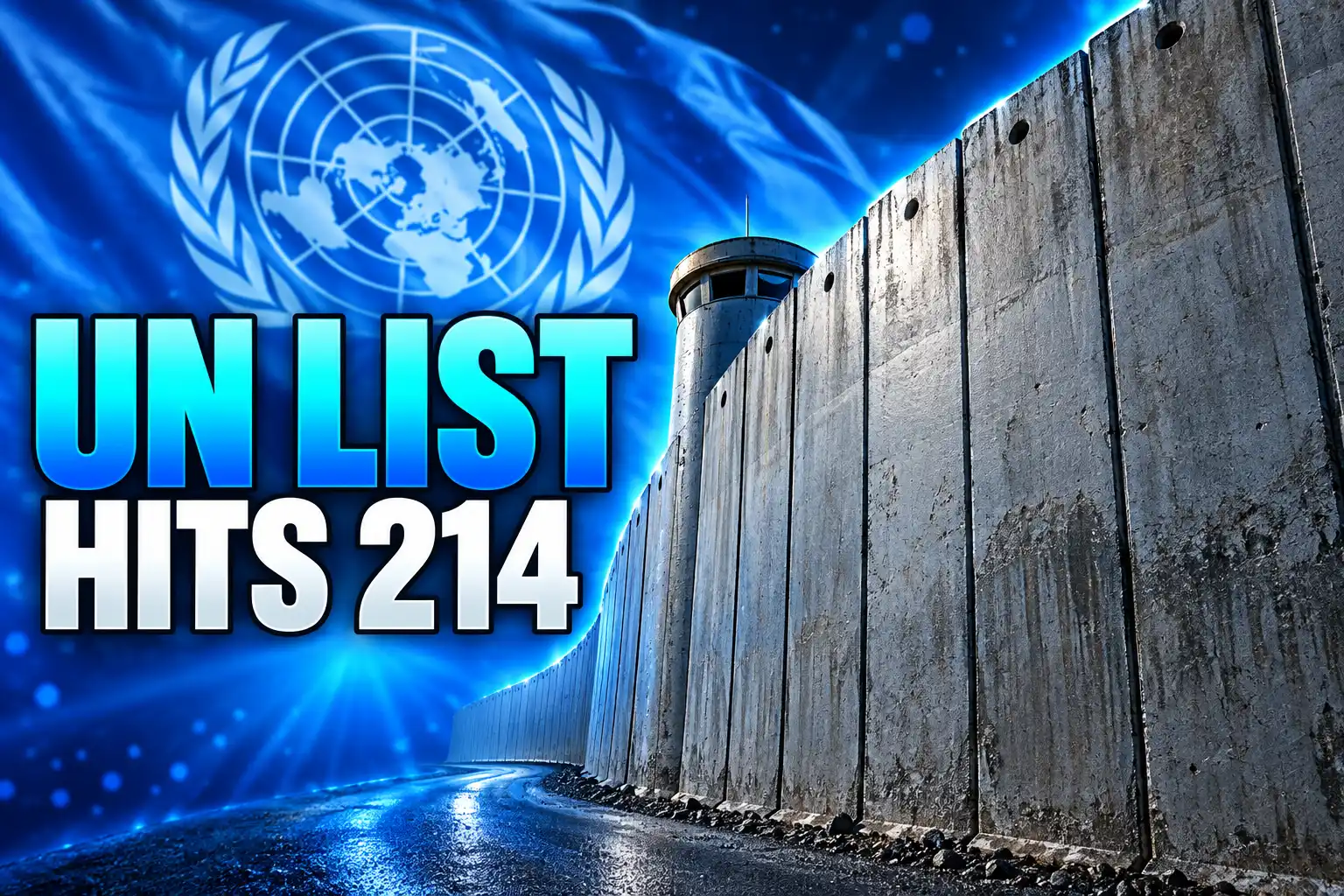
The UN named 214 settlement-linked firms, and investors plus European import bans now treat that roster as a working screen, not a pamphlet.

The UN Human Rights Office added 61 companies to its settlement database on 25 September 2026, taking the total to 214 firms. Five names came off after the office found they had left the work that put them there.
The roster still carries no fine. It now sits in front of investors, European customs desks and an Israeli grant scheme built for exporters who lose European buyers.
The Database Now Lists 214 Companies
The office’s update, report A/HRC/63/20, says 214 companies from 11 countries are listed for specified work tied to Israeli settlements in the occupied West Bank, including East Jerusalem. Last year’s edition named 158. Add 61 and subtract five and the new total is 214.
Country tallies published with the update put 192 of those firms in Israel. Eight are in the United States, three in Spain, and two each in China, France and the United Kingdom. Germany, Luxembourg, Mexico, the Netherlands and South Africa have one apiece.
WHERE THE 214 COMPANIES ARE BASED
| Home country | Companies | Names on the 2026 list |
|---|---|---|
| Israel | 192 | Alony-Hetz, Adama Agricultural Solutions, Motorola Solutions Israel |
| United States | 8 | Airbnb, Expedia Group, Booking Holdings |
| Spain | 3 | CAF, Ineco, Salvat Logística |
| China | 2 | Adama Ltd |
| France | 2 | Egis, Egis Rail |
| United Kingdom | 2 | J.C. Bamford Excavators, Greenkote |
| Germany | 1 | Heidelberg Materials |
| Netherlands | 1 | Booking.com |
| Luxembourg | 1 | Altice International |
| South Africa | 1 | Absoluteskin Cosmetics |
| Mexico | 1 | One firm, newly listed |
New names this round include Israel’s Adama Agricultural Solutions, the pesticide maker that sits inside China’s Syngenta Group, the Israeli property group Alony-Hetz, and Spain’s Salvat Logística. They join travel platforms already on the roster, among them Airbnb, Expedia Group, Booking.com and Tripadvisor, plus Motorola Solutions Israel.
This round looked at agriculture, transport, storage, waste, energy, food and hospitality. Of 126 companies screened, 61 met the test for listing and 65 did not. The office also split every name, for the first time, by how it is involved in harm to the Palestinian right to self-determination: 200 as contributing, 14 as directly linked, and none at the higher “causation” level.
J.C. Bamford Excavators, Greenkote, Absoluteskin Cosmetics and Salvat Logística sit among those 14. The Human Rights Council will receive the paper at its sixty-third session, which runs from 7 September to 9 October 2026.
Five Firms Got Off, and One Came Back
Getting off the list is possible, and companies now spend real staff time trying. The office received reassessment requests from eight firms that were on the 2025 list. It found that five were no longer involved in the listed work and moved them to the “no longer involved” annex. Two of those five are Spanish. The others are one each from Canada, Israel and Portugal.
One company that had been taken off in 2025 was put back after new information showed it was again involved. Silence is not a shield: if a firm refuses to reply, the office can still make a finding. After its first review of the 126 names, it sent a second notice and gave another 60 days. Fourteen companies sent extra material, which the office says it weighed before locking the 2026 list.
Spanish state engineering firm Ineco is still on the list and has asked to be taken off. It says its Israel work is on projects inside internationally recognised Israeli territory, including the Blue Line light-rail, and that it has taken no new contracts in the country since late 2023. Ineco said its Israel income has fallen from almost 10 million euros a year to less than 3 million. The Blue Line is due to finish in 2029. Breaking the contract early, the firm said, would carry legal and money risk.
HOW THE DATABASE GREW
- 24 March 2016: The Human Rights Council adopts resolution 31/36 and asks for a database of firms involved in specified settlement activities.
- 2020: The first public list, report A/HRC/43/71, names 112 companies.
- 2023: A review of those 112 names removes 15, leaving 97.
- 14 July 2023: Resolution 53/25 orders yearly updates that add and remove companies.
- 2 May to 12 June 2024: A public call brings 733 submissions covering 596 businesses.
- 26 September 2025: After reviewing 215 of those files, the office lists 158 companies.
- 25 September 2026: After reviewing 126 more files, the office lists 214 companies and removes five.
The 2026 paper covers conduct from 2 August 2019 to 15 April 2026. It does not cover Gaza or the occupied Syrian Golan.
Fourteen Investors Have Already Been in the Room
The audience that has to act on these names is larger than the 214 boards. Since September 2025 the office has spoken with 14 Member States, two subnational authorities, 27 other groups, and 14 investors among 43 businesses. That investor channel is the part of the mandate that does not show up in a wire lede.
Israeli banks are on the list as well as builders. Israel Discount Bank is logged for services and for banking work that helps settlements. Mizrahi Tefahot Bank is logged for services and for use of land and water. A European fund that screens human-rights risk does not need a court order to treat those rows as a problem.
The names that move on social feeds are still the consumer brands. Airbnb, Expedia, Booking and Motorola draw the posts. The 192 Israeli contractors do not. That split is why a Geneva PDF starts to matter only when a bank, a shipper or a customs rule uses it.
Six companies have, since September 2025, asked the office to post their own replies on the public database page. Any listed firm can send a response and request that it appear there.
This report is another reminder to companies that they have human rights responsibilities and are expected to conduct due diligence to ensure that they do not become involved in human rights violations or abuses.
Volker Türk, UN High Commissioner for Human Rights, 25 September 2026 statement
Israel’s mission in Geneva rejected the update the same day.
This is a distorted mechanism, created by a deeply flawed body with an automatic majority against Israel.
Israel’s diplomatic mission in Geneva, 25 September 2026
The mission also called the database a political tool used to smear firms that, in its words, committed no wrongdoing. It argued that scaring companies away from conflict zones can itself hurt the people the list claims to protect.
What Puts a Company on the UN List?
A firm is added when the office has reasonable grounds to believe it took part in at least one of the 10 activities that raised human rights concerns in the 2013 fact-finding mission report. That bar matches other UN fact-finding work. It is lower than proof beyond a reasonable doubt in a criminal court.
The database does not try to capture every kind of business tied to settlements. It tracks only those 10 activities, for companies based in Israel, in the occupied territory, or abroad.
THE 10 LISTED ACTIVITIES
- Building kit: Supply of equipment and materials that help build or expand settlements, the wall, and related infrastructure.
- Surveillance kit: Supply of surveillance and identification gear for settlements, the wall, and checkpoints linked to settlements.
- Demolition kit: Supply of equipment used to demolish homes and property or to destroy farms, greenhouses, olive groves and crops.
- Settlement security: Supply of security services, equipment and materials to businesses that operate in settlements.
- Services and utilities: Transport and other services that help keep settlements running.
- Banking: Loans and other financial work that help develop, expand or maintain settlements.
- Land and water: Use of natural resources, especially water and land, for business.
- Waste: Pollution, and the dumping or transfer of waste into Palestinian villages.
- Market capture: Practices that trap Palestinian markets or put Palestinian firms at a disadvantage, including movement limits.
- Settler profits: Use of benefits and reinvestment from businesses owned wholly or partly by settlers to grow the settlements.
Adama’s Israel unit and its China parent are both logged for construction-related supply and for services. Alony-Hetz is logged for use of land and water. Motorola Solutions Israel is logged for security supply and for services. CAF, the Spanish rail group, is logged for construction supply, services, and land and water. Heidelberg Materials is logged for land and water.
Companies found to be involved, the report says, should take action to deal with the harm. States, Türk’s office added, must use courts, rules or other tools so that people hurt by business-related abuses can get a remedy.
Import Bans Turn Names Into a Trade Screen
The Council cannot order a boycott. Import rules can. On 8 September 2026, Canada, Denmark, Finland, France, Iceland, Ireland, Norway, Poland, Portugal, Spain, Sweden and the United Kingdom said they would restrict settlement goods, back European-level limits, or study such steps.
Only some of those pledges are live. Spain and Ireland have measures aimed at settlement imports. The Netherlands brought a ban into force on 22 September 2026 that covers the import, purchase and sale of goods from settlements, plus services that help that trade and attempts to dodge the rule. The Dutch market also functions as a gateway into the rest of Europe.
The United Kingdom has not yet turned its pledge into law. Foreign Secretary Ed Miliband said legislation would come in six to nine months. France and Canada have promised national steps that are not yet in force. Belgium approved a draft on 18 July 2026 that would refuse import permits, with a 120-day transition, and sent it for legal review. Norway has drafted a ban on both imports from and exports to settlements, still under consideration.
Israel is already writing cheques for the gap. Roey Fisher, head of the Foreign Trade Administration at the Ministry of Economy and Industry, said the state will pay settlement companies up to 200,000 shekels ($54,000) and has a team to find other markets, including the Philippines, India, the United Arab Emirates, Chile and Argentina. More than 25 applications are in, including from fresh-produce exporters.
Fisher said Spain and the Netherlands are among the few places in Europe where a boycott is actually biting, and that countries which have announced bans, including the United Kingdom, have not applied them to all Israeli exports. Julie Norman, an associate fellow at Chatham House, said the United Kingdom and the European Union together account for over a third of Israel’s exports, and that the grants are unlikely to cover lost sales in the short run.
THE 2026 INVOLVEMENT SPLIT
- Contribution, 200 firms: The company’s own acts, mixed with another actor’s, reduce the ability to enjoy a right. This is the bulk of the list, including Airbnb, Booking.com, Expedia Group and Motorola Solutions Israel.
- Direct linkage, 14 firms: Operations, products or services are directly tied to the harm, even if the company did not help cause it. J.C. Bamford Excavators, Greenkote and Absoluteskin Cosmetics are in this group.
- Causation, zero firms: No listed company was found to have acts that, on their own, were enough to take away a right.
- Grant cap, 200,000 shekels: Israel’s ceiling for settlement exporters seeking new markets after European bans.
In July 2024 the International Court of Justice said the settlements are unlawful, that Israel must not found new ones, and that it is obliged to withdraw from occupied Palestinian territory as soon as possible. That opinion is advisory. The 2026 company list is one of the practical documents now being read against it.
255 Company Files Are Still Waiting
The 2024 call for input named 596 businesses. The 2025 and 2026 updates together finished 341 of those files. That leaves 255 still unreviewed, including, the office has said, firms in the security sector. Resource limits, and wider UN cash strain, are why the office does not recheck every old listing on its own. A firm comes off when someone sends new, reliable information that the listed work has stopped.
ADAMA did not immediately comment on its inclusion. Alony-Hetz and Salvat Logística also did not immediately comment. The office contacted firms after it concluded they were involved, then ran the 60-day reply window before publishing.
The next formal report to the Council will pick up names that could not be finished for 25 September. Until then, A/HRC/63/20 is the live version of the database, including the five deletions and the one return.
A list that began as 112 names in 2020 is now 214, with 255 files still in the drawer. The pressure on those names will come from the investors already in contact with the office, from the few European bans that are actually in force, and from companies that, like the five that left this year, decide the cheaper path is to get off the page.
Frequently Asked Questions
What is the UN database of businesses in Israeli settlements?
It is a public roster the Human Rights Council ordered in paragraph 17 of resolution 31/36, compiled with the UN Working Group on business and human rights. The Council has 47 member states. The High Commissioner’s office keeps the names and posts company replies that firms ask to make public.
Can a company stay off the UN settlement list by not replying?
No. The 2026 report says that if a business declines to give information or fails to respond at all, that silence does not by itself stop a finding of involvement in a listed activity.
How can a listed company publish its own response?
A firm can send comments to the office’s database address and ask for them to appear on the public webpage. The office says it does not vouch for those replies. Since September 2025, six companies have used that option.
Does the UN settlement database cover all business in occupied territory?
No. It is limited to 10 specified activities tied to settlements in the occupied Palestinian territory, including East Jerusalem. Work in Gaza and in the occupied Syrian Golan is outside the mandate, and so is settlement-related business that does not match those 10 activities.
When was the UN settlement business database first published?
The first public list was report A/HRC/43/71 in 2020, with 112 companies. An interim 2018 report, A/HRC/37/39, had set out the methods before any names were issued, after the Council’s 2016 request for an annually updated database.

Hurricane Nolo Hits a Big Island Still Digging Out

Gaza Families Remain in Buildings Already Cleared to Fall

Sony Polls Publishers Who Cannot Press PlayStation Discs Elsewhere

UN Settlement List Hits 214 as Investors Take Notice

Southwest Lounges Will Open Behind a New Chase Card

Thameslink Will Pad 60,000 Ironing-Board Seats From 2027

Burger King Rebuilds Chicken Nuggets After Calling Them Rubbery

Royal Caribbean Sends Los Angeles Ships to Singapore and Brisbane

Twenty Controllers Closed Norwich Airport for a Bank Holiday

Micron Sells the Memory Shortage as Five-Year Contracts
-
 NEWS4 weeks ago
Thameslink Will Pad 60,000 Ironing-Board Seats From 2027
-
 BUSINESS4 weeks ago
Burger King Rebuilds Chicken Nuggets After Calling Them Rubbery
-
 NEWS4 weeks ago
Royal Caribbean Sends Los Angeles Ships to Singapore and Brisbane
-
 NEWS4 weeks ago
Twenty Controllers Closed Norwich Airport for a Bank Holiday
-
 NEWS1 month ago
Micron Sells the Memory Shortage as Five-Year Contracts
-
 BUSINESS4 weeks ago
Sweetmore Bakeries Buys Fantasy Baking for Bar Work
-

 BUSINESS1 month ago
U.S. Forces Clear Hormuz Mines, Then Hit Minelayers Again
-

 NEWS4 weeks ago
Frontier Miles Cuts Basic Fares After the Barclays Pact