
NEWS
Starling Finds Its Orbit by Watching Other Satellites
NASA’s Starling swarm fixed its orbit without GPS and rewrote more than 200 catalog tracks in three days, using other satellites as landmarks.

NASA’s Starling swarm has determined a satellite’s orbit without GPS by treating other spacecraft and debris as landmarks, the agency said on Aug. 17, 2026. The test flew on cameras the CubeSats already carry, plus a stored list of known objects.
The same pass did a second job that matters sooner in low Earth orbit. Over three days, with no ground operator in the loop, the software improved the known orbits of more than 200 objects and, NASA said, produced better position predictions than the ground stations that feed the public catalog.
FALCON Used Other Satellites as Moving Landmarks
The flight experiment is FALCON, short for Fast Autonomous Lost-in-space Catalog-based Optical Navigation. NASA ran it with EraDrive, a Stanford University spinout, on the Starling mission led from Ames Research Center in California’s Silicon Valley. EraDrive’s Era-Core flight software sat on top of Starling’s star-tracker cameras and an onboard catalog of known satellites.
Most satellites in low Earth orbit still take their position from GPS. Those signals thin out far from Earth, and they can be jammed. FALCON’s bet is that a spacecraft can fix itself the way a hiker fixes a position on a map, except the landmarks are moving: other spacecraft, rocket bodies, and debris that already have published orbits.
Star trackers normally photograph stars so a spacecraft can tell which way it is pointing. Other bright dots cross the same field of view. FALCON kept those dots, matched them to the catalog, and used the matches as reference points to compute Starling’s own orbit. NASA called that self-orbit determination a first for a spacecraft using optical cameras to navigate by its position relative to other objects in space.
THE TWO JOBS ON ONE CAMERA
- Self-fix: Match what the cameras see to the catalog, then treat those objects as landmarks for Starling’s orbit.
- Catalog fix: Feed the same sightings back into the list so other objects’ predicted paths get tighter than the ground file.
Roger Hunter, program manager for NASA’s Small Spacecraft and Distributed Systems program at Ames, tied both jobs to traffic as much as to exploration.
FALCON is yet another success for the Starling demonstration mission. The results from FALCON can have far-reaching implications for on-orbit space-traffic monitoring, collision avoidance, and alternative navigation.
Roger Hunter, program manager, NASA Small Spacecraft and Distributed Systems, NASA Ames
Hunter added that the number of firsts from Starling keeps growing. The swarm launched on July 17, 2023, from Rocket Lab’s Launch Complex 1 in Māhia, New Zealand, as four six-unit CubeSats. Operators nicknamed them Blinky, Pinky, Inky, and Clyde.
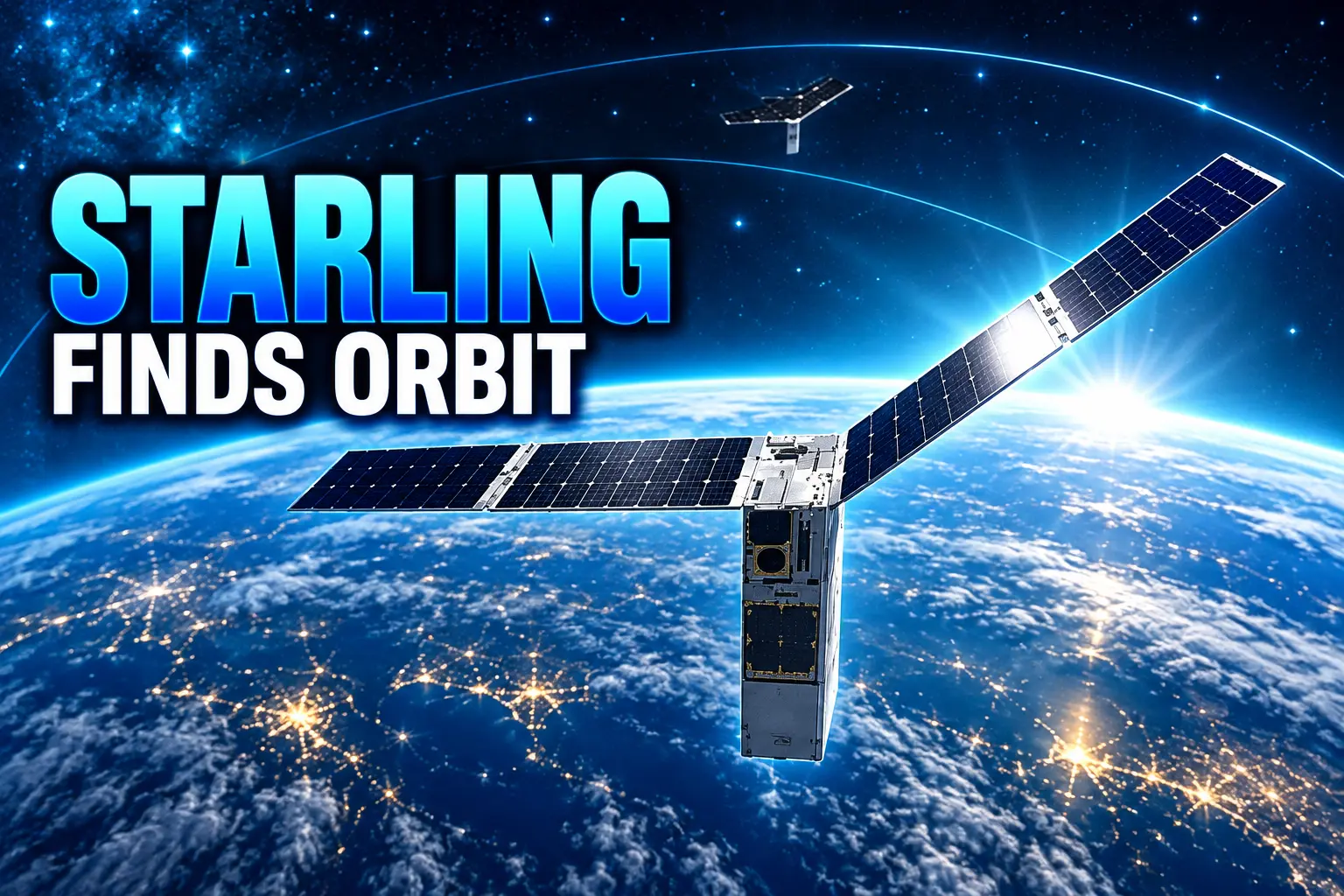
A Three-Day Pass Beat the Ground Catalog
NASA loaded the full catalog of approximately 20,000 space objects and their predicted orbits onto the spacecraft. FALCON then lined that file up with what Starling’s cameras actually saw, including other spacecraft and orbital debris. The public list NASA used is maintained by the U.S. Department of War.
In a separate set of tests from the self-fix, the software refined the orbit estimates of the objects it observed. NASA said the onboard predictions came out more precise than the current catalog data. The three-day run touched more than 200 objects and needed no intervention from operators on the ground.
THE TWO FALCON FLIGHT TESTS
| Test | What flew on Starling | NASA’s result |
|---|---|---|
| Self-orbit determination | Star-tracker cameras plus the onboard catalog as landmarks | First optical self-nav by position relative to other space objects |
| Onboard catalog update | The same cameras checked against approximately 20,000 loaded orbits | More than 200 object tracks improved in three days, tighter than ground predictions |
NASA did not publish a flight figure for how many meters that self-fix was off. The public result is the method and the catalog work, not a GPS-grade error bar from orbit.
A 2025 technical preprint from Stanford’s Space Rendezvous Laboratory, written before the Aug. 17 announcement, had already stress-tested the pipeline in simulation with Starling flight imagery and Space-Track catalog files. Antonio Rizza, Justin Kruger, Mike Timmerman, and Simone D’Amico reported that batch and sequential orbit determination could recover a lost observer with sub-kilometer accuracy in less than one orbit when the right set of beacons was in view. Steady-state errors in that simulation settled near 200 m in the radial and normal directions and about 2 km along track, with image processing in the loop. Those numbers are still simulation, not the flight score NASA withheld.
Why the Pentagon List Still Has to Be on Board
GPS-free in this experiment does not mean map-free. FALCON finds itself by matching live camera dots to identities that already exist in a ground-built catalog. If the list is wrong, stale, or missing the object in the frame, the landmark is no landmark.
That is the quiet limit inside the milestone. The spacecraft can stop asking GPS where it is, and it can stop asking a ground operator to run the filter, but it still needs a current picture of who else is up there. NASA’s own write-up is blunt that the catalog is loaded on board and that the cameras are checked against it.
Stanford’s laboratory page puts the same loop in engineering language. Observer satellites take bearing angles to visible resident space objects, match those detections to catalog identities, and then treat the matches as purely optical beacons for lost-in-space positioning. The sightings also go back into the catalog so coverage and timing get better. The hardware demand is an optical sensor, which most modern spacecraft already fly as a star tracker.
WHAT THE CATALOG RUN CHANGED
- Onboard file: NASA loaded approximately 20,000 known objects and their predicted orbits.
- Three-day yield: FALCON improved more than 200 of those tracks with no ground operator in the loop.
- Ground network scale: Space-Track.org, the public portal run with the U.S. Space Force’s 18th Space Defense Squadron, currently lists about 12,400 active payloads and about 20,400 debris objects.
- Why ground is slow: The Stanford preprint says catalog measurements from radars and telescopes are sparse, which limits how fast and how well the list can be kept current.
The mismatch in size is the point, not a conflict of facts. Starling did not download every object the surveillance network can see. It flew a working slice of the public list, then used one small spacecraft to tighten more than 200 tracks in three days. That is a space-traffic sensor that happens to live on a CubeSat, not a spare GPS receiver with extra software.
The preprint also sketches why anyone is in a hurry. Tracked resident space objects have risen three-fold since 2010, and the authors cite a forecast of up to 3,000 satellites launched each year by 2030. Ground radars and telescopes still build the official picture. FALCON’s catalog run is an argument that some of that picture can be corrected in orbit, on the spacecraft that already have cameras pointed at the sky.
Star Trackers Were Already Watching Traffic
FALCON did not appear from nowhere on Starling. The swarm’s original optical experiment, StarFOX, used the same class of commercial star-tracker cameras so the four CubeSats could find one another without being told their relative state from the ground. NASA later said those cameras could determine a spacecraft’s own position and recognize fellow swarm members, other satellites, and space debris.
The four 6U CubeSats, each about the size of two stacked cereal boxes, fly in a Sun-synchronous orbit more than 300 miles above Earth and no more than 170 miles apart. The pre-launch plan had put them about 355 miles up. They were built to test swarm maneuvering, a crosslink network, relative navigation, and onboard decision-making with little real-time help from mission control.
STARLING FROM LAUNCH TO FALCON
- July 17, 2023: The four CubeSats deploy from a Rocket Lab Electron kick stage after liftoff from Māhia, New Zealand.
- August 2023: Mission managers lock command links with all four, including Blinky after an early communications snag.
- May 29, 2024: NASA says the swarm has met its primary objectives, including optical swarm navigation on StarFOX.
- 2024-2025: StarFOX work on identifying transient objects in star-tracker frames feeds the FALCON design.
- Aug. 17, 2026: NASA posts the FALCON self-orbit and catalog-update results from the extended mission.
- Later in 2026: NASA plans to have all four spacecraft share tracking data on Era-Core and refine their positions together.
Ames leads the mission. NASA’s Small Spacecraft and Distributed Systems program, based at Ames, funds and manages it. FALCON itself started as a University SmallSat Technology Partnerships project and then moved into EraDrive, which is now selling Era-Core and related hardware.
EraDrive Is Selling the Same Software Loop
The commercial handoff is not a side note. NASA said Starling was the on-orbit test stand that showed flight software can turn ordinary satellites into navigators that do not wait on a GPS fix. EraDrive’s public site goes further and frames the product as flight-proven satellite autonomy at scale on the Starling swarm.
The company lists TRL 9 autonomy across 5 heritage missions and 12 satellites, and it describes Era-Core as flight software for autonomous rendezvous, alternative positioning, space-domain awareness, and space traffic. A companion box, Era-Node, bundles a camera, a processor, and a cross-link so other buses can fly a similar stack. The founders are Sumant Sharma, chief executive and a Stanford Space Rendezvous Lab doctorate; Justin Kruger, chief technology officer, who did his Starling flight work from Stanford; and Simone D’Amico, chief science officer, a Stanford aero-astro professor who directs that laboratory. The lab’s own page dates that distributed-satellite line of work at 23 years.
EraDrive’s marketing question is the contested-orbit case, not the lunar brochure. It asks how a spacecraft navigates above the GPS constellation and when radio is jammed. That is a different customer from a science swarm at the Moon, and it is closer to the catalog-update result NASA actually posted. A spacecraft that can identify neighbors and refresh their orbits is doing space-domain awareness even when no one has turned GPS off.
NASA Ames posted a sole-source notice earlier in 2026 for more Starling software from EraDrive, covering resident-space-object tracking, autonomous orbit determination, swarm geometry, and onboard conjunction assessment on the four CubeSats through Jan. 20, 2027. The notice said EraDrive holds the proprietary code already running on the vehicles. The agency is buying more of the same loop, not a new GPS box.
Lunar GPS Still Rides on Spillover Signals
NASA’s FALCON note still points at the Moon and Mars, where GPS was built as an Earth service. That pitch needs a tighter sentence than the one in the press copy. Earth GNSS signals have already been tracked at lunar distance. NASA said the Lunar GNSS Receiver Experiment, LuGRE, acquired and tracked GPS and Galileo on the lunar surface on March 3, 2025, about 225,000 miles from Earth, using a high-sensitivity receiver and a high-gain antenna on Firefly’s Blue Ghost lander.
Those fixes used spillover from beams aimed at Earth, not a dense lunar GPS grid. Availability is patchy, the geometry is poor, and the receiver is not a star tracker. FALCON does not replace that work. It offers a different spare: cameras most spacecraft already fly, plus a catalog, with no need to lock faint Earth GNSS side lobes. Around Earth, where the catalog is dense, that spare is also a traffic sensor. Around the Moon, the same method only works if someone has already mapped the landmarks a camera can see.
Hunter’s collision-avoidance line is the part that does not need a lunar caveat. Precise positions are also what distributed science missions need if they want to line up measurements taken from more than one point in space. Both of those jobs live in Earth orbit today.
The Four CubeSats Still Have to Share
NASA said that later in 2026 Starling will extend FALCON on Era-Core so the four-spacecraft swarm can share tracking data and refine their positions together. That step is still ahead of the Aug. 17 results. One observer with a catalog is a landmark fix. Four observers trading sightings is closer to a small navigation network, and it is the test that shows whether moving landmarks scale past a single CubeSat.
WHAT WE KNOW
- Flown: Optical self-orbit determination against the Department of War catalog, plus a three-day onboard update of more than 200 object tracks.
- Hardware: Starling’s existing star-tracker cameras and Era-Core software, not a new GPS set.
- Next on the plan: Four-way sharing of tracking data later in 2026.
WHAT IS UNCONFIRMED
- Flight error: NASA has not released a meter-class accuracy figure from the on-orbit self-fix.
- Swarm share: The four-spacecraft data exchange has not been posted as a completed result.
- Deep-space map: How a FALCON-style catalog would be kept current far from Earth’s surveillance network is still a design problem, not a flight result.
The next Starling pass is the one that asks whether four small cameras, talking to each other, can turn other people’s satellites and junk into a shared fix. Until that data is down, the thing NASA has in hand is a CubeSat that stopped waiting on GPS, then used the same pictures to edit the catalog the rest of the traffic still flies on.

Hurricane Nolo Hits a Big Island Still Digging Out

Gaza Families Remain in Buildings Already Cleared to Fall

Sony Polls Publishers Who Cannot Press PlayStation Discs Elsewhere

UN Settlement List Hits 214 as Investors Take Notice

Fuel Pushes UK Inflation to 3.1% With Core Unchanged

Thameslink Will Pad 60,000 Ironing-Board Seats From 2027

Micron Sells the Memory Shortage as Five-Year Contracts

Royal Caribbean Sends Los Angeles Ships to Singapore and Brisbane

Burger King Rebuilds Chicken Nuggets After Calling Them Rubbery

U.S. Forces Clear Hormuz Mines, Then Hit Minelayers Again
-
 NEWS1 month ago
Thameslink Will Pad 60,000 Ironing-Board Seats From 2027
-
 NEWS1 month ago
Micron Sells the Memory Shortage as Five-Year Contracts
-
 NEWS1 month ago
Royal Caribbean Sends Los Angeles Ships to Singapore and Brisbane
-
 BUSINESS1 month ago
Burger King Rebuilds Chicken Nuggets After Calling Them Rubbery
-
 BUSINESS1 month ago
U.S. Forces Clear Hormuz Mines, Then Hit Minelayers Again
-

 NEWS1 month ago
Twenty Controllers Closed Norwich Airport for a Bank Holiday
-

 BUSINESS1 month ago
Sweetmore Bakeries Buys Fantasy Baking for Bar Work
-

 NEWS1 month ago
Frontier Miles Cuts Basic Fares After the Barclays Pact