
LIFESTYLE
Gulf Oysters Take the Blame for a Wound-Borne Scare
Louisiana tied 14 of 15 Vibrio cases to wounds, not meals, yet Gulf oysters still carry the scare as the fishery that supplies most of the Gulf’s meat.

Louisiana has recorded 15 Vibrio vulnificus cases and six deaths in 2026, and 14 of those cases started with wounds or seawater, not a plate of oysters. The count, current as of September 2, 2026, still lands on Gulf oysters every time the phrase flesh-eating bacteria hits a menu.
That is a problem for the people who grow and ship the bivalves. Louisiana landed 6.9 million pounds of oyster meat in 2024, worth $52.9 million at the dock, and took 77.3% of Gulf oyster meat that year. A wound in warm water is what the state’s own files describe. The crop still pays the bill.
Fourteen of Fifteen Louisiana Cases Started in the Water
On August 6, 2026, the Louisiana Department of Health reported nine cases and five deaths among residents. Every patient had been hospitalized. Every case was tied to a wound exposed to seawater. Every patient had an underlying health condition. Across the same stretch of the prior 10 years, the department said, the state had averaged seven cases and one death.
By September 2 the file was heavier: 15 cases, six deaths, and 14 of 15 still tagged to wound or seawater exposure. Dr. Keith Schneider, a food safety professor at the University of Florida’s Institute of Food and Agricultural Sciences, has spent a career on the food side of this bacterium. He still points first at the estuary.
It just happens. Somebody steps on an oyster shell, or goes swimming with a cut in an estuary where the Vibrio vulnificus bacteria is present.
Keith Schneider, professor of food safety, University of Florida Institute of Food and Agricultural Sciences
Florida’s official ledger, updated at 9:30 a.m. ET on September 3, 2026, shows 20 confirmed cases and four deaths from Vibrio vulnificus. That is fewer cases than Florida logged in 2025 (33 cases, five deaths) and far below 2024, when Hurricane Helene helped drive 82 cases and 19 deaths. The 2022 Hurricane Ian year sat at 74 cases and 17 deaths.
THE 2026 GULF COUNT
- August 6, 2026: Louisiana reports nine cases and five deaths, all tied to wounds in seawater, all in people with other illnesses.
- September 2, 2026: Louisiana’s count rises to 15 cases and six deaths, with 14 of 15 still listed as wound or seawater.
- September 3, 2026: Florida posts 20 cases and four deaths, with fatalities in Bay, Broward, Marion, and Palm Beach counties.
The Centers for Disease Control and Prevention says about 150 to 200 Vibrio vulnificus infections are reported in the United States each year, and about one in five people with this infection die, sometimes within a day or two. Eastern U.S. wound infections rose eightfold from 1988 to 2018, from 10 cases a year to 80, and the northern edge of the map moved about 48 km per year. Warm water is the common ingredient. A raw oyster is only one way in.
The first public guess after a new Florida death is still a raw oyster. That guess is what follows the half-shell from the dock to the bar, even when a state file says the patient went into the Gulf with a cut.
Louisiana Still Supplies Most of the Gulf’s Oyster Meat
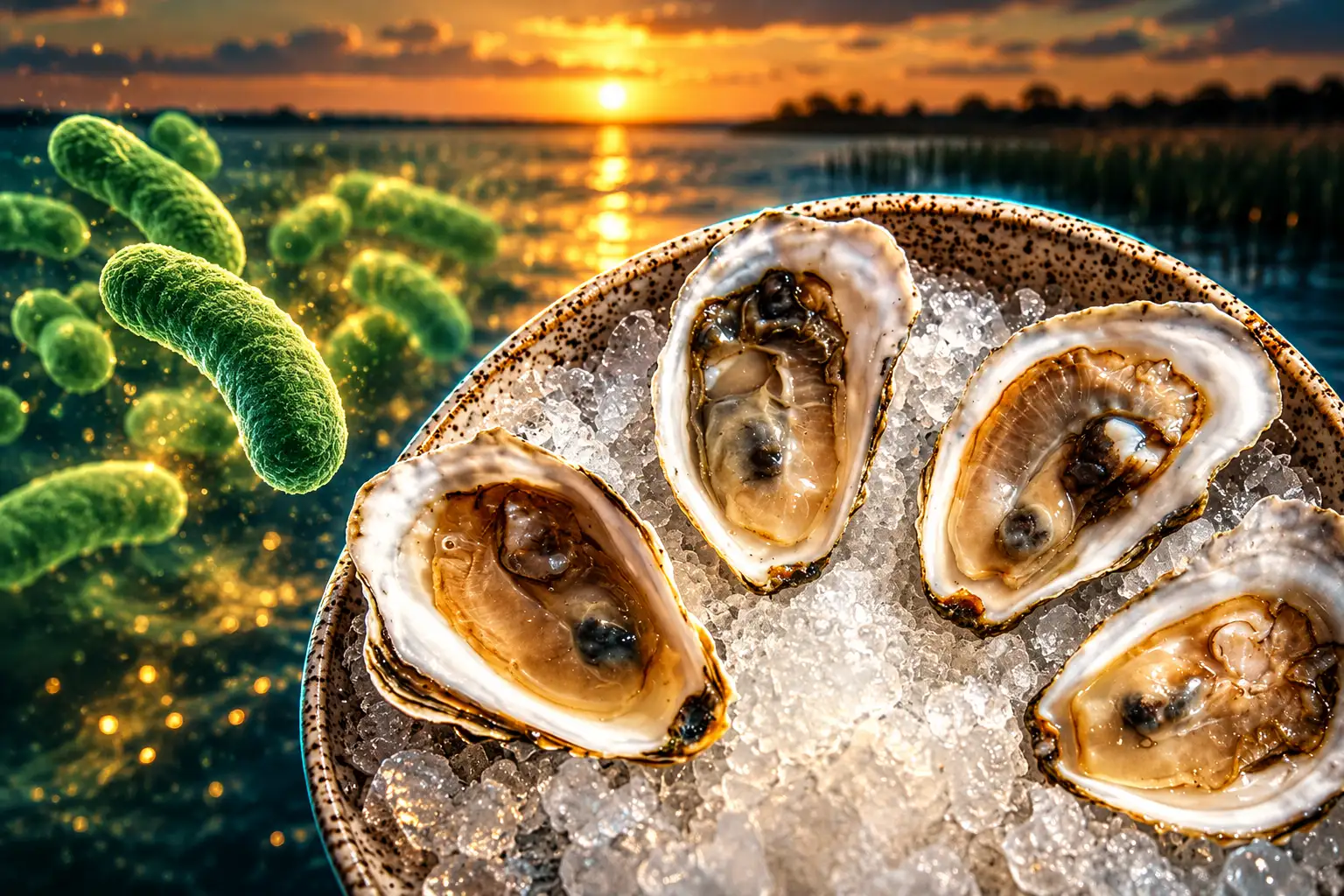
Pretty much any month on the American Gulf Coast, oysters sit on restaurant tables, raw on the half-shell or cooked under bacon and crumbs. The animal is a staple crop, not a garnish. From 2005 through 2024, Louisiana accounted for 32.2% of U.S. oyster landings by pounds of meat. In 2024 it accounted for 34.5% of the country’s oyster meat and 77.3% of the Gulf’s.
LOUISIANA’S OYSTER CROP IN 2024
| Measure | Figure |
|---|---|
| Meat landed | 6.9 million pounds |
| Dockside value | $52.9 million |
| Value per pound | $7.63 |
| Share of Gulf meat | 77.3% |
| Share of U.S. meat | 34.5% |
| Share from private leases | 91.2% |
| Share from public reefs | 8.8% |
Those pounds come off a working coast. The Louisiana Department of Wildlife and Fisheries manages about 1.7 million acres of public oyster areas and lists about 400,000 acres currently under lease. Most of the meat in 2024, 91.2%, came off private leases. Public reefs supplied 8.8%.
When a national alert treats Vibrio as an oyster-plate story, this is the inventory that sits in the blast radius. Dealers, boat crews, and raw bars live on repeat orders. A scare that starts in a cut still shows up as empty ice at 4 p.m.
Schneider’s warning to diners is really a warning to the cheap end of that trade. He tells people to skip the super-cheap raw oyster happy hour, where low prices and high volume can mean sloppy handling. Live, cold, carefully moved shellstock is the product the leases are built to sell. Dead, warm, unmarked oysters are how a food case gets written.
Harvest Tags, Storm Closures, and a July Reopening
The food-safety machinery around Gulf oysters is older than this summer’s headlines. Louisiana’s Molluscan Shellfish Program is the regulator for harvest waters along the coast. Growing areas are set under the state sanitary code and under National Shellfish Sanitation Program rules, the federal-state system recognized by the U.S. Food and Drug Administration for shellfish sold as food.
Producers have to use shipping tags that follow a bag of oysters through the chain. If a cluster of illnesses points at food, those tags are how a specific lot comes off a cooler. Schneider put it in one line: if there is an outbreak, agencies can find that exact batch and pull it.
The same desk already closes water for storms and spills, then opens it again when tests allow. After Tropical Storm Bertha, the program said all molluscan shellfish growing areas would revert on July 24, 2026, to the May-August 2026 reclassification. Harvest areas 15, 17, and 19 had already been put back to work at sunrise on April 3, 2026, after a precautionary shutdown. Samples taken after a February 26, 2026, transfer-hose leak at the Louisiana Offshore Oil Port came back as non-detect for petroleum markers in oysters, shrimp, crabs, and finfish.
That is the hidden daily cost. Boats sit. Ice melts. A tag is only useful if the bag was handled right after it left the water. Schneider’s rule for diners is the same rule for cooks: serve oysters that are still alive and healthy, because if they are not, the bacteria start to multiply, and you cannot tell by look or smell.
Prestige Sells a Safer Oyster Diners Resist
Some processors have tried to cut the food path without a frying pan. At Prestige Oysters in Dickinson, Texas, high-pressure processing is used to pop the meat from the shell and knock down foodborne pathogens, including Vibrio, while stretching shelf life. The U.S. Food and Drug Administration describes high hydrostatic pressure, in a range from 14,500 to 145,000 pounds per square inch, as a process that can reduce Vibrio vulnificus in raw molluscan shellfish to a non-detectable level, less than 30 MPN per gram, while keeping a raw product. It is not cooking, and it does not wipe out every germ of public health concern.
The catch for the trade is on the plate. Many diners dislike how the pressure step changes the texture and the fresh flavor of a raw oyster, even when the illness risk is lower. A safer raw oyster that no one orders does not protect a lease. It sits in a tub.
So the industry is stuck between two products. Untreated half-shell oysters still define the Gulf feast, and they still carry whatever the water held that morning. Treated oysters solve a lab test and lose a slurper. Cheap happy-hour volume solves a price and invites the handling failures Schneider flags. The people with the most money on the table are the ones who cannot pick a version everyone will eat.
Who Faces the Highest Risk From Vibrio
The deaths are concentrated, not random. Louisiana said all nine patients in its August 6 file had underlying health conditions. Florida’s health department says Vibrio vulnificus bloodstream infections are fatal about 50% of the time, and that people with certain pre-existing medical conditions were 80 times more likely to develop those bloodstream infections than healthy people. The CDC’s one-in-five death figure covers Vibrio vulnificus infections as a group, including wound cases and food cases.
Florida also flags chronic liver disease as a special concern. The CDC’s prevention page puts liver disease first among the conditions that make the usual steps more urgent.
WHO LOUISIANA SAYS FACES THE HIGHEST RISK
- Liver disease: Hepatitis and other liver conditions leave the body less able to fight a Vibrio vulnificus infection.
- Other chronic illness: Cancer, diabetes, HIV, and thalassemia are on the state’s list.
- Weaker immunity: Immune-suppressing treatment, medicine that reduces stomach acid, and recent stomach surgery raise the odds of a severe course.
- Open skin: Cuts, scrapes, recent surgery sites, piercings, and tattoos are the wound path into coastal water.
Experts also tell very young children, older adults, pregnant people, and anyone with a weak immune system to skip raw oysters. For those diners, the half-shell is the wrong product, in any month. Heat is the control that does not depend on a tag.
Schneider still eats Gulf oysters. He has no liver disease, he said, though he is getting older and may stop at some point. His own math depends on the time of year and how many oysters he plans to eat. He called the risk fairly low if the oysters come from a reputable place.
The R-Month Rule Tracks Water Temperature
Schneider’s first piece of advice is older than the CDC. Eat raw Gulf oysters in months with the letter R in the name. September has an R. May through August do not. Vibrio numbers in coastal water run higher from May to October, when the water is warmer, which is why the old calendar still maps onto the lab work.
Sometimes, the old adage is just true. Warmer waters mean that there are more pathogens in the water, and we have seen upticks in Vibrio illnesses in the summer for decades. These organisms just thrive in warmer water.
Keith Schneider, professor of food safety, University of Florida Institute of Food and Agricultural Sciences
The eightfold rise in Eastern wound cases between 1988 and 2018 is what happens when that warm window stretches and moves north. Gulf harvests already live inside it. An R-month rule does not close a lease. It tells a diner when a raw Gulf oyster is the less bad bet, and it tells a cook when cooking should be the default.
It does not help a swimmer with a cut. Waterproof bandages, staying out of brackish water with open skin, and washing a wound with soap after a splash are the steps Louisiana put at the top of its August advisory, ahead of the oyster advice. That order matches the state’s 2026 file.
Boiling Three Minutes Ends the Foodborne Risk
If the question is the oyster on the plate, heat ends it. The CDC tells people not to eat raw or undercooked oysters, and it gives times that are short enough to use in a home kitchen. Lemon juice, hot sauce, and alcohol do not kill Vibrio. Some oysters are treated after harvest to cut vibriosis levels; the CDC says that treatment does not remove all harmful germs, and people at higher risk should not eat those raw either.
CDC TIMES FOR COOKED OYSTERS
- In the shell: Discard any with open shells, boil until they open, then keep boiling 3 to 5 minutes, or add them to a steamer that is already steaming and cook 4 to 9 minutes more. Throw out any that do not open fully.
- Shucked, boiled: Boil shucked oysters for at least 3 minutes.
- Shucked, fried: Fry in oil at least 3 minutes at 375°F.
- Shucked, broiled or baked: Broil 3 inches from heat for 3 minutes, or bake at 450°F for 10 minutes.
Cooked oysters are the product that does not need an R in the month. They are also the product that does not need a diner to trust a happy-hour price. For the leases that still live on the raw bar, the live animal, the tag, the cooler, and the calendar remain the whole defense.
September, a month with an R, is when that defense is supposed to get easier as the water cools. Louisiana’s 2026 deaths did not wait on a menu. They arrived through seawater and sick bodies, and the state’s oyster boats still have to sell past the headline.
Disclaimer: This article is news reporting and analysis for general information. It is not medical advice, a diagnosis, or a guide to treating wounds, liver disease, or foodborne illness, and it is not a substitute for the cooking and handling rules issued by health agencies. Anyone with liver disease, a weak immune system, or an open wound, and anyone who becomes ill after coastal water contact or after eating shellfish, should talk with a licensed physician before swimming, eating raw seafood, or ignoring symptoms. Case counts, harvest openings, and risk figures reflect the health-department and fisheries sources cited and can change as new cases are confirmed.

Kering’s Growing Houses Cannot Outrun a Shrinking Gucci

Studio Staff and Bitcoin Buyers Built the Eminem Leak Case

A Mutated H1N1 Strain Is Hitting Younger Immunity First

Albert Heijn Returns at One-Third as Rivals Take Share

Art Basel Paris Ends After One Public Day

Thameslink Will Pad 60,000 Ironing-Board Seats From 2027

How Tall Was Adolf Hitler Really? Debunking the Myth of his Height

Micron Sells the Memory Shortage as Five-Year Contracts

Royal Caribbean Sends Los Angeles Ships to Singapore and Brisbane

U.S. Forces Clear Hormuz Mines, Then Hit Minelayers Again
-
 NEWS2 months ago
Thameslink Will Pad 60,000 Ironing-Board Seats From 2027
-
 SCIENCE3 years ago
How Tall Was Adolf Hitler Really? Debunking the Myth of his Height
-
 NEWS2 months ago
Micron Sells the Memory Shortage as Five-Year Contracts
-
 NEWS2 months ago
Royal Caribbean Sends Los Angeles Ships to Singapore and Brisbane
-
 BUSINESS2 months ago
U.S. Forces Clear Hormuz Mines, Then Hit Minelayers Again
-

 BUSINESS2 months ago
Sweetmore Bakeries Buys Fantasy Baking for Bar Work
-
 BUSINESS2 months ago
L Catterton Installs a Kraft Heinz Operator at Kettle Cuisine
-

 NEWS2 months ago
CISA’s 100 Water System Hacks Hit One-Operator Plants