
BUSINESS
Gaza Families Remain in Buildings Already Cleared to Fall
Gaza families still occupy collapse-risk buildings because tents and timber sit at the crossings after Al-Saada killed 21.

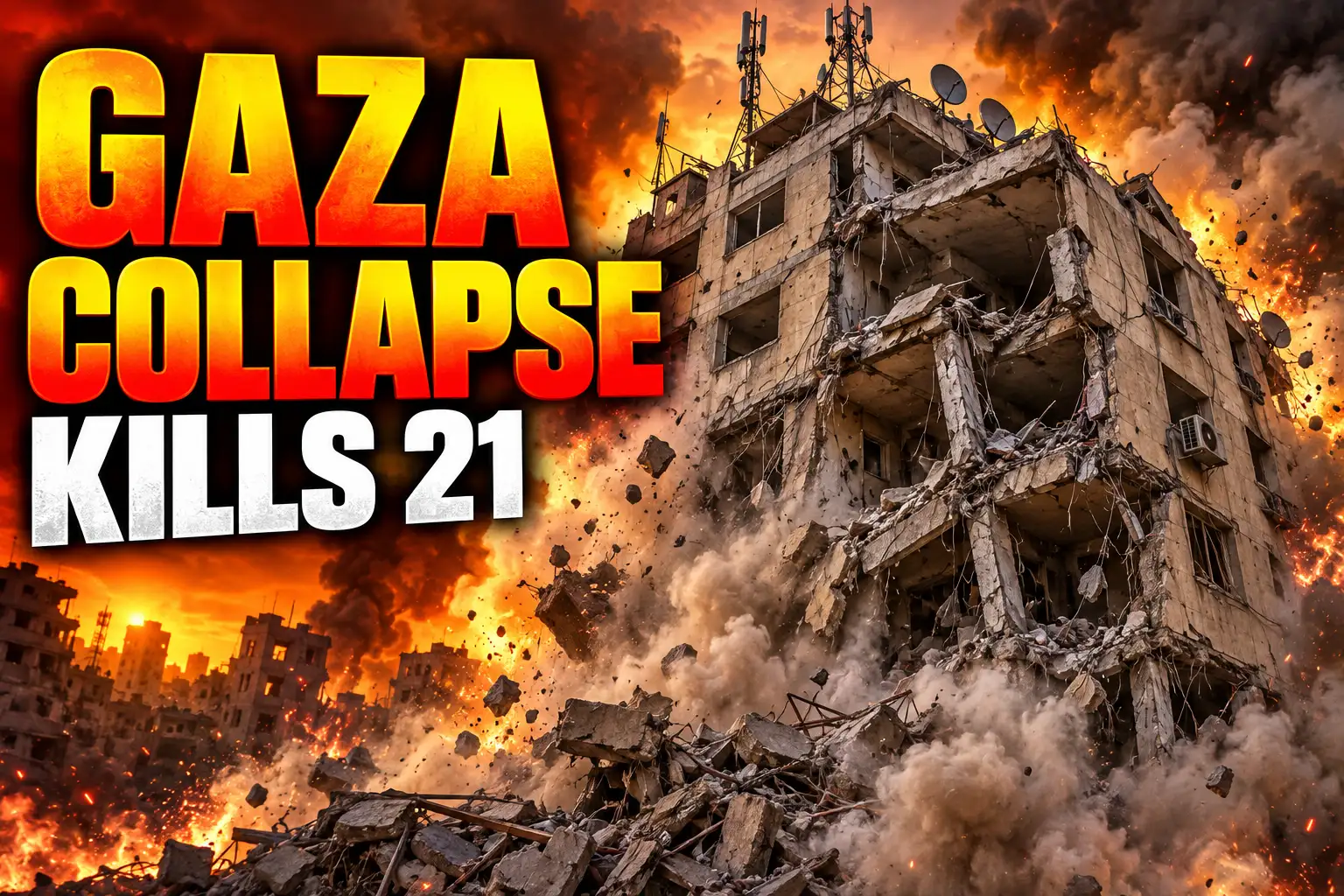
A six-storey block in Gaza City killed 21 people on September 16, 12 of them children, when its war-damaged frame gave way around 2 a.m. Rescuers pulled 45 people from the Al-Saada rubble and then stopped, while families in other cracked buildings stayed put because they had no second address.
Cement, timber and tents that could have moved those families, or held the walls, remain stuck at the crossings. Winter rain is next to load the same slabs.
Twenty-One Died When Al-Saada Came Down
Gaza’s Civil Defence said displaced families had been living in the Al-Saada building even after it was left tilting and cracked. The block came down in the dark, onto homes and tents beside it, and crews first feared about 100 people were under the slab. Egypt sent heavy kit. Until it arrived, teams dug with their hands.
Alessandro Mrakic, who heads the UN Development Programme office in Gaza, said the scene was tragic because the machinery that search work needs was not there. Ramiz Alakbarov, the UN humanitarian coordinator, asked for more rescue gear, engine oil and fuel to keep the kit already inside the Strip running. Mahmoud Basal, a Civil Defence spokesman, said families had no other choice, and that people were living in cracked buildings because neither tents nor homes were on offer.
THE NIGHT AL-SAADA CAME DOWN
- August 26, 2026: Israeli authorities reject a load of timber and emergency shelter kits that had already been approved for entry.
- September 2, 2026: The same cargo is manifested again and rejected a second time.
- September 16, 2026: The six-storey Al-Saada building comes down around 2 a.m. in Gaza City.
- September 17, 2026: Search work ends with 21 people dead, 12 of them children, and 45 pulled out alive.
- September 24, 2026: The Palestinian Ministry of Social Development warns that rain and wind will raise the risk in other damaged blocks.
How the building was weakened is still split. Civil Defence said Al-Saada was hit in 2024 and again in March 2025, and that people had been told not to go back. The Israeli military said it did not strike that building during the war.
HOW THE BUILDING WAS DAMAGED
- Civil Defence: The block was hit in 2024 and in March 2025, and families were warned off it.
- Israeli military: It said it did not strike the building during the war.
That argument does not change the occupancy. Basal said people were in cracked buildings because the other places to sleep were gone. The UN humanitarian office recorded collapses at five shelters in the first week of September, a count that includes standalone homes and units inside larger blocks. Raed al-Dahshan, director of Civil Defence in Gaza City, said crews were then called to four building collapses in 72 hours when the season’s first heavy rains arrived.
Three-Quarters of Gaza’s Housing Stock Is Destroyed or Damaged
The joint Rapid Damage and Needs Assessment released on April 20 by the European Union, the United Nations and the World Bank put Gaza’s recovery needs of $71.4 billion over the next decade, including $26.3 billion in the first 18 months. Physical damage was put at $35.2 billion, with $22.7 billion in economic and social losses. Those two sums are the wreckage and the lost income. The $71.4 billion is the bill to rebuild.
GAZA’S REBUILD BILL
| Item | Figure |
|---|---|
| Rebuild needs over a decade | $71.4 billion |
| First 18 months | $26.3 billion |
| Physical damage | $35.2 billion |
| Economic and social losses | $22.7 billion |
| Housing units destroyed or damaged | 371,888 |
| Share of the housing stock | 76.6 percent |
| Economy contraction | 84 percent |
The same count found 371,888 housing units destroyed or damaged, 76.6 percent of the stock, and said more than 60 percent of people had lost their homes. Around 1.9 million people had been displaced, often more than once, out of about 2.1 million in the Strip. Human development was put back 77 years. UNCTAD, in its September report to the Trade and Development Board, found construction output down 99 percent from 2022, with 92 percent of economic establishments damaged or destroyed and GDP per capita at $212 in 2025.
A later satellite pass tells a parallel story on a different base. UNOSAT, using imagery from June 16, identified 201,290 damaged structures, about 82 percent of all structures in the Strip, a count of buildings rather than housing units. The war has killed more than 73,000 Palestinians. Rebuild work has barely started, nearly a year after the October 9, 2025 ceasefire, because the political track that was supposed to open the crossings has stalled and dual-use rules still sit on cement, steel and heavy kit.
Approved Timber Was Turned Away Twice
Israel bars cement, steel and much of the heavy kit as dual-use goods, saying they could be used to rebuild tunnels. The freeze now reaches the thin stuff that does not pour a column: timber, tarpaulins, framing kits and tents. The UN humanitarian sitrep dated September 4, and the Norwegian Refugee Council’s note on the collapse, record the same cargo being cleared on paper and then blocked at the gate.
WHAT IS STUCK AT THE CROSSING
- Rejected twice: 36,960 pieces of timber turned away on August 26 and again on September 2, with 660 emergency shelter kits in the same load.
- Timber still waiting: 442,000 pieces, 80 percent of the Shelter Cluster’s timber pipeline, sit pending clearance on the Jordan corridor.
- Tents and sheets: 7,540 tents and 141,000 tarpaulins are in that same waiting pile.
- The truck gap: the Shelter Cluster says at least 400 truckloads would be needed to move the urgent lot now sitting outside.
Jan Egeland, secretary general of the Norwegian Refugee Council, which leads the Palestine Shelter Cluster, said announced approvals do not keep anyone dry if the trucks do not roll.
Families in Gaza face an impossible choice between a damaged building that could collapse and a tent that could flood. Israeli authorities recognise the desperate need for shelter, yet repeatedly turn away even the materials they previously approved for delivery. Announced approvals of building materials and shelter kits cannot keep families safe. We need deliveries, not promises. And we need them before winter arrives.
Jan Egeland, Secretary General, Norwegian Refugee Council
COGAT, the Israeli military body that handles civilian goods for Gaza, ran an online survey in September in which more than 80 percent of respondents said they needed new tents, and then said tents and winter kit would be allowed in. Aid teams inside the Strip say remaining stocks are already thin, and that prices will rise as rain gets closer. This will be the fourth winter since October 2023 in which a large share of Gaza sleeps under plastic.
A Tent Pitched Under an Open Roof
Masada Abu Jarad, 60, lives in Gaza City’s Palestine Square in a building whose roof has already partly come down. Broken concrete and twisted bars hang over a room that is open to the sky. Under that gap her family has pitched a tent. The Palestinian Red Crescent and Civil Defence came in mid-September and told them to leave. She has lived in the block for a year after coming back to the north, and she is still not home. The family is from Beit Lahiya, which was emptied early in the war, and they cannot return.
“We have no options,” she said. “I want to leave, but who will give me an alternative?” Even a safer rental is out of reach. “Even if there is a better place, tell me how I can afford to rent it.”
The Shelter Cluster’s June survey, based on 1,951 household interviews in accessible parts of North Gaza, Gaza, Deir al-Balah and Khan Younis, found 1.98 million people, 94 percent of the assessed population, needed shelter or basic household aid. It classified 84 percent of households as facing Critical or Catastrophic living conditions, a measure of sleep, cooking, washing, storage, light and heat, not the same 84 percent as the wartime drop in GDP. Only 1 in 10 households had received shelter or household aid in the month before that survey. Among people already in damaged buildings, 71 percent could not afford repair materials and 49 percent said the materials were not on the local market.
Mohammed Al-Aklouk, the Shelter Cluster’s information management coordinator, rents a damaged house with plastic sheeting for windows. He said that, next to a tent, it still felt like a palace, and that his children called themselves prisoners inside who wanted to breathe. His youngest son wanted somewhere safe to play football.
Why Families Stay in Buildings That Crack at Night
Abdullah Abu Hajar, 40, lives with his wife and five children in the al-Najma building in southern Remal, a different six-storey block from Al-Saada and one that city notices already mark as unsafe. About 17 families, some 50 to 60 people, are in it, he said. At night he stays up and listens for concrete shifting, stones moving, or a creak he cannot place.
I stay awake all night, keeping watch. I can’t close my eyes. I keep just listening to sounds around me.
Abdullah Abu Hajar, resident, al-Najma building, Gaza City
He was displaced from Beit Hanoon and moved again and again until al-Najma. After September 16 he barely slept. “I’m already on edge,” he said. “But I don’t know where I can go.” A relative has been going back and forth between south and north looking for ground to pitch a tent. Abdullah told him to come and stay. The relative hesitated because of the building, and still had nowhere else.
Islam Hassanein, 36, a mother of five, has spent nearly a year in a single room on the third floor of al-Najma. She found it full of rubble, cleaned it, and stayed. The plumbing does not work, so the family uses a bathroom outside. “We keep looking, but we can’t find anywhere,” she said. A column fell and they were taken out for a time. “Every day, you hear the cracking.” She said she would leave in the morning if someone offered a safe place and a tent. “But where is this place? And where is the tent?”
Bisan Owda, a Palestinian journalist, said life in the city now runs on surprise, the surprise of having survived and the surprise of how a person will die. The louder constraint is duller than that. Land that might hold a safer camp sits beyond the Yellow Line, off limits to most Palestinians, so people pack into the buildings that still have a floor.
Rain Will Load the Same Walls Next
Mrakic put the number of buildings at imminent risk of collapse at 400 and said those buildings will come down, especially with winter, and that crews are running against time. Gaza Civil Defence and the Ministry of Social Development use a wider net: about 2,000 buildings and housing units at risk, with about 20,000 people still inside them. Gaza authorities also announced a plan to empty 255 buildings judged most at risk. Husni Muhanna, a Gaza City municipality spokesman, called the damaged blocks a real danger as the weather turns.
THE WINTER LOAD
- Imminent risk: UNDP’s Gaza office estimates 400 buildings are close to collapse.
- Wider Civil Defence count: about 2,000 buildings and units at risk, with about 20,000 people still living in them.
- Last June’s flood share: 71 percent of surveyed households reported flooding, a preview of what rain does to torn roofs and open walls.
- Shelter condition: more than half of tents and makeshift shelters in the June round were already in poor or very poor shape.
Islam said last winter was terrifying, that the building flooded through its openings, and that she spent most days in her family’s tent. “Now, I am very afraid of this winter, and I don’t know what we are going to do.” Her children are afraid. “If there is an alternative, I will leave. We leave it to God.”
The alternative she asked for is sitting in a queue of tarpaulins, tents and timber on the other side of the gate. Until those trucks enter, the night watch in al-Najma goes on, and the next hard rain will test the same cracked columns that failed at Al-Saada.

Hurricane Nolo Hits a Big Island Still Digging Out

Gaza Families Remain in Buildings Already Cleared to Fall

Sony Polls Publishers Who Cannot Press PlayStation Discs Elsewhere

UN Settlement List Hits 214 as Investors Take Notice

Southwest Lounges Will Open Behind a New Chase Card

Thameslink Will Pad 60,000 Ironing-Board Seats From 2027

Burger King Rebuilds Chicken Nuggets After Calling Them Rubbery

Royal Caribbean Sends Los Angeles Ships to Singapore and Brisbane

Micron Sells the Memory Shortage as Five-Year Contracts

Twenty Controllers Closed Norwich Airport for a Bank Holiday
-
 NEWS4 weeks ago
Thameslink Will Pad 60,000 Ironing-Board Seats From 2027
-
 BUSINESS4 weeks ago
Burger King Rebuilds Chicken Nuggets After Calling Them Rubbery
-
 NEWS4 weeks ago
Royal Caribbean Sends Los Angeles Ships to Singapore and Brisbane
-
 NEWS4 weeks ago
Twenty Controllers Closed Norwich Airport for a Bank Holiday
-
 NEWS1 month ago
Micron Sells the Memory Shortage as Five-Year Contracts
-

 BUSINESS4 weeks ago
Sweetmore Bakeries Buys Fantasy Baking for Bar Work
-

 BUSINESS1 month ago
U.S. Forces Clear Hormuz Mines, Then Hit Minelayers Again
-

 NEWS4 weeks ago
Frontier Miles Cuts Basic Fares After the Barclays Pact