
BUSINESS
Hormuz Oil Recovers on a Navy Night Shuttle
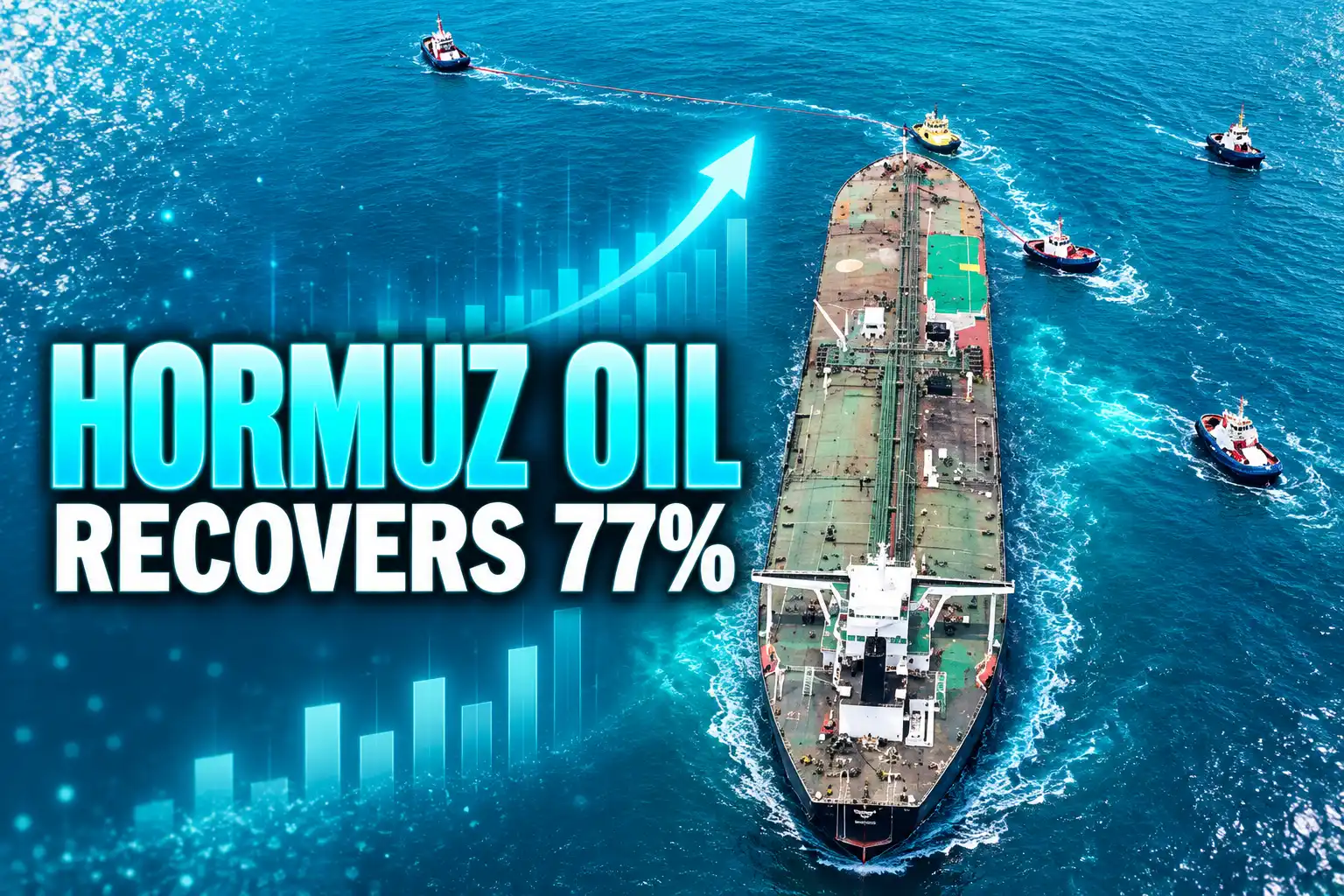
Hormuz oil is back near 77% of its prewar pace, on Navy night shuttles and pipelines, while U.S. diesel still sits above $6 a gallon.

Crude moving through the Strait of Hormuz has climbed back to roughly 77% of its prewar oil pace, on a Navy night run that still prices like a war. The International Energy Agency counted 20 million barrels a day in 2025 through the world’s tightest oil choke point. What is coming back is a southern lane, shuttle tankers, and pipelines, not that old traffic pattern.
Amena Bakr, head of Middle East energy and OPEC+ insights at Kpler, put the latest seven-day average of crude and product flows at roughly 77% of Kpler’s 17.1 million barrel prewar oil baseline. U.S. diesel, after a record week, was still $6.382 a gallon in the week ended September 28.
77% of Prewar Oil Moves on a Wartime Route
Kpler’s briefing dated September 28, using flow data through September 26, put the seven-day average of Hormuz oil clearance at 13.1 million barrels a day against that 17.1 million baseline. Hormuz crude transits, including ship-to-ship work in the Gulf of Oman, averaged 9 million barrels a day through September 22, up from a late-July low of 2.2 million and equal to about 60% of the 2025 average.
Confirmed tanker crossings ran 7 to 17 a day across September 23 to 26, against a Kpler baseline of 50. Daily prints still whipped from 7,172 kbd to 17,578 kbd in that window, which is why a single busy day can look like peacetime on a tracker and the week still does not.
THE HORMUZ LEDGER
| Metric | Prewar baseline | Latest reading |
|---|---|---|
| Hormuz oil, Kpler oil-only | 17.1 million barrels a day | 13.1 million barrels a day, 7-day |
| Confirmed tanker crossings | 50 a day | 7 to 17 a day |
| Hormuz crude including ship-to-ship | 2025 average, Kpler | 9 million barrels a day through Sept. 22 |
| Share of regional crude using Hormuz | 83% | 60% in September, 40% by pipeline |
The IEA’s last full monthly read is older and harsher. Flows averaged only 7.6 million barrels a day in August, 13.1 million below prewar levels, with cumulative export losses via the waterway approaching 2.8 billion barrels, Toril Bosoni, head of the agency’s oil industry and markets division, wrote on September 18. September’s tracker rebound sits on top of that hole, it does not erase it.
Including Yanbu and Fujairah net additions, Kpler estimated Middle East crude exports at just under 80% of pre-conflict levels. That is the number that reads as “almost back.” It mixes the strait with the long way around.
The Navy Runs a Night Lane off Oman
The restored flow is a corridor, not a reopened seaway. U.S. forces have been shepherding tankers through the southern part of the strait on routes close to Oman, while Iran still sits on the northern side. Ships go at night, hug the Omani shore, and often darken AIS transponders, the same trick used by shadow fleets, so Iranian sensors get less to shoot at.
Adm. Brad Cooper, head of U.S. Central Command, said in a September 19 video that American forces had reached a wartime milestone on that lane.
CENTCOM forces have supported more than one billion barrels of crude oil leaving the Gulf. That’s one billion barrels of crude oil out through the Strait of Hormuz in the last couple of months.
Adm. Brad Cooper, commander, U.S. Central Command
Cooper said the command had assisted over 2,000 commercial ship transits with coordinated protection, that primary transit lanes were clear of mines, and that Iran had exported zero barrels under a U.S. blockade. Those are command figures, not Kpler’s, and they describe protection, not a free market in the strait.
The White House rapid-response account put the same push in public view, calling shipments a six-month high.
Oil and gas shipments through Strait of Hormuz hit six-month highhttps://t.co/okgyYMv3Y4
— Rapid Response 47 (@RapidResponse47) September 20, 2026
THE WAR CALENDAR
- February 28, 2026: The U.S. and Israel open the war with Iran, and Hormuz traffic collapses.
- March through May 2026: The IEA puts average Hormuz flows at 2.7 million barrels a day.
- June 2026: U.S. Central Command says a southern pathway is open for commercial ships, and transits jump after a short-lived memorandum.
- Late July 2026: Kpler’s Hormuz crude, including ship-to-ship, bottoms near 2.2 million barrels a day.
- September 10, 2026: A drone strike hits pumping stations on Saudi Arabia’s East-West pipeline, knocking the main bypass.
- September 19, 2026: Cooper says more than one billion barrels have moved under U.S. protection.
Robin Brooks, a senior fellow at the Brookings Institution, wrote that Iran had “lost control of the Strait of Hormuz, where tanker traffic is the highest in many months.” The objection that landed under that claim was the obvious one: if the strait is lost to Tehran, why is crude still dear. Gulf oil is moving under U.S. cover, and Iranian barrels are being held off the water. That is a blockade with a protected exit, which is a different market than 50 tankers a day steaming in the open.
How Shuttle Tankers Move the Oil
Most of the barrels that still cross the strait do not sail from a Gulf berth to Asia in one shot. They change ships. Bakr wrote that the lion’s share of volumes that do cross switched tankers off Fujairah or Sohar, and that most of the so-called shuttles are very large crude carriers making round trips every 16 days or so.
HOW THE WARTIME ROUTE WORKS
- Southern night lane: Laden ships run close to Oman after dark, as far from the Iranian coast as the water allows.
- Dark transits: Gulf operators switch off AIS for stretches of the crossing, then show up again in satellite shots and port logs.
- Shuttle VLCCs: Very large crude carriers loop the strait on about a 16-day round trip instead of making a single long-haul voyage.
- Outside the strait: Oil is handed off to waiting long-haul tankers off Fujairah or Sohar, so the biggest ships never have to sit inside the Gulf.
- Navy cover: U.S. ships, aircraft, and helicopters coordinate the southern run and intercept attacks, which is why the lane exists at all.
Kpler’s own sample of late-September crossings still showed dark transits and fresh attacks in the Mideast Gulf, with three confirmed incidents in the week to September 23. Freight had eased a little. The war-risk premium had not left the routing.
Ras Tanura loadings were running around 6.5 million barrels a day in that briefing, after Aramco swung volumes east when the pipeline to Yanbu was hit. Saudi VLCC loadings in September had risen to 3.5 million barrels a day across 39 vessels calling at eastern ports, with about 90 million barrels of September and October crude placed with Asian buyers after the outage.
Pipelines Now Carry 40% of Gulf Crude
Before the war, 83% of the region’s crude crossed Hormuz, Bakr wrote. In September, 40% of the region’s crude left without crossing the strait, moving through pipelines in Saudi Arabia and the UAE. The waterway is no longer the only door, and that is a large part of why export totals look healthier than tanker counts.
The IEA had already watched that bypass swell. Exports from Saudi Arabia’s Red Sea port of Yanbu and the UAE’s Gulf of Oman port of Fujairah rose from 4.1 million barrels a day in February to a high of 7.8 million in June, then Houthi attacks in the Red Sea cut those flows back to 5.5 million in August. Increased bypass flows had offset more than 500 million barrels, or 2.8 million barrels a day, of Hormuz losses since the conflict began, Bosoni wrote.
Then the East-West pipeline was hit on September 10. Kpler estimated Petroline throughput at about 2.65 million barrels a day while Aramco tested repairs, likely climbing to 3 to 4 million, against a pre-attack rate of roughly 5.5 million. The house base case was the repaired line running at half of pre-attack capacity, which would cut Yanbu exports by 2.5 to 2.7 million barrels a day and shove that volume back toward Hormuz.
Even so, Yanbu was busy again at the end of the month. All seven berths at Yanbu and Muajjiz were occupied on September 27, Bakr wrote, and 12.5 million barrels were loaded onto nine tankers in just 72 hours as of September 29. Within 10 days of the attack that halted Yanbu, all six Juaymah moorings were full, and Saudi crude crossing Hormuz nearly quadrupled on the month.
The UAE’s Habshan-Fujairah line, which already could move about 1.8 million barrels a day around the strait, remains the other fixed bypass. Gulf producers are still talking about new pipelines so they are less exposed the next time the strait is a battlefield. The wartime map is being poured into steel.
Record Diesel Meets a Partial Reopening
The barrels on the water have not shown up as cheap gallons. The U.S. Energy Information Administration’s weekly survey, released September 29, found that on-highway diesel averaged $6.529 a gallon in the week ended September 21, then eased to $6.382 in the week ended September 28. Regular gasoline was $4.465 a gallon in that latest week.
THE PUMP IN LATE SEPTEMBER
- Regular gasoline: $4.465 a gallon in the week ended September 28, including taxes.
- Diesel, record week: $6.529 a gallon in the week ended September 21.
- Diesel, latest week: $6.382 a gallon in the week ended September 28.
- Brent crude: $113.96 a barrel on September 29, on the EIA’s spot series.
Kpler called middle distillates the tightest leg of the barrel and flagged U.S. retail diesel at a fresh record above $6.50 a gallon in the same briefing that showed Hormuz clearance at 13.1 million barrels a day. U.S. distillate stocks were 105.180 million barrels in the week ended September 25, down 14.9% from a year earlier, per the EIA’s weekly petroleum status numbers. Gasoline stocks were 204.362 million barrels, down 7.4%.
Bosoni wrote that global oil inventories had been drawing at 2.8 million barrels a day over six months and were 507 million barrels lower than at the onset of the war, after IEA member countries released more than 300 million barrels of emergency stocks. Global oil demand over those six months averaged 5.8 million barrels a day less than in February, a cumulative cut of more than 1 billion barrels, with China the largest drop. For 2026 as a whole, the IEA expected demand to contract by 2.5 million barrels a day.
That is why a 77% tracker reading can coexist with a $6.382 diesel gallon. The market already burned through a lot of demand and a lot of tanks to survive the spring. What is arriving now is still short of the old 20 million barrels a day, still skewed away from middle distillates, and still expensive to insure.
A $7.5 Million Bill for One Crossing
Hull war-risk rates for Hormuz transits started the conflict around 0.15% to 0.25% of vessel value, spiked as high as 10% during the worst fighting, and in late September sat at roughly 5% for the most exposed voyages, according to figures discussed by International Union of Marine Insurance officials ahead of a Rotterdam gathering. On a $150 million tanker, 5% is a $7.5 million bill for a single transit.
Patrick Tiernan, the Lloyd’s market chief executive, said in September that cover would stay available even as owners pulled back, and that maritime war-risk pricing moves in real time.
In maritime war risk, there’s more real-time, dynamic pricing. You may see spikes and you may see prices drop off pretty quickly.
Patrick Tiernan, Lloyd’s market chief executive
The Joint War Committee has kept the Persian Gulf on its high-risk list. Until that listing narrows, each crossing is still an extra premium, priced ship by ship, flag by flag. QatarEnergy has also kept force majeure on some LNG deliveries, Bakr noted, another sign that “open” in a speech and “open” in a contract are not the same word.
Freight for the shuttle fleet has been rich enough that Gulf tankers have been earning wartime rates for those 16-day loops. The owners who will run dark and take Navy instructions get paid. The liner operators who want a cease-fire first stay out. That split is why 7 to 17 confirmed tanker crossings can move 13.1 million barrels a day and still look nothing like the old 50-ship procession.
Why Crude Stays Dear After the Rebound
Javier Blas, the energy columnist, put the political scoreboard and the price in the same frame on September 30: President Donald Trump has the advantage in the battle over the strait, and the oil market still behaves as if Iran’s next move is a military escalation. Satellite shots the same day showed strong loadings inside the Gulf, with Saudi Arabia loading six tankers at Ras Tanura and Juaymah and Iraq loading six more. The docks are busy. The barrel is still priced as if the docks can go quiet again.
Bakr’s warning sits on the infrastructure that is doing the bypass work, not only on the waterway.
Without a diplomatic and political resolution, the threat to energy infrastructure will remain high.
Amena Bakr, head of Middle East energy and OPEC+ insights at Kpler
The East-West line was already hit. Bypass ports in the Red Sea were already squeezed by Houthi attacks. A protected southern lane can move oil while those other doors stay at risk, which is why a 77% Hormuz reading is not the same product as a peacetime strait. Producers outside the Gulf have added supply, the IEA said, including gains from the United States, Brazil, Kazakhstan, Venezuela, and Nigeria, and that extra crude is part of what kept the shock from running even higher. It is not the same barrel as a free Hormuz, and it does not refill diesel the same way.
Kpler also noted that weekend policy headlines, including talk of a U.S. diesel export ban and another round of U.S.-Iran contacts, were setting the tone more than the flow tape. Physical repair on Petroline was under way. The Red Sea corridor was only slowly coming back, with a queue of at least 13 VLCCs and 3 Aframaxes waiting off Egypt after Sidi Kerir restarted on September 22.
IEA inventories are 507 million barrels lower than they were when the war began on February 28, 2026. U.S. diesel, after a record $6.529 a gallon in the week ended September 21, was still $6.382 in the week ended September 28. The southern lane is moving oil again, and the gallon has not been given back.

Russia Hits the Kyiv Bridges That Keep the Capital Alive

Blast Unwinds Its Lido Book and Closes the Chain

GTA 6 Gets an M Rating and a Purchases Tag

Gentle Monster Trailer Leaves Jella Haase’s Detective Offscreen

Esther Rantzen Dies at 86 After the Bill’s Defeat

Thameslink Will Pad 60,000 Ironing-Board Seats From 2027

Micron Sells the Memory Shortage as Five-Year Contracts

Royal Caribbean Sends Los Angeles Ships to Singapore and Brisbane

Burger King Rebuilds Chicken Nuggets After Calling Them Rubbery

U.S. Forces Clear Hormuz Mines, Then Hit Minelayers Again
-
 NEWS1 month ago
Thameslink Will Pad 60,000 Ironing-Board Seats From 2027
-
 NEWS1 month ago
Micron Sells the Memory Shortage as Five-Year Contracts
-
 NEWS1 month ago
Royal Caribbean Sends Los Angeles Ships to Singapore and Brisbane
-
 BUSINESS1 month ago
Burger King Rebuilds Chicken Nuggets After Calling Them Rubbery
-
 BUSINESS1 month ago
U.S. Forces Clear Hormuz Mines, Then Hit Minelayers Again
-

 BUSINESS1 month ago
Sweetmore Bakeries Buys Fantasy Baking for Bar Work
-

 NEWS1 month ago
Twenty Controllers Closed Norwich Airport for a Bank Holiday
-

 BUSINESS1 month ago
L Catterton Installs a Kraft Heinz Operator at Kettle Cuisine