
NEWS
Appeals Court Turns Westlaw Headnotes Into Licensable AI Fuel
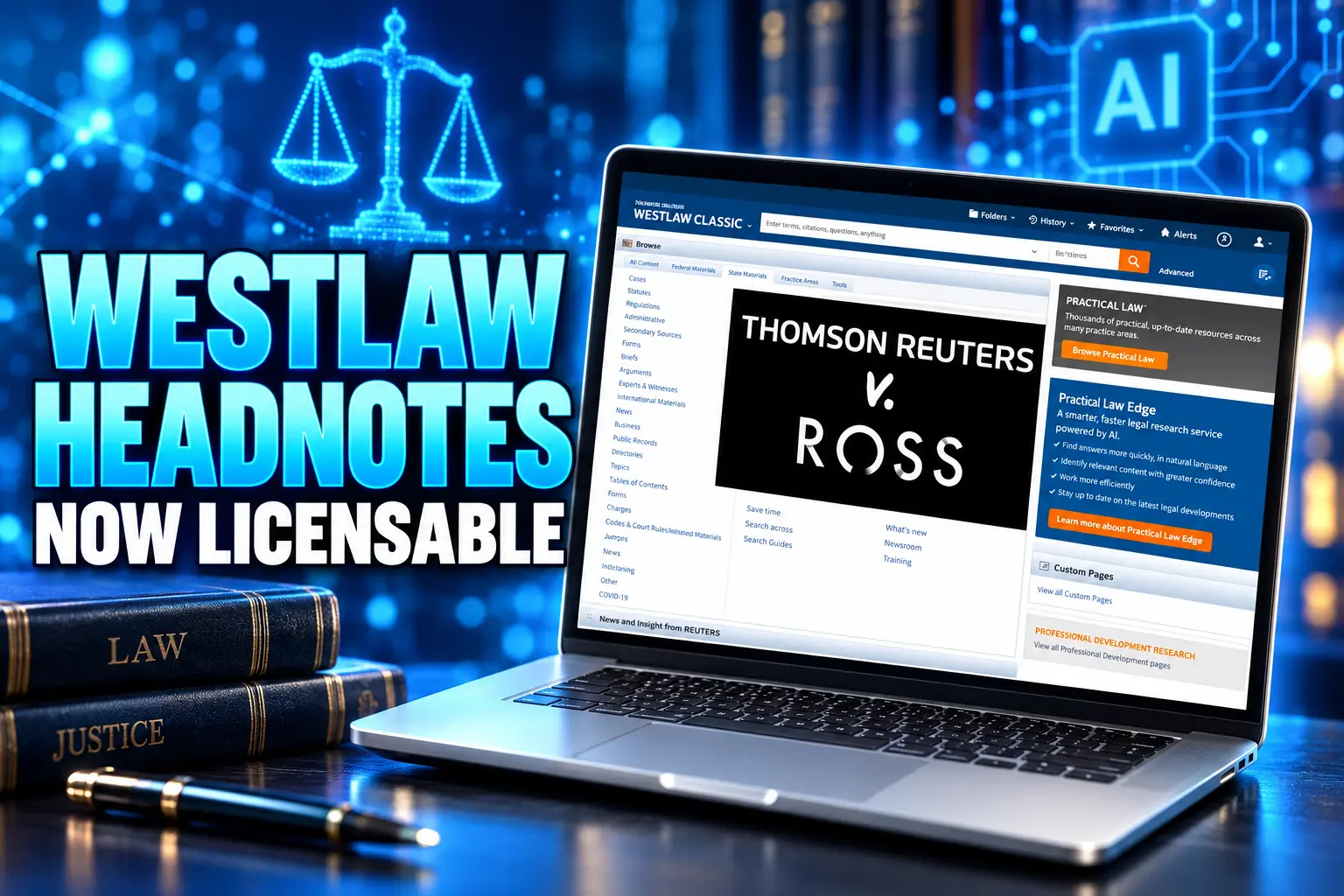
The Third Circuit held Ross’s Westlaw-headnote training was not fair use, and it named a live market for licensing those editor notes as AI data.

The Third Circuit held on September 29, 2026 that Ross Intelligence infringed Thomson Reuters by using Westlaw headnotes to train a rival legal search tool, and that the copying was not fair use. The Third Circuit’s published opinion also treats those editor notes as something a publisher can license as AI training text.
Judge Tamika Montgomery-Reeves, writing for a three-judge panel, called the fight “no more than an ordinary copyright case.” The lasting move sits one layer up from that line. Court opinions stay public. The editorial wrap around them now looks like a product with a price.
Westlaw’s Editors Own the Layer Above Public Opinions
Westlaw sells more than a pile of free cases. Attorney-editors read each opinion, pick the legal points that matter, and attorney editors write a short description of the facts, holding, and reasoning so a researcher can skip the rest.
Those short descriptions are headnotes. They sit above the opinion. They are not the court’s words, and they carry no weight as precedent. They exist so a lawyer can find the right passage fast.
THE EDITORIAL LAYER
- The headnote: A publisher-written summary of one legal point in a case, placed above the opinion text.
- The public layer: The judicial opinion itself, which no one can copyright.
- The editor’s job: Choose the issue, choose the facts and reasoning to keep, and write a note that can stand on its own.
- The Key Number System: Westlaw’s long-running map of topics and numbers that files those notes into research buckets.
Ross told the panel the notes were too close to the opinions to own. Montgomery-Reeves disagreed. “Each headnote had to convey enough factual background and reasoning to stand on its own without reference to the opinion or any other headnote, while accurately reflecting the corresponding opinion passage,” she wrote. “Because these decisions show the requisite minimal ‘creative spark,’ the headnotes are original.”
That is the same low bar the Supreme Court set in Feist for factual compilations. The panel did not decide whether a headnote copied word for word from an opinion would still qualify, because none of the 2,243 notes in the appeal did that.
How Ross Trained Its Search Engine on Headnotes
Ross built a non-generative legal search engine. A lawyer typed a question in plain English and got ranked passages from real opinions, not new prose. The model had to learn which opinion text answered which question. Ross asked Thomson Reuters for a Westlaw license, was refused as a competitor, then hired LegalEase Solutions to build the training set instead.
LegalEase, with subcontractor Morae Global, wrote about 25,000 “Bulk Memos.” Each memo posed a legal question and listed four to six opinion passages, scored from a full answer down to a miss. Memo writers used Westlaw headnotes to frame the questions. The “great” answers were, most often, the same opinion passages Westlaw had already linked to the headnote that became the question.
Ross then turned those memos into machine-readable data. Users of the finished tool never saw a Westlaw headnote. The notes still did the labeling work that taught the model what “responsive” looked like.
Mark Davies, the lawyer for Ross, pressed that point on June 11, 2026. “It’s not poetry,” he told the panel, and said the company used “0.08%” of “28 million headnotes.” Judge Emil J. Bove III asked what was so earth-shattering about the product next to a morning Westlaw login. Dale Cendali, for Thomson Reuters, leaned on the Supreme Court’s Warhol ruling and on the fact that Ross was building a substitute.
THE PATH TO THE APPEAL
- May 6, 2020: Thomson Reuters Enterprise Centre GmbH and West Publishing Corp. sue Ross in Delaware, case 1:20-cv-00613, for copyright infringement and tortious interference.
- December 2020: Ross stops taking new customers as the suit lands.
- January 31, 2021: Ross shuts the research platform, citing the cost of the fight.
- September 25, 2023: Judge Stephanos Bibas, a Third Circuit judge sitting by designation, largely denies summary judgment in Judge Bibas’s 2023 opinion and leaves fair use for a jury.
- February 11, 2025: Bibas reverses course, finds infringement of 2,243 headnotes out of a 2,830-note batch, and rejects fair use.
- June 11, 2026: Judges L. Felipe Restrepo, Montgomery-Reeves, and Bove hear the mid-case appeal, No. 25-2153.
- September 29, 2026: The panel affirms, then unseals the opinion the next day after neither side asked for redactions.
Bibas opened the 2025 ruling with a line about wisdom and error, then compared a headnote to a sculpture cut from a block of marble. The appeals court did not need the metaphor. It treated the notes as original writing used to stand up a competing product.
The Panel Called This an Ordinary Copyright Case
“Under Ross’s framing, this case appears to concern the future of AI legal technology,” Montgomery-Reeves wrote. “But appearances can be deceiving. In truth, this is no more than an ordinary copyright case.”
The undisputed evidence reflects that Thomson Reuters’ materials possess a creative spark, and Ross aspired to be a direct competitor by using them for a highly similar purpose. We therefore hold that Thomson Reuters’ materials are copyrightable and that Ross’ use was not fair.
Judge Tamika Montgomery-Reeves, Third Circuit opinion, September 29, 2026
The tool “would only return text passages from preexisting judicial opinions.” That fact cut both ways. It kept the case out of the generative-AI pile. It also made the purpose easy to name. Both companies, the panel said, used headnotes “to create and optimize a legal-research platform that helps users find responsive legal material.”
Ross called the training step a different use because the notes never appeared on screen. The court called that step intermediate, then looked at the finished product. “Ross took an intermediate step of using the headnotes to train an AI program, which arguably presents a slight degree of difference in use,” Montgomery-Reeves wrote. “But the undisputed evidence demonstrates that Ross used the headnotes to train an AI program for the benefit of its legal-research platform.”
Google v. Oracle and the older software reverse-engineering cases did not help. Those copies were the price of reaching unprotected function. Ross could have trained on the opinions, which are free. “Unlike necessity, ease is not a justification for copying,” the panel wrote.
Four Fair Use Factors and a Market the Court Named
Fair use is a four-factor test. On appeal, three of the four landed with Thomson Reuters. The panel even flipped the one factor Bibas had given Ross.
FAIR USE ON APPEAL
| Factor | What the panel asked | Who it favored |
|---|---|---|
| Purpose and character | Was the use commercial, and did it do Westlaw’s job by another method? | Thomson Reuters. Use was “minimally transformative, at best.” |
| Nature of the work | Are headnotes thin, factual writing? | Ross. The notes sit close to facts. |
| Amount used | Did Ross take more than the purpose required? | Thomson Reuters. Opinions were free, so the notes were not needed. Bibas had counted this for Ross because users never saw the notes. |
| Market harm | Did the use hit Westlaw’s research market or a training-data license market? | Thomson Reuters. Both, the panel said. |
Factor three is the quiet change. Bibas had weighed it for Ross because no headnote showed up in the output. The Third Circuit barely discussed output. It asked whether Ross copied more than it had to. If the opinions were already public, taking the editor’s map was extra.
Factor four is the one other publishers will quote. Ross built a product in Westlaw’s market. The notes also help sell Westlaw subscriptions even though nobody buys a headnote by itself. And the panel said “the market for licensing headnotes as text to train AI is rapidly developing,” a market Ross “usurped.”
A Thomson Reuters spokesperson said the appellate court “agreed that Westlaw’s editorial content, created and maintained by our attorney editors, is protected by copyright and that ROSS’s copying of Thomson Reuters content did not constitute fair use.” The company, the spokesperson added, “believes that strong copyright protections are essential to promoting innovation and safeguarding the intellectual property that powers our Fiduciary-Grade AI solutions.” Ross did not issue a public comment.
Headnotes Become a Product You Can License for Training
That license sentence is the part of the ruling that travels. It does not require a jury to find that lawyers would have dropped Westlaw for Ross. It says a publisher can treat editor notes, labels, and rankings as a separate input that AI shops should buy.
The same pattern sits in a lot of data that looks public until someone has paid for the wrap. News abstracts on top of public filings. Physician-written summaries of papers. Catalog copy around public-domain images. Rankings and topic tags that make a raw corpus searchable. The Third Circuit did not rule on those files. It did say that copying the wrap to build a substitute, even as an unseen training step, can be infringement.
Closed legal models make that problem a buying problem. A firm that cannot see a vendor’s training set cannot tell whether the model learned on a publisher’s notes or on the opinions those notes describe. After this opinion, that gap is a contract risk, not a trivia question.
Ross is a clean defendant for that theory. It priced against Westlaw, aimed at the same users, and, on the panel’s reading, admitted it wanted to replace the incumbent. A general chatbot that also answers a case-law question is a harder fit. The opinion does not pretend otherwise.
What the Ruling Leaves Open for Chatbots
Footnote 7 is the off-ramp. The panel distinguished Bartz v. Anthropic on two grounds: Ross’s tool “cannot generate original expression,” and Ross trained it “for the purpose of creating a commercial substitute for Westlaw.” It never says which ground does the work. That silence is the live fight in the generative cases.
In June 2025, two Northern District of California judges held that training general-purpose language models on books was transformative under the first fair-use factor, on the records in Bartz and Kadrey v. Meta. They split on almost everything else, including how to think about a market for licensing books as training data. The Third Circuit named that kind of market and did not pause to call the theory circular.
WHAT WE KNOW
- This record: A non-generative search tool, trained on editor notes, built to compete with the notes’ owner.
- This holding: Those notes are copyrightable, and that training use was not fair use.
- This circuit: The opinion is precedential inside the Third Circuit.
WHAT IS UNCONFIRMED
- Generative training: The panel did not decide whether training a general model on books, news, or code is fair use.
- Verbatim headnotes: Word-for-word quotes from opinions were not in the 2,243-note set.
- Further review: A rehearing request is due in the usual short window after judgment; a Supreme Court petition is due within 90 days. Ross’s appetite for either step is not on the public record.
The appellate case docket shows a finished mid-case appeal, not a finished lawsuit. Unless a further appeal is taken, the file goes back to Delaware on leftover claims: other headnotes, use of the Key Number System, tortious interference, and damages. Ross has not operated a research platform since January 31, 2021. The template in the opinion is what still works.
Frequently Asked Questions
Are Westlaw Headnotes the Same Thing as Court Opinions?
No. A judicial opinion is a public document and is not protected by copyright. A Westlaw headnote is written by a publisher’s attorney-editors, cannot be cited as precedent, and exists only as a research aid above the opinion. The Third Circuit held that the editor’s choices about which point to cover and how to phrase it supply the “creative spark” copyright law requires, even when the note tracks the case closely.
Did the Third Circuit Ban Training AI on Copyrighted Books or News?
No. The panel limited its facts to a non-generative legal search tool that could not produce original expression and that was trained to substitute for Westlaw. It pointed to the 2025 book-training rulings in Bartz and Kadrey as a different kind of record. Those cases still turn on whether a general model is transformative and on how a court measures market harm, including any market for licensing works as training data.
Why Did the Appeals Court Flip Fair Use Factor Three?
Judge Bibas had counted the amount-used factor for Ross because no headnote appeared in the product’s answers. The Third Circuit asked a different question: whether Ross took more than its purpose required. Because the underlying opinions were free, the panel said copying the headnotes was not necessary at all, so the volume of copying cut against fair use even though users never saw the notes.
What Did This Appeal Leave Undecided in the Delaware Case?
The certified questions covered originality and fair use for the 2,243 headnotes in the summary-judgment batch, not the whole complaint. Claims still queued in Delaware include alleged copying of other headnotes, alleged use of the Key Number System, tortious interference with LegalEase’s Westlaw contract, and damages. Thomson Reuters has also said all about 25,000 Bulk Memos infringe; the appeal did not try that larger set.
Disclaimer: This article is news reporting and analysis of a federal appeals court opinion. It is for information only and is not legal advice, not an opinion about any other lawsuit, and not a prediction of how another court will rule on a different training set. Readers who face a copyright, licensing, or AI-training question should consult a qualified copyright lawyer or intellectual-property counsel about their own facts before they act. The holdings, dates, and party statuses described here reflect the Third Circuit opinion and the public docket as of the sources used for this piece and may change if the case is reheard, reviewed, or tried on the remaining claims.

Russia Hits the Kyiv Bridges That Keep the Capital Alive

Blast Unwinds Its Lido Book and Closes the Chain

GTA 6 Gets an M Rating and a Purchases Tag

Gentle Monster Trailer Leaves Jella Haase’s Detective Offscreen

Esther Rantzen Dies at 86 After the Bill’s Defeat

Thameslink Will Pad 60,000 Ironing-Board Seats From 2027

Micron Sells the Memory Shortage as Five-Year Contracts

Royal Caribbean Sends Los Angeles Ships to Singapore and Brisbane

Burger King Rebuilds Chicken Nuggets After Calling Them Rubbery

U.S. Forces Clear Hormuz Mines, Then Hit Minelayers Again
-
 NEWS1 month ago
Thameslink Will Pad 60,000 Ironing-Board Seats From 2027
-
 NEWS1 month ago
Micron Sells the Memory Shortage as Five-Year Contracts
-
 NEWS1 month ago
Royal Caribbean Sends Los Angeles Ships to Singapore and Brisbane
-
 BUSINESS1 month ago
Burger King Rebuilds Chicken Nuggets After Calling Them Rubbery
-
 BUSINESS1 month ago
U.S. Forces Clear Hormuz Mines, Then Hit Minelayers Again
-

 BUSINESS1 month ago
Sweetmore Bakeries Buys Fantasy Baking for Bar Work
-

 NEWS1 month ago
Twenty Controllers Closed Norwich Airport for a Bank Holiday
-

 BUSINESS1 month ago
L Catterton Installs a Kraft Heinz Operator at Kettle Cuisine