
BUSINESS
Europe’s Youth Strike Aimed First at Rearmament and Pay
Youth groups struck in more than 25 European countries on Friday, aiming first at rearmament and conscription as Italian unions walked out over pay.

A coordinated youth strike hit more than 25 countries on Friday, November 20, over rearmament, conscription and living costs.
The same day, Italy’s largest union called a general strike against Prime Minister Giorgia Meloni’s 2027 budget, putting pay and public services on the street beside the students.
Protesters Filled Squares in 25 Countries on Friday
The Youth Strike Coalition, a platform of more than 50 student and youth groups, said walkouts and rallies ran in about 400 cities. Its slogan was Fight for Our Future, Not Their Wars. Britain, Germany, Spain, Italy, Sweden, Austria and Croatia were among the countries named on the day.
In Italy the student actions rode with a 24-hour general strike called by CGIL, the country’s biggest union confederation. Maurizio Landini, the general secretary, later put turnout at 1.5 million people in more than 100 cities and said worker participation averaged 60 percent. Rome alone, the union said, drew 50,000.
In Milan, marchers set fire to a cardboard tanker and cardboard figures of Israeli Prime Minister Benjamin Netanyahu and U.S. President Donald Trump. In Rome, demonstrators threw objects at the Ministry of Education. In Bologna, some clashed with police.
WHERE FRIDAY LANDED
| Place | Who called it | What they asked | Crowd note |
|---|---|---|---|
| Italy, 100-plus cities | CGIL, Cobas, student unions | Pay, health, schools; less for arms | Union tally 1.5 million |
| Germany, 73 cities | Gen Z regelt and school strikers | Schools, climate, no draft | Organisers 87,000; Berlin police 4,000 |
| London, Parliament Square | Youth Strike groups | Schools, not war budgets | Hundreds in Whitehall |
| Vienna, university steps | Youth-led rally | Education, less for weapons | Several hundred; pepper spray, arrests |
| Croatia, about a dozen cities | Student boycotts | Education, housing, services | Class walkouts |
Socialist Students said pupils at more than 350 schools, colleges and universities in Britain were due to walk out. One cardboard sign in London read, “I wasn’t skipping lectures, I was working to survive.”
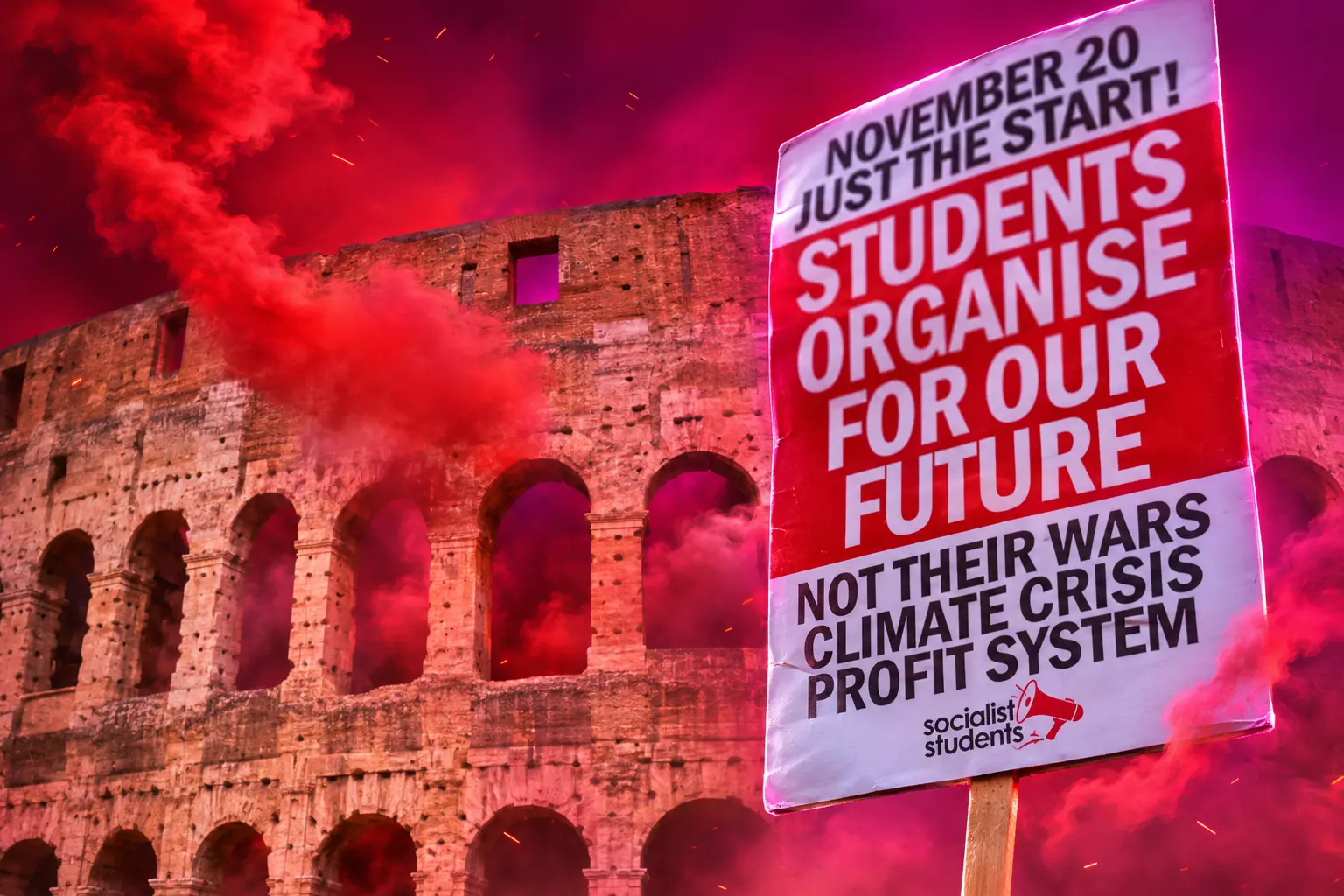
The Coalition Called It a Strike Against Wars
Cost of living, housing and broken classrooms were on the placards. The written programme of the day put weapons first. The coalition launched the November 20 call on August 10 as an antimilitarist student strike, then restated five shared demands in its manifesto.
THE FIVE DEMANDS ON THE CALL
- Arms and austerity: End rearmament and the cuts made in the name of war, and put money into welfare, schools, health and youth instead.
- The draft: Abolish every form of conscription, and keep armies out of classrooms.
- Occupied peoples: Cut ties with states the manifesto calls genocidal, starting with Israel.
- Climate: End fossil extraction and environmental damage.
- Rights: Push back on repression, racism, patriarchy and the far right.
The same text names the European Union’s ReArm Europe plan, which it puts at 800 billion euros, and says NATO should be dissolved. That is a harder line than the German school-funding lists that marched on the same Friday, and it is the line that named the date.
Military spending is reaching historic highs while education, healthcare, housing and public services are sacrificed to finance rearmament.
Youth Strike Coalition, November 20 manifesto
Alessandro Di Miceli of Italy’s Rete della Conoscenza said the generation was claiming “a better and dignified future.” Adam Powell-Davies, national chair of Socialist Students in Britain, said young people would not sit quietly “while our schools, colleges and universities are cut and billions are found for war.”
German 18-Year-Olds Already Face the Questionnaire
Germany was the place where the draft stopped being a theory. The Bundestag’s Military Service Modernisation Act took effect on January 1, 2026. From that date, 18-year-old men must complete an army form; for women it is voluntary. From July 1, 2027, men born in 2008 and after face a mandatory medical evaluation.
The government’s own note on the law says volunteering comes first. If too few people sign up, or if the security situation worsens, the Bundestag can make service “compulsory on demand.” The same page sets the 2035 force at more than 260,000 active soldiers and 200,000 reservists.
THE SERVICE LAW IN FORCE
- The form: Men aged 18 must answer; women may. A missed reply can bring a 250 euro fine.
- The medical: From July 1, 2027, men born in 2008 and after are called for evaluation.
- The switch: Parliament can vote a demand-based draft if recruiting falls short.
- The 2035 target: More than 260,000 on active duty and 200,000 in reserve.
Münster student Phil Werring said the form asked about disease, weight, height and sport, then about a driving licence and languages. After he ignored the first letter, a second warned of the 250 euro fine.
I want to help people, not shoot or harm anyone. I don’t want my future to be interrupted by the military.
Phil Werring, high school student, Münster
Gen Z regelt, whose name is German for “Gen Z sorts it,” listed rallies in 73 cities and asked for money for schools, addiction support and psychotherapy, cheaper living, a no to conscription and climate action. Police counted about 4,000 people at Berlin’s Alexanderplatz. The group put Berlin at 15,000 and the national figure at 87,000, and said rain held numbers down against earlier Fridays.
A separate School Strike Against Conscription track ran in the morning. Organisers put that student turnout at 50,000. In Frankfurt about 400 people marched against call-ups while 2,000 officers were deployed, a hangover from October 31, when youth protests in several cities ended in looting and, in Frankfurt, attacks on emergency crews. Shops in Hamburg, Bremen and Cologne boarded windows before Friday’s marches. In Leipzig, police used a water cannon after fireworks were thrown. In Bremen, officers halted a column after fireworks and paint-filled ornaments.
Akram Selo, a Gen Z regelt co-organiser, told RBB that people who want violence are not at their demonstrations. “Talks won’t make us stop demonstrating,” he said. “So far, we feel that we aren’t being taken seriously at all.” Education Minister Karin Prien said young people have every right to be heard and that she was already talking with the Federal Pupils’ Conference. Yasin Hinz of Fridays for Future said he was prepared for a job market with no prospects, another rent rise and a world 3 degrees warmer, but not hopeful. “Youth used to mean: everything is still possible. Today, for many of us, it means: everything is subject to change.”
Italy’s Pay Fell as Defense Hit a Record
The Italian strike was CGIL’s fifth in a row against a Meloni budget, and the other two big confederations, CISL and UIL, stayed out. The cabinet’s 2027 package is worth 26 billion euros ($30 billion). Meloni has said about 9 billion euros of that simply rolls over measures from the previous year. About 2,000 amendments from her own majority were already on the table. Istat put October inflation at 5.5 percent, up from 4.2 percent in September. Output was flat in the third quarter. About 2.5 million workers are still waiting for contract renewals.
Once prices are stripped out, the average yearly wage per employee in Italy, using OECD pay data adjusted with Eurostat’s price index, fell by almost 5 percent between 2000 and 2025. Over the same span, real pay rose 7 percent in Spain, 11 percent in France and 20 percent in Portugal. Eurostat’s index for food, energy, transport and bills is up 59 to 78 percent since 2000 in those four countries.
REAL FULL-TIME PAY, 2000 TO 2025
| Country | Real wage change | Price pressure since 2000 |
|---|---|---|
| Italy | Almost -5% | Food, energy, transport, bills +59% to +78% |
| Spain | +7% | Same Eurostat range |
| France | +11% | Same Eurostat range |
| Portugal | +20% | Same Eurostat range |
That pay record is why Landini could fill squares with a kitchen-table list. “People have very basic problems: they struggle to make ends meet and therefore need higher wages; they need a healthcare system that works; young people need schools that work,” he said in Rome. The union slogan was “The future is now.”
The budget fight, though, is also an arms fight. The Milex observatory, reading the 2027 tables, said direct military spending will exceed €40 billion next year, up 18 percent from almost 34 billion euros in 2026 and up 50 percent from 26.7 billion euros in 2023. Of that 2027 total, 17.2 billion euros, or 43 percent, is for new weapons. The manovra itself adds about 4.8 billion euros for defense in 2027 and 10.9 billion euros across 2027 to 2029, using the EU’s national escape clause for defence outlays. The health fund is due 3.4 billion euros more, taking it to 146.3 billion euros in 2027.
Elly Schlein, leader of the Democratic Party, joined the Rome march and used a wider figure of her own. She said the budget “puts an extra 14 billion on military spending, but cuts public health, cuts pensions, cuts minimum pensions, cuts on schools, invests nothing in housing, invests nothing on climate.” That 14 billion euros is her reading of extra defence room across 2027 and 2028, not the 4.8 billion euros added in 2027 and not the 40 billion euro level Milex draws from the tables.
How a Créteil Blockade Spread Across Europe
The continental habit started in a suburb of Paris. On September 17, teachers at Lycée Saint-Exupéry in Créteil walked out over staff shortages. Students blocked the gates. Videos moved, and by the end of September about 400 schools had joined. Unions and the old yellow-vest networks followed. The list of grievances widened from crumbling classrooms to rents, food and fuel.
THE AUTUMN WAVE
- September 17, 2026: Teachers strike and students blockade the Créteil lycée; the walkouts spread through the Paris suburbs and then the country.
- October 17, 2026: France’s interior count is 550,000 nationwide and 110,000 in Paris; organisers say 800,000. Riots and looting follow in several French cities. In Italy a separate national day ends in rioting, and Meloni’s government later tightens security rules and puts the army with police at later marches.
- October 24, 2026: The French interior count is 410,000.
- October 31, 2026: France’s interior count is 320,000. Gen Z regelt holds its first big German wave; some cities see looting and attacks on crews.
- November 17, 2026: France’s Interior Ministry counts 146,000 people, 28,000 of them in Paris. The CGT union puts the national total at just over 500,000.
- November 20, 2026: The Youth Strike Coalition’s international day lands with the Italian general strike.
An ACLED tally of events with 100 or more people logged more than 1,700 protests and riots across 31 European countries between September 15 and October 30. France accounted for more than 1,200, then Spain 173, Italy 160, Germany 70 and Portugal 33. France remains the centre of gravity. Friday’s actions outside France were smaller, and in Germany they were smaller than the organisers’ earlier Fridays.
Union Tallies and Ministries Still Do Not Agree
The numbers from Friday will not settle. They never do on a strike day. CGIL’s 1.5 million and 60 percent are the union’s own first cut. Paolo Zangrillo, the public administration minister, said fewer than 12 percent of public employees had joined, on a sample covering half the payroll at 18:45. The Interior Ministry declined an early crowd figure. A separate rail strike was timed from 9 p.m. on Friday until 8 p.m. on Saturday, November 21, after the general strike’s own transport rules had already left trains and flights largely running.
WHAT WE KNOW
- The union claim: CGIL reported 1.5 million people in more than 100 cities and 60 percent worker participation, with 50,000 in Rome.
- The minister’s sample: Zangrillo reported under 12 percent of public staff out, from a 50 percent sample late on Friday afternoon.
- The German split: Berlin police counted 4,000; Gen Z regelt counted 87,000 nationwide and said weather cut the crowd against prior weeks.
WHAT IS UNCONFIRMED
- A single Europe total: The coalition spoke of hundreds of thousands across 25 countries; no interior ministry has issued a combined count.
- The Italian public-sector rate: 60 percent and under 12 percent cannot both describe the same payroll, and no joint figure exists.
- Dialogue with Merz: Prien says she is talking to pupil representatives; no meeting between the chancellor and Gen Z regelt has been confirmed.
Landini, speaking at the Fori Imperiali, called it “a wonderful day of extraordinary participation” and said the demand for change is growing “across Europe and among ordinary people.” He also said that if the budget text does not move, the union will plant a democratic sit-in at parliament. “Even after a great day like today, if there is no response, we will not stop.”
Pistorius Says the Draft Can Wait
Defence Minister Boris Pistorius has said that if recruiting stays on its present path, Germany will not need extra compulsory elements. That is a ministerial forecast, not a repeal of the January law, and it is not a promise the Bundestag will leave the on-demand switch untouched. The form is already in 18-year-olds’ letterboxes. That is the detail that turned a budget argument into a generational one.
Meloni has mocked Friday strikes as a long weekend. Her coalition is still rewriting its own 26 billion euro package ahead of a 2027 election, and it has already answered the October 17 unrest with wider security powers. In Germany, Chancellor Friedrich Merz is the name on the Hamburg chants. In both capitals the official line is that defense has to rise to meet NATO goals, and that schools and hospitals are not being emptied to pay for it. The people in the squares used a shorter formula, money for schools, not for war, and they used it from London to Zagreb on a date chosen in August, before this particular Italian budget was even published.
Selo said assurances, not talks, would be the only thing that slows his network. Landini has already named the next tactic if the manovra does not change. The draft questionnaire has a date of its own in July 2027, when the first 2008 birth cohort is due for medical evaluation, whether Friday’s columns shrink or not.

Netflix Bets on 15-Minute Sitcom Minimum Wage

Quarter-Cow Shares Sell Out as Grocery Beef Stays High

Hunger Games Hits $120 Million Without a Next Film

Disney+ Puts Hulu Live TV in One App This December

Merch Builds a Parallel Closet Beside Luxury Fashion

Thameslink Will Pad 60,000 Ironing-Board Seats From 2027

How Tall Was Adolf Hitler?

U.S. Forces Clear Hormuz Mines, Then Hit Minelayers Again

Micron Sells the Memory Shortage as Five-Year Contracts

Royal Caribbean Sends Los Angeles Ships to Singapore and Brisbane
-
 NEWS3 months ago
Thameslink Will Pad 60,000 Ironing-Board Seats From 2027
-
 HISTORY3 years ago
How Tall Was Adolf Hitler?
-
 BUSINESS3 months ago
U.S. Forces Clear Hormuz Mines, Then Hit Minelayers Again
-
 NEWS3 months ago
Micron Sells the Memory Shortage as Five-Year Contracts
-
 NEWS3 months ago
Royal Caribbean Sends Los Angeles Ships to Singapore and Brisbane
-
 NEWS3 months ago
Twenty Controllers Closed Norwich Airport for a Bank Holiday
-

 BUSINESS3 months ago
Sweetmore Bakeries Buys Fantasy Baking for Bar Work
-

 BUSINESS3 months ago
L Catterton Installs a Kraft Heinz Operator at Kettle Cuisine