
AUTO
GM Pays $220 Million While Drivers Get No Checks
GM will pay 36 attorneys general $220 million for Smart Driver data sales, while insurers keep the files and drivers get no restitution from the deal.

General Motors has agreed to pay $220 million to 36 attorneys general over OnStar Smart Driver data that reached auto insurers. The check goes to state offices, and the drivers whose braking and speeding records were sold are not on the payee list.
Michigan Attorney General Dana Nessel’s office said the settlement does not pay consumers. The brokers and insurers who already bought the files are not defendants in this case.
The $220 Million Goes to State Treasuries
Oregon Attorney General Dan Rayfield, who co-led the case with Washington Attorney General Nick Brown, said GM will pay $220 million to settle allegations that it sold private driving behavior and location data to brokers, who then sold it to insurance companies. For many drivers, insurers used that data in part to set rates. Oregon will receive more than $10.4 million. Washington will receive $12.3 million.
People bought a car, not a tracking device. GM told drivers this program would help them drive more safely and promised it wouldn’t share their data with insurers without permission. Our investigation found GM sold that data anyway, and some drivers paid for it with higher premiums.
Dan Rayfield, Oregon Attorney General, October 29, 2026 statement
The 36 offices are 35 states and the District of Columbia. California is not among them, because it finished its own case in May. Nessel’s office, announcing Michigan’s $7,205,319 share, said consumer restitution is not provided for by the settlement.
That is the split that matters more than the headline number. State consumer-protection accounts get the money. A driver who already paid a higher premium does not get a refund from this caption, and the underwriter who used the score is not writing a check.
WHERE THE $220 MILLION GOES
| Office | Announced share | Role |
|---|---|---|
| Washington | $12.3 million | Co-lead |
| New York | $12,054,341 | Coalition member |
| Illinois | About $10.5 million | Executive committee |
| Oregon | More than $10.4 million | Co-lead |
| Ohio | $8,076,105 | Coalition member |
| North Carolina | $7,657,771 | Coalition member |
| Michigan | $7,205,319 | Coalition member |
| Maryland | $7.33 million | Executive committee |
Those eight shares do not add up to the national total, because the remaining offices in the coalition also take a cut. New York Attorney General Letitia James said GM will also limit the driving data it collects and run in-house and third-party privacy assessments, with training at dealerships so staff cannot enroll buyers in data collection without consent.
A GM spokesperson said, “This agreement addresses Smart Driver, a product we ended in 2024, and reinforces steps we’ve taken to strengthen our privacy practices. Safer, more helpful and personalized experiences are enabled by connected vehicle data, and GM is committed to being clear about what information is used, how it’s protected, and the choices customers have about what they share.”
A Single Sign-Up at the Dealership
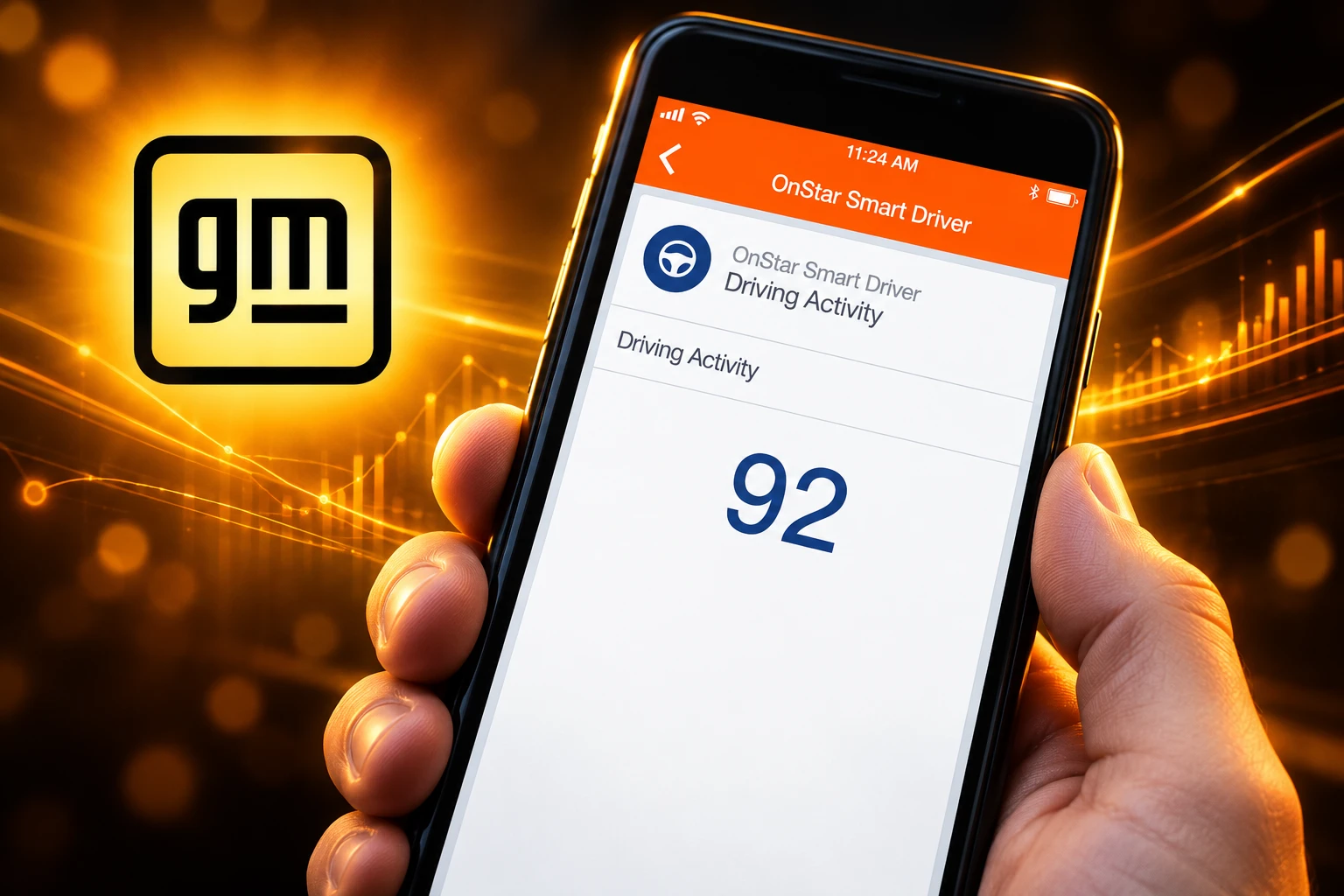
From 2016 to 2024, GM enrolled millions of drivers in Smart Driver, which logged how often a person drove, the start and end times of each trip, hard braking, hard acceleration, and whether the car went over the speed limit. The company pitched the feature as a way to drive more safely and told customers it would not share the data with insurers without express consent.
The coalition said GM sold the information anyway, under contracts that specified it was for insurance products. Brokers resold it to carriers, who could then change a premium based on how someone drove, including for people who had not filed a claim. GM did not tell drivers the data would be used that way.
Most people who ended up in Smart Driver were enrolled at the dealership when they bought the car, through one sign-up that also switched on OnStar, GM’s connected service for directions, security, and roadside help. In many cases, the states said, dealership staff accepted the terms on the customer’s behalf. Between 2020 and 2024, GM paid bonuses based in part on how many buyers staff signed up for connected services, and it ranked stores by those enrollment numbers.
James said more than 700,000 New York drivers were enrolled. Her office described one GM owner who was told by an insurance broker that a 22 percent rise in the car insurance premium came from personal driving information a data broker supplied. The driver obtained a 130-page report and found extensive details on every time the car had been driven over the prior six months.
Utah Attorney General Derek Brown put the same files in plain language. Driving data, he said, tells the story of a commute, errands, the route to a child’s school, and the hour someone gets home at night.
More Than 370,000 Drivers Were Told They Were Out
GM’s own app added a second failure. The OnStar app told more than 370,000 drivers they were not in Smart Driver when they were, and GM was collecting and selling their data the whole time. A driver cannot opt out of a program the screen says is off.
The company later unenrolled those people without telling them about the mistake, the states said, and left their data with the brokers and insurance companies. Quietly ending the feature did not pull the trip history back. Once a broker has a scored file, the automaker’s later unenrollment does not erase the copy sitting in an underwriting system.
The data, the attorneys general wrote, was personal, identifiable, and specific. Insurers could see trip counts, timestamps, hard braking, hard acceleration, and speeding. Location data was in the same bundle. The states said GM discontinued Smart Driver after those practices became public in 2024.
California Took $12.75 Million and Found a $20 Million Haul
On May 8, 2026, California Attorney General Rob Bonta, four county district attorneys, and the California Privacy Protection Agency announced a separate settlement. GM will pay $12.75 million in civil penalties, which Bonta’s office called the largest California Consumer Privacy Act penalty to date and the state’s first data-minimization case.
From 2020 to 2024, the complaint said, GM sold names, contact information, location data, and driving behavior of hundreds of thousands of Californians to Verisk Analytics and LexisNexis Risk Solutions. Between those two firms, the California filing said GM made approximately $20 million nationwide from these data sales. Both brokers bought the data to build driver-rating products for auto insurers.
General Motors sold the data of California drivers without their knowledge or consent and despite numerous statements reassuring drivers that it would not do so.
Rob Bonta, California Attorney General, May 8, 2026 statement
Bonta’s office also said California drivers were not hit with higher premiums from those sales, because state insurance law bars carriers from using that kind of driving data to set rates. The harm the 36-state group describes, higher premiums, sat outside California. GM’s privacy policy, the California complaint said, even stated that it did not sell driving or location data, and that any insurance disclosure would be at the consumer’s express direction.
The California deal requires GM to stop selling driving data to consumer reporting agencies for five years, including to LexisNexis and Verisk, to delete retained driving data within 180 days unless a customer gives clear consent, and to ask those two brokers to delete what they received. It also requires a privacy program and reports to the state.
THE SMART DRIVER ENFORCEMENT CLOCK
- 2016: GM begins enrolling drivers in Smart Driver through OnStar.
- 2020 to 2024: Dealership bonuses and store rankings push connected-service sign-ups, including Smart Driver.
- 2024: GM ends Smart Driver after public reporting on the data sales.
- January 2025: The Federal Trade Commission announces a complaint over geolocation and driving-behavior sales.
- January 14, 2026: The FTC finalizes a 2-0 order with a five-year credit-bureau sharing ban.
- May 8, 2026: California announces $12.75 million in civil penalties.
- October 29, 2026: Thirty-six attorneys general announce the $220 million settlement.
Each of those dates closed a case against GM. None of them names the insurer that used a score, and none of them rolls back a premium that already went out on a renewal notice.
Five Years of No Sharing With Credit Bureaus
The FTC finalized its order on January 14, 2026, against General Motors LLC, General Motors Holdings LLC, and OnStar, LLC. The order imposes a five-year ban on GM disclosing consumers’ geolocation and driver-behavior data to consumer reporting agencies. LexisNexis Risk Solutions sits in that category. The commission called the extra fence appropriate given what it described as an egregious betrayal of trust.
The 36-state judgment stacks more process on top of that federal order. The coalition said its terms are stronger than GM’s earlier resolutions because they mandate internal and external data-protection assessments, plus dealer oversight. Going forward, GM must get affirmative express consent before it collects or shares driving and location data.
WHAT GM MUST CHANGE NOW
- Fresh consent: Get affirmative express consent from consumers before collecting or sharing driving and location data.
- Less collection: Limit the driving data it takes from customers and protect that information inside a comprehensive privacy program.
- Two assessments: Run an in-house privacy assessment and a third-party assessment of the same program.
- Dealer training: Oversee and train dealership staff so customers are not enrolled in data collection without consent.
Those rules change how GM may collect and share from here. They do not reach a file a broker already sold last year, and they do not require an insurer to ignore a score it already stored. Oregon brought its case under the Unlawful Trade Practices Act, which still covered conduct that happened before the Oregon Consumer Privacy Act took effect in July 2024.
What Drivers Can Still Pull From Broker Files
Verisk’s consumer page says it stopped receiving GM driving data on March 18, 2024, and that it no longer provides driving-behavior history reports to insurers. That cutoff matches the year GM says it ended Smart Driver. It does not mean every copy vanished. The 36-state complaint itself says GM left data with brokers and insurers after it quietly unenrolled the group the app had mislabeled.
A driver who wants to know what those firms still hold has to ask them, not GM. LexisNexis Risk Solutions is a consumer reporting agency, so federal credit-reporting law gives a person a way to request a file. Verisk publishes a driving-behavior disclosure form and says it will provide one free report in any 12-month period. Those requests are how a driver sees whether a 130-page trip history still exists under a vehicle identification number.
The settlement’s consent rule is a forward lock on GM. The older product is the scored report that already left the building. Until a class case or a regulator orders those copies deleted, and until a carrier is told it cannot keep using them, the people who paid more for insurance remain the party this caption does not pay.
Rayfield’s office and Brown’s office got a large civil check and a tighter consent regime. The unpaid stakeholder is still the driver whose hard stops became someone else’s pricing input.
Frequently Asked Questions
Do GM Drivers Get Money From the $220 Million Settlement?
No. Nessel’s office said this settlement does not provide consumer restitution. The same announcement said a nationwide private class-action lawsuit seeking money remains pending, which is a separate case and has no ruling in the state releases.
How Can I See If LexisNexis or Verisk Has My Driving File?
LexisNexis Risk Solutions takes identity-verified requests through its consumer disclosure portal and by phone at 1-888-497-0011. Verisk’s Consumer Inquiry Center is at 800-709-8842, and its form can be mailed to P.O. Box 5404, Mt. Laurel, NJ 08054, or sent to FCRA-NPC@verisk.com. Verisk says it will provide one free driving-behavior report in any 12-month period, and its form still lists GM, Honda, and Hyundai as the makers whose driving data it received.
What Extra Steps Does the FTC Order Require of GM?
For the 20-year life of the order, GM must get affirmative express consent before collecting, using, or sharing connected-vehicle data, with limited exceptions such as sending location to emergency responders. It must also give all U.S. consumers a way to request a copy of their data and seek deletion, let drivers disable precise location collection if the vehicle has the hardware, and offer an opt-out from geolocation and driver-behavior collection, with some exceptions.
Why Did California Settle Separately From the 36-State Deal?
California sued under the California Consumer Privacy Act and unfair-competition law, not as a member of the 36-office group. Bonta’s office said the May 8, 2026, case was the state’s eighth CCPA action and its first to enforce data-minimization rules, and it pointed Californians to the Delete Request and Opt-out Platform at privacy.ca.gov/drop, which sends one deletion request to more than 575 registered data brokers.
Disclaimer: This article is news reporting on public attorney general settlements and a Federal Trade Commission order, and it is for information only. It is not legal advice, insurance advice, or a finding that any driver’s premium was raised or should be refunded. Readers who think a carrier used connected-car data in a rate should consult a licensed attorney or their state insurance regulator before they dispute a policy or file a claim. Figures and program statuses come from attorney general and FTC releases dated January 14, 2026, May 8, 2026, and October 29, 2026, and from Verisk’s consumer disclosure pages, and they may change.

Josh Sinn Draws the Heaviest AFL Betting Ban Since 2019

Rolapp Shuts the PGA Door as DeChambeau Heads to Europe

Apple TV Renews Slow Horses Past the Last Novel

Oasis Lifts UK Music to £8.4 Billion as Venues Shrink

Beyoncé Hits 100 Grammy Nominations on a Vault Track

Thameslink Will Pad 60,000 Ironing-Board Seats From 2027

How Tall Was Adolf Hitler?

U.S. Forces Clear Hormuz Mines, Then Hit Minelayers Again

Micron Sells the Memory Shortage as Five-Year Contracts

Royal Caribbean Sends Los Angeles Ships to Singapore and Brisbane
-
 NEWS3 months ago
Thameslink Will Pad 60,000 Ironing-Board Seats From 2027
-
 HISTORY3 years ago
How Tall Was Adolf Hitler?
-
 BUSINESS3 months ago
U.S. Forces Clear Hormuz Mines, Then Hit Minelayers Again
-
 NEWS3 months ago
Micron Sells the Memory Shortage as Five-Year Contracts
-
 NEWS3 months ago
Royal Caribbean Sends Los Angeles Ships to Singapore and Brisbane
-

 BUSINESS3 months ago
Sweetmore Bakeries Buys Fantasy Baking for Bar Work
-
 NEWS3 months ago
Twenty Controllers Closed Norwich Airport for a Bank Holiday
-

 BUSINESS3 months ago
L Catterton Installs a Kraft Heinz Operator at Kettle Cuisine