
NEWS
Alaska Bets Hawaiian Jets Can Open Osaka and Tahiti
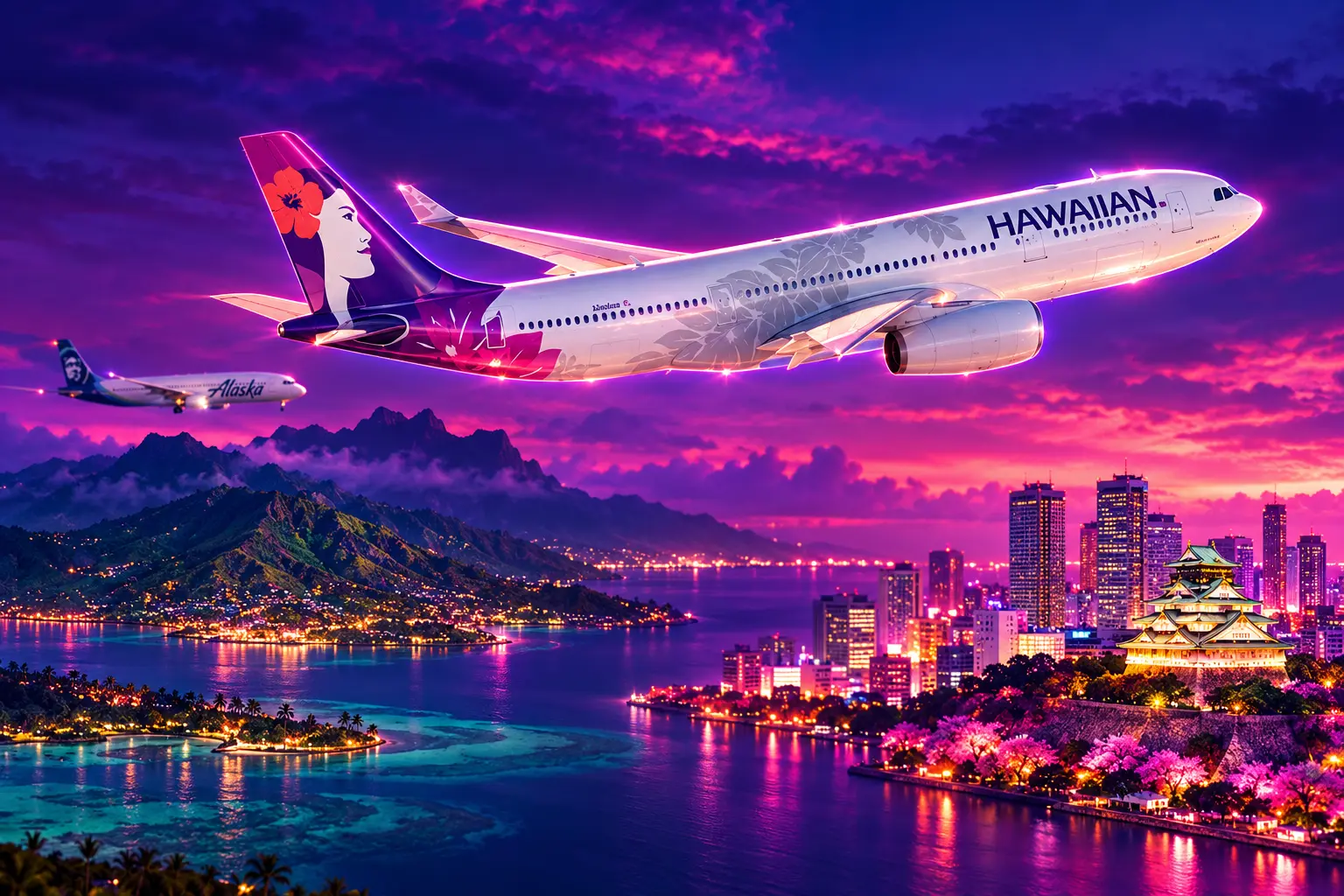
Alaska is putting Hawaiian A330s on Seattle flights to Osaka and Tahiti in 2027, reviving a South Pacific route Air Tahiti Nui just dropped.

Alaska Airlines and Hawaiian Airlines will start nonstop Seattle-Osaka flights on May 14, 2027, four times a week on Hawaiian A330s. Tahiti follows on June 11, three times a week, after Air Tahiti Nui left the same Seattle city pair.
Both routes are year-round and subject to government approval. The wager is the metal already in the fleet, not a new cabin and not a new widebody order.
Hawaiian A330s on Two New Seattle Routes
Alaska Air Group on Oct. 20 named Osaka’s Kansai International Airport and Faa’a International Airport in Papeete as its eighth and ninth long-haul cities from Seattle-Tacoma International Airport. Hawaiian will fly both with Airbus A330-200s, the same type it already uses across the Pacific from Honolulu.
Ben Minicucci, president and CEO of Alaska Air Group, tied the pair to a larger West Coast build rather than to two vacation add-ons.
We are building an airline that connects the Pacific Northwest to more of the world and we know our guests will be excited to have convenient access to Osaka and Papeete from Seattle. We’re just getting started, with more international destinations on the horizon as we grow as the leading global airline on the West Coast.
Ben Minicucci, President and CEO, Alaska Air Group
The airline says it will be the only carrier with nonstop service on either pair when flying starts. Round-trip Main Cabin fares from Seattle start at $999 to Papeete and $1,199 to Osaka, on sale through Oct. 26, while seats last.
THE NEW SEATTLE SCHEDULE
| Route | First flight | Days | Times | Aircraft |
|---|---|---|---|---|
| Seattle to Osaka (KIX) | May 14, 2027 | 4x weekly (Mon, Wed, Fri, Sun) | Leave 12:10 p.m., arrive 4 p.m. next day | A330-200 |
| Osaka to Seattle | May 15, 2027 | 4x weekly (Mon, Tue, Thu, Sat) | Leave 6 p.m., arrive 12:20 p.m. | A330-200 |
| Seattle to Papeete (PPT) | June 11, 2027 | 3x weekly (Wed, Fri, Sat) | Leave 11:55 p.m., arrive 7:20 a.m. next day | A330-200 |
| Papeete to Seattle | June 12, 2027 | 3x weekly (Thu, Sat, Sun) | Leave 5 p.m., arrive 6 a.m. | A330-200 |
Osaka leaves Seattle at lunch and lands in Kansai in the late afternoon, which is a usable arrival for trains toward Kyoto and Kobe. Papeete leaves just before midnight and lands at 7:20 a.m., a time Alaska says can feed same-day hops to Bora Bora and Moorea without a night in Tahiti.
Air Tahiti Nui Dropped Seattle in January
The Osaka flight is a new nonstop in a market with no current Seattle service. The Tahiti flight is a return. Air Tahiti Nui, the French Polynesian flag carrier, suspended its twice-weekly Seattle flights effective Jan. 31, 2026, and told customers to move via Los Angeles, where it still runs 7 to 11 flights a week with partners.
That notice went out on Sept. 24, 2025, from Papeete. The specialist that already knew the island traffic, and already had a Dreamliner on the route, could not make a twice-weekly Seattle tag work. Alaska is now putting a Hawaiian A330 on the same city pair, three days a week, year-round, and selling it through Atmos Rewards as well as cash.
The sharper read is that Seattle-Tahiti is the softer half of this announcement. Osaka has a large metro, a second Japanese gateway next to Alaska’s Tokyo flying, and connecting traffic from the domestic map. Papeete is a long leisure haul with thin midweek demand, which is why the schedule clusters on Wednesday, Friday and Saturday nights.
HOW SEATTLE LOST TAHITI, THEN REBOOKED IT
- Sept. 24, 2025: Air Tahiti Nui tells customers it will end nonstop Papeete-Seattle service.
- Jan. 31, 2026: The twice-weekly flights stop; remaining trips are sent through Los Angeles.
- Sept. 29, 2026: Alaska’s investor day flags more Asia flying from Seattle and a 15-city long-haul target.
- Oct. 20, 2026: Alaska and Hawaiian put Osaka and Papeete on sale for 2027.
- June 11, 2027: Hawaiian A330s are due to restart Seattle-Tahiti, three times a week.
Alaska is betting its own Seattle customers, its domestic feed, and a shared loyalty program can fill a route a foreign partner could not. The cabin will not be new when that test begins.
The Cabin Refresh Lands After Launch
Guests will get Hawaiian crews, lie-flat seats up front, and free Starlink Wi-Fi for Atmos Rewards members, sponsored by T-Mobile. The business cabin on these A330s is still a legacy 2-2-2 layout. The door-equipped product Hawaiian has been selling in renderings is a later job.
Hawaiian’s 24 A330 jets from 2028 are due for a nose-to-tail interior, including 22 Leihoku Suites and 28 Premium Reserve seats. Andrew Harrison, Alaska’s chief commercial officer, has already described that work as a gap-closer, not a 2027 delivery.
Aurora, Leihōkū and Premium Reserve close important product gaps across international, Hawaiʻi and premium transcontinental flying, giving us more ways to compete for high-value demand while preserving the distinct identity of the Alaska Airlines and Hawaiian Airlines brands.
Andrew Harrison, Chief Commercial Officer, Alaska Airlines, 2026 Investor Day
WHAT IS ON THE PLANE IN 2027
- The jet: A Hawaiian-branded Airbus A330-200 on both new Seattle routes.
- Up front now: Lie-flat business seats in a 2-2-2 cabin, the current Hawaiian long-haul product.
- Wi-Fi: Starlink is already on the fleet, free for Atmos Rewards members through a T-Mobile tie-up.
- The 2028 cabin: 22 Leihoku Suites and 28 Premium Reserve seats, plus a full interior refresh, starting the year after these flights launch.
That lag is part of the bet. Alaska is using the widebodies it already owns to take two city pairs, rather than waiting for a suite that will not fly next summer. People who care about a door and a true premium-economy cabin will be flying the old room through the first seasons.
Nine Long-Haul Cities and a 2030 Target
Osaka and Papeete did not arrive as one-off leisure ideas. On Sept. 29, at investor day in Seattle, Alaska said it wants at least 15 long-haul destinations by 2030 from Seattle, with long-haul flying rising from about 8% of capacity to about 15%. Harrison told that audience the next cities would mix Asia and Europe, with a tilt toward Asia.
As of that meeting the company counted seven intercontinental cities in the Seattle plan, including Paris and Athens, which had been unveiled in August. Osaka and Papeete make nine. Six names are still unlisted if the 2030 target holds.
ALASKA AND HAWAIIAN LONG-HAUL FROM SEATTLE
| City | Status | Notes |
|---|---|---|
| Tokyo-Narita | Flying | Year-round; Delta plans its own NRT flight in March 2027 |
| Seoul | Flying | Year-round |
| Rome | Flying | Added in 2026 |
| London | Flying | Added in 2026 |
| Reykjavik | Flying | Added in 2026 |
| Athens | Starts May 12, 2027 | Announced in August |
| Paris | Starts May 25, 2027 | Announced in August |
| Osaka | Starts May 14, 2027 | 4x weekly, year-round, Hawaiian A330-200 |
| Papeete | Starts June 11, 2027 | 3x weekly, year-round, Hawaiian A330-200 |
The Port of Seattle now lists those nine long-haul cities from Sea-Tac together: Athens, London, Osaka, Paris, Papeete, Reykjavik, Rome, Seoul, and Tokyo-Narita. Paris and Athens were the first two 2027 adds. Osaka and Papeete are the third and fourth.
The company also says it has captured roughly two-thirds of a $1 billion incremental profit target due in 2027, a figure that includes $500 million in merger synergies from combining with Hawaiian. That is the cash story behind putting older A330s on new map dots instead of waiting for a cabin program.
What Else Is Growing at Sea-Tac
Sea-Tac already has 61 international nonstop services to 36 international destinations on 29 airlines, and 2027 is another busy year on the board. Alaska’s four new long-haul cities sit next to a Delta Air Lines Tokyo-Narita flight due in March, which puts a second U.S. carrier on a Japan route Alaska started from Seattle.
Wendy Reiter, the airport’s managing director, treated Osaka and Tahiti as inbound tourism as well as outbound leisure, a two-way pitch the Port needs if widebody flying is going to keep rising.
AT SEA-TAC INTO 2027
- The base: 61 international nonstops, 36 international cities, 29 airlines.
- Added in 2026: Six new long-haul services, including Alaska to Rome, London, and Reykjavik, Delta to Rome and Barcelona, and Cathay Pacific to Hong Kong.
- Due in 2027: Five new services on the books, including Alaska and Hawaiian to Athens, Paris, Osaka, and Papeete, plus Delta to Tokyo-Narita in March.
- The overlap: Tokyo is about to have two U.S. carriers from Seattle; Osaka and Papeete, for now, have one.
Most of Alaska’s other Seattle long-haul flying already sits on city pairs a larger rival also serves or is adding. Osaka and Tahiti are the two that, on the current board, it gets to itself. That is why the A330s are going there first. The planes are available, the city pairs are empty, and waiting for 2028 would give someone else a year to file the same routes.
Honolulu’s Direct Flights Stay in Place
Hawaiian will keep flying Osaka and Papeete from Honolulu. The Seattle flights are extras, not a shift of the island hub’s own metal off those cities. Guests will see Hawaiian A330s into Kansai and Faa’a from both gateways, which is a fleet problem as much as a marketing win.
Honolulu-Osaka already runs daily on the same A330 type, alongside Japan Airlines. Honolulu-Papeete stays on the map too. Twenty-four widebodies now have to cover Asia and Oceania from Hawaii, the new Seattle flying, and a cabin program that takes jets off the line from 2028. The combined airline is stretching one pool of A330s across two hubs rather than buying a second long-haul type for Seattle.
Minicucci has said the Hawaiian purchase sped up a plan Alaska already had, and the Oct. 20 routes are that plan in concrete. Seattle gets two more dots. Hawaiian’s jets do the work. The suites come later. Six long-haul names are still missing if 2030 is real.
Schedules remain subject to government approval, and the introductory fares are on sale through Oct. 26.

Kering’s Growing Houses Cannot Outrun a Shrinking Gucci

Studio Staff and Bitcoin Buyers Built the Eminem Leak Case

A Mutated H1N1 Strain Is Hitting Younger Immunity First

Albert Heijn Returns at One-Third as Rivals Take Share

Art Basel Paris Ends After One Public Day

Thameslink Will Pad 60,000 Ironing-Board Seats From 2027

How Tall Was Adolf Hitler Really? Debunking the Myth of his Height

Micron Sells the Memory Shortage as Five-Year Contracts

Royal Caribbean Sends Los Angeles Ships to Singapore and Brisbane

U.S. Forces Clear Hormuz Mines, Then Hit Minelayers Again
-
 NEWS2 months ago
Thameslink Will Pad 60,000 Ironing-Board Seats From 2027
-
 SCIENCE3 years ago
How Tall Was Adolf Hitler Really? Debunking the Myth of his Height
-
 NEWS2 months ago
Micron Sells the Memory Shortage as Five-Year Contracts
-
 NEWS2 months ago
Royal Caribbean Sends Los Angeles Ships to Singapore and Brisbane
-
 BUSINESS2 months ago
U.S. Forces Clear Hormuz Mines, Then Hit Minelayers Again
-

 BUSINESS2 months ago
Sweetmore Bakeries Buys Fantasy Baking for Bar Work
-

 BUSINESS2 months ago
L Catterton Installs a Kraft Heinz Operator at Kettle Cuisine
-

 NEWS2 months ago
CISA’s 100 Water System Hacks Hit One-Operator Plants