
BUSINESS
Lisa Cook Says Waiting on Inflation Now Has a Cost
Lisa Cook says 67 months above 2 percent is teaching firms to charge 3 percent, so the October pause itself now feeds the inflation the Fed wants to break.

Lisa Cook said Friday that U.S. inflation has been above 2 percent for 67 months, and that waiting to hike rates is now a cost of its own.
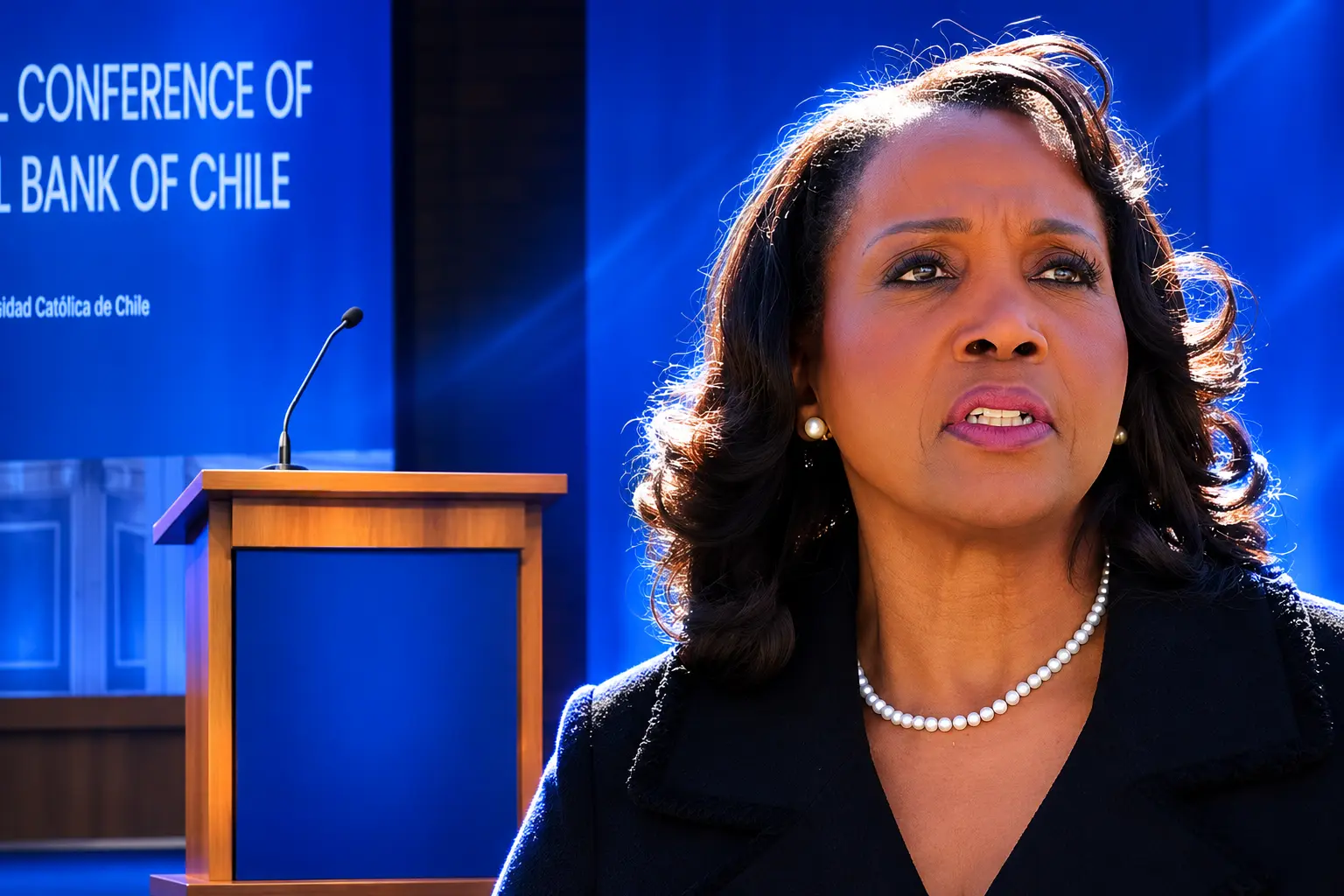
In a Santiago keynote explaining her October dissent, the Federal Reserve governor argued that holding the funds rate at 3.75 percent to 4 percent is itself a policy choice, made with no clear sign that prices are coming down.
The Dissent She Explained in Santiago
Cook spoke at the 29th Annual Conference of the Central Bank of Chile, walking through a vote she had not publicly unpacked since the October 27-28 meeting. The committee kept the target range unchanged on a 10-2 vote. She and Cleveland Fed President Beth M. Hammack wanted another quarter-point increase, after she had backed the September 15-16 rise that took the range to 3.75 percent to 4 percent, the first hike in more than three years.
Her prepared remarks in Santiago put two reasons on the record, and she treated the hold as an action rather than a pause.
COOK’S TWO REASONS FOR THE DISSENT
- Easy conditions: She said financial conditions are too loose while inflation stays stuck, with no clear disinflation in train, and that the current stance does not appear to be curtailing the AI buildout while equity prices still support spending.
- The clock: She said every extra day above target raises the odds that firms and workers lift their inflation assumptions, and that falling behind the curve would force larger increases later.
Holding the rate, in her telling, widens a positive output gap and feeds price pressure across goods and services. She has called inflation unacceptably high, and she said that view has not changed.
In a different environment, the Committee could afford to be patient, but I continue to believe that in this economic climate we do not have that luxury.
Lisa D. Cook, Federal Reserve governor, Santiago, Nov. 20, 2026
She is skeptical that September’s single quarter-point move will change the path of inflation. Data since that meeting, including reports from the week of November 10, have not given her enough evidence that prices are returning to a sustainable path. She did not put a half-point December increase on the table. She did say the number and size of future moves should follow how the economy reacts, and that waiting now risks a harder catch-up later that would stress the financial system and households.
How High Inflation Is After 67 Months
Cook started with the price-stability side of the dual mandate because, she said, that is her focus in this economy. Using last week’s inflation reports, she estimated that the 12-month change in the personal consumption expenditures price index was 3.8 percent in October, with core prices, which leave out food and energy, at 3.2 percent.
Those October estimates sit above the staff figures the committee had in the room in late October. Staff, working from CPI and producer-price data then in hand, put 12-month PCE inflation at 3.6 percent in September and core PCE at 3.1 percent, both higher than a year earlier. They blamed earlier tariff increases, energy, and upward pressure on consumer goods tied to the AI buildout.
The consumer-price print that arrived after the hold was not gentler. The Bureau of Labor Statistics said consumer prices rose 0.4 percent in October, after 0.6 percent in September. Core CPI rose 0.3 percent for a third straight month. Shelter rose 0.3 percent and accounted for over 30 percent of the monthly all-items increase. Food rose 0.5 percent. Energy rose 0.7 percent after a 5.2 percent jump in September.
BLS did not publish 12-month percent changes for most October series. It did not collect survey data for October 2025 because of a lapse in appropriations, so it had no year-ago indexes to compare. Cook’s 3.8 percent PCE figure is her estimate from the available monthly data, not a BLS annual rate.
INFLATION READINGS THE FED IS LOOKING AT
| Gauge | Period | Reading |
|---|---|---|
| Cook PCE estimate | 12 months to October | 3.8% |
| Cook core PCE estimate | 12 months to October | 3.2% |
| Fed staff PCE | 12 months to September | 3.6% |
| Fed staff core PCE | 12 months to September | 3.1% |
| CPI-U, seasonally adjusted | October | +0.4% |
| Core CPI | October (third month at this pace) | +0.3% |
She said annual inflation has been steadily above 3 percent for much of this year, and that the latest release showed prices rising in a broad range of categories, including airfare, appliances, furniture, hotels, and restaurants. Energy still matters. Core at 3.2 percent is her evidence that the pressure is no longer just oil and tariffs.
Firms Are Starting to Treat 3 Percent as Normal
Two days before Cook spoke, Governor Christopher Waller, who had voted to hold in October, described the same problem in plainer shop-floor terms. He said businesses are beginning to put through 3 percent increases because they think customers will take them, and that this is when getting inflation down gets harder.
You might need to shock people to say, wait a minute, 3% is not the number you should be thinking about going forward. That’s the kind of psychology we need to start breaking. We can’t wait.
Christopher Waller, Federal Reserve governor, Nov. 18, 2026
Waller said inflation is headed in the wrong direction and spreading beyond energy into services. He put a half-point increase on the table for the December 8-9 meeting, which would lift the target range to 4.25 percent to 4.5 percent. The other path he offered was a quarter point plus a clear signal of another hike in January. Chair Kevin Warsh has resisted that kind of forward guidance on the grounds that it ties the committee’s hands.
Waller also said the Fed needs to reverse the three insurance cuts it made in 2025, and that getting back to last summer’s rate may not be enough if that setting was not bringing inflation down. He left the door open to going further. Cook’s Santiago text never used the word shock and never named 50 basis points. The shared claim is narrower: 3 percent is being internalized as a planning number, and patience is part of how that happens.
The October minutes, released the same day Waller spoke, split that worry in two. Participants said medium- and longer-term inflation expectations were still consistent with the 2 percent objective. Some also warned that a long stretch of above-target inflation could raise the risk that high inflation becomes entrenched in household and business expectations. Staff went further, listing as a salient upside risk a staff warning on longer-run expectations that those longer-run views could have become unanchored after five years of elevated inflation. The committee’s description and the staff risk are not the same claim. One is the current read. The other is the failure mode Cook is trying to head off.
Williams Rejects a Jumbo Hike for December
New York Fed President John C. Williams, the FOMC vice chair and a permanent voter, drew the opposite operational conclusion from the same strong economy. Speaking in New York on November 17, he said inflation is not moving in the right direction and that more tightening likely lies ahead, but that the situation does not call for dramatic action. He said what the Fed has been doing over the past few months is working well, and he poured cold water on a half-point move next month.
Williams pointed to a resilient economy, a solid labor market, and growth that is strengthening rather than overheating. He has also said the central bank targets the rate of change in prices, not the price level built up by a war or a pandemic, and that a higher cost of living is a consequence of that choice. St. Louis Fed President Alberto Musalem, arguing for more firming soon, put the gradualist case in one line of his own: small steps now beat a later jolt.
That is the live fight inside the building. Cook says the hold is already the delay that forces a larger move later. Williams says a jumbo step is the larger move, and that it is not required. Waller, having voted for the October hold, is now the one naming 50 basis points. Rate futures have treated a quarter-point December increase as the base case. A couple of participants in October said an increase of more than 25 basis points could warrant consideration at the next meeting if incoming inflation data were unfavorable. Those data, on Cook’s read, were unfavorable.
AI Spending Is the Inflation the Pause Did Not Touch
Cook spent the first half of the Chile speech on forces that do not stop at the U.S. border, then used the AI buildout to explain why she thinks policy is too easy. Companies have announced plans for more than $2 trillion in specific data-center construction projects, she said, and only a fraction of that has been realized. She sees the spending already in output, in chip and equipment prices, in construction wages, and in electricity costs. By some estimates she cited, roughly half of the world’s data-center capacity now under construction is being built outside the United States.
She also said the current stance does not appear to be curtailing that buildout. Equity prices, in her account, keep supporting consumer spending. GDP rose at a 3.4 percent annual pace in the third quarter, and real household spending rose at a 3.8 percent annualized rate last quarter even with higher energy prices.
THE REAL-SIDE BACKDROP SHE CITED
- Unemployment: The jobless rate was 4.1 percent in October and has trended down modestly for nearly a year.
- Hiring: Payrolls climbed by 165,000 in October, after averaging about 50,000 a month over the three months ending in September, a slower window the October meeting had in hand.
- Slack: Job openings were largely unchanged at 7.5 million in September, and the four-week moving average of initial claims was about 195,000.
- Wages: Average hourly earnings rose 3 percent over the 12 months ending in September, a pace staff called consistent with 2 percent inflation even as Cook said wages are not keeping up with the damage from prices.
Almost all participants in October commented on a scenario in which returns on AI investment disappoint. High-yield bonds issued to finance data-center construction had already seen spreads widen in the intermeeting period, after two leading AI firms reported revenue growth below investor expectations. Cook’s urgency about easy money feeding that boom landed as investors were already marking those same shares down. The objection that follows is blunt: oil has cooled from September’s 5.2 percent energy spike, and hiking into a market that is selling the AI trade is the cost of her argument. Her reply is already in the text. She sees little imprint of AI on the aggregate unemployment rate so far, and she is still more focused on prices than on that labor risk.
Cook’s Chile Remarks Land in a White House Fight
She delivered the hawkish case while President Donald Trump continues a campaign to remove her. Trump has sought to fire her since August 2025 over mortgage-application allegations she denies, a bid she has called a pretext for policy disagreement. The Supreme Court in June blocked an earlier removal effort, stressing both the fact and the appearance of Fed independence. On November 17 her lawyer, Abbe David Lowell, said she would not appear before a White House committee of inquiry, calling the process a facade for a predetermined firing and saying she had a duty to decline a proceeding that would undermine the Fed’s status.
The Santiago speech does not mention that fight. The politics still sit on the vote. Cook is the governor arguing that rates are too low, and she is the governor the White House is trying to take off the Board. A vacancy would be one of seven seats. Hammack’s dissent means Cook was not alone in October. The majority that held, including Warsh, Williams, Waller, and Jerome H. Powell, still wrote into the statement that the committee “will deliver price stability.”
The December Meeting Already Has Its Script
Almost all participants in October judged that, under their baseline outlooks, further increases would likely be appropriate to bring inflation back to 2 percent in a timely way. Many who backed the hold wanted more information on AI demand, financing conditions, and how the September hike was feeding through. A few called the hold a close call. Staff’s own forecast still has inflation stepping down sharply next year as energy decelerates and reaching about 2 percent in 2028. Cook’s point is that the forecast is not a policy.
THE PATH TO THE DECEMBER MEETING
- September 15-16, 2026: The committee raises the funds rate by a quarter point to 3.75 percent to 4 percent. Cook supports the move.
- October 27-28, 2026: The committee holds, 10-2. Cook and Hammack prefer another quarter point. A couple of participants say a larger increase could be considered in December if inflation data are unfavorable.
- November 10, 2026: CPI rises 0.4 percent, core 0.3 percent. BLS publishes no official 12-month rate for most series.
- November 17-18, 2026: Williams rules out dramatic action. Minutes land. Waller floats a 50-basis-point shock or a quarter point plus a January signal.
- November 20, 2026: Cook, in Santiago, says the hold was a decision she rejected and that patience is a luxury the committee does not have.
- December 8-9, 2026: The next FOMC meeting. The following morning, December 10, BLS is scheduled to publish November CPI.
WHERE THE THREE CAMPS STAND
| Official | October vote | December lean | Core claim |
|---|---|---|---|
| Lisa Cook | Hike 25 bp | More hikes; size left to the data | Waiting teaches 3 percent |
| Christopher Waller | Hold | 50 bp, or 25 bp plus a January signal | Shock the 3 percent psychology |
| John Williams | Hold | Further hikes, not a jumbo step | Gradual firming is working |
Cook closed in Chile on the dual mandate, saying the promise of the new technology will be best supported if the Fed restores the stable prices that growth depends on. The committee meets December 8 and 9. The next CPI report is due December 10, the morning after they vote.
Disclaimer: This article is news reporting and analysis of Federal Reserve communications and inflation data, and it is for information only. It is not investment advice, a recommendation to buy or sell any security or derivative, or a forecast you should use to set loan, mortgage, or savings decisions. Readers who may act on rate-path or inflation outcomes should consult a qualified financial adviser or investment professional who can weigh their own facts. Figures, votes, and policy leanings reflect the cited speeches, minutes, and statistical releases as of the dates named in the piece and can change at the next meeting or data print.

Netflix Bets on 15-Minute Sitcom Minimum Wage

Quarter-Cow Shares Sell Out as Grocery Beef Stays High

Hunger Games Hits $120 Million Without a Next Film

Disney+ Puts Hulu Live TV in One App This December

Merch Builds a Parallel Closet Beside Luxury Fashion

Thameslink Will Pad 60,000 Ironing-Board Seats From 2027

How Tall Was Adolf Hitler?

U.S. Forces Clear Hormuz Mines, Then Hit Minelayers Again

Micron Sells the Memory Shortage as Five-Year Contracts

Royal Caribbean Sends Los Angeles Ships to Singapore and Brisbane
-
 NEWS3 months ago
Thameslink Will Pad 60,000 Ironing-Board Seats From 2027
-
 HISTORY3 years ago
How Tall Was Adolf Hitler?
-
 BUSINESS3 months ago
U.S. Forces Clear Hormuz Mines, Then Hit Minelayers Again
-
 NEWS3 months ago
Micron Sells the Memory Shortage as Five-Year Contracts
-
 NEWS3 months ago
Royal Caribbean Sends Los Angeles Ships to Singapore and Brisbane
-

 NEWS3 months ago
Twenty Controllers Closed Norwich Airport for a Bank Holiday
-

 BUSINESS3 months ago
Sweetmore Bakeries Buys Fantasy Baking for Bar Work
-

 BUSINESS3 months ago
L Catterton Installs a Kraft Heinz Operator at Kettle Cuisine