
NEWS
Japan’s MMX Probe Leaves for Phobos, Skipping Mars
Japan’s MMX probe left Tanegashima for Phobos, skipping Mars, as NASA’s sample cache sits unfunded and China targets the same 2031 window.

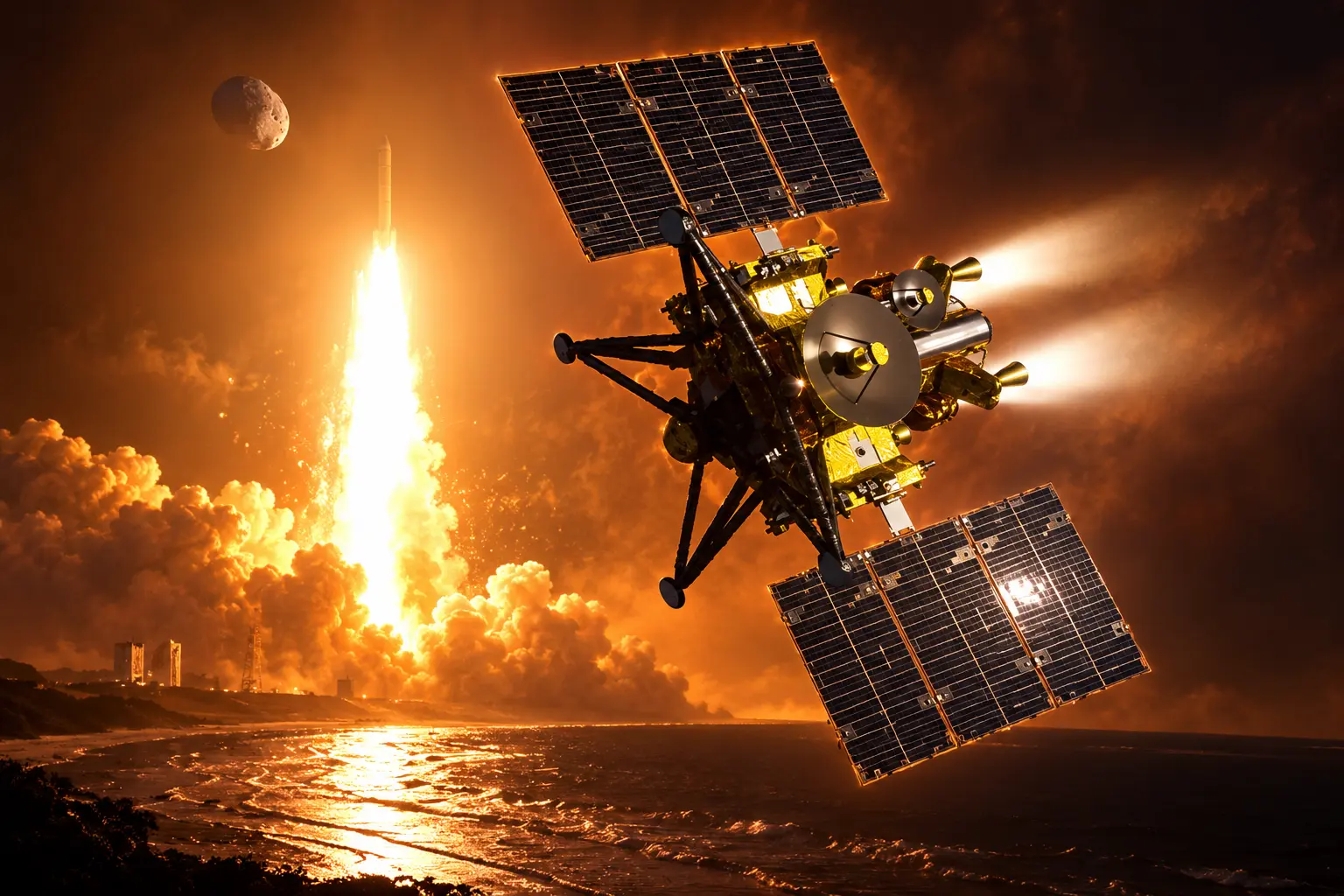
Japan’s H3 rocket sent the MMX probe toward Phobos at 04:41:03 Japan time on October 20, 2026, opening the first attempt to return rocks from a Martian moon. JAXA confirmed MMX separated after 71 minutes 13 seconds and that the craft was on its planned path.
The flight does not go to Mars. It goes to the larger of the two small moons, a $578 million round trip aimed at Earth in 2031, while rock cores already sealed by NASA’s Perseverance rover still have no funded ride home.
H3 Flight 10 Put MMX on Course for Phobos
Flight No. 10 left the Yoshinobu pad at Tanegashima Space Center in the dark. An hour later the control room saw the spacecraft come off the upper stage, the moment that actually starts the cruise. The second-stage second burn is the injection that sets the Mars transfer; when that call ran late on the livestream, the room waited, then the numbers came back clean.
THE H3 F10 LAUNCH
- Liftoff: 04:41:03 Japan time on October 20, 2026, from Tanegashima.
- Separation: About 71 minutes and 13 seconds after leaving the pad.
- Mass: About 4,200 kilograms including fuel, in three modules.
- Size: 5.3 metres high, 9.0 metres long, 4.5 metres wide with the arrays out.
H3 is now at 80 percent after 10 flights, with losses on March 7, 2023, and December 22, 2025. That is still short of the 95 percent commercial buyers treat as the line, and it is the rocket Japan is using for a five-year deep-space run. Makoto Arita, the H3 project manager, called the tenth flight the step where the vehicle has to look grown-up to customers.
◤H3ロケット10号機 打上げ🚀◢#MMX を搭載した #H3ロケット10号機 を、本日4時41分03秒に種子島宇宙センターから打ち上げました🚀
あたたかいご声援、誠にありがとうございました✨
がんばれMMX!🛰#H3F10#MMXLIFTOFF 10月20日 04:41:03(日本時間)#GOODLUCKMMX #フォボ旅 #MMX pic.twitter.com/xJ9HI9Gq4m— JAXA種子島宇宙センター (@tnsc_JAXA) October 19, 2026
Yasuhiro Kawakatsu, MMX project manager at JAXA’s Institute of Space and Astronautical Science, told the post-launch briefing the probe was in a stable condition. NASA astrophysicist Tom Statler, who is on the Japan-led team, said there was “a lot of adrenaline and a lot of excitement and a lot of wow.” Five agencies share the work: JAXA, NASA, France’s CNES, Germany’s DLR, and ESA.
Stranded Cores at Jezero Crater
Perseverance has been sealing Mars rock since 2021. Congress ended money for the existing Mars Sample Return program in January 2026, after a 2023 independent review put the campaign near $11 billion with a return that had slipped toward 2040. Lawmakers left $110 million in a Mars Future Missions line for landing and sensing work, not a pickup of the tubes already on the ground.
MMX’s sticker is about 19 times smaller than that review figure. China has not launched either. CNSA’s Tianwen-3 plan still calls for two Long March 5 flights around 2028 and at least 500 grams of Mars back around 2031, a mass fifty times MMX’s floor if both crafts deliver.
THREE SAMPLE BETS, ONE CALENDAR
| Mission | Lead | Target | Sample goal | Earth return |
|---|---|---|---|---|
| MMX | JAXA, with NASA, CNES, DLR, ESA | Phobos | At least 10 g | 2031 |
| Mars Sample Return | NASA with ESA | Jezero crater, Mars | Perseverance cache | Unfunded, January 2026 |
| Tianwen-3 | CNSA | Mars surface | At least 500 g | Around 2031 |
NASA has put nine craft on Mars in half a century, and China landed in 2021. No one has landed on Phobos or Deimos. NASA’s Mars office congratulated JAXA and said Phobos samples would feed later discoveries and possible crewed work. That is the American stake now: instruments and a sampler on someone else’s lander, plus a speech about crews, while the tubes Perseverance already filled wait.
Ten Grams, Two Samplers, and a Shoebox Rover
The mothership carries 13 instruments, including the rover. After about a year of cruise it should reach Mars orbit in August 2027, then spend 2027 to 2030 in a quasi-satellite path around Phobos, a potato 22.5 kilometres (14 miles) across that loops the planet three times a day at about 6,000 kilometres. JAXA plans two soft landings for the four-legged exploration module, then Deimos flybys, with departure in 2030.
ESA’s factsheet gives the grab kit as a corer and a gas-powered sampler, plus a sample-return capsule about 60 centimetres across.
HOW MMX PLANS TO GRAB THE DIRT
- Corer sampler: A robotic arm takes cores from a depth of two centimetres into a canister for the trip home.
- Pneumatic sampler: High-pressure ultra-pure nitrogen, mounted on one of the four landing legs, lifts surface dust in seconds.
- Idefix rover: A 25 kilogram French-German box drops first, can run 100 days, and will weigh as much as 15 grams on Phobos.
Blue Origin said the nitrogen unit is its P-Sampler. That is a US commercial part on a Japanese lander, built to finish while the clock on the surface is still in seconds, not hours.
Liftoff! Congratulations to @JAXA_en, @NASA, and the entire MMX team. Once MMX reaches Phobos, our P-Sampler will collect surface material using high-pressure, ultra-pure nitrogen gas. Mounted on one of the MMX lander’s four legs, the P-Sampler is designed to complete sampling in… pic.twitter.com/oLp5C89RUg
— Blue Origin (@blueorigin) October 19, 2026
CNES and DLR built the 100-day Idefix rover on Phobos, named for the white terrier in the Asterix books. Gravity there is so weak the four-wheeler is expected to bounce before it bites. Markus Grebenstein, DLR’s rover chief, put the European share in one line.
It is a once-in-a-lifetime chance. We are part of the first sample return mission from the Martian system.
Markus Grebenstein, rover chief, German Aerospace Center
France also flies the MIRS near-infrared spectrometer and helps plan the tight orbits. NASA flies MEGANE, a gamma-ray and neutron spectrometer. ESA supplied the deep-space radio set and will lend Estrack dishes. The 10 gram floor is the number the whole stack is built around, not a press-kit flourish.
Why Scientists Want Phobos Dirt
Phobos may be a captured asteroid, or it may be wreckage from a giant strike on early Mars. Either answer is a different solar system. If the moon is impact debris, the canister holds a piece of young Mars without a Mars landing. If it is a captured primitive body, the same grams track water and organics that moved through the inner system. The moons also sit under a rain of material thrown off Mars, so even a captured Phobos can carry ejecta.
WHERE EXPERTS DISAGREE
- Giant impact: A large body hit Mars and left two moons of crust and debris, a story like Earth’s Moon, which would make Phobos a record of a wet early Mars.
- Capture: Mars’s gravity took two asteroids, so the chemistry should look unlike Mars and more like the small bodies Japan has already sampled.
Kiyoshi Kuramoto, MMX principal investigator, has described ancient Mars as a world with a thick air and rivers that ran into oceans, and he wants the moons because they resemble carbonaceous asteroids that can carry air and water. Kawakatsu has said the same samples should also teach engineers how to go to a planetary moon and come back, a round trip no Mars lander has made.
By bringing home samples from Phobos, we hope to explore how the Martian moons were formed, how the Mars sphere evolved, and how the water and organic materials found on the terrestrial planets originated.
Yasuhiro Kawakatsu, MMX project manager, JAXA
Ten grams will not settle every fight about life on Mars. It can tell laboratories which of the two moon stories is true, and whether the dirt includes Mars itself. That is the scientific reason Japan accepted a moon instead of the planet.
The Last Phobos Sample Mission Fell Into the Pacific
Phobos has already killed a sample mission that never left Earth orbit. Russia’s Phobos-Grunt, stacked as a 13.5-tonne craft with a Chinese Yinghuo-1 orbiter riding along, lifted off from Baikonur on November 8, 2011. The burns that should have sent it toward Mars did not fire. Contact faded, and the wreckage came down in the Pacific on January 15, 2012. Investigators pointed to a computer reboot and parts that were not built for flight. The plan had been on the order of 100 to 200 grams of Phobos, far above MMX’s floor, if the engines had lit.
PHOBOS SAMPLE ATTEMPTS
- 1988: The Soviet Phobos 1 and Phobos 2 craft fly toward Mars with landers; ground teams lose both before the moon work is done.
- November 8, 2011: Phobos-Grunt launches from Baikonur and stays in low Earth orbit when its Mars burns fail.
- January 15, 2012: The spacecraft re-enters over the Pacific, ending the last dedicated Phobos sample attempt before MMX.
- October 20, 2026: H3 Flight 10 places MMX on a Mars transfer orbit from Tanegashima.
MMX is lighter, already on the transfer path, and it uses a sampling style Japan has flown on asteroids rather than a one-shot Russian stack. The failure mode that ended Phobos-Grunt was never leaving home. JAXA’s first cut is already behind it.
Hayabusa2 Already Brought Asteroid Dirt Home
Japan has done this kind of return twice. Hayabusa brought Itokawa grains back in 2010. Hayabusa2 dropped a capsule in Australia in December 2020 with 5.4 grams of Ryugu asteroid grains, weighed at 5.424 grams plus or minus 0.217 grams in the Sagamihara clean chambers, well above that mission’s 0.1 gram floor. MMX’s 10 gram target is nearly twice that haul, aimed at the same Australian recovery country, then at the same ISAS lab in Sagamihara.
The return module carries its own engine. In 2031 the 60 centimetre capsule is supposed to come in on a heat shield and a parachute, after which curators open it under clean conditions and share the grains. CNES has said French labs will get a cut at the National Natural History Museum. The method is the one Japan already proved on Ryugu: a small mass, a hard landing zone, and years of microscope work after the headlines fade.
China can still put 500 grams of Mars on a bench in the same year if Tianwen-3 flies in 2028 and the rendezvous in Mars orbit works. NASA can still invent a later pickup for Jezero. Neither of those craft left Earth on October 20, 2026. MMX did, bound for Phobos, with a 10 gram canister and a 2031 date already on the door.

Kering’s Growing Houses Cannot Outrun a Shrinking Gucci

Studio Staff and Bitcoin Buyers Built the Eminem Leak Case

A Mutated H1N1 Strain Is Hitting Younger Immunity First

Albert Heijn Returns at One-Third as Rivals Take Share

Art Basel Paris Ends After One Public Day

Thameslink Will Pad 60,000 Ironing-Board Seats From 2027

How Tall Was Adolf Hitler Really? Debunking the Myth of his Height

Micron Sells the Memory Shortage as Five-Year Contracts

Royal Caribbean Sends Los Angeles Ships to Singapore and Brisbane

U.S. Forces Clear Hormuz Mines, Then Hit Minelayers Again
-
 NEWS2 months ago
Thameslink Will Pad 60,000 Ironing-Board Seats From 2027
-
 SCIENCE3 years ago
How Tall Was Adolf Hitler Really? Debunking the Myth of his Height
-
 NEWS2 months ago
Micron Sells the Memory Shortage as Five-Year Contracts
-
 NEWS2 months ago
Royal Caribbean Sends Los Angeles Ships to Singapore and Brisbane
-
 BUSINESS2 months ago
U.S. Forces Clear Hormuz Mines, Then Hit Minelayers Again
-

 BUSINESS2 months ago
Sweetmore Bakeries Buys Fantasy Baking for Bar Work
-

 BUSINESS2 months ago
L Catterton Installs a Kraft Heinz Operator at Kettle Cuisine
-

 NEWS2 months ago
CISA’s 100 Water System Hacks Hit One-Operator Plants