
NEWS
Congo Fights Bundibugyo Ebola Without a Licensed Vaccine
Congo’s Bundibugyo Ebola outbreak has 11,042 cases and no licensed vaccine, a gap left after two small earlier waves and a Zaire-only shot.

Congo has recorded 11,042 confirmed Bundibugyo Ebola cases and 5,387 deaths, national figures compiled through Nov. 9 show. The outbreak, declared on May 15, has reached eight of the country’s 26 provinces and is now the largest Ebola wave Congo has ever reported.
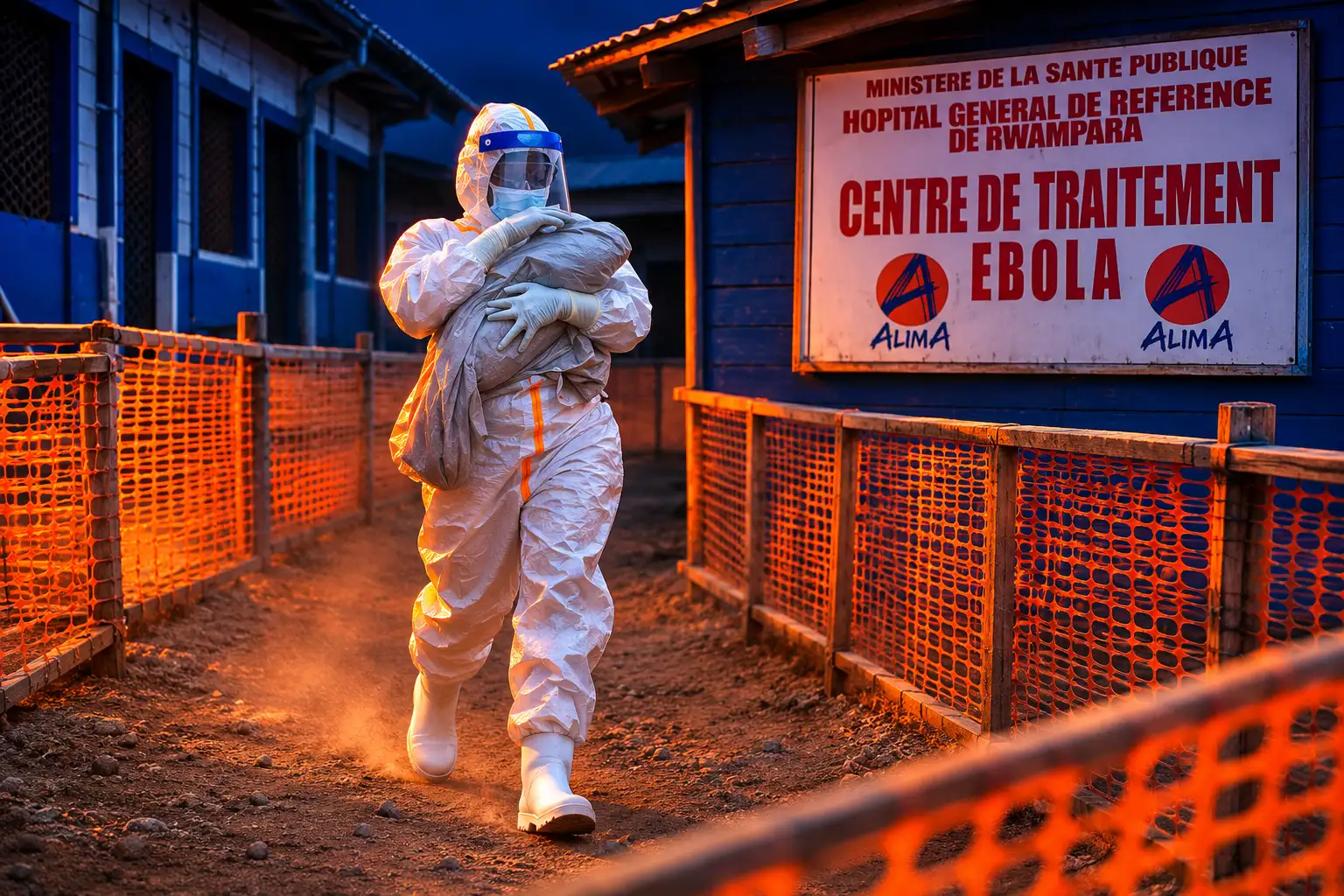
Unlike the 2018 to 2020 Zaire-virus epidemic in the same eastern provinces, this one has no licensed vaccine and no licensed specific drug. Isolation, contact tracing and safe burial are doing the work a shot did last time.
11,042 Confirmed Infections Across Eight Provinces
The European Centre for Disease Prevention and Control, citing Congolese health authorities, put the national total at 11,042 confirmed cases and 5,387 deaths as of Nov. 10, from data through Nov. 9. That is a case fatality ratio of 48.8%. Another 2,990 people have recovered, and 651 patients were in isolation wards.
THE NATIONAL COUNT
- Confirmed cases: 11,042 infections reported across eight provinces.
- Deaths: 5,387, or 48.8% of confirmed patients.
- Recovered: 2,990 people have left care alive.
- In isolation: 651 patients were in treatment centres as of those figures.
This is Congo’s 17th recorded Ebola outbreak. The last one, in Kasai province in 2025, was Zaire virus, the species covered by Ervebo. The present wave started in Ituri. The index patient was a nurse who died in a clinic in Bunia, the provincial capital, after fever, bleeding, vomiting and weakness. Officials say the virus had likely been moving for weeks before the May 15 declaration.
WHO declared a public health emergency of international concern on May 17. Africa CDC declared a continental emergency the next day. Cases have been reported in five countries since then: Congo, Uganda, Kenya, Nigeria and France. Uganda and France have had their outbreaks under control since August.
The 2018 to 2020 Zaire outbreak in North Kivu, Ituri and South Kivu ran about 22 months and recorded 3,470 cases and 2,287 deaths, a 66% fatality ratio. The current count is already more than three times that case total, in 178 days from May 15 through Nov. 9, and the death toll is more than double. The only larger Ebola epidemic on record remains West Africa in 2014 to 2016, with more than 28,000 infections and more than 11,000 deaths.
The Licensed Shot Was Built for a Different Virus
Bundibugyo virus is one of the orthoebolaviruses. It was identified in 2007 in Bundibugyo District in western Uganda, where it caused 149 cases and 37 deaths. A second wave hit Congo’s Orientale Province in 2012: 57 cases and 29 deaths. Across those two waves, 206 people were recorded as cases and 66 died.
Ervebo, a live vesicular stomatitis virus vaccine, was licensed in 2019 for Zaire ebolavirus and later prequalified by WHO. Ring vaccination with that shot was the backbone of the 2018 to 2020 response in eastern Congo. The proteins the shots aim at on Bundibugyo and Zaire viruses share only about 60 to 65 percent of their amino acids, WHO emergency guidance issued on May 28 found, so a Zaire product cannot be assumed to work.
That guidance is blunt. Ervebo is licensed for Zaire disease. There is still no approved vaccines or specific treatments for Bundibugyo virus disease. Evidence of cross-protection is too thin for routine use, and giving the Zaire shot outside a trial could create a false sense of safety if people then become infected. WHO told countries to keep Ervebo inside controlled research and to pour money into Bundibugyo-specific and broader shots instead.
A homologous rVSV vaccine that carried Bundibugyo glycoprotein protected all three vaccinated macaques in a 2013 study WHO later reviewed, with no detectable illness. A 2011 rVSV-EBOV construct, closer to Ervebo, protected three of four macaques against Bundibugyo challenge, against one of four controls. Those animal results sat for years while Zaire products moved through human trials, licensure and stockpiles.
THE BUNDIBUGYO CLOCK
- 2007: First recognised outbreak, in Bundibugyo District, Uganda, with 149 cases and 37 deaths.
- 2012: Second outbreak, in Congo’s Orientale Province, with 57 cases and 29 deaths.
- November 2019: Ervebo is licensed for Zaire ebolavirus, not Bundibugyo.
- May 15, 2026: Congo declares the present outbreak in Ituri.
- May 17, 2026: WHO declares a public health emergency of international concern.
- October 23, 2026: The Tumaini trial enrolls its first participants in Bunia.
- November 4, 2026: WHO experts recommend adding Oxford’s ChAdOx1 and Moderna’s mRNA-1469.
Incubation runs from two to 21 days, and people are not infectious until symptoms start. Early fever, fatigue, muscle pain, headache and sore throat look like malaria and other local illnesses, which is one reason patients still arrive late.
Ituri Province, Center of the Outbreak
Ituri still holds 7,684 of the 11,042 confirmed cases and 3,628 of the deaths, from 28 of its 36 health zones. That is 69.6% of national cases. North Kivu is second, and it has the higher provincial fatality ratio, 55.0%.
CONFIRMED CASES BY PROVINCE
| Province | Confirmed cases | Deaths | Health zones hit |
|---|---|---|---|
| Ituri | 7,684 | 3,628 | 28 of 36 |
| North Kivu | 2,737 | 1,505 | 17 of 34 |
| Haut-Uele | 496 | 215 | 7 of 13 |
| Tshopo | 98 | 32 | 7 of 23 |
| Bas-Uele | 13 | 4 | 4 of 11 |
| North Ubangi | 9 | 1 | 2 of 11 |
| South Kivu | 3 | 1 | 1 of 34 |
| South Ubangi | 2 | 1 | 1 of 16 |
| Total | 11,042 | 5,387 | 67 of 178 |
Over the 21 days to Nov. 3, WHO counted 1,463 new confirmed cases: 710 in Ituri, 640 in North Kivu, 77 in Haut-Uele, 31 in Tshopo and 5 in North Ubangi. Bas-Uele, South Kivu and South Ubangi reported none in that window. North Kivu led the prior week, with 232 cases. Congolese Health Minister Roger Kamba has pointed to North Kivu as the main site of new spread. Beni, Bunia and Mandima logged the most cases and deaths in those 21 days. Yakoma, in North Ubangi, is the newest affected zone, with three confirmed cases.
Schools in Ituri have been pulled into the outbreak. Two head teachers in Bunia said staff have died. Isaac Singoma, one of them, said students and staff are shaken. “Our students and the entire staff have been left traumatized. At this stage, we need psychologists to support us, as the situation is extremely difficult,” Singoma said.
Gunmen Hit Cantine-Aloya Last Week
WHO Director-General Tedros Adhanom Ghebreyesus told member states on Nov. 11 that insecurity is now one of the greatest obstacles to the response. He described an attack on Cantine-Aloya in which 66 civilians were killed, including three health workers, and three health facilities were looted and burned. More than 1,000 contacts were lost to follow-up, and three confirmed cases were unaccounted for.
During an attack on the town of Cantine-Aloya last week, 66 civilians were killed, including three health workers, and three health facilities were looted and burned.
Tedros Adhanom Ghebreyesus, WHO Director-General, member state briefing, Nov. 11, 2026
He listed other incidents that have given the virus time.
ATTACKS TEDROS TIED TO THE RESPONSE
- Tshopo: A nurse was killed and another health worker badly injured about two weeks before the Nov. 11 briefing, while answering an Ebola alert.
- A health zone office: A grenade was found nearby.
- A treatment centre: Gunfire nearby, and a separate arson attempt on a centre.
- Burials: Stones thrown at a vehicle used for safe and dignified burials, plus threats against health workers.
Tedros also said delays in paying frontline workers risk strikes and local tension. Displacement, rough roads and rain add to the delay between an alert and isolation. WHO’s own contact-tracing target is that 95% of known contacts are seen each day. As of Nov. 3 the 14-day average was 86%, with Tshopo at 71% and North Kivu at 82%.
Of 512 deaths reported since Oct. 21 in that WHO update, 335 of 512 happened in communities rather than treatment centres, and 177 in centres. A high share of those community deaths were among young children. People who die at home are more likely to infect family during care and burial.
Why Are Ambulances Running Without Fuel?
Médecins Sans Frontières said on Thursday, Nov. 12, that the outbreak remains out of control and that a troubling disconnect persists between money raised and what reaches patients. Dr. Javid Abdelmoneim, the charity’s international president, said frontline teams are trying to contain the virus with empty hands.
Despite the vast amounts of money provided for the response, many frontline responders are left trying to contain the outbreak with empty hands and empty pockets.
Dr. Javid Abdelmoneim, MSF International President, Nov. 12 statement
The Ebola outbreak was declared in DRC six months ago.
Our teams see a troubling disconnect between the considerable resources mobilised for the response and the resources reaching communities. Without urgent action, we risk playing catch-up for years.https://t.co/jqA2Q0Ht2v
— MSF International (@MSF) November 12, 2026
MSF described gaps between resources and action that its teams keep walking into, nearly six months after the May 15 declaration.
WHAT MSF SAYS IS MISSING ON THE GROUND
- Pay and training: Response staff who are untrained, unpaid, and sometimes on strike.
- Transport: Vehicles and ambulances without fuel.
- Surveillance: Teams that exist on paper but are not found in the field.
- Alerts: Community workers without phones or mobile data to pass on suspected cases.
- Clinics: Health staff without supplies or technical support to handle suspects, including water and chlorine.
In Ituri, only 9% of Ebola patients treated by MSF teams had been identified as contacts by the surveillance system before they arrived. In the Beni health zone in North Kivu, MSF said almost three-quarters of Ebola patients are believed to have caught the virus in health facilities. Neil Ferguson, an epidemiologist at Imperial College London, said teams are probably detecting only about half of infections.
As of early November, MSF was working in five of the eight affected provinces, running eight Ebola treatment centres and three rapid response teams. About 1,500 patients with confirmed infection have been admitted to MSF-supported facilities. The charity has put €64.6 million into its response, almost all from private donations, and about 2,900 people work on it, 90% of them hired locally. Of those 2,900, 29 were infected, most likely in the community, and three died.
What the Tumaini Trial Will Test
The medical gap is now a trial, not a stockpile. On Oct. 23 the Tumaini platform, named for the Swahili word for hope, enrolled its first participants in Bunia. It is a phase 2/3 ring-vaccination study. Contacts of confirmed patients are offered a shot so several candidates can be tested in one protocol. Congo’s Institut National de Recherche Biomédicale leads it with the University of Antwerp, with WHO, Epicentre, MSF, the Institute of Tropical Medicine of Antwerp, Africa CDC and the national public health institute.
Ervebo is already in that study, to see whether the Zaire product does anything against Bundibugyo in people. On Nov. 4, WHO said expert groups had recommended adding two new candidate vaccines built for Bundibugyo: ChAdOx1, from the University of Oxford with the Serum Institute of India, and Moderna’s mRNA-1469. Both still need national approvals. WHO said this would be the first time Bundibugyo-specific vaccines are evaluated during an outbreak of that disease. Readouts are expected in early 2027.
Tedros told member states a trial is not a substitute for the work that saves lives now: early care, contact tracing, isolation, safe burial, infection control, and communities that trust the people knocking on the door. Congo has updated its national response plan through January 2027. WHO is asking countries that imposed blanket travel bans to lift them, arguing that those bans slow the response and punish reporting.
Kenya’s 42-Day Countdown
Kenya has reported nine confirmed cases, including two deaths, all tied to one imported patient from Congo. Eight secondary cases followed: four family members and four health workers. The last Kenyan case was recorded on Oct. 20. On Wednesday, Nov. 11, Kenya discharged its final patient and began the 42-day countdown used to declare an outbreak over, two full incubation periods with no new case. As of Nov. 5, Kenyan authorities had screened 760,415 travellers at designated entry points. All 135 contacts in that cluster were traced; there has been no sign of spread outside it.
Nigeria reported one imported case on Oct. 20 in Abuja, in a Swiss citizen who had travelled from Uganda and transited Addis Ababa. She developed symptoms on Oct. 7 and sought care on Oct. 11. On Oct. 26 she was flown to Geneva with her spouse. Nigeria identified 62 contacts; 34 had finished 21-day quarantine by Nov. 10. A British health worker who tested positive after working in Congo was evacuated to London on Nov. 5.
Uganda, the first neighbour hit, recorded 20 confirmed cases and two deaths. Its last case was on June 21, its last patient left Mulago on July 16, and the outbreak was declared over on July 28. Kenya can finish its countdown if no new case appears. Congo is still adding cases in Ituri and North Kivu, and Tumaini’s first efficacy readout is not due until early 2027.
Disclaimer: This article is news reporting on an active Bundibugyo virus disease outbreak and related vaccine research. It is for information only and is not medical advice, a diagnosis, a treatment recommendation, or guidance on travel, vaccination, or clinical care. Readers who have symptoms, possible exposure, or questions about shots or trials should consult a licensed physician or local public health authority. Case counts, deaths, trial status and outbreak declarations reflect the official sources cited as of the dates in the article and can change as health authorities revise figures.

Josh Sinn Draws the Heaviest AFL Betting Ban Since 2019

Rolapp Shuts the PGA Door as DeChambeau Heads to Europe

Apple TV Renews Slow Horses Past the Last Novel

Oasis Lifts UK Music to £8.4 Billion as Venues Shrink

Beyoncé Hits 100 Grammy Nominations on a Vault Track

Thameslink Will Pad 60,000 Ironing-Board Seats From 2027

How Tall Was Adolf Hitler?

U.S. Forces Clear Hormuz Mines, Then Hit Minelayers Again

Micron Sells the Memory Shortage as Five-Year Contracts

Royal Caribbean Sends Los Angeles Ships to Singapore and Brisbane
-
 NEWS3 months ago
Thameslink Will Pad 60,000 Ironing-Board Seats From 2027
-
 HISTORY3 years ago
How Tall Was Adolf Hitler?
-
 BUSINESS3 months ago
U.S. Forces Clear Hormuz Mines, Then Hit Minelayers Again
-
 NEWS3 months ago
Micron Sells the Memory Shortage as Five-Year Contracts
-
 NEWS3 months ago
Royal Caribbean Sends Los Angeles Ships to Singapore and Brisbane
-

 BUSINESS3 months ago
Sweetmore Bakeries Buys Fantasy Baking for Bar Work
-
 NEWS3 months ago
Twenty Controllers Closed Norwich Airport for a Bank Holiday
-

 BUSINESS3 months ago
L Catterton Installs a Kraft Heinz Operator at Kettle Cuisine