
LIFESTYLE
Quarter-Cow Shares Sell Out as Grocery Beef Stays High
Grocery ground beef averaged $6.755 a pound in October. Grass-fed quarter-cow shares now run $949 to $1,900, and small plants are booked into 2027.

U.S. shoppers paid $6.755 a pound for 100% ground beef in October 2026, the Bureau of Labor Statistics said, a shade under August’s record of $6.923. That is the meat-case number. The quieter number is the deposit on a living animal.
Buying a quarter of that animal from a ranch still undercuts grocery steak prices for families who can float four figures, fill a chest freezer, and wait for a slaughter date that may fall in 2027.
Ground Beef’s $6.92 Peak Is Not the Whole Bill
Ground beef averaged $6.755 a pound in October 2026, according to BLS series APU0000703112, the U.S. city average for fresh regular 100% ground beef. The series record is $6.923, set in August 2026. A 2014 farm-share account put the same grocery staple at about $3.50 a pound, which makes the October reading 93 percent higher.
Steaks are where the bill really jumps. BLS average prices for October 2026 put all uncooked beef steaks at $12.845 a pound and USDA Choice boneless sirloin at $13.848. Lean and extra-lean ground beef ran $8.401. The mix in a typical cart is no longer a $4 protein; it is a split between hamburger that still looks familiar and steaks that do not.
CATTLE AND THE MEAT CASE
- Beef cows: 27.6 million head on Jan. 1, 2026, down 1 percent from a year earlier, USDA’s National Agricultural Statistics Service said.
- Calf crop: 32.9 million head in 2025, down 2 percent.
- Cattle on feed: 13.8 million head, down 3 percent.
- Replacement heifers: 4.71 million beef heifers, up 1 percent, a small rebuild signal inside a smaller herd.
NASS counted 86.2 million cattle and calves on U.S. farms as of Jan. 1, 2026, down from 86.5 million a year earlier, after surveying about 35,000 operators. Mindy Brashears, USDA under secretary for food safety, has called the herd the lowest in 75 years. Milk cows were a rare uptick, at 9.57 million head, up 2 percent. The beef side of the ledger is the one on the grocery sticker.
What a Quarter Cow Costs Right Now
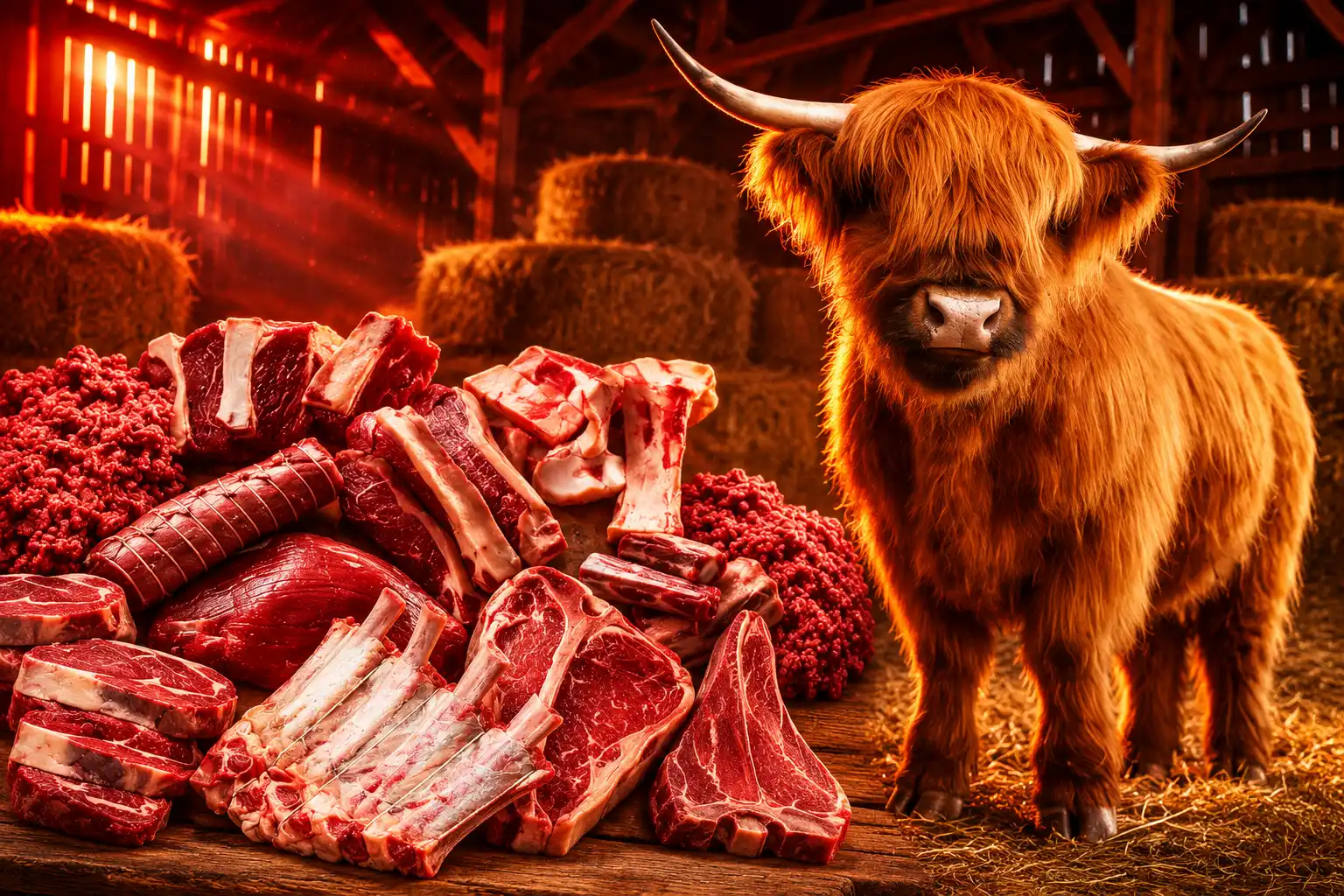
On Nov. 22, 2026, grass-fed quarter-cow listings from 13 U.S. ranch stores ran from $949.49 to $1,900.00, with the middle of nine quarter listings at $1,487.93, and shipping extra. Cathy Pomanti’s Sugar Hill Farm in rural Pennsylvania, which raises grass-fed organic Scottish Highland cattle, now charges about $1,100 for a quarter, the same farm that sold one in a 2014 write-up when grocery ground beef was about $3.50.
GRASS-FED SHARE LISTINGS, NOV. 22, 2026
| Share | Lowest | Middle listing | Highest |
|---|---|---|---|
| Quarter cow | $949.49 (Thousand Hills Lifetime Grazed, Minn.) | $1,487.93 | $1,900.00 (Primal Pastures, Calif.) |
| Half cow | $2,391.50 (White Oak Pastures, Ga.) | $3,055.48 | $3,600.00 (Primal Pastures) |
| Whole cow | $5,267.99 (John Henry’s Meats, Mich.) | $6,000.00 | $6,800.00 (Primal Pastures) |
| Eighth cow | $605.30 (White Oak Pastures) | $839.98 | $1,025.00 (Wholly Cow Market, Kan.) |
White Oak Pastures listed a grass-fed quarter at $1,181.79. Shares that state a packaged meat weight ran $15.57 to $25.00 a pound, which is more than grocery ground beef and less than a grocery ribeye. USDA Agricultural Marketing Service quarterly grass-fed figures for the second quarter of 2026 put 90%+ lean grass-fed ground at $13.63 a pound in direct-to-consumer sales, a useful check on what “cheap bulk” actually means when the animal ate grass.
The half-cow ticket for grass-fed beef now starts near $2,400. Households chasing the old bargain are buying a second freezer first and the cow second. The cash up front, not the flavor, is the filter.
The Gap Between Hanging Weight and Take-Home Meat
Ranches quote two different pounds, and the cheap-looking one is not the one you eat. Hanging weight is the carcass before the butcher cuts it. Take-home weight is what is left after bone, fat, and trim. Mississippi State University Extension’s worked example starts with a 1,200-pound steer at a 63 percent dress, which is a 756-pound hot carcass, about 726 pounds after chilling, and about 470 pounds of mostly boneless cuts once fat and bone come off.
FROM LIVE WEIGHT TO THE FREEZER
- Live steer: 1,200 pounds in the Extension example.
- Hot carcass: 756 pounds at a 63 percent dress.
- After the cooler: about 726 pounds once the carcass chills.
- Packaged beef: about 470 pounds of mostly boneless cuts, a further 30 to 40 percent loss from trim and bone.
- A quarter of that example: about 118 pounds in the freezer, not a quarter of the live animal.
Grass-finished cattle often dress a little lighter than grain-finished ones, and a longer dry age takes more weight still. Pomanti’s animal went to Rising Spring Meat Company outside State College, Pennsylvania, and hung about 14 days before it was cut, vacuum-sealed, and sent back. Mundorf Heritage Beef in Iowa sells a quarter as about 100 pounds of custom-cut, dry-aged beef for $1,250 total, processing included, which is a packaged-weight quote, not a hanging-weight teaser. If a farm quotes $4.15 a hanging pound, ask what share of that hanging pound lands in the bags.
Direct Sales Pay Ranchers a Different Number
Grocery beef still moves through a short list of large packers. Farm-direct quarters do not. The animal is spoken for before it reaches the rail: the buyer puts down a deposit, sometimes months ahead, and the rancher is selling a specific steer rather than a commodity lot. USDA’s Economic Research Service tracks monthly spreads among the farm, packing plant, and grocery store, which is the chain a quarter-cow sale is built to skip.
Under the custom exemption, a locker may slaughter and cut an animal only for its owner’s household, guests, and employees, and every package is marked not for sale. That is why the farm sells you a share of a live animal instead of a stack of steaks. The legal door is narrow, and it is also the door that lets a small ranch keep the retail margin that the boxed-beef trade takes.
Dennis Family Farms in Stanchfield, Minnesota, was quoting about $4.15 a hanging pound as of August 2026 and estimating a quarter, processing included, around $1,150 to $1,275, with beef and pig dates already spoken for through December 2026 and January 2027. Brass Family Farm was quoting $9.95 a hanging pound on 100% grass-fed quarters, with a typical bill around $1,675 including processing. Those are not the same product, and they are not the same customer. The conventional hanging-weight quarter can still land under grocery steak money. The grass-fed quarter is a quality buy that only looks cheap next to grass-fed steaks, not next to store hamburger.
Why Small Lockers Are Booked Into 2027
Small and very small plants, which Brashears has said hold about 5 percent of U.S. beef processing capacity, are the gate for a farm-direct quarter. About 80 percent of capacity sits with four major processors and another 15 percent with other large plants, she said, which leaves local ranchers hauling cattle an hour or more, and sometimes much farther, when a nearby rail is full. Large fed-cattle plants can idle shifts because there are not enough cattle. Custom lockers can still have no open date until next spring.
This is unfortunate because we have local ranchers who might want to have a branded product or even just to have their beef processed for their family and bring it home.
Mindy Brashears, USDA under secretary for food safety
Mundorf’s harvest calendar ran from Nov. 17, 2026, into April 2027, with prices held through May 2027. Chandler Pond Farm said 2026 half and quarter reservations were sold out and that 2027 spots were open, at $8.75 a hanging pound, typically $1,093 to $1,575 for a quarter with processing included. USDA launched a Small Processors Action Plan on June 4, 2026, under Agriculture Secretary Brooke L. Rollins, and a fourth round of the Meat and Poultry Processing Expansion Program worth $60 million. The SPUR loan program, announced in November 2026, offers up to $5 billion in guaranteed loans aimed at slaughter capacity, from mobile units to larger plants. Those programs do not open a slot this month for a family that just bought a chest freezer.
The 2026 Study Puts a Number on Grass-Fed Claims
The health pitch that travels with grass-fed bulk beef is no longer just a 2010 review. The Beef Nutrient Density Project, published in the Journal of Animal Science in 2026 by Joseph V. Varre, Stephan van Vliet, and colleagues, compared 253 grass-fed and 84 grain-fed samples from 108 commercial producers and retailers, 337 ribeyes in all. Grass-fed beef had a lower omega-6 to omega-3 ratio on average, plus more of the omega-3s ALA, EPA, and DPA, more conjugated linoleic acid, and more calcium, copper, iron, and selenium.
FATTY ACIDS AND MINERALS IN THE 2026 RIBEYE STUDY
| Measure | Grass-fed (n=253) | Grain-fed (n=84) |
|---|---|---|
| Omega-6:3 ratio | 2.14 | 8.28 |
| ALA (% of fatty acids) | 0.99 | 0.27 |
| EPA (% of fatty acids) | 0.28 | 0.07 |
| Iron (mg/100 g) | 2.29 | 1.92 |
| Selenium (mg/100 g) | 0.012 | 0.002 |
A 100-gram serving of the grass-fed samples supplied 2.29 mg of iron, about 29 percent of the daily value used for adult men and 13 percent for adult women. Grain-fed samples supplied 1.92 mg, about 24 percent and 11 percent. Selenium was about sixfold higher in grass-fed beef, calcium about threefold higher. The same paper found grass-fed omega-6:3 ratios ranging from 0.62 to 11.45. Some grocery and large-online “grass-fed” steaks looked like grain-fed steaks on fat profile, especially when the pasture was thin on plant diversity. The label on the bag is not a lab result.
Simplified labels like grass-fed or grain-fed may not fully capture nutritional differences.
Joseph V. Varre, Stephan van Vliet, and colleagues, Journal of Animal Science, 2026
The Upfront Cost the Store Never Charged
A quarter of beef is a cash product before it is a food product. Deposits of $100 to $500 are common, sometimes nonrefundable, and the balance is due when the animal goes to the locker or at pickup. Minnesota Extension, as quoted by Dennis Family Farms, puts a 142-pound quarter at 4.5 cubic feet in a chest freezer or 5.5 cubic feet in an upright. Chandler Pond tells buyers to plan on 4 to 5 cubic feet. That is a dedicated freezer, not a crisper drawer.
The cut list is the other price. A quarter is ground beef, roasts, stew meat, shanks, and a few steaks, not a box of ribeyes. If a household mostly eats hamburger, a bulk ground box can beat a share on price, because the share’s per-pound number is pulled up by tenderloin and strip. If the household will braise oxtail and grind the rest, the math against $12.845 grocery steaks still works, especially on a conventional hanging-weight quarter. Grass-fed bulk is a different bet: you are paying $15.57 to $25.00 a packaged pound, when you can measure it, to get the fatty-acid profile Varre’s group measured on biodiverse pasture, and you are accepting that a store-labeled grass-fed steak may not deliver the same ratio.
Pomanti still will not name cattle headed for slaughter. The Scottish Highland that becomes a $1,100 quarter spends its first months on milk, then on grass, then on a truck to Rising Spring, then in a cooler for about 14 days. The family that wants that animal in 2027 needs the deposit, the freezer, and a locker date that several farms have already sold through the rest of 2026. Chandler Pond is taking 2027 names. The grocery sticker will still be there in the meantime, at $6.755 a pound for ground and $12.845 for steaks, until the 4.71 million replacement heifers turn into a larger calf crop, which they will not do this packing season.
Disclaimer: This article is news reporting on retail beef prices, farm-direct meat shares, and published nutrition research, and it is for information only. It is not medical, dietary, or financial advice, and it does not recommend any ranch, diet, or purchase. Talk with a registered dietitian or physician before changing how much red meat you eat, and with a tax or financial professional before putting a large cash sum into bulk food. Figures, waitlists, and study results follow the dated sources named above and can change with the next BLS release, the next harvest date, and the next cattle report.

Netflix Bets on 15-Minute Sitcom Minimum Wage

Quarter-Cow Shares Sell Out as Grocery Beef Stays High

Hunger Games Hits $120 Million Without a Next Film

Disney+ Puts Hulu Live TV in One App This December

Merch Builds a Parallel Closet Beside Luxury Fashion

Thameslink Will Pad 60,000 Ironing-Board Seats From 2027

How Tall Was Adolf Hitler?

U.S. Forces Clear Hormuz Mines, Then Hit Minelayers Again

Micron Sells the Memory Shortage as Five-Year Contracts

Royal Caribbean Sends Los Angeles Ships to Singapore and Brisbane
-
 NEWS3 months ago
Thameslink Will Pad 60,000 Ironing-Board Seats From 2027
-
 HISTORY3 years ago
How Tall Was Adolf Hitler?
-
 BUSINESS3 months ago
U.S. Forces Clear Hormuz Mines, Then Hit Minelayers Again
-
 NEWS3 months ago
Micron Sells the Memory Shortage as Five-Year Contracts
-
 NEWS3 months ago
Royal Caribbean Sends Los Angeles Ships to Singapore and Brisbane
-

 NEWS3 months ago
Twenty Controllers Closed Norwich Airport for a Bank Holiday
-
 BUSINESS3 months ago
Sweetmore Bakeries Buys Fantasy Baking for Bar Work
-
 BUSINESS3 months ago
L Catterton Installs a Kraft Heinz Operator at Kettle Cuisine