
NEWS
UK eGates Let Returning Britons Skip the Passport Scan
Contactless UK eGates at East Midlands match British faces to border records, leaving the passport in the bag unless the camera fails.

British citizens arriving at East Midlands Airport can walk through eGates without putting a passport on the reader. The Home Office switched the first contactless gates on 6 October 2026 and says testing shows the pass is up to 25% faster. The live face is matched to travel, passport and immigration records the department already holds, and the barrier opens if those checks clear.
The booklet still has to travel. It is the backup if the camera fails, and it remains the document used to check in and board. What changed at East Midlands is which object does the identity work at the UK border: the face, not the chip on a glass scanner.
You Still Pack the Passport
Home Office guidance is blunt on this point. Passengers must continue to travel with a valid passport, and Border Force officers will keep watching the lanes. If extra checks are needed, the traveller puts the document on the reader or is sent to an officer, which is the same fallback used on ordinary eGates.
That is why the “passport-free” label oversells the switch. The passenger no longer has to seat a booklet on a scanner for a clean match. They are not being waved through without papers. Dual nationals are told to travel on a valid British passport or hold a Certificate of Entitlement, or they can expect delay.
The hardware in the hall is not being ripped out. Notes to the announcement say software is being updated as part of a phased rollout rather than replacing eGates. Signage is going up so people know which lane is live. The physical passport becomes something you carry and may still have to present, not the thing the gate has to taste on every pass.
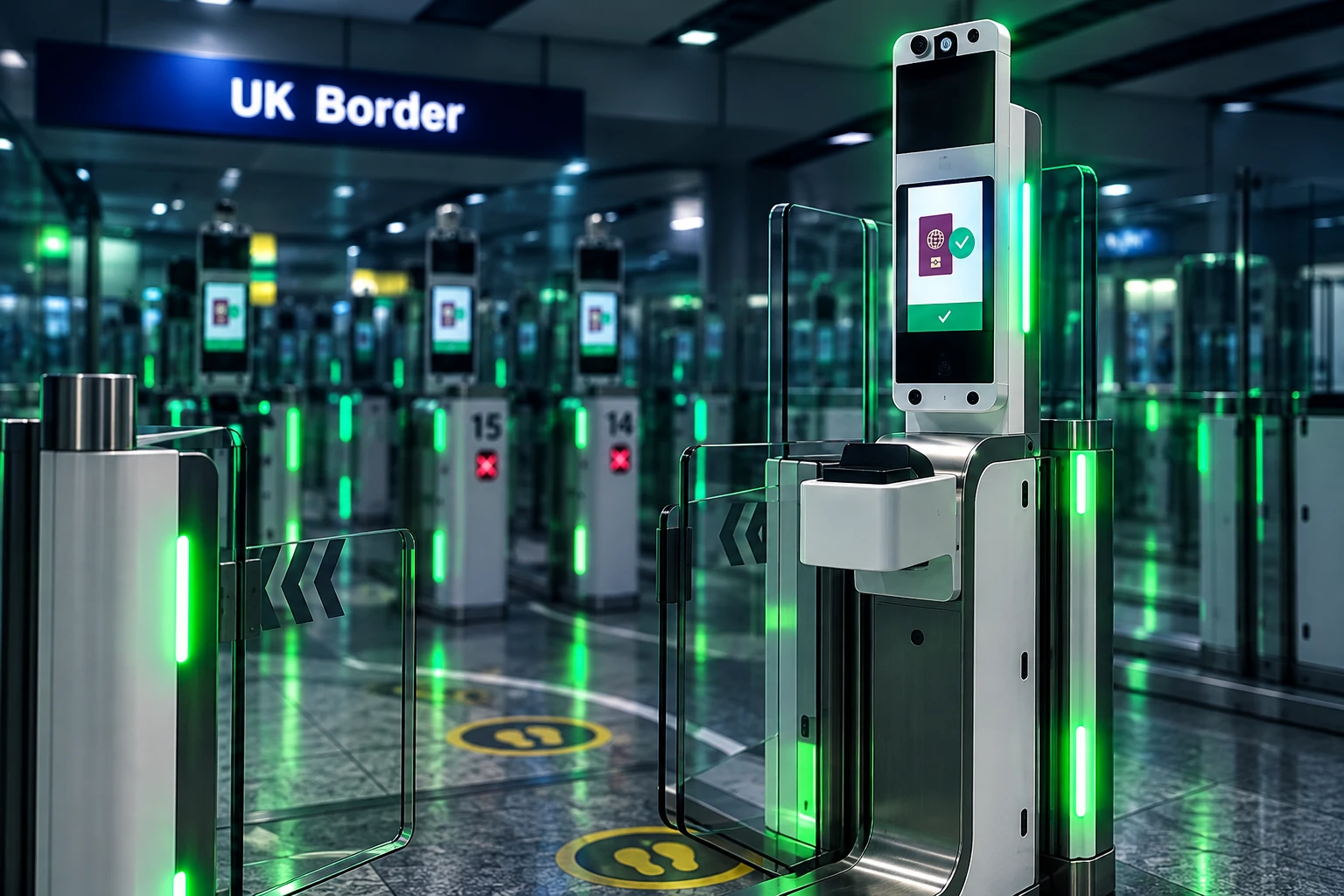
How the Contactless Gate Checks a Face
The Home Office published a three-step description of the new pass, and it is shorter than the old ritual of lining up a chip, waiting for a read, then facing the camera.
THE CONTACTLESS PASS
- The approach: The passenger walks up to an eGate and has a photo taken.
- The match: The system checks that live image against verified immigration, travel and passport information.
- The opening: The eGate opens automatically once those checks are complete, with no need to place a passport on the reader.
Full immigration and security checks still run, the department says. The time saving it is selling is the removal of the fiddle that slows a conventional eGate: a booklet that will not sit, a chip that will not read, a passenger who has to try again. Testing, not a published stopwatch study, is the source of the up to 25% figure.
This is a win for travellers coming to our brilliant country. By using state-of-the-art technology, we are making journeys smoother and faster, all while fully maintaining the UK’s robust border security.
Phil Douglas, Director General of Border Force, Home Office announcement, 6 October 2026
Douglas had already described the logic during a three-week trial at Manchester Airport in October 2025, when British passport holders used modified existing gates. People approach the eGate, it recognises them as already on the database, and they are checked through. Briefings before this week’s launch described airlines sending Border Force passport photographs of British passengers due in that day, so the gate is matching a live face to a list built before the plane lands.
That pre-load is the quiet change. A conventional eGate reads the chip you present. A contactless eGate looks you up.
British Citizens Go First
Contactless lanes are limited to British citizens only at the start. Other nationalities who already qualify for ordinary eGates are due to get the contactless pass later, the guidance says, with no date attached. Eligibility for the older gates is unchanged, and the Home Office says it is still exploring how to put most arrivals through some form of eGate.
WHO GETS THE CONTACTLESS LANE
| Traveller | Contactless now | At the gate |
|---|---|---|
| British citizen at East Midlands | Yes, on the new lanes | Face match; passport stays in the bag |
| Other eGate-eligible nationalities | Not yet | Scan the passport as now |
| Failed face match | No | Scan the passport or see an officer |
| Dual national not on a British passport | Risk of delay | Travel on a British passport or a Certificate of Entitlement |
| Child under 8, or under 120cm | No | Staffed Border Force desk |
Chris Wilson, head of terminal and capacity planning at Birmingham Airport, said the airport is already “one of the first” to introduce the Border Force system and has been supporting the rollout with industry partners. East Midlands is the site the Home Office names as the start. Birmingham is in the same first wave even if it is not the named opener.
ETAs and Eight-Year-Olds Came First
Douglas tied the East Midlands switch to work completed in the summer, when eGates opened to children aged eight and above. That was not a side project. It was an earlier cut of the same contactless border the Home Office has been describing in public for months.
THE STEPS THAT GOT THE CAMERA TO THE GATE
- October 2025: Border Force runs a three-week contactless trial at Manchester Airport for British passport holders on existing eGates, and Douglas says processing times are considerably reduced.
- 14 May 2026: The Home Office says an estimated 1.5 million more children will be able to use eGates over the next year, based on 2025 arrival figures, and cites 24.8 million Electronic Travel Authorisations issued as one step closer to a contactless border.
- 8 July 2026: Accompanied children aged 8 and 9 who are at least 120cm (3ft 11in) tall become eligible on more than 290 eGates at UK and juxtaposed ports.
- 6 October 2026: A small number of contactless eGates go live at East Midlands Airport, British citizens first, as a software update rather than a rip-and-replace of the machines.
- Early 2027: Contactless eGates are expected at Birmingham, Bristol, Cardiff, East Midlands, Edinburgh, Gatwick, Glasgow, Heathrow, London City, Luton, Manchester, Newcastle and Stansted.
The May announcement treated the ETA scheme as the pre-travel half of the same design: officials see a passenger before the passenger sees an officer. Contactless eGates are the arrivals half. Face comparison, the Home Office wrote then, would verify identity rather than needing a passport to be presented, while “keeping our country’s borders secure.”
Mike Tapp, then minister for migration and citizenship, sold the age change as a family-time measure. Douglas sold it as a way to free officers to intercept people who pose a threat. Both lines reappear in this week’s copy. The passenger-facing gift is a shorter shuffle at the barrier. The operational gift is a border that has already looked the traveller up.
British Faces Are Kept for 30 Days
A live match against “verified immigration, travel and passport information” is biometric processing, not a simple photo. UK data protection rules treat biometric recognition as special-category data, which needs a lawful basis for biometric recognition and a separate condition before it can run. Border processing typically sits on the public-task basis, not on a tick-box at the gate.
Home Office biometric guidance issued to staff on 24 February 2026 is more specific about what happens to the picture the camera takes. Facial images of British citizens captured at eGates and the primary control point may be retained for up to 30 days. Facial images of other nationalities may be retained for up to 6 years. Those are two different rules for two different groups, not two figures for the same file.
The same guidance sets the direction of travel in language the launch press notice does not use. The department says it wants a biometrically enabled migration and borders system in which face and fingerprints are the primary biometric information, and it is moving toward records centred around a person’s facial image, with facial biometrics as the main modality for transactions.
That is the larger shift the queue-time headline sits on. Once the live face is enough to open the gate, the booklet is proof you can still produce, not the thing the system has to read. People reading the launch as a digital ID move are not inventing a second story. They are describing the same architecture in plainer words than “contactless travel.”
What Happens If the Camera Misses You?
The Home Office has built a visible failure path, and passengers will meet it the first time a hat, a mask, a bad angle or a thin gallery match refuses to clear.
WHEN THE LANE WILL NOT OPEN
- Second try on the reader: Staff tell the passenger to place the passport on the eGate reader to finish verification.
- The officer’s desk: The traveller is directed to a Border Force officer, as happens already when an ordinary eGate rejects a pass.
- The wrong document: Dual nationals who do not present a British passport or a Certificate of Entitlement are warned to expect delay.
- The wrong person for this phase: Non-British eGate users still scan a booklet until the contactless pass is opened to them.
- The wrong height or age: Children under 8, and children under 120cm, still go to a staffed desk even if they hold an eligible biometric passport.
Officers remain in the hall. The department’s claim is not that the border becomes unstaffed. It is that a clean British match should not need a hand on a scanner. Families who already use eGates for children aged eight and over will only get the contactless version where the child is a British citizen on a live lane. A French parent on a standard eGate still puts a passport down.
Karen Dee, chief executive of AirportsUK, called the move excellent news for the passenger and said arrivals now expect fast, efficient borders. That expectation is the pressure under the software update. It is also why a reject lane that dumps people onto a short-staffed desk will be the first complaint if the match rate is messy in the morning banks at Heathrow.
East Midlands Opens a 13-Airport Queue
East Midlands is a revealing place to start. It is not Heathrow. MAG, which runs the airport with Manchester and London Stansted, recorded 3,997,160 passengers over 12 months to June 2026, and 498,365 in June 2026 alone. Steve Griffiths, the airport’s managing director, said contactless eGates complement recent changes in the immigration hall aimed at moving arrivals through the area.
A smaller arrivals hall is a kinder place to watch a software cutover than Terminal 5 at 06:00. The Home Office still has to take the same code to the busiest gates in the country. The listed sites are Birmingham, Bristol, Cardiff, East Midlands, Edinburgh, Gatwick, Glasgow, Heathrow, London City, Luton, Manchester, Newcastle and Stansted, with every eGate upgraded by early 2027. Other UK eGates, including juxtaposed controls that still run the older process, stay as they are until they are brought in.
The announcement presents the switch as delivery on the Immigration White Paper and as a companion to the ETA scheme, which screens people before they travel. Millions already use eGates each year, the Home Office says, and it calls them the fastest way for legitimate travellers to enter. Contactless travel is the next turn of that screw: same machines, different token, British faces first.
By early 2027 the plan is that a returning British passenger at any of those 13 airports will clear the gate with a face the system already knows. The passport stays in the bag for the clean match, and comes back out the moment the camera does not.

Kering’s Growing Houses Cannot Outrun a Shrinking Gucci

Studio Staff and Bitcoin Buyers Built the Eminem Leak Case

A Mutated H1N1 Strain Is Hitting Younger Immunity First

Albert Heijn Returns at One-Third as Rivals Take Share

Art Basel Paris Ends After One Public Day

Thameslink Will Pad 60,000 Ironing-Board Seats From 2027

How Tall Was Adolf Hitler Really? Debunking the Myth of his Height

Micron Sells the Memory Shortage as Five-Year Contracts

Royal Caribbean Sends Los Angeles Ships to Singapore and Brisbane

U.S. Forces Clear Hormuz Mines, Then Hit Minelayers Again
-
 NEWS2 months ago
Thameslink Will Pad 60,000 Ironing-Board Seats From 2027
-
 SCIENCE3 years ago
How Tall Was Adolf Hitler Really? Debunking the Myth of his Height
-
 NEWS2 months ago
Micron Sells the Memory Shortage as Five-Year Contracts
-
 NEWS2 months ago
Royal Caribbean Sends Los Angeles Ships to Singapore and Brisbane
-
 BUSINESS2 months ago
U.S. Forces Clear Hormuz Mines, Then Hit Minelayers Again
-

 BUSINESS2 months ago
Sweetmore Bakeries Buys Fantasy Baking for Bar Work
-

 BUSINESS2 months ago
L Catterton Installs a Kraft Heinz Operator at Kettle Cuisine
-

 NEWS2 months ago
CISA’s 100 Water System Hacks Hit One-Operator Plants