
NEWS
Thameslink Will Pad 60,000 Ironing-Board Seats From 2027
New Thameslink cushions start in 2027, a decade after the Department for Transport specified the hard ironing-board seats commuters still sit on.

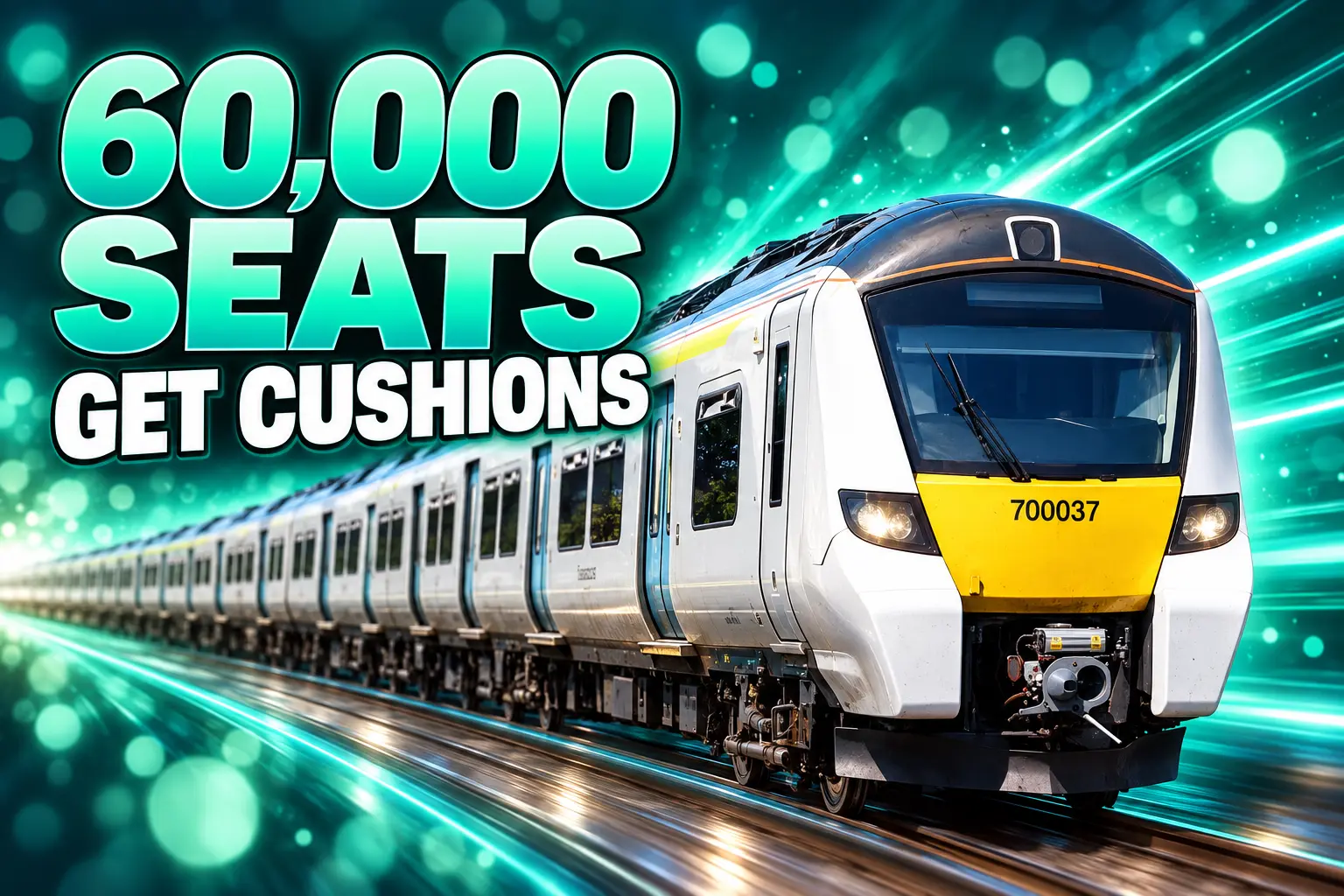
More than 60,000 Thameslink seats will get new cushions from 2027, a decade after the government paid £1.6 billion for the hard, thin seats commuters nicknamed ironing boards. Transport Secretary Heidi Alexander called the plan public ownership in action, 87 days after Govia Thameslink Railway moved into state control.
The foam is a genuine passenger win. It is also a late patch on a Department for Transport brief that chose standing space and weight over comfort before a single Class 700 carried a fare-payer.
Thameslink Will Pad the Ironing Boards From 2027
Alexander said all 115 Thameslink trains will receive more comfortable seat-base cushions and improved backrests, with the work due to start in 2027 and run for two years. The Department for Transport billed it as an end to the notorious ironing-board seats on one of Britain’s busiest commuter routes, and folded the job into the wider Great British Railways pitch.
This is what public ownership looks like in action. Less than 100 days since GTR transferred into public control, we’re delivering on the improvements commuters have been asking for. From next year, we’ll start getting rid of the dreaded ‘ironing board seats’ so passengers can enjoy comfier, more pleasant journeys on some of Britain’s busiest commuter routes.
Heidi Alexander, Transport Secretary
John Whitehurst, chief executive at GTR, said customers had told the operator that comfort matters, and that commuter research had shaped the cushion plan. The trains themselves are the Siemens Desiro City Class 700 fleet, built at Krefeld in Germany after a bidding process that began in 2008 and a contract finalised in 2013. They entered passenger service from 20 June 2016, with the last units in traffic by 2019, and they still do the Bedford, Cambridge, Peterborough and Brighton runs through the Thameslink core.
GTR is Britain’s largest train operator, carrying about one in six passenger rail journeys. After the 31 May handover it became the fifth operator moved into the public sector under the 2024 public ownership act, with services now run by Thameslink Southern Great Northern Limited under DfT Operator Limited. The Thameslink, Southern, Great Northern and Gatwick Express names stay on the trains.
What Passengers Get
The announcement is a cushion and backrest job, not a new seat. Standard-class riders are promised a softer base and a redesigned backrest. First class gets the better base and keeps the backrest it already has. Seat-back tables will be fitted to the 70 trains that still lack them, which means 45 of the 115 already have a table of some kind.
WHAT THE 2027 JOB INCLUDES
- Standard class: New seat-base cushions and improved backrests across the whole Thameslink fleet.
- First class: New seat-base cushions only, with the existing backrest design left in place.
- Tables: Seat-back tables added on the 70 trains that still do not have them.
- Timing: Work starts in 2027 and is described as a two-year rollout, so the last units may not be done until 2029.
- Money: No price, no supplier and no foam thickness have been published; more contract detail is promised in the autumn.
Pitch, width and the 2+2 layout are not part of the published plan. Anyone hoping the ironing board will become a proper long-distance seat is waiting on a different project from the one ministers described.
The Department Specified Those Hard Seats
Siemens built the trains. The department bought them and wrote the brief. A DfT freedom of information reply later set out the chain: the department specified the Class 700, Interfleet and First Capital Connect (later absorbed into GTR) produced a detailed specification, and First Capital Connect worked with Siemens on the design. Stakeholder trips then reviewed mock-ups.
The department’s own procurement guidance stressed high capacity and reduced weight. It said the electric fleet must cater for about 1,000 people to board or alight at one time, with a 2+2 seat layout to ease flow and provide standing space. Seat dimensions and pitches were chosen to guarantee a minimum standing-passenger capacity. Safety, capacity and comfort were listed as the three guides; comfort came last in practice.
THE SEAT DECISION, YEAR BY YEAR
- 2011: Two mock-up seat viewings. Attendees preferred “Supplier B” for style and grab handles, then asked for significant work on comfort, softness and width. The Bedford Commuters Association criticised the spacing. A representative of the East Surrey Transport Committee said the seats “make me round-shouldered”. The Association of Public Transport Users and London TravelWatch both asked for better cushioning.
- June 2013: The £1.6 billion Siemens contract is finalised for 60 eight-car and 55 twelve-car trains.
- 2013: Stakeholder parties view two mock-up carriages in Kassel, Germany. Opinion of the standard-class seats is poor. The industry line is that fire standards have become more demanding, so modern seats feel firmer.
- 28 January 2014: A full-scale mock-up is shown at London’s Excel centre. Railfuture’s rolling stock panel sits in it and files a warning before series production.
- 20 June 2016: The first Class 700 carries passengers. The nickname ironing board is in circulation within months.
- 26 August 2026: Alexander announces new cushions, to be fitted from 2027.
Production went ahead without a redesigned seat. The department now says it could not reopen a private-sector contract until public ownership took effect this year. That sits awkwardly with an earlier retrofit: after the trains were already in service, the department funded seat-back trays and Wi-Fi to be added in depots. A foam change was always a cheque and a slot on the lift, not a change of owner.
We found the seats very hard and imagine this will soon lead to complaints from passengers, particularly bearing in mind that some journeys on these trains will be up to 130 miles long such as Peterborough or Cambridge or Bedford to Gatwick and Brighton and taking over two hours.
Railfuture rolling stock panel, Excel mock-up report, 2014
The same panel said passenger comfort was severely compromised and strongly urged a redesign before series production. The trains were built anyway.
A Metro Seat on a 130-Mile Ride
The Class 700 was specified as a high-capacity metro train that also had to grind out regional trips. A 12-car set is rated for 1,754 people, most of them on their feet. Railfuture, which inspected the design in Germany in 2013, counted 666 seats on a 12-car train against 798 on the 12-car Class 377s then used between Brighton and Bedford. The standing allowance was cut from 0.45 square metres per person on older stock to 0.25 square metres on the 700s.
CLASS 700 SEATS AND STANDING ROOM
| Formation | Units | Seats | Standing |
|---|---|---|---|
| 8-car (700/0) | 60 | 427 | 719 |
| 12-car (700/1) | 55 | 666 | 1,088 |
Each train carries 52 first-class seats. The only concession Railfuture recorded after the German visit was a 2 cm extra gap between adjacent seats, still tight enough that many riders touch the person beside them. Peak standing from Haywards Heath toward London already ran about 50 minutes on the old pattern; Cambridge, Peterborough, Bedford and the Sussex coast sit far beyond that.
Then Transport Secretary Patrick McLoughlin, opening Three Bridges depot in 2015, talked of fantastic new Class 700 trains. The interior that arrived was uncompromisingly metro, which suits the Wimbledon loop and the core through Farringdon. It is a thin offering on a two-hour Bedford to Brighton diagram. New foam will take the edge off the base. It will not put back the seats the crowding model removed.
Fire Standards Did Not Demand Bare Foam
When the complaints landed, the operator’s first defence was the rulebook. Govia Thameslink said padding was constrained by fire standards and that graffiti-proof covers gave a firm feel. The department accepted that its guidelines had made for less comfortable seats. Crashworthiness was cited for the backrest shape. The material, the department said in its FOI reply, met minimum safety precautions.
Hugh O’Neill, then head of rolling stock at the Rail Safety and Standards Board, was blunt. He said it is absolutely not true that seat comfort is related to fire standards, that thicker foam could be fitted, and that the thin pad on the Thameslink fleet looked commercial. That was 2018. The ironing boards stayed. Industry comfort guidelines on cushion depth were promised after the outcry and did not lift the Class 700 seat off the floor.
The fire line is still the first technical objection when a foam swap is floated, including among people who work on tunnel stock. The safety body’s answer has been on the record for eight years: the hardness was a cost choice dressed up as a regulation.
May’s Transfer Left the Cushions Off the List
Govia Thameslink Railway transferred into public ownership on Sunday 31 May 2026. The written statement to Parliament listed the early passenger measures: doubling Gatwick Express trains each hour from December, extra Great Northern off-peak trains from Moorgate, 75 more Thameslink and Great Northern drivers, WhatsApp disruption support, 110 Travel Safe Officers, automatic train operation training by December 2026, and deep cleaning of all 115 Class 700 units plus toilet refreshes to fight graffiti. Seats were not on that list.
Eighty-seven days later the cushions became the exhibit for “less than 100 days” of public control. Framing the job as the state clearing up a private mess ignores who wrote the 2013 brief. Putting right the thin foam, and finishing tables that were already supposed to be retrofitted, is also the more expensive order of events: specify a hard, table-less metro interior, then pay twice to soften it.
After the GTR transfer, publicly owned operators were delivering 8 in 10 of the passenger journeys Great British Railways is meant to run. Chiltern is due next, on 20 September 2026, then Great Western Railway on 13 December 2026, with the DfT contract transfers aimed at the end of 2027. A padded Thameslink seat is useful politics in that queue. It is not the same as a seat that was specified for a two-hour ride in the first place.
WHAT WE KNOW
- The fleet: Every one of the 115 Class 700s is in scope, 60 of them eight-car and 55 twelve-car.
- The work: Standard class gets new bases and backrests; first class gets new bases only; 70 trains get tables.
- The calendar: Announced 26 August 2026, starts in 2027, described as two years.
WHAT IS UNCONFIRMED
- The bill: No figure has been attached to more than 60,000 cushions and the backrests.
- The product: Foam depth, supplier and whether width or pitch move at all are unpublished.
- The contract: The department has said more detail on negotiations will come in the autumn.
Other hard-seat fleets will be asked the same question the moment the first 700 looks softer. That is already the obvious next letter for anyone who sits on an Azuma. Thameslink is simply first because its nickname stuck.
Autumn Talks Still Have No Price Tag
More contract detail is due in the autumn. Until that lands, passengers have a date and no invoice, no named manufacturer and no sample seat to sit on. The first new cushions are not due on a diagram until 2027, and a two-year programme leaves some units on the original foam into 2028 or 2029, which is 12 or 13 years after the first Class 700 left Brighton for London Bridge.
Commuters asked for a decent seat at the Excel mock-up in 2014 and at the Kassel viewing the year before. They will get extra foam under public ownership, on the same frames, after the next timetable year. Until the first unit comes back from the depot, the ironing boards stay in the peak.

Nvidia RTX Spark Laptops Make Local AI a RAM Bill

A Drone Strike in Bulgaria’s EEZ Leaves NATO Idle

Sharma Unwinds Game Pass After Xbox Hit Freefall

Shawn Layden Says Sony’s Disc Cut Hits the Faithful 20 Percent

The EU Cabin Bag Law Frees Only a Personal Item

Thameslink Will Pad 60,000 Ironing-Board Seats From 2027

Micron Sells the Memory Shortage as Five-Year Contracts

Royal Caribbean Sends Los Angeles Ships to Singapore and Brisbane

U.S. Forces Clear Hormuz Mines, Then Hit Minelayers Again

Burger King Rebuilds Chicken Nuggets After Calling Them Rubbery
-
 NEWS1 month ago
Micron Sells the Memory Shortage as Five-Year Contracts
-
 NEWS1 month ago
Royal Caribbean Sends Los Angeles Ships to Singapore and Brisbane
-
 BUSINESS1 month ago
U.S. Forces Clear Hormuz Mines, Then Hit Minelayers Again
-
 BUSINESS1 month ago
Burger King Rebuilds Chicken Nuggets After Calling Them Rubbery
-
 NEWS1 month ago
Twenty Controllers Closed Norwich Airport for a Bank Holiday
-
 SCIENCE3 years ago
How Tall Was Adolf Hitler Really? Debunking the Myth of his Height
-

 BUSINESS1 month ago
Sweetmore Bakeries Buys Fantasy Baking for Bar Work
-

 BUSINESS1 month ago
L Catterton Installs a Kraft Heinz Operator at Kettle Cuisine