
NEWS
The EU Cabin Bag Law Frees Only a Personal Item
EU cabin bag rules from 23 October 2027 free a personal item and force bag-inclusive fares first, while cheaper no-trolley tickets remain.

The European Union published new cabin bag rules on 2 October 2026, with the duties due to apply from 23 October 2027. Passengers get a free personal item that fits under the seat, and airlines must open the booking path with a fare that already includes a piece of hand baggage.
A cheaper ticket without that overhead bag remains legal. A charge for a trolley on that cheaper fare remains legal too.
The Law That Landed on 2 October
The instrument is Regulation (EU) 2026/2202 in the Official Journal, dated 16 September 2026. It amends Regulation (EC) No 261/2004, the delay and cancellation rulebook that has stood since 2004, and it also amends the 1997 baggage-liability rules.
HOW THE TEXT GOT THERE
- 15 June 2026: Council and Parliament negotiators strike a provisional deal, the first full rewrite of the 2004 rights.
- 7 July 2026: Parliament backs the joint text by 646 votes to 12, with 3 abstentions.
- 13 July 2026: the Council gives final clearance.
- 2 October 2026: the act appears in the Official Journal.
- 23 October 2027: the new cabin-bag and fare-display duties start to apply, the date named by the European Parliament.
Until that 2027 date, the 2004 rules still govern what happens after a delay or a cancelled flight. Airlines have a year to recode fare families, booking engines and airport scripts.
The Council set the territorial map in the June deal. The rules cover flights inside the EU on any carrier, flights leaving the EU on any carrier, and flights into the EU only when an EU airline is operating them.
What Passengers Get for Free in the Cabin
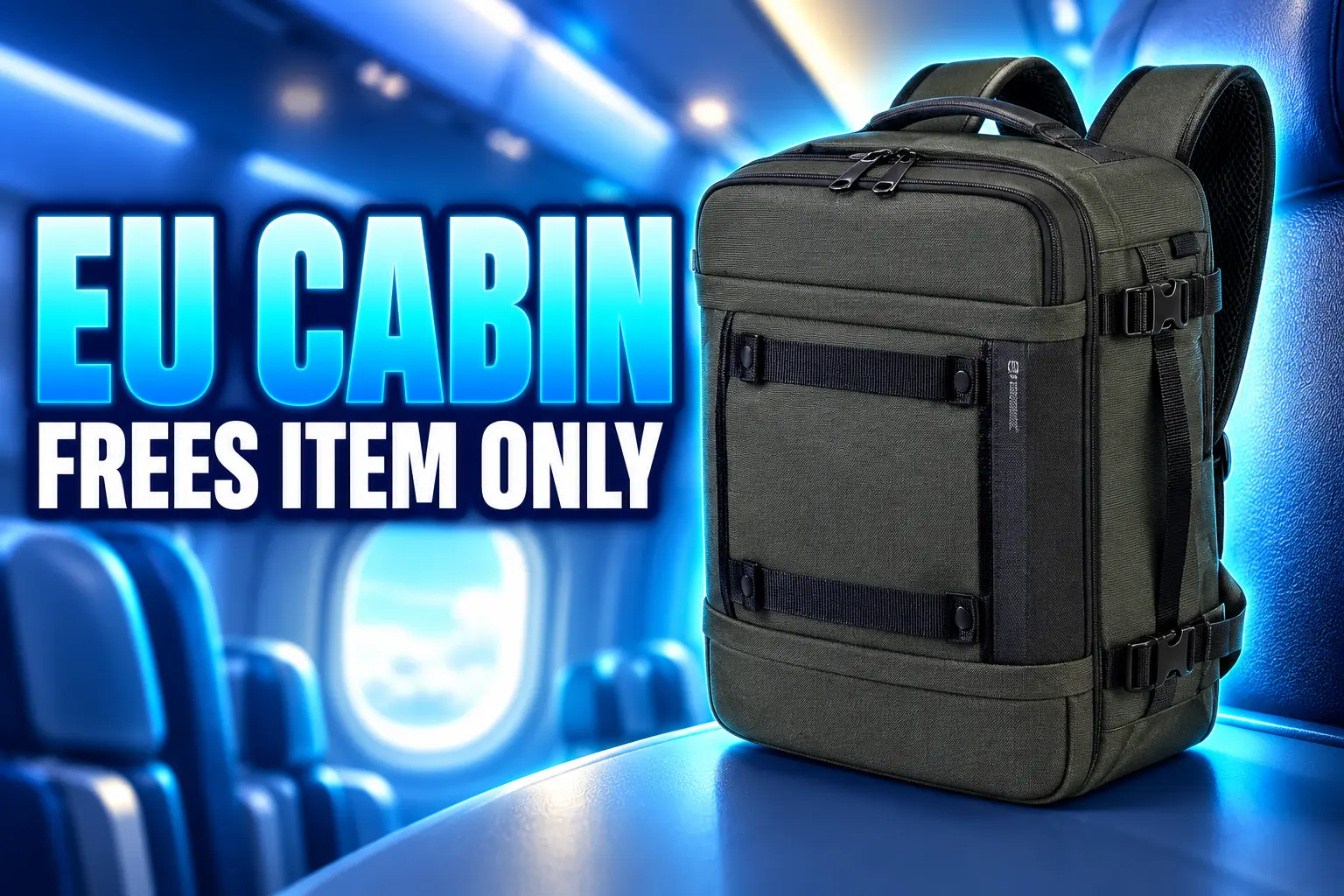
Parliament’s July press note said the new rules include the right to carry on board without extra cost one personal item, such as a small bag or backpack. That is the only cabin piece the adopted package treats as a free entitlement for every passenger.
THE TWO CABIN CATEGORIES
- Personal item: A handbag, laptop bag or small backpack that is at most 40 x 30 x 15 cm, or that fits under the seat in front. Every passenger may bring this with no extra fee.
- Hand baggage: The larger piece destined for the overhead locker. Airlines still set its size and weight. They may still charge for it on a cheaper fare, so long as the first price shown already includes it.
The Commission’s own questions-and-answers page is blunt on the second category. The new rules introduce no commonly agreed EU standard for hand luggage size. They also say there is no obligation to include an item of hand luggage in every fare. Airlines may still set a weight limit on the personal item if they wish, provided it stays reasonable under existing Court of Justice case law. The agreement itself does not fix a kilo cap for that small bag.
The 7 kg Cabin Bag Did Not Become a Right
A lot of the copy that followed the June deal described a free 7 kg cabin bag with combined dimensions of 100 cm, sitting next to the personal item, on every standard ticket. That figure was the European Parliament’s earlier demand during the fight over the file. It is still the version that travels on booking forums.
The text that left conciliation does not turn every wheeled cabin bag into a free service. It freezes the small item as a right, then attacks the way the trolley is sold. easyJet chief executive Kenton Jarvis called a mandatory free 7 kg carry-on “crazy European legislation” and “lunatic” in February 2026, when that trolley mandate was still the live proposal, and said there was not the space in the cabin for it. The final bargain left the space argument with the airlines. They keep control of overhead size. They keep a product that omits the trolley. They lose the right to hide that trolley until the last page of checkout.
Ryanair chief executive Michael O’Leary aimed at that display duty, not at a vanished 7 kg gift, once the June deal was public.
Booking Screens Must Lead With a Bag Fare
The Council’s June statement said that, to create price transparency, air fares including a piece of hand baggage shall be displayed by default before the start of any booking process, so passengers can compare airlines. Negotiators also agreed that airlines may offer cheaper tickets to people who choose to travel without hand luggage.
WHAT THE FIRST SCREEN HAS TO DO
- Default fare: The price a customer sees first must already include allowance for a piece of hand baggage.
- Opt-out fare: A lower ticket with no overhead bag may still be sold, if the passenger picks it.
- Intermediaries: Booking sites and metasearch engines sit under the same display duty as the airline.
- Specifications: Offers have to list the number, weight and dimensions of permitted bags, and any surcharge, before purchase.
That is a shopping-screen rule. It will lift the headline fare on Ryanair, Wizz Air and easyJet routes where the cheapest click today is an under-seat bag only. It will not, on its own, put a suitcase in every locker. A passenger who wants the old basic price will still be able to take it, with the small personal item and nothing in the bin.
A €4.99 Billion Ancillary Line
Unbundled bags are not a side hustle for the low-cost carriers. In results for the year to 31 March 2026, released on 18 May 2026, Ryanair said ancillary revenue rose 6% to €4.99bn, or €24 per passenger, as traffic reached 208.4 million. Group revenue was €15.54 billion, of which scheduled fares were €10.56 billion. Bags, seats and priority boarding live inside that ancillary total. The display rule does not delete those products. It changes which number the customer sees first.
RYANAIR FY26, IN FOUR FIGURES
- Ancillaries: €4.99 billion, up 6%, or €24 a head.
- Traffic: 208.4 million passengers.
- Scheduled fares: €10.56 billion.
- Group revenue: €15.54 billion.
O’Leary’s objection follows from that mix. He said more than 50% of Ryanair customers already choose the lowest fare and skip a second cabin bag, so a bag-inclusive default is, in his words, false advertising of a higher fare. In a later interview he put a different number on a different problem, saying about 45% of passengers, less than half, can physically bring a second bag given the space on board. One figure is a purchase choice. The other is locker physics. Both survive under the adopted text, because the cheap no-bag fare is still allowed and because a full cabin can still force a bag into the hold.
On the ground, the centimetre rules have not moved yet. Ryanair’s free bag is 40 x 30 x 20 cm under the seat. The paid overhead piece is 55 x 40 x 20 cm and 10 kg, sold with Priority, from £12.49 to £36 when added at booking. easyJet’s free bag is more generous at 45 x 36 x 20 cm and 15 kg; the large cabin bag is 56 x 45 x 25 cm, advertised from £5.99. Wizz Air’s free bag is 40 x 30 x 20 cm, with a 55 x 40 x 23 cm overhead piece tied to WIZZ Priority. British Airways already includes a 40 x 30 x 15 cm personal item and a 56 x 45 x 25 cm cabin bag on typical short-haul economy tickets, so the 2027 personal-item floor matches what it already gives away.
FREE BAGS NOW, AGAINST THE 2027 FLOOR
| Airline | Free bag now | Overhead bag | Overhead in the basic fare? |
|---|---|---|---|
| Ryanair | 40 x 30 x 20 cm | 55 x 40 x 20 cm, 10 kg | No, Priority add-on |
| easyJet | 45 x 36 x 20 cm, 15 kg | 56 x 45 x 25 cm | No, paid extra |
| Wizz Air | 40 x 30 x 20 cm | 55 x 40 x 23 cm | No, WIZZ Priority |
| British Airways | 40 x 30 x 15 cm | 56 x 45 x 25 cm | Yes, on typical economy |
Which? researchers who priced cabin bags on more than 1,500 flights in 2025 found that the advertised floors were scarce. The average Ryanair cabin-bag fee in that sample was £20.50. easyJet’s average was £30, and the cheapest bag they found on easyJet was £23.49. Wizz Air’s average was £28.93. Those are 2025 checkout prices, not the 2027 legal floor. They show why a default bag-inclusive fare will look higher than the teaser fare passengers have been trained to screenshot.
Why a UK Outbound Can Skip the New Allowance
The UK left the EU passenger-rights system at the end of the Brexit transition and now runs its own version, often called UK261, through the Civil Aviation Authority. Which rulebook applies depends on where the aircraft takes off, and on whether the operating carrier is an EU airline, not on the passport in the seat.
easyJet has said outbound journeys from the UK on easyJet UK will not get the new allowance, and that the rules will apply to UK passengers only on return flights from EU countries. The same outbound gap covers other UK airlines, including British Airways and Jet2. A Palma to Manchester leg on any carrier is an EU departure, so the 2027 duties bite on the way home. A Manchester to Palma leg on a UK airline is a third-country departure operated by a non-EU carrier, so it does not.
Ryanair is licensed in Ireland. A UK to Spain sector it operates is an arrival in the EU on an EU airline, which is the third limb of the Council’s map. That is a different legal hook from easyJet UK’s outbound statement, and it is one reason two people on the same Stansted security queue can be flying under two different bag regimes in 2027 if they booked different airlines.
There has been no published move by the CAA to copy the 2026 baggage clauses into UK261. Until that happens, a UK starting airport remains the old world of airline policy, gate jigs and add-on fees, even if the return is already under the new EU screen.
Full Bins Can Still Send a Paid Bag Below
Capacity is written into the deal. Operating carriers must, subject to the capacity of the aircraft cabin, permit passengers to carry a piece of hand baggage into the cabin. If lockers are full, or if an aircraft change or a safety limit forces a cabin bag into the hold, the passenger who was entitled to take it on board is not to be charged extra for that transfer.
That clause is a gift to the people who already paid for a trolley and then watch it tagged at the jet bridge. It is not a promise that the next passenger in line will get a free locker. O’Leary’s space point still sits over every 189-seat 737 boarding. The regulation’s answer is a free hold ride when the bin is gone, not a redesigned cabin.
Instead of encouraging EU airlines to advertise our lowest fares (which exclude second cabin bags), which is what over 50% of our customers choose, these new rubbish regulations require airlines to falsely advertise higher air fares, making EU airlines even less competitive.
Michael O’Leary, chief executive, Ryanair
Gate measuring will not vanish in October 2027. Passengers still describe being pulled aside for a couple of centimetres on a bag that looked fine at home, and the unpaid overhead bag remains the item those checks are built to catch. The new law’s pressure is upstream, on the first price tile, not on the sizer by the boarding door.
The first screens that must lead with a bag-inclusive fare go live on 23 October 2027. The cheap no-bag button is still allowed to sit one click behind them, and the small under-seat item is the only cabin piece the EU has actually made free.
Frequently Asked Questions
When Do the New EU Cabin Baggage Rules Start?
They apply from 23 October 2027. The 2004 compensation bands of €250, €400 and €600 for long delays stay in force until then, and they stay in force after then as well; the rewrite left those euro amounts in place and spent its new energy on refunds, seating, no-show bans and the way bags are sold.
What Size Is the Free Personal Item Under the New Rules?
It qualifies if it is no more than 40 x 30 x 15 cm, or if it fits under the seat in front, two alternative tests rather than a single hard cap. The Commission said the deal does not standardise a weight for that item, though any airline-set kilo limit has to be reasonable under Court of Justice case law.
Can Airlines Still Sell a Cheaper Ticket Without a Trolley?
Yes. The Council and Parliament both recorded that a passenger who does not want a piece of hand baggage can still be offered a fare that omits it. Search engines and online travel agents have to show the bag-inclusive fare first as well, so the cheaper no-bag tile cannot be the only number on a comparison page.
Do Flights From the UK Get the New Allowance?
Not as a UK right. UK261, as amended by the 2019 EU Exit regulations, is still the outbound UK rulebook, and the CAA has not announced a copy-across of the 2026 baggage clauses. Coverage on a UK-starting flight turns on the operating carrier: an EU airline arriving in the EU can pull the passenger into the new regime, a UK airline cannot.
What If Overhead Bins Are Full at the Gate?
If a bag that was meant for the cabin has to go in the hold because of capacity, an aircraft change or safety, the carrier cannot add a fee for that transfer. Adjacent seats for a child under 14 and an accompanying adult, at no extra cost, are a separate new right in the same 2026 package and have nothing to do with locker space.

The EU Cabin Bag Law Frees Only a Personal Item

Russia Hits the Kyiv Bridges That Keep the Capital Alive

Blast Unwinds Its Lido Book and Closes the Chain

GTA 6 Gets an M Rating and a Purchases Tag

Gentle Monster Trailer Leaves Jella Haase’s Detective Offscreen

Thameslink Will Pad 60,000 Ironing-Board Seats From 2027

Micron Sells the Memory Shortage as Five-Year Contracts

Royal Caribbean Sends Los Angeles Ships to Singapore and Brisbane

Burger King Rebuilds Chicken Nuggets After Calling Them Rubbery

U.S. Forces Clear Hormuz Mines, Then Hit Minelayers Again
-
 NEWS1 month ago
Thameslink Will Pad 60,000 Ironing-Board Seats From 2027
-
 NEWS1 month ago
Micron Sells the Memory Shortage as Five-Year Contracts
-
 NEWS1 month ago
Royal Caribbean Sends Los Angeles Ships to Singapore and Brisbane
-
 BUSINESS1 month ago
Burger King Rebuilds Chicken Nuggets After Calling Them Rubbery
-
 BUSINESS1 month ago
U.S. Forces Clear Hormuz Mines, Then Hit Minelayers Again
-

 BUSINESS1 month ago
Sweetmore Bakeries Buys Fantasy Baking for Bar Work
-
 NEWS1 month ago
Twenty Controllers Closed Norwich Airport for a Bank Holiday
-
 SCIENCE3 years ago
How Tall Was Adolf Hitler Really? Debunking the Myth of his Height