
BUSINESS
A Drone Strike in Bulgaria’s EEZ Leaves NATO Idle
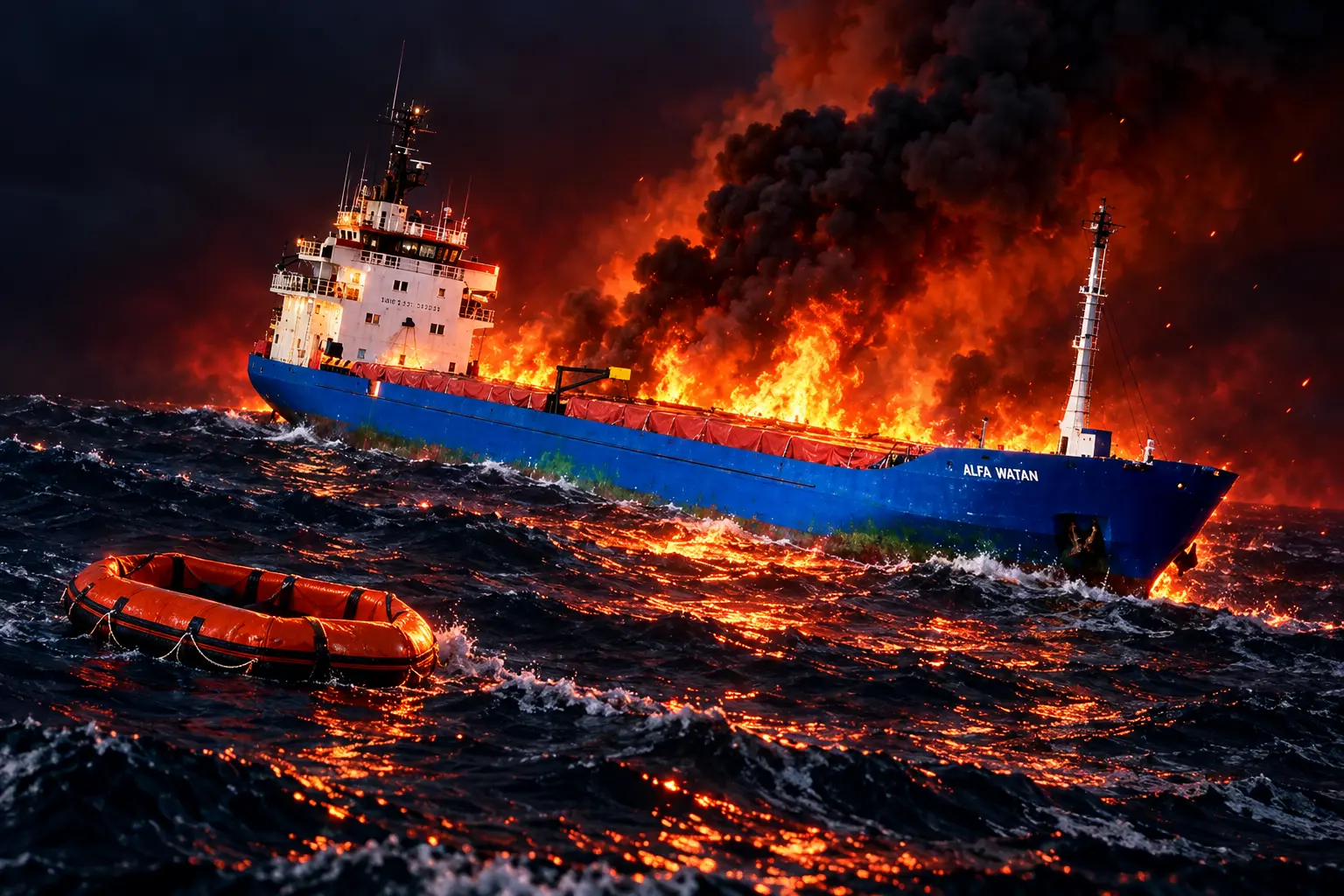
Drones sank the Alfa Watan in Bulgaria’s EEZ on October 6, and Sofia says NATO treaties do not cover that water.

A Togo-flagged cargo ship sank in Bulgaria’s Black Sea economic zone after a drone strike on October 6, and Sofia said NATO treaties do not apply. The Togo-flagged cargo ship Alfa Watan went down about 70 nautical miles (about 130 km) east of Byala, and its crew was still missing on the morning of October 7.
Prime Minister Rumen Radev called the strike a blatant breach of maritime law, then said Articles 4 and 5 of the North Atlantic Treaty do not cover an exclusive economic zone. A second ship, the Palau-flagged Able, caught fire nearby. Its 18 sailors got off. Two were hurt. The war did not cross a NATO beach. It sat in water Sofia still calls neutral, and Bulgaria had to search it anyway.
The Alfa Watan Had Three Minutes
Chief of Defence Admiral Emil Eftimov, speaking on Bulgarian National Television, said the sunken ship’s crew had three minutes to react, which is why no one launched a proper abandon-ship drill that rescuers could follow. Sea drones and air drones both hit. Radev said the crews themselves confirmed that mix.
THE STRIKE CLOCK OFF BYALA
- 2:54 a.m., October 6: The Maritime Rescue Coordination Centre in Varna takes an alert from the motor vessel Alfa Watan.
- 3:05 a.m.: The Bulgarian ro-ro ferry Dioscuria sees aerial unmanned vehicles striking the Alfa Watan, then an explosion, then the sinking.
- Around 9 a.m.: The hull drops off Border Police radar. Search teams later find an overturned boat, three rafts, and life jackets, and no people.
The Alfa Watan is a 3,160-deadweight-ton general cargo ship built in 1976, about 83 metres long, IMO 7510884. Vessel records had it bound for Sulina, Romania. Radev said it was heading north and that its cargo was not known. Shipping databases list the owner as Mersin-based Baraka Shipping. Radev did not give a headcount for the missing crew, and no official figure has been published.
Dioscuria, IMO 7931997, had been on a Constanta-to-Varna run and turned toward the blast. A navy fast craft and Border Police boats followed. The Air Force put up a Su-25 for a first look, then two Cougar helicopters. Eftimov said the jet saw the burning second ship and the rafts from the wreck. That was the start of a search that, by the morning of October 7, had still found no one from the Alfa Watan.
Why NATO Treaties Stay Dark in an EEZ
An exclusive economic zone is not sovereign territory. Bulgaria has resource rights there, and other states keep freedom of navigation. Radev said that legal status rules out NATO’s Article 4 consultations and Article 5 collective defence, even as Sofia flies search helicopters through the same water.
Bulgaria’s EEZ in the Black Sea covers just over 29,000 sq km, about 6% of the basin. The territorial sea ends at 12 miles. The strike sat far outside that line. Radev told reporters the site was about 130 km from the coast, inside the EEZ, and still treated as neutral water. He said Bulgaria has already seen worse hits inside territorial waters, and that this case is not a treaty trigger.
We have much more serious attacks inside territorial waters. Keep in mind that this is 130 km from our coast; it falls within our exclusive economic zone, but these are considered neutral waters.
Rumen Radev, Prime Minister of Bulgaria, to reporters in Sofia
He had already briefed EU Council members by video and said the matter was raised with NATO. He still saw no basis to invoke the articles. The North Atlantic Treaty’s collective defence under Article 5 treats an armed attack on one ally as an attack on all, but the attacked ally has to request or accept that step, and the strike has to fit the treaty’s map. These hulls flew Togo and Palau flags, not a NATO ensign, and they were not in Bulgarian territorial sea.
Ivaylo Mirchev, co-chair of Yes Bulgaria, said Radev was mixing the two articles on purpose. Article 5 is collective defence after an armed attack. Article 4 is only consultations when a member thinks its security is at risk. Mirchev argued that an EEZ is not nobody’s water, and that Sofia has every right to put the security question to allies without asking for a war declaration. Radev’s choice was to brief and stop there.
Eftimov described the operational split in plain terms. Navy powers run to the 12-mile territorial sea, then a contiguous zone where the fleet can help other agencies. In the EEZ, the Air Force carries the national search-and-rescue plan. That is how a NATO navy can be a few hours from a sinking and still have no patrol duty on the water where the drones hit.
Eighteen Sailors Made It Off the Able
The second target, the Palau-flagged Able, IMO 9001136, is a 7,416-deadweight-ton general cargo ship in the fleet of Istanbul-based Ocean Eagle. Radev said it was carrying wheat and heading south. Its last reported position was 5 nautical miles (about 9 km) from the Alfa Watan. After the strike a fire spread, and all 18 people on board left the ship.
THE TWO HULLS HIT BEFORE DAWN
| Ship | Flag and size | What happened | People on board |
|---|---|---|---|
| Alfa Watan | Togo, 3,160 dwt, built 1976 | Critical hull damage, sank | Crew missing; official number not given |
| Able | Palau, 7,416 dwt | Fire, ship abandoned | 18 rescued: 11 Turkish, 7 Indian |
Dioscuria took the Able’s crew off the water. A navy craft then embarked the two more seriously hurt men, one with burns and one with a head injury, for the Naval Hospital in Varna. Varna Regional Governor Mario Smarkov said a mechanic had burns covering 45% of his body and was in critical condition. The Turkish captain had injuries to his head, chest, and left leg and was later released. The other 16 arrived in Varna on a Border Police boat, 10 of them Turkish and six Indian. Inspector Ivan Ivanov, commanding that boat, said they were exhausted, tired, and stressed, and otherwise in fair shape.
Radev put the state’s duty in the EEZ without waiting for a culprit. Bulgaria, he said, is responsible for the health and lives of anyone navigating in that zone, whoever launched the drones, and therefore has to run emergency search and rescue. Sea state was light, one to two degrees Douglas, with visibility of more than 10 nautical miles. The empty rafts were still the only trace of the first ship.
London’s War-Risk List Already Covered Byala
The drones did not surprise the London hull market. On September 16 the Joint War Committee issued circular JWLA-035, widening the Black Sea listed area from waters off Russia and Ukraine to almost the whole basin. Insurer notices that reproduced the war-risk listed areas dated September 16 kept one carve-out: the territorial waters of Türkiye, Romania, Bulgaria, and Georgia. Those belts run only 12 nautical miles from shore. The Byala strike, at about 70 nautical miles, sat inside the new box.
WHAT THE SEPTEMBER LIST ALREADY SAID
- The circular: JWLA-035 lists the Black Sea except territorial waters of adjoining states other than Russia and Ukraine.
- The count: Maritime risk firm Ambrey found that 45 merchant vessels were struck outside the old listed area in the 12 months to September 21, against none in the year before.
- The ports: Ambrey recorded port strikes rising from 21 to 139 quarter on quarter, and judged it highly likely the open Black Sea stays a contested operating area through the rest of 2026.
- The price: A listing is not a ban. Underwriters can demand separate war-risk cover and an extra premium, set ship by ship.
Radev said the attacks were already disrupting Black Sea shipping, pushing insurance costs higher, and making traffic extremely difficult. That line landed after the market had already redrawn the map. Ambrey’s note said the listing followed the threat rather than anticipating it. The western basin was on the board before the Alfa Watan’s rafts went in the water.
Zelensky Names Russia and Sofia Will Not
Radev would not name a state. Later on October 6 he said it was not clear where the drones came from, “but they were clearly either Russian or Ukrainian.” Defence Minister Dimitar Stoyanov said wreckage would be needed to type the drones. Eftimov said the same: to determine the type, he would need to see the remains. He also said he was in contact with NATO operational structures, and that no NATO country has enough surveillance and anti-drone defence.
Ukrainian President Volodymyr Zelensky, in his nightly address, said Ukraine’s forces were not operating in that part of the sea. He said Ukraine’s navy had checked with Bulgarian counterparts and that the strike was a Russian combined attack with sea and aerial drones, part of an effort to make the western Black Sea unsafe for navigation. Moscow had not commented on the Bulgarian incident in public statements issued that day.
WHERE OFFICIALS DIVERGE
- Radev: The drones were either Russian or Ukrainian, the water is neutral, and Articles 4 and 5 stay unused.
- Zelensky: Ukraine was not in that part of the sea; contacts with the Bulgarian navy point to a Russian air-and-sea strike.
- Mirchev: Article 4 consultations do not require a territorial hit, and mixing them with Article 5 is a way to avoid asking allies to talk.
European Commission President Ursula von der Leyen wrote that the situation in the Black Sea is increasingly concerning, that commercial ships and innocent crews are being targeted, with lives already lost at sea, and that attacks on civilian shipping are unacceptable. She said the exact circumstances were still being established and that the EU stands with member states on the eastern flank. That is a political line, not a treaty trigger, and it matches Sofia’s choice to condemn the strike without asking Brussels or Brussels, Virginia, for a binding step.
President Iliana Iotova scheduled a meeting of the Consultative Council for National Security for October 7 on maritime security and critical infrastructure. Radev had argued that such a session can become a platform for what he called stupid theories. The political fight in Sofia is over whether an EEZ sinking is an alliance event or a coast-guard problem with better headlines.
Grain Ships Now Burn West of Ukraine
The Byala attack was the first reported drone strike on merchant ships inside Bulgaria’s EEZ. It was not the first sinking of the week, and it was not a hit on a ship coming out of Odesa. The Alfa Watan was northbound toward Romania. The Able was southbound with wheat. Neither needed a Ukrainian berth to be in the blast radius.
THREE CIVILIAN HULLS IN TWO DAYS
- October 5, Romania’s EEZ: The Turkish-owned Royad Mammadov, flying the flag of Saint Kitts and Nevis, caught fire and sank about 20 nautical miles off the coast near the Pescăruș platform while carrying corn from Izmail toward Italy. Romanian authorities said two people died and 11 were rescued. Zelensky blamed two Russian drones and said the captain was among the dead.
- October 6, Alfa Watan: Togo flag, Turkish-owned, sank east of Byala. Crew missing.
- October 6, Able: Palau flag, Turkish-owned, wheat cargo, fire, 18 off, two badly hurt.
Flags of Togo, Palau, and Saint Kitts put these ships outside any NATO navy’s duty to defend a national ensign. The crews still came from Turkey and India, the cargo still moved grain, and the search still fell on Bulgaria because the wreck was in its EEZ. That is the cheap-flag bargain in a drone war: a registry that will take the fee, and no fleet that will take the shot.
A separate strike the same Tuesday near Odesa killed one crew member and injured seven on a Marshall Islands-flagged ship, according to Ukrainian regional officials. The western basin is no longer a quiet bypass around that fight. Ordinary north-south runs off Bulgaria and Romania now sit on the same risk list as the approaches to Greater Odesa.
Bulgaria’s Navy Stops at 12 Miles
Eftimov’s map is the part that will last after the rafts are towed in. The navy’s writ stops at 12 miles. Past that line, Bulgaria can search, sample for oil, and talk to NATO. It cannot treat a foreign-flag wreck as an attack on the republic, and Radev has said he will not ask the alliance to pretend otherwise. The Su-25 and the Cougars still have to fly the box, because people may be in the water, and because a leak would be Sofia’s problem even if the missile was not.
Radev has warned for some time that if the war is not halted, it will widen its map and raise the chance of a larger clash. On October 6 that widening was a pair of small dry-cargo ships, a ferry that turned toward a flash, and a legal category that lets drones hunt in a NATO member’s economic zone without lighting Article 5. The alliance was informed. The helicopters went anyway.
By the morning of October 7, the search still had the picture Dioscuria logged before dawn: an overturned boat, three rafts, and life jackets, and no one from the Alfa Watan.

Nvidia RTX Spark Laptops Make Local AI a RAM Bill

A Drone Strike in Bulgaria’s EEZ Leaves NATO Idle

Sharma Unwinds Game Pass After Xbox Hit Freefall

Shawn Layden Says Sony’s Disc Cut Hits the Faithful 20 Percent

The EU Cabin Bag Law Frees Only a Personal Item

Thameslink Will Pad 60,000 Ironing-Board Seats From 2027

Micron Sells the Memory Shortage as Five-Year Contracts

Royal Caribbean Sends Los Angeles Ships to Singapore and Brisbane

Burger King Rebuilds Chicken Nuggets After Calling Them Rubbery

U.S. Forces Clear Hormuz Mines, Then Hit Minelayers Again
-
 NEWS1 month ago
Thameslink Will Pad 60,000 Ironing-Board Seats From 2027
-
 NEWS1 month ago
Micron Sells the Memory Shortage as Five-Year Contracts
-
 NEWS1 month ago
Royal Caribbean Sends Los Angeles Ships to Singapore and Brisbane
-
 BUSINESS1 month ago
U.S. Forces Clear Hormuz Mines, Then Hit Minelayers Again
-
 BUSINESS1 month ago
Burger King Rebuilds Chicken Nuggets After Calling Them Rubbery
-

 NEWS1 month ago
Twenty Controllers Closed Norwich Airport for a Bank Holiday
-

 BUSINESS1 month ago
Sweetmore Bakeries Buys Fantasy Baking for Bar Work
-

 SCIENCE3 years ago
How Tall Was Adolf Hitler Really? Debunking the Myth of his Height