
NEWS
Nvidia RTX Spark Laptops Make Local AI a RAM Bill
Nvidia RTX Spark laptops start at $2,599, but 24GB configs cannot hold the 120B models in the ads. The 128GB machines run to $6,999.99.

Nvidia RTX Spark laptops from Microsoft, Asus, Dell, HP, Lenovo and MSI are on preorder from $2,599, and a loaded Asus ProArt P16 lists at $6,999.99. Preorders opened October 7, with the first U.S. boxes due October 16.
The cheap-looking number is an 18-core machine with 24GB of unified memory and, on Microsoft’s base Surface Laptop Ultra, 512GB of storage. Nvidia and Microsoft sell the same family as a way to run 120 billion parameter models at home. That job lives in the 48GB, 64GB and 128GB builds, where the invoice jumps by four figures before anyone loads a file.
The 24GB Machine Behind the $2,599 Pitch
RTX Spark is Nvidia’s N1X superchip for Windows 11. The full part pairs a 20-core Grace CPU with a up to 128 GB of LPDDR5X memory pool and a 6,144-core Blackwell RTX GPU. A second laptop part drops to 18 cores and 5,120 GPU cores and tops out at 64GB. Both sit in a 45W to 80W envelope. Compact desktops use the bigger chip at 140W and are due in November.
CPU and GPU share one memory pool, the same idea as Apple silicon. Nvidia rates the platform at up to one petaflop of FP4 AI math when sparsity is on, and says it can hold models up to 120 billion parameters with a 1 million token context. Microsoft’s product page repeats that models up to 120 billion parameters can run locally with CUDA. Those claims assume you bought enough of the pool.
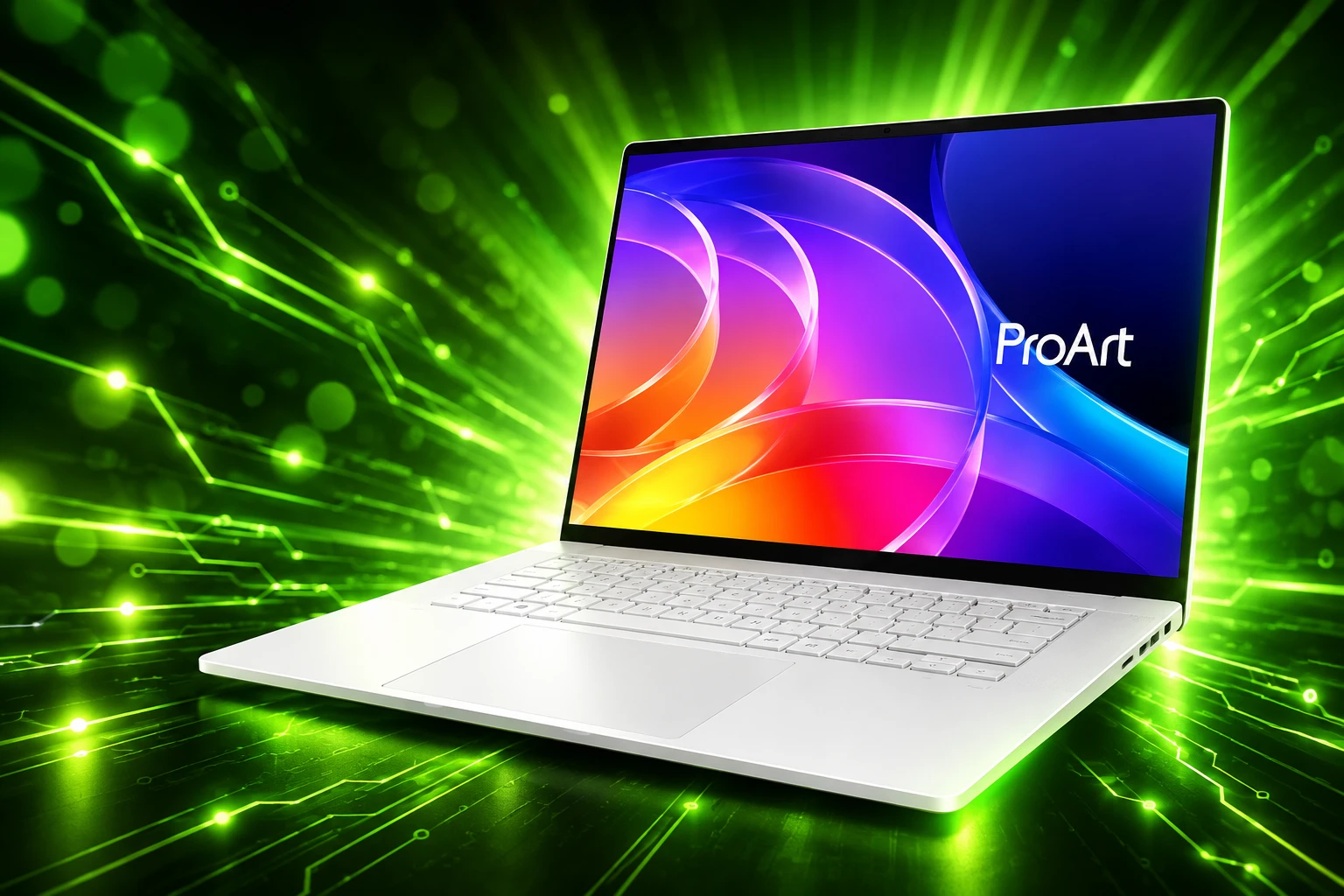
Microsoft’s $2,599 Surface Laptop Ultra is the 18-core chip, 24GB, and 512GB. Asus lists the 14-inch ProArt P14 from $2,599.99 and the 16-inch ProArt P16 from $2,799.99. Dell’s XPS 16 Creator Edition opens at $3,799.99 with 32GB and a 512GB drive. HP’s listings put the OmniBook X 14 at $2,999.99 (18-core, 32GB, 1TB) and the OmniBook Ultra 16 at $3,199.99, with 20-core, 64GB, 2TB builds at $4,499.99 and $4,999.99.
THE FIRST WAVE ON PREORDER
- Microsoft: Surface Laptop Ultra, a 15-inch mini-LED laptop under 18 mm and under 4.5 lb, from $2,599.
- Asus: ProArt P14 from $2,599.99 and ProArt P16 from $2,799.99, OLED panels, up to $6,999.99.
- Dell: XPS 16 Creator Edition from $3,799.99 at Best Buy, 32GB in the posted config.
- HP: OmniBook X 14 and OmniBook Ultra 16, 32GB at the listed openings.
- Also named for October 16: Lenovo Yoga 9n 2-in-1 and MSI Prestige N16 Flip AI+, without public U.S. prices in the first wave.
Acer and Gigabyte are on Nvidia’s partner list too. Compact desktops, including Microsoft’s Surface RTX Spark Dev Box at $5,999 and Asus’s later ProArt GR1X, follow after the laptops.
How Much Unified Memory Local Models Need
Soldered unified memory is the spec you cannot fix later. A 4-bit 70 billion parameter model occupies about 42GB of weights before context and runtime. A 120 billion parameter model at 4-bit is about 60GB. The 24GB box is a 20 billion to 32 billion class machine if you want the whole model resident.
That split is why the ads and the opening SKU do not describe the same computer. Nvidia’s 120 billion parameter line needs the high-capacity builds. A 24GB RTX Spark laptop still has CUDA and a Blackwell GPU, which is enough for smaller local models, image tools, and a lot of creative work. It is not the machine in the 120 billion parameter sentence.
WHAT FITS AT 4-BIT, IN PRACTICE
| Unified memory | Comfortable local load | Where it sits in this wave |
|---|---|---|
| 24GB | About 20B to 32B models at 4-bit; 70B only with ugly compression or offload | Surface and Asus opening SKUs |
| 32GB | 32B-class with more context; still short of a clean 70B | Dell $3,799.99 XPS 16; HP 14-inch opening |
| 48GB | 70B at 4-bit with a tight context window | Surface at $3,999; Asus mid configs at retail |
| 64GB | The honest floor for a single 70B at 4-bit | Surface $4,299 (1TB) and $4,699 (2TB); 18-core chip’s ceiling |
| 128GB | 120B-class mixture-of-experts models plus context | Surface $5,899; Asus ProArt P16 $6,999.99 |
Demos that “fit” a huge model often do it with aggressive compression. Fitting weights in RAM is the headline. Quality on your actual prompts is a different test, and that test is not public yet because review hardware has not shipped.
$1,600 Extra for the Jump to 128GB
Microsoft Store listings spell the tax out in eight rows. Storage moves a few hundred dollars. The 18-core to 20-core step at 32GB and 1TB is $400. Doubling memory from 64GB to 128GB, still at 1TB, is $1,600.
SURFACE LAPTOP ULTRA STORE LADDER
| Chip | Memory | Storage | Price |
|---|---|---|---|
| 18-core, 5,120 GPU cores | 24GB | 512GB | $2,599 |
| 18-core, 5,120 GPU cores | 24GB | 1TB | $2,999 |
| 18-core, 5,120 GPU cores | 32GB | 1TB | $3,299 |
| 20-core, 6,144 GPU cores | 32GB | 1TB | $3,699 |
| 20-core, 6,144 GPU cores | 48GB | 1TB | $3,999 |
| 20-core, 6,144 GPU cores | 64GB | 1TB | $4,299 |
| 20-core, 6,144 GPU cores | 64GB | 2TB | $4,699 |
| 20-core, 6,144 GPU cores | 128GB | 1TB | $5,899 |
There is no 128GB build with a 2TB drive on that list. The flagship memory SKU is stuck at 1TB. Best Buy’s 48GB Surface at $3,999.99 matches the 48GB row. Microsoft’s own page also offers up to $1,000 back on a qualifying MacBook trade-in through November 23.
Asus is where the ceiling actually sits. A ProArt P16 with the 20-core chip, 128GB, and 2TB is $6,999.99. Configs from 24GB through 48GB go through the Asus eShop and Best Buy. The 64GB and 128GB builds stay on those two, with the 128GB machine also headed to Micro Center.
Memory Makers Set These Stickers
Nvidia did not invent a $7,000 laptop class in a vacuum. PC memory has been pulled toward high-bandwidth stacks for data-center accelerators, which use several times the wafer area per gigabyte of ordinary DRAM. Laptop LPDDR and DDR5 then get what is left, at a much higher bill.
HP has said memory now makes up about 35 percent of a PC’s component cost, up from 15 to 18 percent a quarter earlier. Lenovo, Dell, HP, Acer and Asus have already warned of notebook price increases in the 15 to 20 percent range this year. High-end configs can move more than that because they ship more of the scarce part.
THE BILL INSIDE THE CHASSIS
- HP’s split: Memory at about 35 percent of component cost, versus 15 to 18 percent one quarter earlier.
- OEM warnings: 15 to 20 percent notebook price increases across the big Windows brands.
- The Spark delta: $1,600 to go from 64GB to 128GB on the Surface, same 1TB drive.
- The wall: Memory makers have said PC and phone DRAM tightness runs through 2027, and some through 2028.
That is why 128GB is both the product and the penalty. Local AI on a laptop is a capacity problem first. Capacity is exactly the part of the bill of materials that AI data centers have bid up.
Apple’s $2,199 Floor Includes 1TB
The comparison everyone reaches for is the 14-inch MacBook Pro. Apple’s March launch put the 14-inch MacBook Pro with M5 Pro starts at $2,199, with 1TB as the standard drive on M5 Pro. The 16-inch M5 Pro starts at $2,699. M5 Max starts at $3,599 for 14-inch and $3,899 for 16-inch, with 2TB standard.
A $2,599 Spark laptop with 24GB and 512GB is not a steal against that floor. You pay a little more, you get half the storage, and you still cannot load the 120 billion parameter models in the Windows ads. Apple also includes 1TB on the cheaper M5 Pro while Microsoft charges $400 to go from 512GB to 1TB on the 24GB Surface.
Memory ceilings diverge in a way that favors Spark only after you spend. M5 Pro stops at 64GB, with up to 307 GB/s of bandwidth. M5 Max reaches 128GB at up to 614 GB/s. Spark’s 20-core laptop chip also reaches 128GB. The related DGX Spark desktop, the Linux twin on similar Grace Blackwell silicon, is rated at about 273 GB/s on LPDDR5X. Nvidia has not posted a matching bandwidth number for N1X. Token generation is usually limited by that pipe, not by the petaflop slide.
John Ternus, Apple’s senior vice president of Hardware Engineering, said MacBook Pro with M5 Pro and M5 Max lets professionals “run advanced LLMs on device” while keeping battery life. Spark’s counter is CUDA, DLSS, and a 128GB Windows pool. Those are different products once you leave the 24GB row.
CUDA on Grace, in a Thin Windows Laptop
The chassis work is real. Surface Laptop Ultra is a 15-inch 3:2 mini-LED touchscreen at 262 ppi and up to 2,000 nits peak HDR, with a haptic pad Microsoft says is more than 30 percent larger than the last Surface Laptop, three USB-C ports, USB-A, HDMI, a full-size SD reader, and a magnetic breakaway USB-C charger. Storage is replaceable. Asus cut the ProArt P16 to 12.9 mm and 1.77 kg with a 99Wh battery, and the P14 to 13.9 mm and 1.48 kg. Both use Lumina Pro OLED panels at up to 1,600 nits.
Pavan Davuluri of Microsoft put the memory claim in one line at the Windows event in San Francisco:
We built Surface Laptop Ultra around NVIDIA RTX Spark. With up to 128 gigs of unified memory and up to a petaflop of AI compute, you can run models on this laptop that simply don’t fit on a traditional machine.
Pavan Davuluri, Microsoft, Windows AI and Surface event, San Francisco
Grace is Arm. These are Windows on Arm machines, not another generation of x86 laptops with a discrete GPU. Translation for older apps, anti-cheat in multiplayer games, and driver maturity are the software risks that sit next to the spec sheet. Early N1X Cinebench chatter already has people comparing it with last year’s Apple parts rather than with a 16-inch MacBook Pro M5 Max, which is the honest money rival once you buy 128GB.
WHAT YOU ARE ACTUALLY BUYING
- The GPU link: Blackwell talks to the CPU and memory controller over NVLink-C2C at 600 GB/s, then shares LPDDR5X with the CPU. It is not a 5070-class card with its own GDDR.
- The 18-core cap: Nvidia’s own table stops that SKU at 64GB, so the $2,599 machine cannot be optioned to the 120B tier.
- The solder: Unified memory is on-package. The 24GB buyer cannot add the 128GB later.
- The software: CUDA is native, which is the point for developers. Classic x86 Windows apps still depend on Arm translation.
Asus is pitching ComfyUI and Nous Research’s Hermes agent as the local creative stack, with MuseTree running FLUX and Wan on the machine. Dillon Rolnick, CEO of Nous Research, said ProArt RTX Spark PCs “provide the memory capacity to run powerful models locally.” That sentence is doing a lot of work. Memory capacity is the line item that turns a $2,599 laptop into a $5,899 or $6,999.99 laptop.
October 16 Is the First Ship Date
Microsoft, Nvidia and the PC makers opened preorders on October 7. Asus says first U.S. units on October 16 for ProArt P16 and P14. Microsoft gives the same date for Surface Laptop Ultra. Compact desktops are slated for November, with Microsoft’s Dev Box at $5,999 and Asus’s GR1X later in the year, mostly in 64GB and 128GB form.
THE SHIP CALENDAR
- October 7, 2026: Preorders open for RTX Spark laptops from Microsoft, Asus, Dell, HP, Lenovo and MSI.
- October 16, 2026: First U.S. shipments for Surface Laptop Ultra and the ProArt P14 and P16.
- November 2026: Compact RTX Spark desktops go on sale, including Microsoft’s $5,999 Dev Box.
- Later in 2026: Asus ProArt GR1X mini PC arrives through select retailers, aimed at 64GB and 128GB buyers.
Independent reviews will have to show whether the 20-core chip at 45W to 80W holds a 70B or 120B model at a usable token rate, and whether Windows on Arm stays out of the way. Until those numbers exist, the buying choice is simpler than the keynote. Pay $2,599 for a 24GB CUDA laptop that matches a Mac on price and loses on storage, or pay $1,600 more than a 64GB Surface, and up to $6,999.99 at Asus, for the memory the local-AI pitch actually uses.

Nvidia RTX Spark Laptops Make Local AI a RAM Bill

A Drone Strike in Bulgaria’s EEZ Leaves NATO Idle

Sharma Unwinds Game Pass After Xbox Hit Freefall

Shawn Layden Says Sony’s Disc Cut Hits the Faithful 20 Percent

The EU Cabin Bag Law Frees Only a Personal Item

Thameslink Will Pad 60,000 Ironing-Board Seats From 2027

Micron Sells the Memory Shortage as Five-Year Contracts

Royal Caribbean Sends Los Angeles Ships to Singapore and Brisbane

Burger King Rebuilds Chicken Nuggets After Calling Them Rubbery

U.S. Forces Clear Hormuz Mines, Then Hit Minelayers Again
-
 NEWS1 month ago
Thameslink Will Pad 60,000 Ironing-Board Seats From 2027
-
 NEWS1 month ago
Micron Sells the Memory Shortage as Five-Year Contracts
-
 NEWS1 month ago
Royal Caribbean Sends Los Angeles Ships to Singapore and Brisbane
-
 BUSINESS1 month ago
U.S. Forces Clear Hormuz Mines, Then Hit Minelayers Again
-
 BUSINESS1 month ago
Burger King Rebuilds Chicken Nuggets After Calling Them Rubbery
-

 NEWS1 month ago
Twenty Controllers Closed Norwich Airport for a Bank Holiday
-

 BUSINESS1 month ago
Sweetmore Bakeries Buys Fantasy Baking for Bar Work
-

 SCIENCE3 years ago
How Tall Was Adolf Hitler Really? Debunking the Myth of his Height