
NEWS
Russian Missiles Fell Beside Europe’s Postwar Ukraine Force
Russian missiles hit Poland near a European postwar Ukraine force the same week U.S. envoys sold NATO-like guarantees.

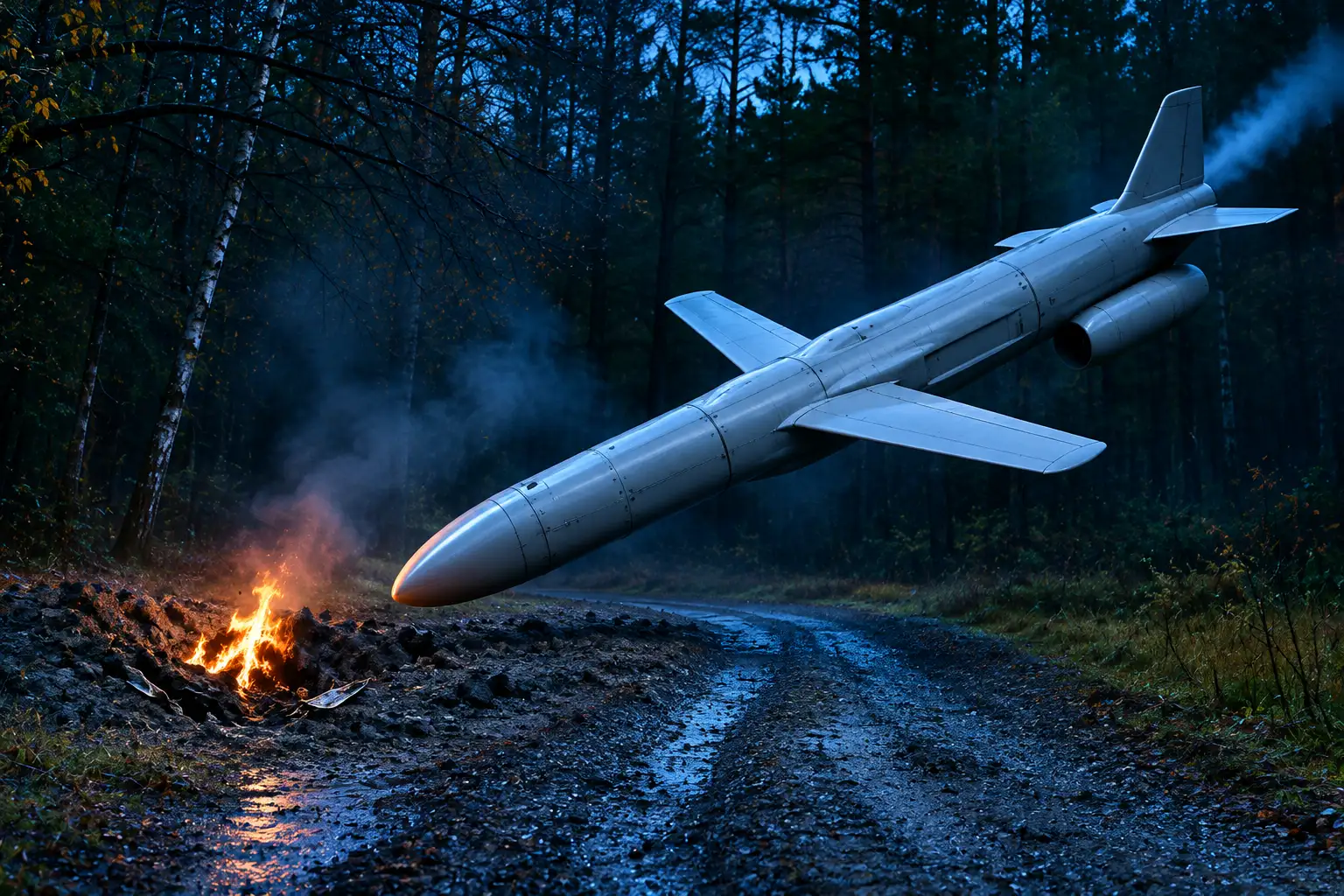
Two Russian cruise missiles and a jet-powered drone came down in southeastern Poland on Friday, November 20, before dawn. Prime Minister Donald Tusk said the crashes looked like an intentional provocation, timed to a European drill for a postwar Ukraine force.
NATO Secretary-General Mark Rutte called the episode a grave violation of Polish airspace and is due in Warsaw on Saturday, November 21. No one was hurt.
Three Objects Came Down Before Dawn
The Polish military had been watching a large Russian raid on Ukraine since 1:40 a.m. Lt. Gen. Ireneusz Nowak, the operational commander, said 11 objects came close enough to threaten Polish airspace and that three of them crossed it. Defence Minister Władysław Kosiniak-Kamysz identified a Kh-101 cruise missile at Nowy Lipowiec in Biłgoraj County, a second object he also described as a missile at Rudnik nad Sanem, and a likely jet-powered drone at Mołodycz.
The Kh-101 came down about 6:30 a.m., about 50 kilometers from the Ukrainian border. Natalie Szponar, who lives nearby, said she was getting her children ready for school when she heard “a whistle and a dull impact.” Farm cameras caught a flash in the trees. Tusk later told reporters the rest in one breath.
Three Russian objects violated Polish airspace. They fell on Polish land. One exploded. There is no destruction, no casualties.
Donald Tusk, Prime Minister of Poland, Warsaw press conference
The defence ministry’s own readout made the same point: no casualties and no damage to critical infrastructure. Polish F-16s and Swedish Gripens flew overnight with a Dutch tanker and a Polish Saab early-warning aircraft. Patriot batteries around Rzeszów-Jasionka Airport and near Świdnik went active, as did Poprad and Pilica+ short-range batteries. The control tower at Jasionka, a logistics gate for aid into Ukraine, was emptied. Kosiniak-Kamysz called the raid on Ukraine, with its spill onto Polish ground, one of the largest since the full-scale war began in February 2022.
THE NIGHT OF NOVEMBER 20
- 1:40 a.m.: Polish forces log the first alerts as Russia opens a large air attack on Ukraine.
- About 6:30 a.m.: A Kh-101 comes down at Nowy Lipowiec; two more objects fall at Rudnik nad Sanem and Mołodycz.
- Friday morning: Tusk convenes ministers, generals, and security services and tells the country the objects are Russian.
- Friday afternoon: Five coalition defence ministers still go to the Nowa Dęba range as planned.
Ukrainian President Volodymyr Zelenskyy said the same night’s strikes killed at least eight civilians in Ukraine and wounded more than two dozen. Apartment blocks, clinics, warehouses, and three bridges were hit, and power cuts spread after strikes on plants and lines. That is the raid the Polish objects rode in on. It is not the part Warsaw is treating as chance.
The Postwar Force on the Nowa Dęba Range
The crashes landed in the same southeastern belt as Koalicja 26.2, the first major field exercise of the Multinational Force-Ukraine. The force, built by the Coalition of the Willing and led by France and the United Kingdom, has been in the mud at Nowa Dęba since November 9. The range sits about 100 kilometers from the Ukrainian border. The drill runs through November 22.
About 2,800 troops from 11 countries are on the manoeuvre, with France sending about 1,100 and Britain about 300, plus Typhoon fighters and a Voyager tanker. Poland has put just under 2,000 of its own troops on host and logistics duty, bringing the camp to almost 5,000 people. Turkey is running a maritime piece from Istanbul rather than sending a landing force to the range. British Lt. Gen. Tom Bateman, who commands the force, said the point of the fortnight is to show a “real, capable, readily deployable force.” UK Defence Secretary Wes Streeting, who was in Poland on Friday, put it more bluntly: “This isn’t a hypothetical plan, it’s a real force, ready to help Ukraine once the fighting stops.”
KOALICJA 26.2 CONTINGENTS
| Contingent | Personnel | Role in the drill |
|---|---|---|
| France | About 1,100 | Largest national group; land lead and Rafale flyovers |
| United Kingdom | About 300 | Joint command; Typhoon and Voyager aircraft |
| Poland | Just under 2,000 | Host, logistics, and medical cover; no troops into Ukraine |
| Eight other nations | Rest of the 2,800 | Belgium, Estonia, Germany, Lithuania, the Netherlands, Spain, Sweden, Turkey |
Poland is hosting the rehearsal and has said it will not send its own soldiers onto Ukrainian territory after a ceasefire. The job, as Paris, London, and Warsaw describe it, is defensive and comes only if fighting has stopped and Kyiv asks. Instructors would help rebuild Ukraine’s army. Air patrols would try to get civilian flights back into Ukrainian airspace. Ships would help clear mines in the Black Sea. It is not a ceasefire-monitoring mission and it is not a NATO operation, even though most of the flags on the range belong to NATO states.
Kosiniak-Kamysz went to the range anyway on Friday, with his counterparts from Britain, France, Estonia, and Lithuania and with eight chiefs of staff. He said the presence of those ministers, on that day, next to those crash sites, “is no accident.” Tusk used the same map. “It is no coincidence that these objects landed near the site where military manoeuvres by a ‘coalition of the willing’ supported by Polish troops are taking place in Nowa Dęba,” he said. The exercise did not pause.
Putin Called Those Troops a Target in November
Moscow had already written the caption for this drill. On November 12, after talks with U.S. envoys Steve Witkoff and Jared Kushner, President Vladimir Putin said European troops sent to Ukraine after a peace deal would be legitimate targets and that the war would “resume immediately.” He has used that line since at least September 2025, when the coalition first talked about a force of this kind.
When Koalicja opened, Russian Foreign Ministry spokeswoman Maria Zakharova condemned the manoeuvre as proof that the West would not weigh what she called Russia’s security concerns. She went further than a protest note.
Any military units in Ukraine will be regarded by the Russian armed forces as legitimate targets, with all the risks and consequences that entails.
Maria Zakharova, Russian Foreign Ministry spokeswoman, on the Koalicja exercise
That warning is the second punch in Friday’s story. The objects did not have to kill anyone in Poland. They only had to fall in the county next to the first rehearsal of a force Putin has already said he would shoot. A British defence intelligence chief, Lt. Gen. Matthew Jones, told an audience in Cambridge later on Friday that he was confident Russia “does not actively seek war with NATO.” His fear, he said, is “the risk of a significant miscalculation,” and he listed recent reckless Russian behaviour that could have ended much worse if the geometry had been slightly different. He did not name Nowa Dęba. He did not need to.
Why the Missiles Landed During a Peace Sales Pitch
The timing sat on top of a diplomatic split that opened in public over 24 hours. On Thursday, November 19, President Donald Trump met Putin and Chinese leader Xi Jinping at a summit in China, Witkoff said. Kushner told European leaders the United States believes Russia is “comfortable” with NATO-like security guarantees for a postwar Ukraine. That line was meant to sound like movement. It is also the same U.S. channel that has floated NATO-style cover in a Donbas deal.
On Friday morning, while Polish crews were still around the craters, Russian Deputy Foreign Minister Sergei Ryabkov closed the door. “Even finding a formula for quasi-membership in NATO for Kyiv and searching for some kind of ‘creative’ solution in this area is an unacceptable option for us,” he said, in remarks carried by the state news service TASS. Security guarantees, in his telling, start with Russia’s own security. They do not start with a European force on Ukrainian soil, and they do not start with a NATO-like pledge.
The missiles did not have to refute Kushner in a communique. They only had to arrive in a NATO country on the morning Ryabkov was already saying no. The Kremlin had not, by Saturday morning, offered its own account of the three objects. The Russian embassy in Warsaw did not answer a request for comment on Friday. Silence, in that setting, is also a position.
Poland Is Asking for Radar and Extra Jets
Rutte spoke with Tusk on Friday and then wrote that NATO jets had been scrambled, that the alliance stood with Poland, and that the incident was “clearly dangerous.”
Spoke with @donaldtusk about the grave violations of Polish airspace overnight. NATO jets were scrambled in response. We stand in solidarity with Poland and will continue to strengthen our ability to deter and defend.
This incident is clearly dangerous – a consequence of…
— Mark Rutte (@SecGenNATO) November 20, 2026
Tusk asked him for practical steps on the eastern flank, “not within hours, but in the coming days and weeks.” Kosiniak-Kamysz said he would request extra forces and kit for Operation Eastern Sentry, including more airborne surveillance and allied fighters. Czech troops are already on that mission, he said, and it is not enough. He also said Polish law has been changed so that pilots and commanders can fire when the threat to civilians is clear; the choice on Friday, he said, sat with the people in the cockpits.
WHAT POLAND PUT IN THE AIR
- Fighters: Polish F-16s and Swedish Gripens stayed up through the night with a Dutch tanker on call.
- Radar aircraft: A Polish Saab early-warning plane worked the Podkarpackie and Lublin area.
- Ground batteries: Patriot units at Jasionka and Świdnik, plus Poprad and Pilica+ short-range systems, were switched on.
- On the ground: Helicopters and three Territorial Defence brigades joined the search around the crash sites.
Collective defence is still the document on the shelf. NATO’s treaty says an armed attack against one member is an attack against all 32, and that each ally then takes “such action as it deems necessary,” which may or may not mean shooting. The clause is not automatic. The attacked country has to want it, and the North Atlantic Council has to agree. NATO has used Article 5 once, after the September 11, 2001, attacks on the United States. Poland did not ask for it on Friday. It asked for radar, jets, and a secretary-general in Warsaw on Saturday.
The sharper public language is already priced in. So is the habit of stopping there. Extra surveillance and extra fighters are real. They are also the kind of reply a state can read as a probe that still has room to run.
Last Year’s Drone Wave Brought Article 4
Friday was not Poland’s first night of Russian metal in its sky. On September 10, 2025, Tusk told parliament that Polish airspace had been breached 19 times during a Russian attack on Ukraine. Polish F-16s and Dutch F-35s shot down drones that night, the first time a NATO member is known to have fired during this war. A house in Wyryki-Wola took a hit. No one died. Warsaw invoked Article 4, the consultation clause, not Article 5. Two days later, on September 12, 2025, Rutte and Supreme Allied Commander Europe Gen. Alexus Grynkewich launched Eastern Sentry along the eastern flank, a mix of fighters, ships, and counter-drone kit that is still running.
The weapon that fell at Nowy Lipowiec is a poor candidate for a lost dumb bomb. The Kh-101 is a stealthy air-launched cruise missile with a range of 2,500 to 2,800 kilometers, a 7.45-meter airframe, and a 450-kilogram conventional warhead. It flies as low as 30 to 60 meters to stay under radar, and it uses satellite and terrain matching to steer. Russian long-range aviation has been firing that family of missiles throughout the war. Calling one of them a stray is a claim that has to beat the seeker head, not just the weather.
WHERE ASSESSMENTS SPLIT
- Warsaw: Tusk and Kosiniak-Kamysz say the objects are Russian, the date is not chance, and the crashes sit next to Koalicja on purpose.
- Moscow: No public account of the three objects had been issued by Saturday morning; the embassy in Warsaw did not comment on Friday.
- London’s intelligence view: Jones says Russia is not seeking a war with NATO and that the live risk is a miscalculation that no one planned.
Koalicja 26.2 is still on the calendar through November 22. The ministers walked the range on Friday after the sirens. Rutte is due in Warsaw on Saturday, November 21, to talk about the eastern flank, not about a treaty clause Poland has not pulled. The force that would police a peace still does not have a peace to police, and the country hosting its first rehearsal has fresh holes in three fields to show for the week’s diplomacy.

Netflix Bets on 15-Minute Sitcom Minimum Wage

Quarter-Cow Shares Sell Out as Grocery Beef Stays High

Hunger Games Hits $120 Million Without a Next Film

Disney+ Puts Hulu Live TV in One App This December

Merch Builds a Parallel Closet Beside Luxury Fashion

Thameslink Will Pad 60,000 Ironing-Board Seats From 2027

How Tall Was Adolf Hitler?

U.S. Forces Clear Hormuz Mines, Then Hit Minelayers Again

Micron Sells the Memory Shortage as Five-Year Contracts

Royal Caribbean Sends Los Angeles Ships to Singapore and Brisbane
-
 NEWS3 months ago
Thameslink Will Pad 60,000 Ironing-Board Seats From 2027
-
 HISTORY3 years ago
How Tall Was Adolf Hitler?
-
 BUSINESS3 months ago
U.S. Forces Clear Hormuz Mines, Then Hit Minelayers Again
-
 NEWS3 months ago
Micron Sells the Memory Shortage as Five-Year Contracts
-
 NEWS3 months ago
Royal Caribbean Sends Los Angeles Ships to Singapore and Brisbane
-

 NEWS3 months ago
Twenty Controllers Closed Norwich Airport for a Bank Holiday
-

 BUSINESS3 months ago
Sweetmore Bakeries Buys Fantasy Baking for Bar Work
-

 BUSINESS3 months ago
L Catterton Installs a Kraft Heinz Operator at Kettle Cuisine