
NEWS
Anthropic IPO Filing Hands Control to a Seven-Founder LLC
Anthropic’s S-1 shows $16.3 billion in half-year revenue, a 50.1% founder vote, and compute bills that stay due even if usage falls.

Anthropic asked Nasdaq on October 26 to list a company its public buyers will not control. The filing shows $16.3 billion of first-half revenue and a Founder LLC that keeps 50.1% of the vote through one Class F share.
The lab behind Claude wants to trade under the ticker ANT. Cash on June 30 was $112.4 billion. The people putting up new money will own a claim on the business, not the board that runs it.
The First Public Look at Claude’s Books
Anthropic, PBC, a Delaware public benefit company, dropped its October 26 registration statement on EDGAR after months of private drafts. First-half sales were fourteen times the $1.16 billion posted a year earlier, and the June quarter was the first period in the document with an operating profit.
The filing does not set a listing price. It does set out how fast the bill for chips has grown beside that sales line.
ANTHROPIC’S REPORTED RESULTS
| Period | Revenue | Compute spend | Operating result |
|---|---|---|---|
| Full year 2025 | $4.6 billion | $7.3 billion | $8.1 billion loss |
| First half 2025 | $1.16 billion | $2.3 billion | $2.1 billion loss |
| First half 2026 | $16.3 billion | $8.9 billion | $693 million loss |
| Second quarter 2026 | $11.6 billion | $5.6 billion | $974 million profit |
Compute spending in the first half still ran close to $9 billion, but it no longer swallowed the whole company. Adjusted operating income, which strips stock pay and similar items, came in at $1.6 billion, a 10% margin. Anthropic has raised $141.1 billion to date. Short-term investments of $19.3 billion sat beside the cash.
About 5,300 people work there. The five largest customers accounted for about 25% of revenue in the first nine months of 2026, and nearly half of sales moved through Amazon Web Services, Google Cloud, and Microsoft Azure. Those cloud firms are also investors, and they are also the companies Anthropic has promised to pay for chips.
One Share Carries 50.1% of the Vote
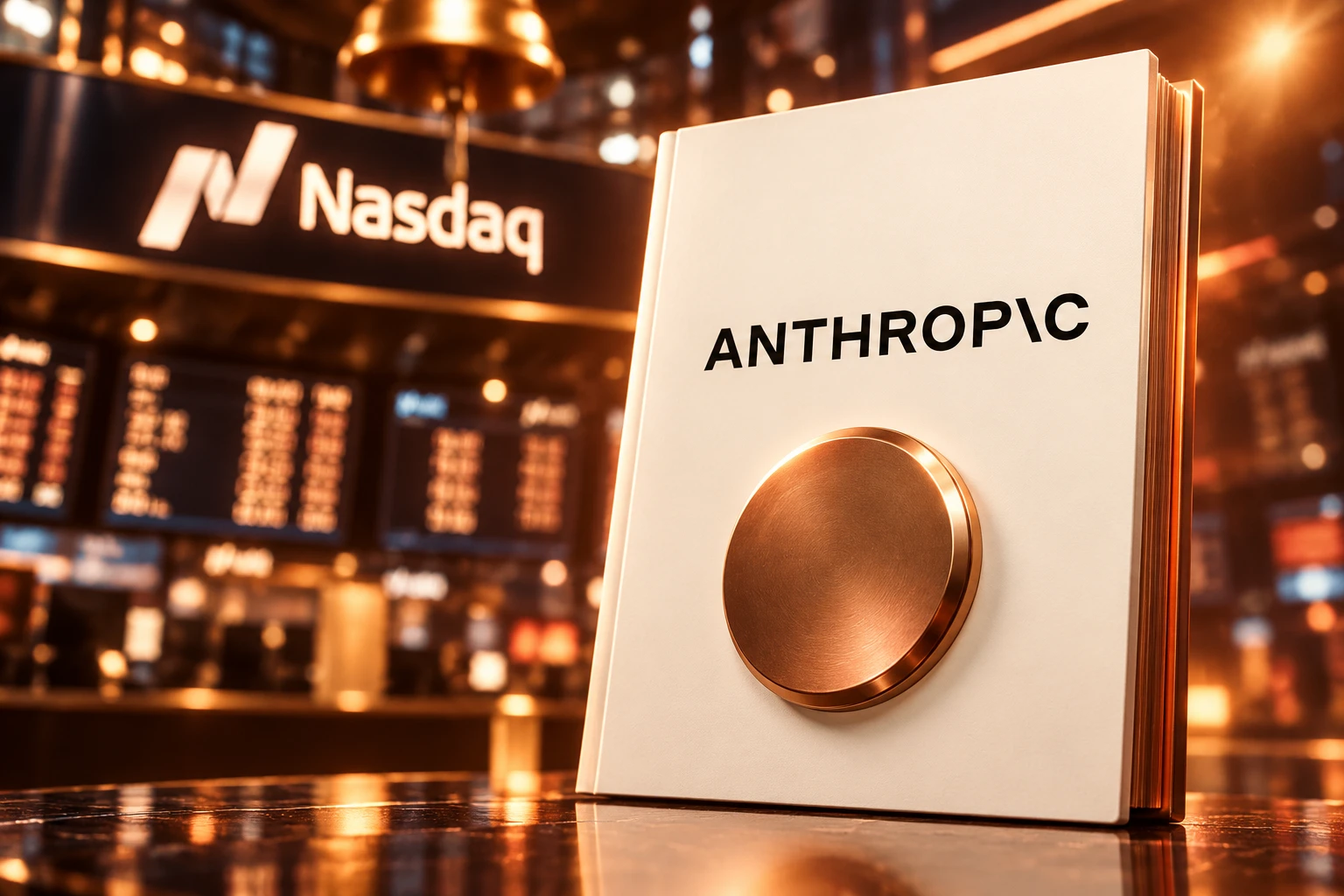
The control design is the part of the S-1 that will still bind buyers after the listing bells fade. A Founder LLC holds a single Class F share. That one share is entitled to 50.1% of the vote on general matters, including the directors the trust does not already name.
The seven members are Dario Amodei, the chief executive; his sister Daniela Amodei, the president and board chair; Tom Brown; Jack Clark; Jared Kaplan; Sam McCandlish; and Christopher Olah. A majority of those seven directs how the Class F share is voted. Benjamin Mann, often named as a co-founder, is outside the LLC and has no say over that vote.
Typical listings use high-vote stock that scales with how super-voting stock usually works, often ten votes per share, so a founder’s grip rises or falls with the pile they keep. Anthropic’s Class F unit does not work that way. It is one share, fixed at 50.1%, with no economic rights. Class A holders, the public included, split the other 49.9%.
The filing describes the co-founders as “distinctly equipped to be stewards of our mission.” Amazon and Google, early backers, are slated to receive nonvoting stock. The Class F setup lasts until a sunset the document ties to founder attrition, including a stretch in which fewer than three continuing founders remain for 90 consecutive days.
A Safety Trust Elects Four of Seven Directors
Votes on stockholder matters are only half of the lock. Board seats are the other half. After the offering, seven seats are authorized. Four are Class T seats, filled and removed by the Long-Term Benefit Trust created in 2023. Class A and Class F voting together elect the other three, named as Dario Amodei, Daniela Amodei, and Yasmin Razavi of Spark Capital.
The first Class T directors are Reed Hastings, the Netflix co-founder, as lead independent director; Vas Narasimhan, chief executive of Novartis; Christopher Liddell, the former Microsoft and GM finance chief; and one vacant seat. The trust’s Class T stock has no economic rights. Anthropic says the structure will make it a controlled company under Nasdaq rules, and that it plans to use that exemption only for its nominating and governance committee.
WHO HOLDS THE LEVERS
- Founder LLC: One Class F share carries 50.1% of the general stockholder vote and helps elect three directors.
- Long-Term Benefit Trust: Class T stock elects and removes four of seven authorized directors and has no claim on profits.
- Class A holders: Split 49.9% of the general vote and the economic upside, with no path to a board majority on their own.
- Public benefit charter: Delaware law lets the board weigh the stated AI mission beside stockholder returns, which narrows the room for a later revolt in court.
The trust is a Delaware purpose trust of five financially disinterested trustees. Neil Buddy Shah, head of the Clinton Health Access Initiative, chairs it. Richard Fontaine, a national security specialist, joined in 2025. Ben Bernanke, the former Federal Reserve chair, joined in June 2026. Christopher Stubbs, a Harvard physicist, joined in October 2026. One seat is empty, and sitting trustees pick their own replacements.
Anthropic told readers in 2023 that default company law pushes directors toward stockholder returns, and that AI may create costs and benefits the public never gets to price. The trust, it said, is meant to step in on extreme events rather than on ordinary commercial calls. Trustees serve one-year terms. Changing the arrangement later takes heavy supermajorities of the board, the trustees, or both.
Amazon’s Compute Bill Comes Due Either Way
The same filing that limits stockholder power also shows who gets paid if Claude’s growth cools. As of June 30, Anthropic had $265.6 billion of fixed or minimum commitments under noncancelable compute purchase agreements. Several of those floors are owed even if the company uses less capacity than it reserved.
In April it announced a deeper Amazon pact, committing more than $100 billion over ten years for up to 5 gigawatts of capacity. The S-1 now puts that Amazon floor at $110 billion through April 2036. Google’s floor is $114.5 billion through July 2033. Anthropic said it already uses more than one million Trainium2 chips and that more than 100,000 customers run Claude on Amazon Bedrock.
THE NAMED COMPUTE FLOORS
- Amazon: At least $110 billion from May 2026 through April 2036, due even if usage undershoots the reserve.
- Google: At least $114.5 billion from April 2026 through July 2033, written the same way.
- Company-wide minimums: $265.6 billion of fixed or minimum compute purchase commitments as of June 30.
- Fresh Amazon equity: $5 billion invested in April, with up to $20 billion more, on top of $8 billion Amazon had already put in.
Dario Amodei tied the Amazon deal to demand he said the company could not serve on the hardware it already had.
Our users tell us Claude is increasingly essential to how they work, and we need to build the infrastructure to keep pace with rapidly growing demand.
Dario Amodei, CEO and co-founder, Anthropic-Amazon compute announcement
Amazon and Google therefore sit on three sides of one trade. They hold paper in Anthropic, they sell it chips and cloud time, and they sell competing models of their own. A weak listing still leaves those contracts in force. The $112.4 billion cash pile looks like a wall until it is read against bills that run into the 2030s. Public buyers inherit that mismatch. The suppliers do not.
Why the $80.7 Billion Loss Is Mostly Paper
The headline net loss for the first half is $80.7 billion. Most of it is not cash going out the door. The filing books a $72.4 billion charge for the rising fair value of convertible notes, derivatives, and related instruments, a figure that climbed because Anthropic’s own private valuation climbed. Another $8.8 billion sits in other expense, largely tied to note purchase agreements with Google and Amazon.
Add those items back and the operating business is a different company: a $693 million operating loss for the half, and a $974 million operating profit in the June quarter. Stock-based pay was $2.2 billion in the first half. Operating cash flow, on the company’s figures, was positive.
The optics still matter, because the notes are designed to turn into stock around the listing, subject to caps the filing places on at least Amazon’s stake. If the IPO stalls, that conversion math is one of the pressures the risk factors flag. The cash is real. So is the claim the chip vendors already have on the years ahead of it.
Public Shareholders Cannot Elect the Board
Class A stock is the security Nasdaq buyers will be offered. It carries economic rights and a minority slice of the general vote. It does not elect the Class T majority. It does not direct the Class F share. It does not, on its own, strip the public benefit purpose out of the charter.
That is the bargain the S-1 is asking the market to take. Founders keep mission control through a vehicle that does not shrink as new shares are printed. Trustees with no financial stake keep a board majority. Early strategic investors take nonvoting paper and keep their supply contracts. The new money is what is being invited in.
Nasdaq buyers also inherit customer concentration they cannot fix from the outside. The largest accounts are not, on the filing’s telling, locked in for the long haul. Cloud marketplaces that already take a cut of sales can reprice access. Power for data centers is called out as a constraint. None of those knobs sit with a Class A holder who dislikes the next model delay.
94 Pages of the Filing Cover AI Risk
The prospectus runs 318 pages. Ninety-four of them go to AI risk, a share that would look odd in a ordinary software listing and looks like the point here. China appears 11 times, mostly in passing, even though open-weight models from state actors show up as a competitive and security issue. The document also flags Washington. A February clash between President Donald Trump and Amodei over wartime use of the models is in the risk factors, as is the June curb that hit Fable and Mythos after an export-control directive.
Anthropic says it does not plan to stand down from those positions, and that its own lobbying could be costly. The same pages warn that advanced systems, if misused or left too autonomous, could threaten more than a quarterly miss.
Sufficiently advanced AI systems could, if not developed, deployed, and operated with appropriate safeguards, oversight, and security measures, pose catastrophic or existential risks to humanity, particularly if such systems were misused, replicated, weaponized, or allowed to operate with a high degree of autonomy.
Anthropic, PBC, Form S-1 risk factors, filed October 26, 2026
The co-founders have already told investors they may choose to move more slowly even when that hurts them against rivals. The Class F share and the trust are how that choice survives contact with public markets. Until the Class F unit sunsets, a Nasdaq listing will change the cap table and leave the votes where they are.
Disclaimer: This article is news reporting and analysis of a public securities filing and related company statements. It is informational only and is not investment advice, a solicitation to buy or sell any security, or a recommendation on whether to participate in an Anthropic offering. Readers should consult a licensed financial adviser and read the full prospectus, including the risk factors, before acting on any investment. Figures, share classes, and listing terms reflect the October 26, 2026 registration statement and Anthropic’s own announcements and may change in later amendments or at pricing.

Josh Sinn Draws the Heaviest AFL Betting Ban Since 2019

Rolapp Shuts the PGA Door as DeChambeau Heads to Europe

Apple TV Renews Slow Horses Past the Last Novel

Oasis Lifts UK Music to £8.4 Billion as Venues Shrink

Beyoncé Hits 100 Grammy Nominations on a Vault Track

Thameslink Will Pad 60,000 Ironing-Board Seats From 2027

How Tall Was Adolf Hitler?

U.S. Forces Clear Hormuz Mines, Then Hit Minelayers Again

Micron Sells the Memory Shortage as Five-Year Contracts

Royal Caribbean Sends Los Angeles Ships to Singapore and Brisbane
-
 NEWS3 months ago
Thameslink Will Pad 60,000 Ironing-Board Seats From 2027
-
 HISTORY3 years ago
How Tall Was Adolf Hitler?
-
 BUSINESS3 months ago
U.S. Forces Clear Hormuz Mines, Then Hit Minelayers Again
-
 NEWS3 months ago
Micron Sells the Memory Shortage as Five-Year Contracts
-
 NEWS3 months ago
Royal Caribbean Sends Los Angeles Ships to Singapore and Brisbane
-

 BUSINESS3 months ago
Sweetmore Bakeries Buys Fantasy Baking for Bar Work
-
 NEWS3 months ago
Twenty Controllers Closed Norwich Airport for a Bank Holiday
-

 BUSINESS3 months ago
L Catterton Installs a Kraft Heinz Operator at Kettle Cuisine