
BUSINESS
Iran’s Didamar Claim Lands on Oman, the Quiet Broker
Iran claims a Didamar Island strike in the Strait of Hormuz while Oman denies damage and watches its mediator role come under fire.

Iran says it struck Didamar Island, a tiny Omani rock in the Strait of Hormuz that holds radar, radio gear, and a 1914 lighthouse. Three people with knowledge of the matter said navigation systems and communications equipment on the island were attacked. A senior Omani official said the aids were not hit.
The outcrop belongs to the state that has spent this war trying to talk the waterway back open. That is the part the IRGC claim actually reaches.
Smoke, Scorch Marks, and a Denial From Muscat
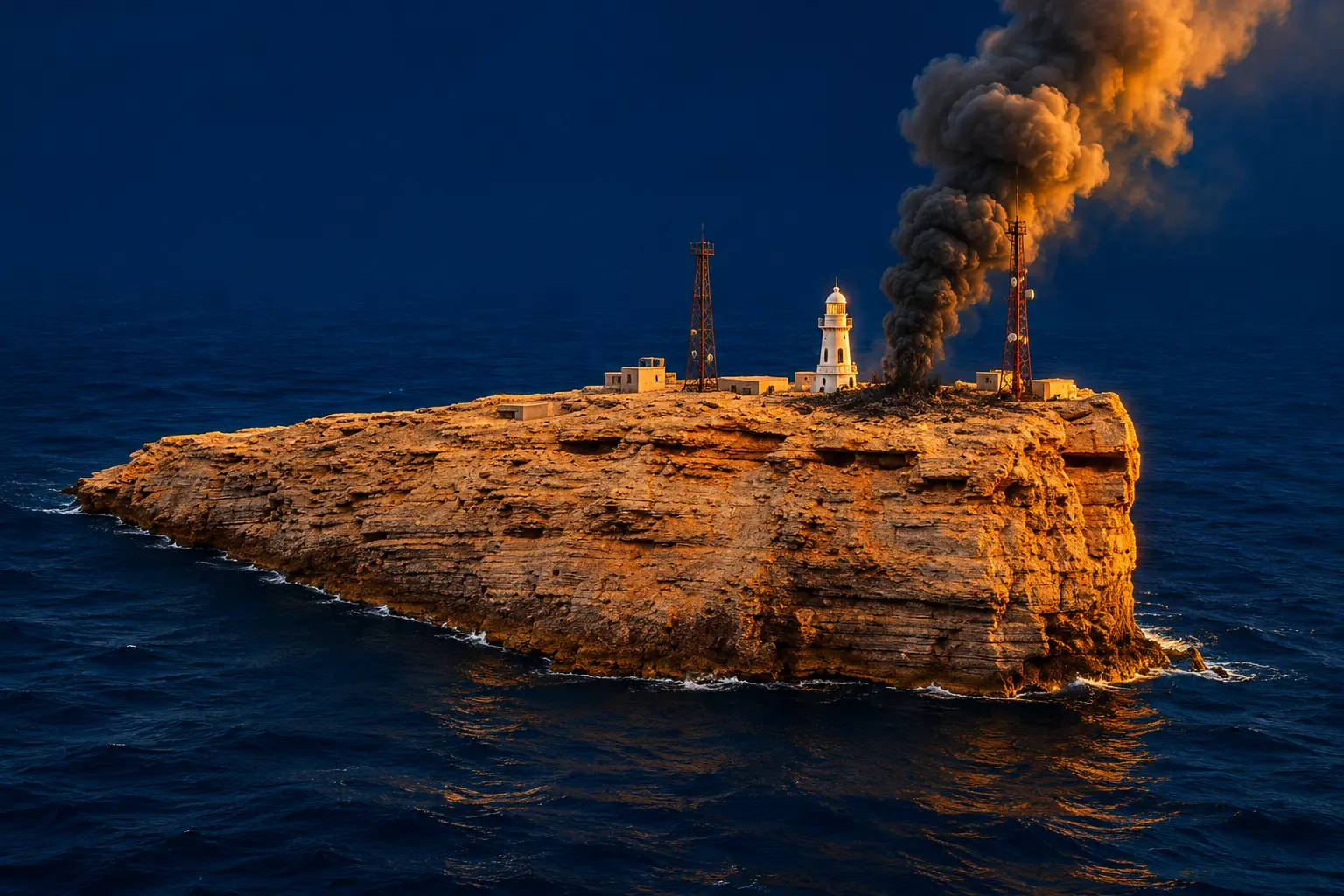
Iranian state media said on Nov. 10 that the Islamic Revolutionary Guard Corps navy had destroyed “enemy navigation systems” on Didamar, also called Little Quoin Island. An IRGC navy official said personnel and equipment there were “helping the flow of oil smuggling by the enemy,” and that no vessel Tehran treated as unauthorized crossed the southern route overnight.
Video verified by news desks showed smoke near the rock. Copernicus Sentinel-2 imagery dated Nov. 8 showed apparent scorch marks near the radar and radio gear. The Institute for the Study of War dated the attack to Nov. 8, two days before the claim, and wrote that “the extent of the damage to these systems and the systems struck remains unclear.” Commercial ships, ISW noted, kept using the southern route.
WHAT WE KNOW
- The claim: Iranian state media said the IRGC navy hit navigation aids on Didamar on the southern side of the strait.
- The sources: Three people with knowledge of the matter said navigation and communications equipment were attacked, with no damage assessment attached.
- The pictures: Smoke rose near the outcrop, and Sentinel-2 showed scorch marks by the radar and radio area on Nov. 8.
WHAT IS UNCONFIRMED
- The kill: Whether the lighthouse, the radar, or the Channel 16 radio relay actually went down has not been shown.
- The weapon: No official time, munition, or target list has been released.
- The shutdown: The IRGC claim that the southern route went dark overnight does not match later traffic.
A senior Omani official said the navigational aids had not been struck. Imagery from the morning of Nov. 10 showed no obvious damage to the lighthouse or the radio and radar masts, though thin mast damage can sit below that resolution. Some accounts said an Omani coast guard official heard an explosion near the island. CENTCOM and Oman’s media ministry did not answer questions about the incident.
University of Tehran professor Seyed Mohammad Marandi called it “a US radar/navigation site on Oman’s Didamar Island.” That line, not a cracked lamp, is the political payload. Recasting a civilian Omani aid as an American node tells Muscat that the southern corridor is now a target set.
Didamar’s Light Has Flashed Since 1914
Didamar is one of three islands about 10 nautical miles off the northern Musandam Peninsula. European crews named the wedge-shaped pair Great and Little Quoin. The Shihuh of Musandam call them mumar and didamar, mother and daughter. The rock is uninhabited, flat-topped, and sits beside the southern shipping corridor.
It holds Oman’s first lighthouse in 1914, now a solar beacon watched from Muscat. Arabian Maritime and Navigation Aids Services runs the light under a 2003 franchise with the Omani government, Royal Decree 81/2003. A 2006 refit replaced kerosene and clockwork with a rotating beacon of 23 nautical miles, monitored from the AMNAS office in Muscat. Seven keepers once rewound the mechanism every six hours. Nobody lives on the rock now.
THE LIGHT ON THE ROCK
- The lighthouse: A white 24-metre hexagonal skeletal tower flashes twice every 10 seconds, Fl(2) W 10s, out to 23 nautical miles.
- The radar: A marine radar sits on a separate tower of roughly 25 metres, used to track traffic near the southern corridor.
- The radio: A relay carries Channel 16, the international distress and calling frequency, for ships in the narrows.
In peacetime the island also hosted the Hormuz Control Centre, staffed by the Royal Navy of Oman, which marshalled traffic through the Traffic Separation Scheme. Shipping sources said a hit here would likely have a limited effect on commercial traffic, because other systems sit elsewhere. A lighthouse gives a bridge a visual fix. Shore radar tracks hulls. Radios let operators talk. Knocking one out is not the same as closing the strait.
Every Deep Channel in Hormuz Sits on Oman’s Side
The IRGC is not attacking a U.S. pier. It is pressing the coastal state that actually owns the deep water. Since 1968, an International Maritime Organization scheme has run two inbound and outbound lanes, each two nautical miles wide, split by a two-mile separation zone. A 1979 change added an inshore zone along Musandam. Analysts Noam Raydan and Farzin Nadimi, writing for the Washington Institute in August, note that the traffic lanes sit in Omani waters, and that the Iran-Oman continental shelf line left the navigable channels mostly on Oman’s side.
Under the 1982 UN Convention on the Law of the Sea, Hormuz is an international strait used for transit passage: continuous, non-suspendible, and free of a coastal state’s permission or a toll for the mere act of passing. Oman is a party to that convention. Iran is not. Tehran’s 1993 maritime law treats the strait as innocent passage, which in its reading can be limited, paused, or put behind a permit.
WHO CLAIMS WHAT IN THE STRAIT
| Issue | Oman | Iran |
|---|---|---|
| Sea-law stance | UNCLOS party, transit passage | Not a party; 1993 law uses innocent passage |
| Traffic scheme | 1968 IMO lanes in its waters | Wants the inbound lane in its waters |
| Money and permission | No tolls; later talked of voluntary service fees | Mandatory fees and prior permission |
Tehran’s preferred end state is a two-state club, Iran and Oman, with Iran holding the last word on who may enter and leave the Gulf. Muscat has pushed a wider regional setup, closer to the Malacca model of safety services and voluntary payments, and has said any deal must fit international law and the rights of other Gulf states. That gap is why a radar mast on an Omani rock is a diplomatic object, not just a technical one.
Sultan Haythim’s Minister Still Calls Tehran
Oman has been the Gulf’s quiet broker with Iran for more than a decade, including the Muscat channel that led to the 2015 nuclear deal. Sultan Haythim bin Tariq Al Said has tried to keep that role through a war that started in late February 2026, when U.S. and Israeli forces opened what Washington called Operation Epic Fury. A day before the bombs, Foreign Minister Sayyid Badr Albusaidi said a peace deal was “within our reach.” That line soured some officials in the Trump administration.
Iran then hit Omani ports and coastal sites. A Nov. 4 Congressional Research Service report by Jeremy M. Sharp counted an estimated 66 strikes against Oman between February and October, with over two dozen casualties, including 14 fatalities. After those early months, the same report said, Iran stopped hitting the Sultanate directly and kept up strikes on tankers in Omani waters. The Didamar claim, if it stands, would break that pattern.
President Donald Trump has already put Muscat on notice. In May, after Iran and Oman talked about tolls or service fees, he warned, “Oman will behave just like everybody else, or we’ll have to blow them up. They understand that. They’ll be fine.” He threatened military action against Oman twice in 2026, according to the same CRS report. The United States still uses Omani facilities, sent $1.6 billion in aid from 1946 to 2025, and recorded $3.3 billion in two-way trade in 2025. The IMF still projected Oman as the only Gulf state with positive growth this year, over 4%, in part because Musandam sits on the workaround.
OMAN BETWEEN THE WAR AND THE STRAIT
- February 2026: War begins. Albusaidi says a peace deal is within reach a day before the first strikes.
- April 2026: The U.S. Navy imposes a blockade of Iranian ports after Iran closes Hormuz.
- May 2026: Washington launches Project Freedom and tells tankers to exit through Omani waters, then pauses the effort when Saudi Arabia withholds territory and airspace. Trump threatens to “blow them up.”
- June 2026: A U.S.-Iran memorandum promises commercial passage with no charge for 60 days and later talks with Oman on how the strait is run. Oman stands up the southern route with the IMO and says there will be no tolls. The deal collapses; U.S. strikes resume.
- July 2026: Washington reinstates the Iranian port blockade. Iran hits laden tankers on the Omani route.
- October 2026: Albusaidi tells GCC states they can “no longer rely upon the co-operation of external partners” and urges a nonaggression pact with Iran.
- Nov. 5, 2026: Albusaidi and Iranian Foreign Minister Abbas Araghchi speak by phone about practical steps to resume Hormuz navigation without obstacles.
- Nov. 8-10, 2026: Scorch marks appear on Didamar. Iranian state media claims the IRGC navy destroyed the southern aids.
The Nov. 4 CRS report also found that Qatar, Turkey, and Pakistan, not Oman, were the lead interlocutors with Iran as of November. In September, Secretary of State Marco Rubio still “acknowledged Oman’s important role in deescalation.” The file is sliding away from Muscat even as the geography stays Omani.
What Ships Use Instead of the Old Lanes
After mines made the old central lanes a bad bet, captains were sent south along Musandam, outside Tehran’s easiest reach and under U.S. cover. Oman’s coast guard handled traffic control. U.S. forces have offered air defense to ships moving along that coast. The original IMO scheme still exists on paper. In practice, the southern route is the one Gulf exporters and the U.S. Navy have used to push oil back out.
Iran has spent the summer trying to make that corridor look unsafe. Raydan and Nadimi wrote in August that Tehran wants to turn wartime disruption into a lasting hold, herding hulls onto routes it can influence and making the U.S.-backed southern path look like a trap. An unnamed Iranian official, quoted by an IRGC-linked outlet, said Tehran intended to keep the strait shut until the United States lifted the naval blockade, dropped oil and petrochemical sanctions, and released blocked assets, even if a deal with Oman were signed.
U.S. forces struck Iranian targets on Qeshm Island on Nov. 2, calling the action defensive against surface-to-air missile threats. Asked about those strikes on Nov. 6, Trump said, “I don’t want to talk about it. We do minor strikes. They built a little bit of an anti-aircraft device, and we knocked it out in about 15 minutes, maybe five.” Didamar sits on the opposite bank of the same narrows. Hitting the Omani aids, or claiming to, is how Tehran answers a U.S. raid without having to sink another tanker that day.
This week’s Iran-Oman channel talks ran into the GCC. When the terms were understood, the proposed single channel would have passed through both countries’ waters, but the entrances at both ends would have sat in Iranian water, giving Tehran a veto on who goes through. Oman also appeared to give up the right to offer innocent passage in its own sea. The United States had been kept informed and, according to maritime briefings, looked ready to treat the setup as a temporary fix. Gulf governments were not.
Gulf Oil Moved While Hormuz Stayed Contested
By September and October, Gulf oil exports recovered to more than 80% of prewar levels in September and October, helped by U.S. escorts through the strait and higher Saudi volumes through Yanbu on the Red Sea. U.S. military officials have said about 1.5 billion barrels have moved through since the summer. The recovery is a patchwork, not a reopened strait.
HOW THE OIL STILL MOVES
- Southern route: Captains run Omani waters along Musandam with U.S. escorts and Omani traffic control, the main Hormuz workaround.
- Ship-to-ship: Very large crude carriers shuttle from Gulf ports to transfer zones off Sohar in Oman and Fujairah in the UAE, then reload onto other hulls.
- Yanbu outlet: Saudi volumes leave via the Red Sea, cutting the share of exports that must risk the strait at all.
That is why a scorch mark on Didamar is a probe of the workaround, not a replay of February’s closure. If the southern aids go dark, wait times stretch and night transits get harder. If they stay up, Tehran still gets the clip of smoke and the claim that “unauthorized” traffic was stopped. Shipping desks have already said other systems can cover a gap. Insurers and skippers will still price a fire on the rock that marks the door.
Ghalibaf Says the Waterway Will Never Return
On Nov. 12, Iranian parliament speaker Mohammad Bagher Ghalibaf, who also heads Tehran’s negotiating team, told Al Jazeera the Strait of Hormuz will “never return” to its prewar status. He said Iran and Oman had reached an understanding on how the waterway should be run, and that UNCLOS did not apply. He said seven conditions had gone to Washington through Qatar, among them removal of the U.S. naval blockade and sanctions, release of frozen Iranian funds, an end to fighting on all fronts, and a formal declaration ending the war. He said the ball was in the Americans’ court, and that Iran would not sit in “neither war nor peace.”
The Strait of Hormuz will never return to its pre-war status.
Mohammad Bagher Ghalibaf, Iranian parliament speaker and chief negotiator, to Al Jazeera
Oman’s own joint statements with Iran have been colder than that. Muscat has said arrangements must be agreed with other regional states, must fit international law, and must respect coastal sovereignty. It has said navigation dues can be charged for services, and that passage fees cannot. It has said Iran cannot limit innocent passage through the strait. Those lines are the opposite of a veto at both doors.
Ghalibaf is already telling Arab audiences that Hormuz will not reopen on the old terms. The island that keeps the southern route visible still belongs to Oman, and the mediator file now sits with Qatar, Turkey, and Pakistan.

Josh Sinn Draws the Heaviest AFL Betting Ban Since 2019

Rolapp Shuts the PGA Door as DeChambeau Heads to Europe

Apple TV Renews Slow Horses Past the Last Novel

Oasis Lifts UK Music to £8.4 Billion as Venues Shrink

Beyoncé Hits 100 Grammy Nominations on a Vault Track

Thameslink Will Pad 60,000 Ironing-Board Seats From 2027

How Tall Was Adolf Hitler?

U.S. Forces Clear Hormuz Mines, Then Hit Minelayers Again

Micron Sells the Memory Shortage as Five-Year Contracts

Royal Caribbean Sends Los Angeles Ships to Singapore and Brisbane
-
 NEWS3 months ago
Thameslink Will Pad 60,000 Ironing-Board Seats From 2027
-
 HISTORY3 years ago
How Tall Was Adolf Hitler?
-
 BUSINESS3 months ago
U.S. Forces Clear Hormuz Mines, Then Hit Minelayers Again
-
 NEWS3 months ago
Micron Sells the Memory Shortage as Five-Year Contracts
-
 NEWS3 months ago
Royal Caribbean Sends Los Angeles Ships to Singapore and Brisbane
-

 BUSINESS3 months ago
Sweetmore Bakeries Buys Fantasy Baking for Bar Work
-
 NEWS3 months ago
Twenty Controllers Closed Norwich Airport for a Bank Holiday
-

 BUSINESS3 months ago
L Catterton Installs a Kraft Heinz Operator at Kettle Cuisine