
NEWS
Europe’s Online Fridges Made a Simple Defrost Hack Work
A technically simple defrost command spoiled supermarket food across 11 European countries because refrigeration controllers were left reachable on the public.

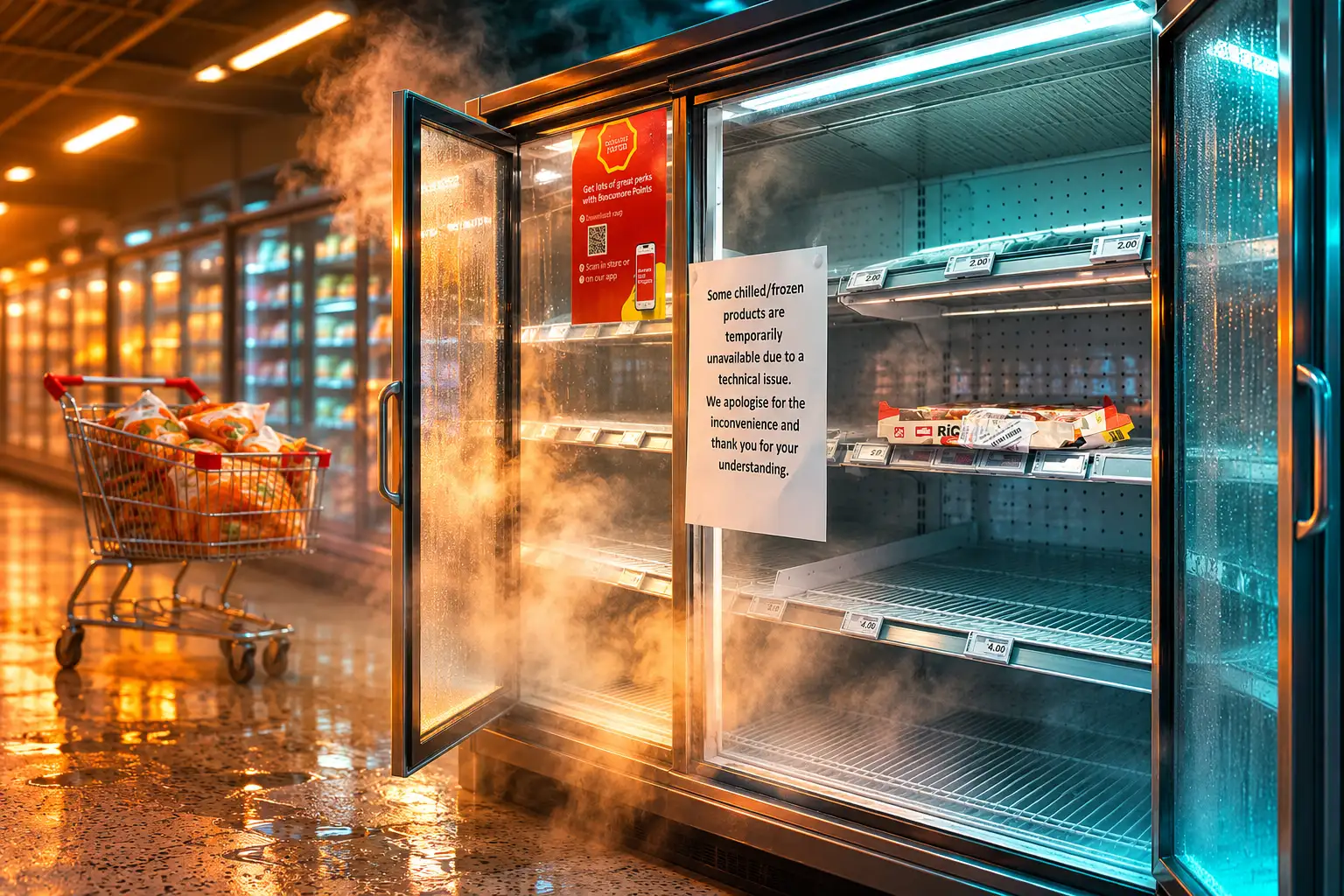
Hackers switched supermarket freezers into defrost across at least 11 European countries on 2 November, pushing some units to 50C (122F) and forcing shops to dump food. They did not plant custom malware on till systems. They used the remote-control pages that cooling contractors already log into, the same pages built so a technician can check a compressor without driving to the shop.
EU food commissioner Christophe Hansen called the wave a deliberate attempt to disrupt the food supply chain. Romania’s cyber chief looked at the same kit and called the work semi-amateurish. Both can be true at once: the damage is physical, and the door was left open.
A Defrost Command Emptied Frozen Aisles Overnight
The Monday incidents started overnight from 1 to 2 November. Attackers reached internet-facing management interfaces on store cooling gear and flipped evaporators into defrost, or raised set points until cabinets blew hot air. Several chains said internal temperatures reached 50C. Frozen food thawed, then warmed. Staff arrived to water on the floor and aisles they had to clear.
Rickard Nilsson, who runs an ICA shop in Sjöbo in southern Sweden, said the attackers had got into the cooling management system and changed the settings. “We can’t adjust the temperatures, we can’t change them. Hot air is blowing into the freezers. Everything is ruined,” he said.
The same pattern showed up in Belgium, where Stephan Moelans, chief executive of refrigeration firm Sabcobel, said the units’ evaporators had been switched into defrost mode. His technicians started disconnecting affected machines from the network around midnight. He said a full fix needs a software update and a physical change to the units, not a remote patch alone.
Nobody has claimed the attacks. EU spokesman Thomas Regnier said the incidents were not isolated and that EU agencies were working with national authorities on a joint response. He would not name a culprit.
Why Supermarket Fridges Sit on the Public Internet
Commercial cooling controllers regulate temperatures, run defrost cycles and send alarms when a cabinet fails. Chains spread across hundreds of sites pay contractors to watch that kit from a desk. Danfoss, a major supplier of the systems named in these incidents, has estimated that remote access cuts unnecessary technician visits by 15 to 30 percent. Manufacturer manuals treat internet maintenance as a normal option, not an accident.
That convenience is the opening. If the management page is on a public IP address, anyone who can log in can change the same settings a contractor would change. Security researcher Kevin Beaumont said the freezers hit on 2 November all had management interfaces facing the internet, the same issue as the French wave, and that many units are end of life with no patch, “left online to quite literally rot.”
Xavier Bellekens, chief executive of threat firm Lupovis, said his company saw login attempts against Danfoss AK-SM controller sensors from 20 to 30 October, peaking on 26 October. Most of those attempts used factory-default credentials. Some traffic came from networks previously classed as bulletproof hosting and used by Russian adversaries. That is probing, not a finished attribution.
THE OPEN DOOR FORESCOUT MAPPED IN OCTOBER
- The scan: Forescout’s Vedere Labs found 12,976 refrigeration services reachable online across 6,017 public IP addresses in 99 countries.
- The two big families: 7,075 Copeland/Dixell XWEB services and 4,697 Danfoss StoreView services, plus 551 Copeland Site Supervisor, 513 Carel pCOWeb and 140 other services.
- The lag: 3,762 Danfoss StoreView observations, 80 percent of that family, were running firmware older than 4.3.1, the release that closed known login flaws.
- The method: Attackers can abuse ordinary supervisory functions (set points, defrost, alarms) without dropping destructive malware.
Daniel dos Santos, Forescout’s vice president of research, said the UK did not sit in the top 10 countries for exposed supermarket cooling systems when his team checked. That matches the smaller British footprint: National Cyber Security Centre chief Richard Horne said vulnerable technology had been exploited in a couple of instances, and the British Association of Independent Meat Suppliers said two members saw fridges begin to defrost.
France Already Lived This Attack in October
The 2 November wave copied a night France had already had. Between 11 and 12 October, attackers seized remote cooling controllers in about 700 of France’s roughly 10,000 supermarkets, according to finance minister Roland Lescure. Temperatures were pushed toward 50C. Some sites reported fires. Food losses were estimated in the tens of millions of euros. Chains including Intermarché, Coopérative U, Carrefour, E.Leclerc and Monoprix were among those named.
France’s CERT-FR, the incident team at cybersecurity agency ANSSI, issued alert CERTFR-2026-ALE-012 on 12 October. It first named Danfoss AK-SM and AK-SC series controllers, then on 13 October added Copeland XWEB and Dixell XWEB. The agency said it knew of numerous compromises, told operators to remove public internet exposure of the controllers, and warned that an unpatched end-of-life unit left online faced a very high chance of being hit again. A factory reset, it said, does not save a device that still has no security updates.
MàJ ⚠️ Incident de sécurité ciblant les contrôleurs à distance des installations de réfrigération Danfoss série AK-SM, AK-SC ainsi que Copeland xweb et Dixell xweb.
Retrouvez le bulletin d’alerte régulièrement mis à jour sur :
➡️ https://t.co/CHUqbSiZAt https://t.co/eyaujVVS7V pic.twitter.com/JmtsTBwudW— ANSSI (@ANSSI_FR) October 13, 2026
Danfoss said most of the French units were older AK-SM 800 and AK-SC 355 models that no longer receive updates, with some newer AK-SM 800A devices running old firmware. On 13 October it told customers to cut direct internet links and come back only through a secure network. A company spokesperson later said most stores did that, “but a small number did not.”
FROM THE FRENCH WAVE TO MONDAY NIGHT
- 11-12 October 2026: Attackers push French supermarket cooling units into long defrost cycles; about 700 stores are hit.
- 12 October 2026: CERT-FR publishes CERTFR-2026-ALE-012 on Danfoss AK-SM and AK-SC remote controllers.
- 13 October 2026: The alert adds Copeland XWEB and Dixell XWEB; Danfoss tells customers to leave the public internet.
- 20-30 October 2026: Lupovis records default-credential logins against Danfoss AK-SM sensors, peaking on 26 October.
- 22 October 2026: Forescout publishes the global scan of exposed cooling-management services.
- 1-2 November 2026: The second wave hits stores from Sweden to Italy on the same class of internet-facing controllers.
- 3 November 2026: Italy holds emergency talks with intelligence chiefs; Germany, Romania and the UK are added to the list.
Internet-mapping firm Censys found that in France, operators pulled controllers off the internet rather than patching them in place. Exposed Danfoss StoreView hosts there fell from 1,825 on 11 October. Patched and unpatched units disappeared at about the same rate, which is what you would expect if the real move was to yank the public IP, not to upgrade firmware.
Empty Shelves From Sicily to Sjöbo
Belgium took the heaviest confirmed retail hit on 2 November. Delhaize reported an IT incident affecting cooling in around 40 stores in Belgium and Luxembourg. Carrefour Belgium spokesman Mich Vergauwen said 15 of the chain’s 700 Belgian stores were hit and stayed open. “It’s a cyberattack, there is no other reason,” he said. Intermarché and Spar shops were also named. Moelans said about 20 sites using Sabcobel equipment were affected, including Carrefour, Spar and Delhaize. Belgian federal prosecutors opened an investigation. An Ikea store in Mons reported a hit on its cooling gear.
Sweden’s ICA press manager Mattias Elander Forsgren said cooling at 23 ICA stores was affected, with eight forced to throw out chilled and frozen goods. Those stores sat outside ICA’s central network, on an external Danfoss-supplied control system. Coop spokesperson Carlos Cancinos said seven Coop shops were hit, then returned to normal. The affected cabinets, he said, were on old 4G links. Coop has a programme to move connected fridges onto 5G.
Musgrave, which owns SuperValu in Ireland, said a cyber incident at 13 SuperValu stores was fully resolved the same day, limited to a specific refrigeration model, with restocking under way. Italy’s government said the impact was highly limited and that only outlets with outdated security were affected, around 20 nationwide. Giuseppe Spadaro, who runs a group of Coop stores in Sicily, said four of 300 shops were hit at 4:00 a.m. through the remote-control system for frozen sections.
“We estimate the damage at several thousands of euros. We had to throw away everything. The shelves are empty,” Spadaro said.
Romania counted six stores. Germany counted four. Finland’s Kesko reported temperature problems at a few K Group shops. Estonia’s Kitman Coldtech said older Danfoss units were involved. At least 17 Dutch food businesses, including butcher shops and local grocers, were named in industry accounts of Danfoss-linked hits. Portugal was on the country list without a public store tally. In Britain, Horne said the problem touched the whole food supply chain and that his staff had worked through the night to warn those at risk.
THE MONDAY NIGHT TOLL
| Chain or country | Stores reported | What operators said |
|---|---|---|
| Delhaize (Belgium, Luxembourg) | Around 40 | Cooling IT incident; prosecutors investigating |
| Carrefour Belgium | 15 of 700 | Cyberattack; stores stayed open |
| ICA Sweden | 23 (8 dumped stock) | External Danfoss controls, outside the central network |
| SuperValu Ireland | 13 | One fridge-control model; resolved the same day |
| Coop Sweden | 7 | Old 4G links; back to normal |
| Italy (all chains) | Around 20 | Outdated security; impact highly limited |
| Romania | 6 | GSM routers with fixed public IPs, old software |
| Germany | 4 | Confirmed by officials and companies on 3 November |
Spadaro’s four Sicilian shops are inside Italy’s total of around 20, not extra. Sabcobel’s about 20 Belgian sites overlap Delhaize, Carrefour and Spar, so they are not a separate country count. The 2 November wave does not have a single audited store total; the named chains above are the ones that put a figure on it.
Romania’s Cyber Chief Sees No State Actor
Dan Cimpean, director of Romania’s National Cyber Security Directorate, gave the most detailed picture of how the kit was actually wired. On 2 November around 1:30 a.m., cooling in six stores of one chain jumped to very high temperatures. Staff noticed at 8:00 a.m., when the shops were opening. The controllers sat on GSM routers with fixed IP addresses, reachable from the internet, running old software. No other infrastructure was touched.
It seems semi-amateurish. We do not suspect, under any circumstances, that it is a state actor.
Dan Cimpean, director, National Cyber Security Directorate
Hansen, speaking on 2 November, used harder language. He said the repeated attacks were a “deliberate attempt to disrupt our food supply chain and undermine consumers’ confidence in it.” Horne, in London, stressed the food chain as a whole and the exploitation of weak technology. Italy still convened intelligence chiefs and the National Cyber Security Agency on 3 November and put out technical advice for retailers.
WHERE EXPERTS DISAGREE
- Hansen: The EU agriculture commissioner treats the two waves as a planned strike on food supply and shopper confidence.
- Cimpean: Romania’s cyber director says the method looks semi-amateurish and rules out a state actor on the evidence he has.
- Bellekens: Lupovis saw default-password probes from hosting once used by Russian adversaries, which is a lead on infrastructure, not a finished who-did-it.
Default passwords, date-based contractor logins on older Danfoss builds, end-of-life boxes with no patch, and 4G routers with public IPs are a weak target set. A capable state service could use that set. So could a small crew that read last month’s alert. No group has claimed either wave, and CERT-FR has not tied the compromises to a named software flaw.
1,825 French Controllers Came Off the Open Internet
The leftover is still sitting on the public internet. After the French night, Censys watched Danfoss StoreView exposures in France collapse from 1,825 hosts on 11 October. In its November follow-up, France’s exposed StoreView count fell to 220, and 41 percent of those remaining hosts appeared to run patched firmware 4.3.1 or later. Patching did not make a public login page safe. It just sat there, still reachable.
DANFOSS STOREVIEW HOSTS STILL ON THE PUBLIC INTERNET
| Country | Exposed hosts | Share on firmware 4.3.1 or later |
|---|---|---|
| France | 220 | 41% |
| Belgium | 138 | 68% |
| Netherlands | 51 | 37% |
| Sweden | 50 | 58% |
Those Censys figures are Danfoss StoreView only, a slice of the wider 12,976 services Forescout counted across ten product groups in October. Belgium, which led this week’s store losses, still showed 138 StoreView hosts online, even with the highest patched share in that table. Sweden, where Sjöbo staff threw out a night of stock, still showed 50. Censys also saw small counts in Luxembourg (6), Ireland (3) and Estonia (2).
WHAT CERT-FR TOLD OPERATORS TO DO
- If not yet hit: Take every management interface off a public IP, review defrost schedules, and bring remote access back only through a VPN or a protected network.
- If already hit: Cut the internet link, restart or factory-reset the Danfoss unit, then rebuild it on a private path; a reset alone will not hold on an end-of-life box.
- Danfoss hardening: Turn on strict security mode and change default passwords, then stop treating the contractor’s shared login as a permanent front door.
Moelans said most of his customers moved to a secure connection after France, which is why the Belgian night was not larger. Danfoss said a small number of stores never made that move. Coop’s remaining 4G cabinets and Romania’s GSM routers with fixed IPs are the same leftover in different packaging. The second wave did not need a new trick. It needed the shops that still answered when someone knocked on the old remote-maintenance page.
In Sjöbo, the Facebook post from ICA went up while staff were still binning stock: the fridges and freezers had been hacked in the night and set to 50C. The cabinets were built to hold ice cream at minus 18. They will do that again once the public login is gone. Until then they will do whatever the next person who finds them types in.

Josh Sinn Draws the Heaviest AFL Betting Ban Since 2019

Rolapp Shuts the PGA Door as DeChambeau Heads to Europe

Apple TV Renews Slow Horses Past the Last Novel

Oasis Lifts UK Music to £8.4 Billion as Venues Shrink

Beyoncé Hits 100 Grammy Nominations on a Vault Track

Thameslink Will Pad 60,000 Ironing-Board Seats From 2027

How Tall Was Adolf Hitler?

U.S. Forces Clear Hormuz Mines, Then Hit Minelayers Again

Micron Sells the Memory Shortage as Five-Year Contracts

Royal Caribbean Sends Los Angeles Ships to Singapore and Brisbane
-
 NEWS3 months ago
Thameslink Will Pad 60,000 Ironing-Board Seats From 2027
-
 HISTORY3 years ago
How Tall Was Adolf Hitler?
-
 BUSINESS3 months ago
U.S. Forces Clear Hormuz Mines, Then Hit Minelayers Again
-
 NEWS3 months ago
Micron Sells the Memory Shortage as Five-Year Contracts
-
 NEWS3 months ago
Royal Caribbean Sends Los Angeles Ships to Singapore and Brisbane
-

 BUSINESS3 months ago
Sweetmore Bakeries Buys Fantasy Baking for Bar Work
-
 NEWS3 months ago
Twenty Controllers Closed Norwich Airport for a Bank Holiday
-
 BUSINESS3 months ago
L Catterton Installs a Kraft Heinz Operator at Kettle Cuisine