
BUSINESS
Bahrain Intercepts Iranian Drones Aimed at a US Radar
Bahrain intercepted six Iranian drones aimed at a US radar at Riffa, a host-nation hit after Trump called the war militarily over.

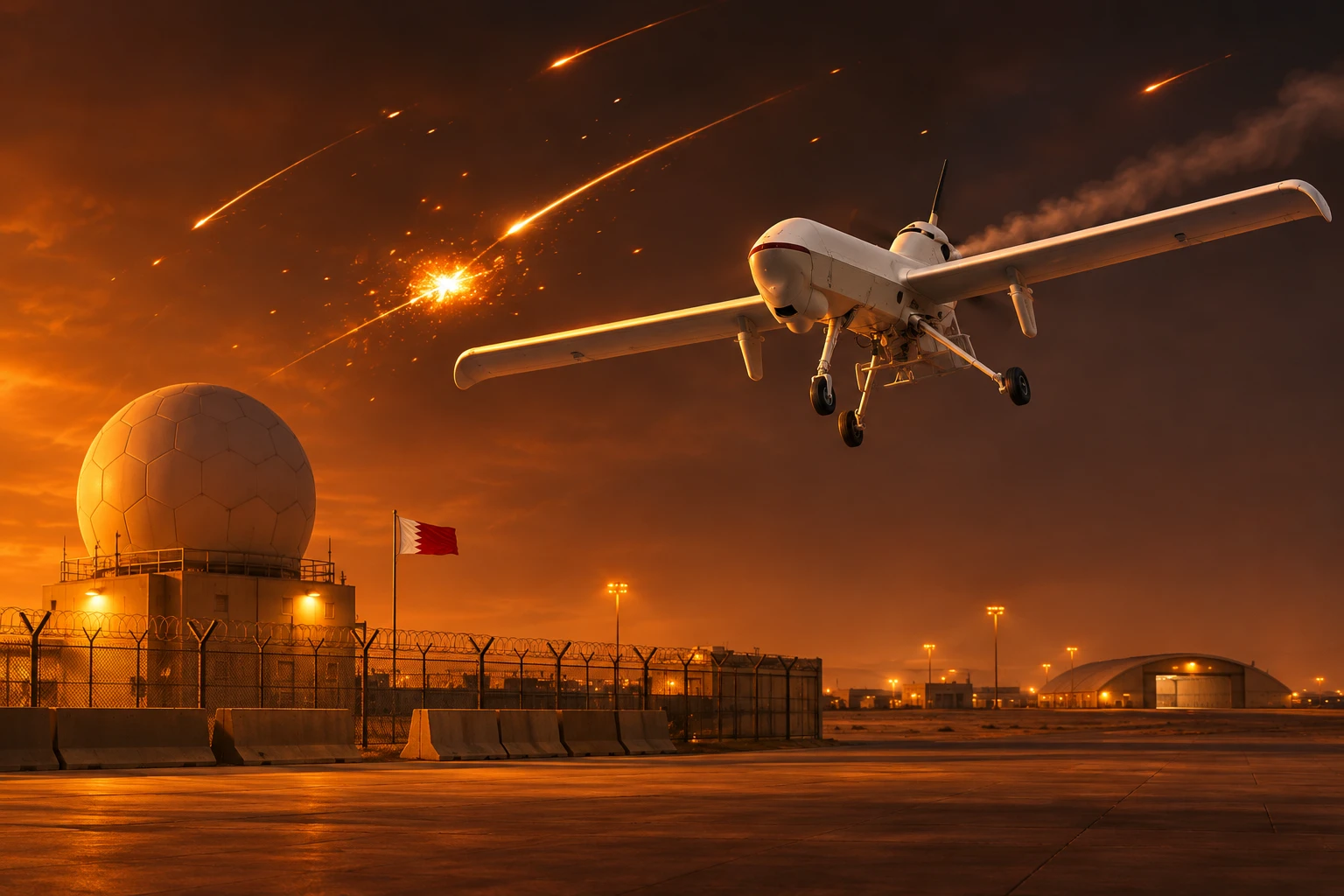
Bahrain’s air defenses intercepted several Iranian drones before dawn on Sunday after Tehran said six aircraft had been sent at a US radar on Riffa Air Base. The Interior Ministry issued two shelter alerts, the first around 4:30 a.m., and residents heard blasts near 4 a.m. and again around 6:30 a.m.
Iran’s Revolutionary Guards called it a hit. Bahrain said the drones never reached their targets. US Central Command spokesman Tim Hawkins said there were “no impacts to American forces.” The shooting was over a host Washington had named, six days earlier, as a country that preferred to keep the war’s status quo.
Sirens Went Off Before Dawn in Manama
The Islamic Revolution Guards Corps Public Relations Office said its Aerospace Force had sent six drones at a US air-defense radar at the Riffa helicopter base, which it also called Al-Riffa. The Guards said the aircraft hit their targets, that the impacts were heard in different parts of Bahrain, and that more drones flew in this wave than in the previous one.
Bahrain’s military said its air defenses intercepted several Iranian aerial attacks before they reached their targets and accused Tehran of a “systematic hostile approach” toward the kingdom. The foreign ministry said the air-defense systems shot down Iranian drones. Those were Bahrain’s first interceptions, and its first nationwide shelter warnings, since September.
The Interior Ministry told citizens and residents to remain calm, go to the nearest safe location, and follow official channels. Sirens sounded across the island, which is about the size of a large city and sits across the Gulf from Iran. The raid was the second in three days. On Friday, November 13, the Guards claimed they had destroyed a US early-warning radar in Bahrain. Central Command said it had shot down two drones and reported no injuries and no damage.
WHAT WE KNOW
- Sunday’s claim: The Guards said six Aerospace Force drones were sent at a US air-defense radar at Riffa Air Base, in what they called the second phase of a reply to US strikes.
- Sunday’s intercept: Bahrain said several aerial attacks were destroyed short of their targets; Hawkins said American forces took no impacts.
- Friday’s claim: The Guards said they had destroyed a US early-warning radar after an air attack on a telecommunications tower in Sirik, in Hormozgan province; Central Command denied a hit and said two drones were shot down.
WHAT IS UNCONFIRMED
- Radar damage: Neither Bahrain nor the United States confirmed that the Riffa radar was struck or destroyed on Sunday.
- The blasts: Explosions around 4 a.m. and 6:30 a.m. were reported by people in Bahrain; those sounds can come from intercepts as well as from impacts, and no public damage survey has been released.
- Mine claims: The Guards also said oil tankers, including a supertanker they put at more than 2 million barrels, hit mines in the Strait of Hormuz on an “unauthorized” route; those sinkings have not been independently confirmed.
The Institute for the Study of War said the Sunday flight was likely meant to degrade US air defense capabilities after recent US strikes on Iranian coastal infrastructure. That is a fight over sensors. The island underneath the sensors still has to sound the sirens.
The Island That Hosts the Fifth Fleet
Bahrain hosts the headquarters of the US Navy’s Fifth Fleet and US Naval Forces Central Command at Naval Support Activity Bahrain in Juffair, on the northeast of the main island near Manama. That naval station is not Riffa Air Base. The Guards named the radar at Riffa, a separate air and helicopter field that Bahrain says is used by the US military.
The distinction matters on the ground. A drone aimed at American radar still enters Bahraini airspace, trips Bahraini alerts, and is met first by Bahraini batteries. Manama has spent the war insisting it is a sovereign state, not a back lot for a US-Iran exchange.
The foreign ministry denounced a “resumption of Iran’s aggression,” said the Revolutionary Guards had violated international law, and said “no pretext can legitimise violations of state sovereignty.” It also used the line that now defines the island’s position.
rejects turning its territory into an arena for settling scores and holds Iran fully responsible for these attacks and their consequences
Bahrain Ministry of Foreign Affairs, statement, November 15, 2026
Saudi Arabia, Qatar, Jordan, and Egypt condemned the attacks. The UAE called the raid a flagrant violation of Bahrain’s sovereignty. GCC Secretary-General Jasem Mohamed Albudaiwi called it a blatant challenge to regional peace efforts. Bahrain, a sitting member of the UN Security Council, asked the Council for decisive measures and for full compliance with the March resolution it helped write.
WHO CONDEMNED THE RIFFA RAID
- Bahrain: The foreign ministry held Iran fully responsible and asked the Security Council to act.
- Gulf partners: Saudi Arabia, Qatar, and the UAE condemned the strike; the GCC chief called it a challenge to peace efforts.
- Arab states beyond the GCC: Jordan and Egypt issued condemnations the same day.
In an August letter to the UN, Iran said US forces had used the territory and airspace of Gulf countries, including Bahrain, against it. Tehran’s argument is that the host is a party. Manama’s argument is that Iran is settling a US account on Bahraini soil.
Why a US Radar Is on Riffa Air Base
Riffa sits inland from the naval complex at Juffair. The Guards described the target as a US air-defense radar at a helicopter base. An early-warning or air-defense radar in that location would feed the picture US and Bahraini batteries use against drones and missiles coming off the Iranian coast.
That is why the target list keeps coming back to sensors. Blind the radar and the interceptors have less time. Leave it up and the next drone wave is easier to see. A Pentagon inspector general review published in September described damage or destruction at US installations in eight countries, Bahrain among them, in the first four months of the war that began on February 28, 2026.
The louder question after an intercept is not whether a single radar dish cracked. It is why a small island still hosts the kit Iran is trying to blind, and who pays when the reply lands short of the American hulls in Juffair and on the streets of Riffa instead.
US naval presence in Bahrain goes back to a British site at Jufair and a transfer to US control in 1971. The Fifth Fleet was reestablished there in 1995. The war that started in February made that old basing choice a daily air-defense problem for the host, not only a logistics story for the tenant.
Trump Called the War Militarily Over After Qatar Talks
On November 9, after an Oval Office meeting with Qatari Prime Minister Sheikh Mohammed bin Abdulrahman Al Thani, President Donald Trump told reporters the fighting in Iran was, in military terms, finished business. He said Gulf partners wanted the present freeze kept in place rather than a new round of US strikes.
Iran, militarily, is effectively over. We’re just keeping it the status quo.
Donald Trump, US president, White House briefing, November 9, 2026
He said taking further military action did not seem necessary, then added that US forces were “locked and loaded, ready to go for any reason.” In a social post the same day he named Qatar, Saudi Arabia, the United Arab Emirates, Bahrain, Kuwait, and others as countries that “would prefer the status quo,” which he described as the naval blockade of Iran and a land cut-off he called Iron Gate. He said a return to strikes was “quite unlikely.”
Six days later, Bahrain was under sirens. The status quo Trump described is a blockade and a pause in big US bombing. It is not a pause in Iranian drones at a radar on the island he listed. Iranian security chief Mohsen Rezaei told Washington the same week to stop “manufacturing fake news about imaginary talks.” Chief negotiator Mohammad Bagher Ghalibaf said Iran wanted to get out of “no war, no peace.”
The UN Resolution Bahrain Wrote in March
Eleven days after the first US and Israeli strikes on Iran, Bahrain submitted a Gulf text to the Security Council. The Council adopted Security Council Resolution 2817 on March 11, 2026, by 13 votes to none, with China and Russia abstaining. Bahrain tabled it on behalf of the GCC states and Jordan. One hundred thirty-five UN members co-sponsored it.
The resolution condemned Iranian attacks on Bahrain, Kuwait, Oman, Qatar, Saudi Arabia, the United Arab Emirates, and Jordan, called those attacks a breach of international law, and demanded they stop. It backed those states’ territorial integrity and pointed to attacks on civilians, energy sites, and merchant ships in and near the Strait of Hormuz.
Sunday’s statement from Manama treated the Riffa raid as a breach of that text, not a new dispute. Foreign Ministry spokesperson Esmaeil Baghaei, speaking in Tehran, said Iran would keep responding to military aggression by the United States and other states. He cited Article 51 of the UN Charter, called the strikes defensive, and said they targeted only US military bases and assets used against Iran.
THE HOST’S WAR CALENDAR
- February 28, 2026: US and Israeli strikes on Iran begin the war; Iran later tells the UN that US forces used Bahraini territory and airspace.
- March 11, 2026: The Security Council adopts Resolution 2817, 13-0-2, demanding Iran stop attacks on Bahrain and its neighbours.
- September 2026: A lull sets in; Bahrain’s next public intercept and nationwide shelter alerts do not come until November.
- November 9, 2026: Trump says Iran is militarily over and names Bahrain among the states that prefer the status quo.
- November 13, 2026: The Guards claim a US early-warning radar in Bahrain; Central Command says two drones were shot down with no damage.
- November 15, 2026: Six drones are claimed against the Riffa radar; Bahrain intercepts several aerial attacks; Hawkins reports no impacts to US forces.
A resolution can name the victim and still leave that victim running its own batteries at 4 a.m. Bahrain asked the Council again on Sunday to make Iran comply. The Council has not moved a new enforcement text in the hours since the raid.
Ship Crossings Through Hormuz Have Collapsed
The Guards tied the Riffa raid to the waterway as much as to the radar. Their Sunday statement said the Strait of Hormuz remained closed, called US escort efforts a failed attempt to move oil, and warned that any further US attack would draw a stronger reply. The United States rejects a legal closure. Ships still cross, in small numbers, under US naval coordination, while Iran requires transit permits through a body it has stood up for the strait.
Before the war, the US Energy Information Administration put oil through the strait at 20.9 million barrels a day in the first half of 2025, about a fifth of world oil use and about a quarter of seaborne oil trade. At its narrowest the strait is 21 nautical miles (39 km) wide, with traffic lanes two miles across in each direction.
A live AIS tracker, hormuz.now, had the strait as restricted on November 16, day 262 of the crisis counting February 28 as day 1. It counted about 6.4 commercial ships a day over the prior week against 84.8 before the crisis, about 8 percent of normal. Broker Kpler put oil and product flows through Hormuz at about 8.3 million barrels a day in the week to November 11, against Kpler’s own pre-war baseline of 17.1 million.
HORMUZ TRAFFIC AGAINST THE PRE-WAR LINE
| Measure | Latest | Pre-war line |
|---|---|---|
| AIS-visible commercial ships (7-day average) | 6.4 a day, about 8 percent of normal | 84.8 a day |
| Oil and products, Kpler, week to Nov. 11 | 8.3 million barrels a day | 17.1 million barrels a day (Kpler) |
| Oil through Hormuz, EIA, first half of 2025 | Not a current flow figure | 20.9 million barrels a day |
On October 25, US Central Command said the main transit routes remained free of Iranian sea mines and that more than 3,000 commercial vessels had crossed with its support in six months. The Guards keep saying those routes are unauthorized. Saturday’s mine claims, including a supertanker the Guards put at more than 2 million barrels, are part of that permit war. Two other tankers, they said, turned back after warnings from Iranian traffic control.
A radar strike in Bahrain and a mine claim in Hormuz on the same weekend are one campaign with two addresses. The sensors sit on the island. The leverage sits in the shipping lane that still carries a large share of the oil the Gulf can get out.
What Iran Wants Before It Reopens Hormuz
Ghalibaf told an interviewer last week that Iran had passed seven conditions through Qatar and was waiting for an official US reply. The conditions he listed included lifting the US naval blockade and sanctions, releasing frozen Iranian funds, ending hostilities on all fronts, and a formal declaration that the war is over. Baghaei said on Sunday that a path to a deal remained open even as the Guards announced the second phase of their Bahrain raids.
Trump’s November 9 line was that strikes were unlikely while the blockade held. Secretary of State Marco Rubio had called Iran’s terms “absurd” on November 10. The UN said on November 13, after a Gulf session Bahrain had sought, that efforts to stop a return to full-scale fighting had not produced a deal.
Saeid Golkar, a political science professor at the University of Tennessee at Chattanooga, said both sides may prefer to avoid a full-scale war, but the danger lies in miscalculation. Limited maritime and regional attacks, he said, can still pull Washington into a military reply neither capital packed for.
Bahrain’s ask is narrower than a grand bargain. It wants the drones to stop, the March resolution observed, and its territory kept out of a US-Iran ledger. Sunday’s intercepts suggest the batteries still work. They do not move the radar off the island, and they do not reopen the strait.

Josh Sinn Draws the Heaviest AFL Betting Ban Since 2019

Rolapp Shuts the PGA Door as DeChambeau Heads to Europe

Apple TV Renews Slow Horses Past the Last Novel

Oasis Lifts UK Music to £8.4 Billion as Venues Shrink

Beyoncé Hits 100 Grammy Nominations on a Vault Track

Thameslink Will Pad 60,000 Ironing-Board Seats From 2027

How Tall Was Adolf Hitler?

U.S. Forces Clear Hormuz Mines, Then Hit Minelayers Again

Micron Sells the Memory Shortage as Five-Year Contracts

Royal Caribbean Sends Los Angeles Ships to Singapore and Brisbane
-
 NEWS3 months ago
Thameslink Will Pad 60,000 Ironing-Board Seats From 2027
-
 HISTORY3 years ago
How Tall Was Adolf Hitler?
-
 BUSINESS3 months ago
U.S. Forces Clear Hormuz Mines, Then Hit Minelayers Again
-
 NEWS3 months ago
Micron Sells the Memory Shortage as Five-Year Contracts
-
 NEWS3 months ago
Royal Caribbean Sends Los Angeles Ships to Singapore and Brisbane
-

 BUSINESS3 months ago
Sweetmore Bakeries Buys Fantasy Baking for Bar Work
-

 NEWS3 months ago
Twenty Controllers Closed Norwich Airport for a Bank Holiday
-

 BUSINESS3 months ago
L Catterton Installs a Kraft Heinz Operator at Kettle Cuisine