
NEWS
Qatar Airways Lands VA7 in Doha After an Alleged Gun Threat
Cable-tied on Qatar Airways VA7, two men reached Doha, not an Australian court, after an alleged inflight gun threat.

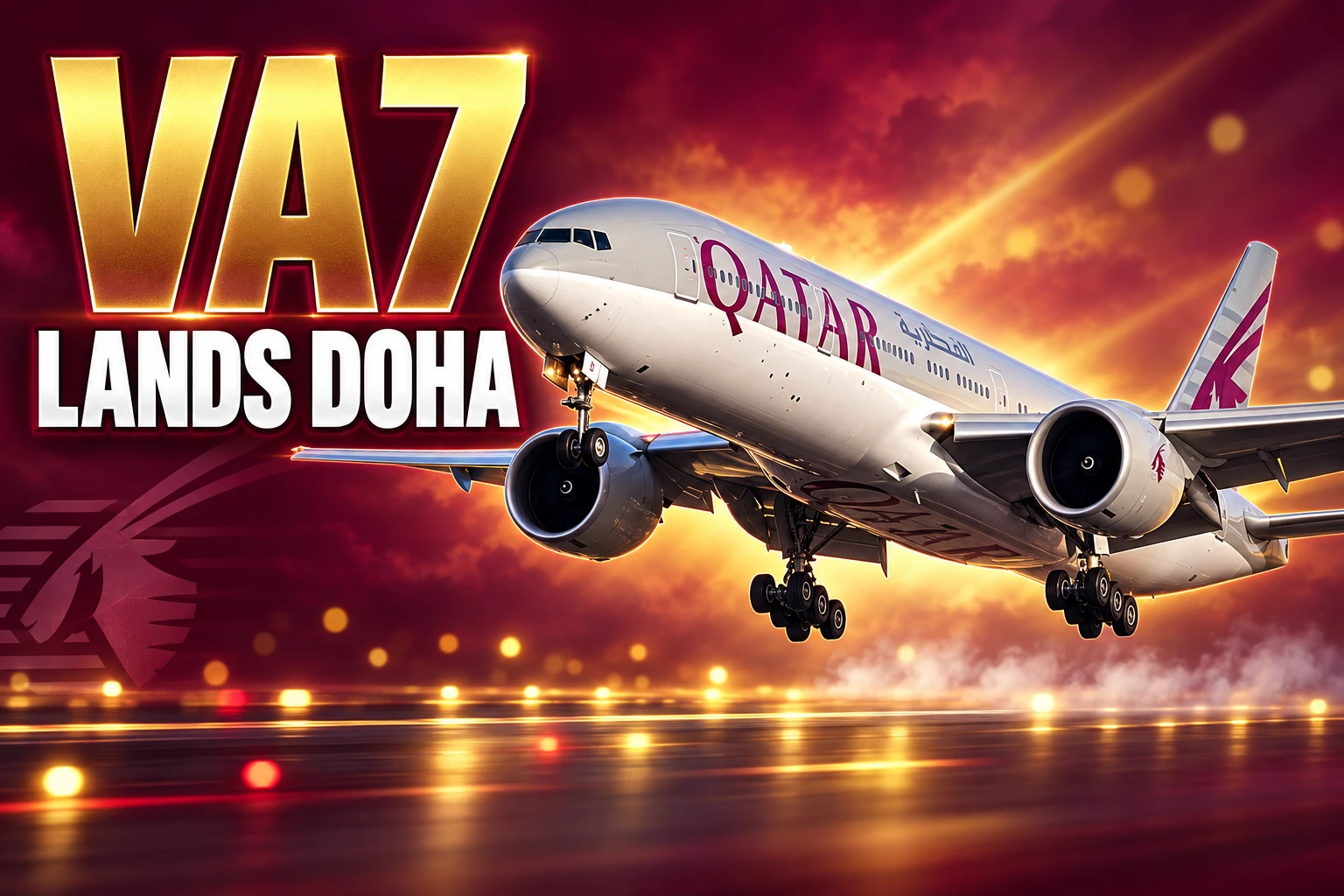
Two men were cable-tied on Qatar Airways flight VA7 and arrested in Doha on Friday, September 11, after allegedly claiming they had a gun and assaulting cabin crew. The Melbourne-to-Doha service, a Virgin Australia flight operated by Qatar Airways, did not divert.
That left the pair under Qatari criminal law on a Qatari-registered Boeing 777-300ER, rather than in an Australian court.
What Happened on Qatar Airways Flight VA7
On Friday, September 11, two male passengers on Qatar Airways-operated VA7 from Melbourne to Doha allegedly fought, claimed they had a gun, and assaulted cabin crew. Other travellers helped pin them with cable ties. The airline confirmed a fight and said both men were handed to local authorities after landing.
Flight-tracking records list the jet as a Boeing 777-300ER registered A7-BEH, which left Melbourne Airport at 4:20 p.m. local time. The scheduled run is about 14 hours and 7,430 miles (11,957 km) to Hamad International Airport.
A woman on the flight, who asked not to be named, said the men looked “extremely agitated and restless” from the moment they boarded. “They were repeatedly getting in and out of their seats, moving around the cabin and into my personal space, and touching or moving my belongings,” she said. She said they kept rummaging through bags for items they claimed they had lost. “At one point, I asked that alcohol service to them be stopped because of their behaviour.”
The same woman said the two men were brothers. About six hours before landing, she said, they started arguing and then fighting. “The men would not comply with instructions from the crew, and ultimately had to be restrained,” she said. She said they made threats about using a gun and killing people.
A passenger stepped in and held one of the brothers, she said, while cabin crew held the other. One man, she said, stayed “extremely angry and agitated” and was “yelling, spitting, kicking and headbutting a flight attendant.” Several male passengers then moved in to help. “They were absolutely amazing and showed enormous courage in helping the crew and protecting other passengers,” she said.
Witnesses told Melbourne radio host Jacqui Felgate that it took six to seven people to control each man and that travellers helped “get the cable ties on.” Felgate said one man then sat with crew, and the second lay down, tied, for the rest of the flight. Video she posted shows attendants struggling with a passenger in the cabin.
We can confirm that two male passengers were involved in a physical altercation on board flight VA7 from Melbourne to Doha, operated by Qatar Airways. Both passengers were restrained and, upon arrival in Doha, were handed over to local authorities. The safety and wellbeing of our crew and passengers remain our highest priority.
Qatar Airways statement, September 12, 2026
Virgin Australia said Qatar Airways operated the service. The Australian Federal Police has not commented. Qatar Airways did not name the men and did not say a firearm was found.
The Jet Kept Flying for Six More Hours
The fight, on the woman’s account, started with about six hours still to run. The crew did not empty the aircraft at a diversion field. VA7 continued to its scheduled Doha arrival on Friday night, with the two men tied in the cabin.
A short-haul crew can dump a violent passenger on the next runway. A Melbourne-to-Doha 777, already deep into a 14-hour sector, has fewer clean options, and turning around would have put hundreds of people back over water for another long night. The legal result of staying on course is still blunt. The men were not walked into an Australian terminal. They were walked into Qatari custody on Qatari-registered metal.
Had the same assault been handed to Australian police, threatening crew or interfering with their work is not a small charge. Assaulting crew starts at 10 years. It rises to 20 years if the assault interferes with crew duties. A threat to kill or injure anyone onboard carries a 10-year maximum under the same Crimes (Aviation) Act 1991. Those figures never came into play, because the aircraft did not go home.
Days earlier, an American Airlines flight from Dallas toward Newark did divert after a passenger was held with zip ties and duct tape. VA7 did the opposite. It burned the remaining fuel to Doha with two men already bound.
THE MELBOURNE-TO-DOHA CLOCK
- Friday, September 11, 4:20 p.m.: VA7 leaves Melbourne for Doha on a Qatar-operated 777-300ER.
- Friday, after boarding: A passenger describes the men as extremely agitated, says they rummage through bags, and asks crew to stop serving them alcohol.
- Friday, about six hours before landing: The men fight, allegedly claim a gun, spit, kick, and headbutt crew, and are cable-tied with help from other passengers.
- Friday night, Doha: Local officers board the aircraft. Passengers applaud. The airline hands both men to Qatari authorities.
Passenger Damien Ractliffe, seated at the front, said he did not see the fight and only saw uniformed men come aboard after landing. The people in the back of the cabin had already spent hours with two restrained men and a crew that could not leave them.
Qatar’s Aircraft Law Allows Life in Prison
A7-BEH is a Qatar-registered aircraft. Law No. 11 of 2004, Qatar’s Penal Code, reaches offences committed on Qatar-registered aircraft wherever they fly. The landing in Doha was not a courtesy drop at a foreign desk. It was a delivery into the state that both registers the jet and receives the alleged offenders.
A Qatari Jet, Wherever It Flies
Article 14 of the Penal Code applies the code to offences on ships and airplanes registered in, owned by, or flying the flag of Qatar, no matter where the aircraft sits. Article 15 adds a second hook for foreign aircraft that enter Qatari territory when the captain asks local authorities for help. VA7 needed only the first hook. The jet’s own registration is enough.
Qatar has also ratified the Montreal Protocol 2014, which amends the Tokyo Convention so the state of landing can prosecute when an aircraft arrives with the alleged offender still onboard. On this flight Qatar is the state of registration, the state of the operator, and the state of landing. The usual gap that lets an unruly passenger walk at a foreign airport is not open here.
Harm Onboard and a 10-Year Safety Offence
Article 245 of the same code sets life in prison for harming anyone onboard, and for hijacking or altering the course of a plane. The official English text on the Al Meezan legal portal is clumsy, but the Arabic text is clear: life in prison for an attack on an aircraft aimed at seizure, at harming a person, or at diverting it without cause. If the conduct kills someone, the statute allows a death sentence. No death has been reported from VA7.
Article 246 sets a separate maximum of 10 years for anyone who deliberately endangers the safety of aviation or of an aircraft. A claimed gun, a fight in the cabin, and an assault on crew sit in the shadow of those articles even before prosecutors file a charge sheet, which they have not yet made public.
MAXIMUM TERMS IN QATAR’S AIRCRAFT ARTICLES
| Article | Maximum | Conduct named in the statute |
|---|---|---|
| Article 245 | Life in prison (death if someone dies) | Hijacking, altering course, or harming any person onboard |
| Article 246 | 10 years | Deliberately endangering aviation or aircraft safety |
| Article 14 | Jurisdiction, not a term | Offences on Qatar-registered aircraft, anywhere |
Those are the ceilings on the books, not a verdict. No Qatari charge has been published, and a gun has not been confirmed. The point is the forum. The men are in a system that can treat an attack on an aircraft as a life-term crime, and they arrived there because the flight finished where it was supposed to finish.
Cabin Crew Stayed Hands-On Until Touchdown
The people who absorbed the six hours after the fight were not lawyers in Doha. They were Qatar Airways attendants and the passengers who got out of their seats. The anonymous woman said the crew did “everything they possibly could to calm the situation and protect the other passengers.” A witness who spoke to Felgate put it in plainer words: “Really big props to the Qatar flight attendants, they were hands on for about 10 hours straight.” That 10-hour line is a passenger’s estimate of how long crew were stuck on the men, not a second clock for when the punching started.
The same witness said some attendants were physically abused and “really couldn’t do too much more.” Another called the scene “terrifying” and “disgraceful what the poor flight attendants had to deal with.” A daughter told Felgate her 63-year-old mother was seated next to the suspects.
WHAT WITNESSES SAY THE CREW AND PASSENGERS DID
- Alcohol: A passenger asked attendants to stop serving the two men after their behaviour in the cabin.
- First hold: One traveller restrained one brother while crew took the other.
- Cable ties: Other passengers helped get the ties on, with six to seven people on each man.
- The remaining hours: One man sat with crew; the second lay down, tied, until Doha.
- The landing: Uniformed officers boarded and passengers applauded.
IATA still tells airlines to train for de-escalation, alcohol service, and restraint because this is the job when the cockpit cannot land. On VA7 that training was not a binder on a shelf. It was hours of holding two men who, on witness accounts, were still spitting and kicking after they were down.
One Unruly Case in 355 Flights Still Lands Hard
Most flights do not look like this. IATA’s June 2026 fact sheet, built on 93,107 reports from more than 140 operators, puts the 2025 global rate at one incident every 355 flights, an improvement from one every 307 flights in 2024. Non-compliance with crew instructions remains the most common tag. Verbal abuse and intoxication reports also fell in 2025.
IATA’S 2025 UNRULY-PASSENGER TALLY
- The file: 93,107 incident reports from more than 140 operators.
- The 2024 baseline: One reported incident every 307 flights.
- The court problem: Member airlines say prosecutions fail to proceed in about 60 percent of unruly-passenger cases, mainly because local police at the arrival airport often lack a clear mandate.
That 60 percent is the industry’s running complaint about the Tokyo Convention’s old rule that the state of registration owns the crime. A passenger can wreck a cabin over France and walk at an airport that says the jet is foreign. MP14 was written to close that hole by giving the landing state a mandate. Qatar is a party. This arrival does not look like one of the cases that dissolve at the jet bridge.
The public argument that started once the videos moved was not about IATA rates. It was about who the two men are. Replies under the first posts asked for nationalities and assumed Doha would not treat a gun claim as a tired-passenger spat. DFAT’s silence is what keeps that argument alive. Until someone names the men, every theory about who they are is guesswork, and the only hard fact is where they are being held.
Doha Police Boarded to a Round of Applause
When the aircraft stopped in Doha, passengers clapped as local officers came down the aisle. One traveller, speaking through Felgate, said that was the moment people had been waiting for. “Only thing I would love to understand is if these people are coming back into Australia,” the passenger said. “Given the language they were screaming about wanting to hurt and shoot people, they really shouldn’t be allowed back in.”
WHAT WE KNOW
- The flight: VA7 from Melbourne to Doha on Friday, September 11, operated by Qatar Airways for Virgin Australia.
- The airline: Confirmed two male passengers in a physical fight, said both were restrained, and said they were handed to local authorities in Doha.
- The cabin: Multiple witnesses describe cable ties, a claimed gun, spitting, kicking, and headbutting of attendants.
WHAT IS UNCONFIRMED
- Names: Neither man has been identified in public.
- Citizenship: DFAT did not confirm whether they are Australian citizens.
- A firearm: Witnesses describe a gun claim. No airline or police statement says a gun was found.
- Charges: Qatari authorities have not published an offence list.
The two men are in Qatari custody after a flight that did not turn around. Their names, their passports, and any charge sheet are still unpublished, and so is any confirmation that a gun was ever on that 777.

Hurricane Nolo Hits a Big Island Still Digging Out

Gaza Families Remain in Buildings Already Cleared to Fall

Sony Polls Publishers Who Cannot Press PlayStation Discs Elsewhere

UN Settlement List Hits 214 as Investors Take Notice

Nintendo’s $20 Plan Draws the Sharpest Cost Blame

Thameslink Will Pad 60,000 Ironing-Board Seats From 2027

Burger King Rebuilds Chicken Nuggets After Calling Them Rubbery

Micron Sells the Memory Shortage as Five-Year Contracts

Royal Caribbean Sends Los Angeles Ships to Singapore and Brisbane

Twenty Controllers Closed Norwich Airport for a Bank Holiday
-
 NEWS1 month ago
Thameslink Will Pad 60,000 Ironing-Board Seats From 2027
-
 BUSINESS1 month ago
Burger King Rebuilds Chicken Nuggets After Calling Them Rubbery
-
 NEWS1 month ago
Micron Sells the Memory Shortage as Five-Year Contracts
-
 NEWS1 month ago
Royal Caribbean Sends Los Angeles Ships to Singapore and Brisbane
-
 NEWS1 month ago
Twenty Controllers Closed Norwich Airport for a Bank Holiday
-

 BUSINESS1 month ago
Sweetmore Bakeries Buys Fantasy Baking for Bar Work
-
 BUSINESS1 month ago
U.S. Forces Clear Hormuz Mines, Then Hit Minelayers Again
-

 NEWS1 month ago
CISA’s 100 Water System Hacks Hit One-Operator Plants