
NEWS
The Largest Cyclospora Outbreak Ends Without a Source
CDC closed a 12,883-case cyclospora outbreak tied to Mexican iceberg lettuce, but the FDA still has not found how the parasite contaminated the crop.

U.S. health officials on September 11 closed the largest cyclospora outbreak on record, tying 12,883 illnesses in 21 states to iceberg lettuce from Mexico. The Centers for Disease Control and Prevention said the recalled product is gone from stores and restaurants, and that people are no longer at risk from that source. The Food and Drug Administration is still trying to learn how the parasite got onto the crop.
The close-out follows the lettuce’s expiration dates. How sewage reached enough produce to sicken thousands remains an open federal investigation, and thousands of other confirmed infections this season were never tied to the same bags.
A Close-Out Timed to Expiration Dates
CDC’s final update on September 11 put the cluster at 12,883 illnesses in 21 states, with at least 570 hospital stays and two deaths, both in Michigan. Virginia was added as the 21st state after the previous public count. Illnesses linked to this outbreak began on June 14 and the last onset date CDC logged was August 17, 2026.
Before Taylor Farms de Mexico recalled the lettuce on July 17, more than 1,000 infections occurred in a single day. In August the average fell to fewer than two a day. Most of the people in the cluster got sick before the recall went out, which is the pattern CDC used to say the contaminated lots had already moved through kitchens.
At this time, there is no risk of people getting sick with cyclosporiasis from this source. The best-by dates for all product linked to this outbreak have passed and it is no longer available in stores or restaurants.
Centers for Disease Control and Prevention, final outbreak update, September 11, 2026
FDA said the same afternoon that CDC had closed the Taylor Farms cluster and that its own work was not finished.
The @CDCgov has declared the Taylor Farms–related Cyclospora outbreak over. The FDA’s investigation and related activities remain ongoing. https://t.co/VCU5omXNCD
See our new post-response page to learn more about the agency’s continued work and future efforts.… pic.twitter.com/WYmqON2BQZ
— U.S. FDA (@FDA) September 11, 2026
THE PATH FROM THE FIRST ILLNESS TO THE CLOSE-OUT
- June 14, 2026: First illness onset CDC later ties to the iceberg cluster.
- June 29 through July 16, 2026: Shredded iceberg from the Mexican plant ships into 27 U.S. states.
- July 16, 2026: FDA and CDC announce a multistate outbreak linked to iceberg lettuce.
- July 17, 2026: Taylor Farms de Mexico recalls iceberg lettuce from central Mexico.
- August 17, 2026: Last outbreak-linked onset date in CDC’s final file.
- August 20, 2026: FDA says on-site inspections and sampling have begun at lettuce growers in Mexico.
- September 11, 2026: CDC issues its final update and calls the cluster over.
CDC will not refresh that outbreak page again. Because it can take about six weeks after symptoms start for a case to reach the agency, some infections from this cluster may still be reported, and CDC said the “unprecedented number of cases” this season could stretch that lag even further.
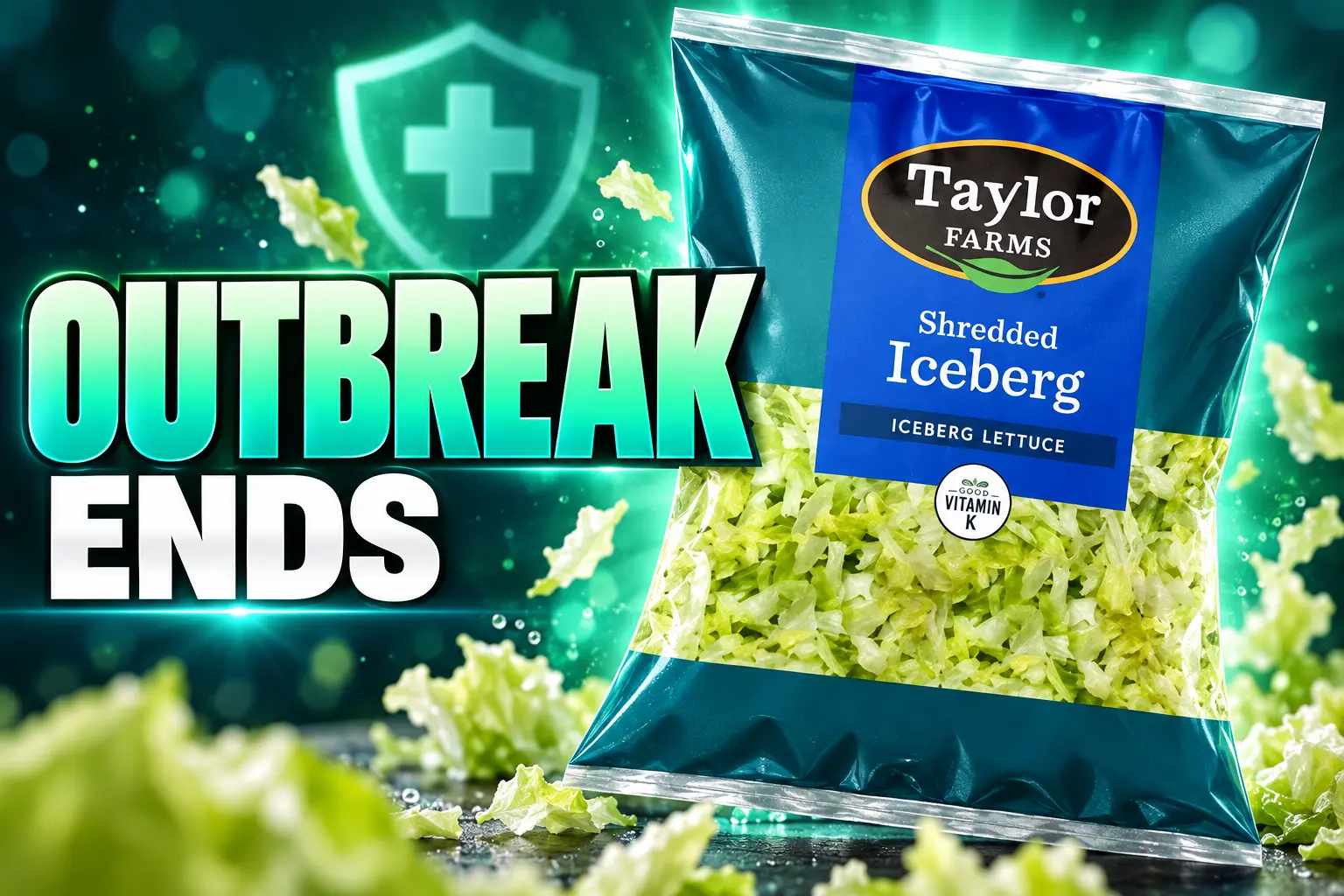
How Cyclospora Reaches a Head of Lettuce
Cyclospora cayetanensis is a microscopic parasite that lives in the human gut and leaves the body in stool. People get cyclosporiasis by swallowing it, almost always on food. The illness is watery diarrhea that can come in frequent, sometimes explosive bursts, with cramps, bloating, nausea, and fatigue. Symptoms can fade and then return. Untreated, the bout can last days to a month or longer.
HOW THE PARASITE MOVES
- The reservoir: Only humans are the source that matters for this parasite, which is why investigators keep coming back to feces, not animals in the field.
- The usual path: Produce picks it up when irrigation, wash water, soil, or workers’ hands carry sewage onto leaves that are eaten raw.
- The seasonal window: U.S. cases cluster from May 1 through August 31, which is also when a large share of salad greens are grown and shipped from warmer regions.
Ellen Shumaker, director of outreach for North Carolina State University’s Safe Plates food safety program, said contamination can happen if produce is grown in soil or comes into contact with water that has been contaminated. Scott Gottlieb, a former FDA commissioner, said raw sewage could have reached growing areas through flooding, a canal breach, irrigation water, or overflowing portable toilets used by farm workers. Mexican authorities said irrigation at Taylor Farms came from certified, company-owned wells. Those two accounts can both be on the record at once, because no public lab result has shown which, if either, put Cyclospora on this lettuce.
The bug is also hard to catch on food. Detection is slow and finicky, and many sick people never get the specific stool test that would put them in a federal count. CDC said the true number of people sick in this cluster was likely higher than 12,883, because some recover without medical care and are never tested.
6,712 Confirmed Cases Have No Iceberg Link
The lettuce cluster was the main driver of this season. It was not the whole season. From May 1 through September 8, CDC logged 19,595 laboratory-confirmed domestic cases, more than 16 times the 1,180 cases reported between May 1 and August 31, 2025. Subtract the closed iceberg outbreak and 6,712 confirmed U.S. infections still sit outside that traceback.
THE LETTUCE CLUSTER AGAINST THE REST OF THE SEASON
| Measure | Iceberg cluster (CDC final) | Rest of domestic season |
|---|---|---|
| Confirmed illnesses | 12,883 | 6,712 |
| Hospital stays | 570 | 473 |
| Deaths | 2 | 0 additional |
| Geography | 21 states | 49 states plus D.C. |
The remainder is already larger than the entire 2025 season CDC used as its comparison. The previous high year, 2019, saw about 4,700 illnesses nationally. This year’s domestic confirmed count is in a different register even after the lettuce outbreak is set aside. Median age among the 19,595 was 46, and 56% were female. Symptom onsets for those domestic cases ran from May 1 through August 30, with a median of July 8.
CDC is still sorting a larger pile. Another 9,355 laboratory-confirmed reports need more work to decide whether they were acquired in the United States or during travel. The agency also knows of at least 6,149 extra cases that are not laboratory confirmed, or are waiting on patient interviews. On top of the domestic file sit 1,997 travel-acquired confirmed infections. CDC and FDA are still investigating multiple other clusters, listed on FDA’s active outbreak table, for which no consumer warning has been issued because no source has been named.
Inspectors Reached Guanajuato a Month Late
Traceback converged on a single supplier on July 17: Taylor Farms de Mexico, a processor in Guanajuato that cut iceberg for restaurants and retailers. FDA did not announce on-site inspections and sample collection at lettuce growers in Mexico until August 20, 34 days after the recall. Frank Yiannas, a former FDA food safety official, said it took the agency too long to get boots on the ground for an outbreak of this size, given how fast cut produce moves.
Agency records show the Guanajuato operation had not had an FDA inspection since 2019, seven years earlier. The visit before that, in 2013, came after another cyclospora outbreak and found the plant was recycling wash water for salad mix, without a conclusive source for that earlier event. The 2019 inspection found no violations.
Foreign food inspections by FDA are down nearly 35% since 2019, according to those records, and fell 17% in fiscal 2025 to 1,140 sites. Congress has long set a much higher target for overseas food checks than the agency has ever hit. Michael Rogers, who spent nearly 35 years in FDA inspection roles, said the number of inspections cannot cover the firms the agency is supposed to oversee. Susan Mayne, a former FDA food director, has argued that food safety for imports cannot rest on inspections alone, because of the volume that enters the country.
A shopper still has no reliable way to tell whether a bag of shredded iceberg came from a farm inspectors visited this year, which is why unlabeled lettuce has stayed suspect even after CDC said this source is gone.
A False Positive at the Border
The case against the lettuce is epidemiology and traceback, not a confirmed bug on a bag. In mid-July, FDA said a sample of Taylor Farms iceberg collected in import surveillance had tested positive for Cyclospora. Laboratory experts then re-reviewed the result, called it a false positive that “does not represent true amplification,” and stripped it from the public update. As of that correction, no product sample had a confirmed positive. The sample was not even part of the recall then underway.
Taylor Farms still pulled the region. In the notice FDA posted, the company said it was voluntarily removing all iceberg lettuce sourced from central Mexico from the U.S. market, had stopped receiving the implicated lot, and had suspended distribution from that region. The company also said traceback pointed to a specific independent farm that represents less than 1% of U.S. iceberg supply, and that it was pulling the whole central Mexico iceberg stream anyway.
Genotyping on samples from sick people later showed the parasites in this cluster were genetically related, which CDC treated as more evidence they shared a source even without a product hit.
WHAT LEFT THE PLANT
- The window: Shredded iceberg moved from June 29 through July 16 into 27 states, a wider map than the 21 states later counted in the outbreak.
- The bags: Most of the recall was food-service lettuce and lettuce-romaine blends in bulk, sold under codes such as CV, MARK, SY, and TF, plus Marketside iceberg salad and shredded lettuce at Walmart with best-if-used-by dates through August 3, 2026.
- The first restaurants: Investigators first zeroed in on shredded iceberg served at Taco Bell in several Midwestern states, then followed the ingredient to Taylor Farms; the cut product also moved through large distributors into other chains owned by Yum Brands.
- The lab gap: After the border test was withdrawn, the public case rested on interviews, shipping records, and related genotypes, not a parasite cultured from a retail bag.
Sysco, the large food-service distributor, told customers to destroy Taylor Farms processed iceberg from Mexico after regulators flagged the link. Taco Bell had already started pulling the lettuce from restaurants as the traceback tightened.
Michigan’s Two Deaths and the Heaviest Caseload
Michigan sat in CDC’s highest band for domestic confirmed cases, 4,000 to 6,999 people, and it is the only state with deaths in the file. The Michigan Department of Health and Human Services said two people died as part of the outbreak there. Medical records showed both had significant underlying health conditions that may have been affected by cyclosporiasis and dehydration, and the department said it would release no further detail on those two cases.
Illinois, Indiana, and Ohio each sat in the next band, 1,000 to 3,999 confirmed domestic cases. Those four states were the original core when investigators were still talking about a five-state restaurant cluster. The map then widened as more people who had eaten processed iceberg in other states were interviewed and added, including travelers who got sick after visiting one of the 21 outbreak states.
State dashboards often run ahead of CDC, because states may count probable illnesses or update on a different clock. CDC and FDA reported only laboratory-confirmed cases in the national outbreak total, which is why a state page can look larger than the federal cluster and still be describing the same summer.
What the FDA Now Wants From Growers
CDC can close a cluster when new linked illnesses collapse and the product is gone. It cannot certify the next harvest. FDA’s investigation of the lettuce outbreak continues, including the root cause, and the agency is also still working other Cyclospora clusters from this summer. During the week of September 8, senior FDA officials met Mexican public health and agriculture counterparts on a prevention framework for produce grown in Mexico.
The same Friday as the close-out, FDA sent a letter to supply-chain companies. The letter said practices that reduce Cyclospora risk already exist and are not being applied hard enough, and it pointed to agricultural water, worker health and hygiene, building and equipment sanitation, and supplier verification for produce entering U.S. commerce. Lessons from this season are supposed to be written into the agency’s Cyclospora Prevention, Response and Research Action Plan in the coming months.
Our message is straightforward: while there are practices known to reduce Cyclospora risk, more work must be done. We are asking you to build on industry investments in prevention and mitigation efforts and to ensure these best practices are rigorously and consistently implemented throughout this supply chain.
U.S. Food and Drug Administration, letter to industry, September 11, 2026
WHAT WE KNOW
- The vehicle: Epidemiologic and traceback data tied this cluster to processed iceberg from Taylor Farms de Mexico, and related genotypes supported a shared source.
- The product: Recalled bags are past their best-by dates and FDA has said it is confident they are off the market.
- The deaths: Two people in Michigan died; both had significant underlying health conditions.
WHAT IS UNCONFIRMED
- The route: No public finding shows whether irrigation, wash water, soil, flooding, or hygiene failures put human feces on the lettuce.
- The other clusters: Thousands of confirmed domestic cases, and several unnamed clusters, still have no identified food.
- The next season: FDA has not said what, if anything, will change at the Guanajuato processor before spring plantings move north again.
The bags that carried this outbreak are compost. The parasite that rode them still has no named door into the field, and the next cutoff of iceberg does not come with a grower name a diner can read.
Disclaimer: This article is news reporting on a public health investigation and is for information only. It is not medical advice, a diagnosis, or a judgment about whether any food is safe for a specific person to eat. Readers who have watery diarrhea, stomach cramps, vomiting, or lasting fatigue after eating produce should talk with a licensed physician or other qualified clinician, and anyone with severe or worsening symptoms should seek urgent care. Figures, product lists, and investigation statuses reflect the federal agency updates named in this article and can change as more laboratory results and interviews are completed.

Hurricane Nolo Hits a Big Island Still Digging Out

Gaza Families Remain in Buildings Already Cleared to Fall

Sony Polls Publishers Who Cannot Press PlayStation Discs Elsewhere

UN Settlement List Hits 214 as Investors Take Notice

Fuel Pushes UK Inflation to 3.1% With Core Unchanged

Thameslink Will Pad 60,000 Ironing-Board Seats From 2027

Micron Sells the Memory Shortage as Five-Year Contracts

Royal Caribbean Sends Los Angeles Ships to Singapore and Brisbane

Burger King Rebuilds Chicken Nuggets After Calling Them Rubbery

U.S. Forces Clear Hormuz Mines, Then Hit Minelayers Again
-
 NEWS1 month ago
Thameslink Will Pad 60,000 Ironing-Board Seats From 2027
-
 NEWS1 month ago
Micron Sells the Memory Shortage as Five-Year Contracts
-
 NEWS1 month ago
Royal Caribbean Sends Los Angeles Ships to Singapore and Brisbane
-
 BUSINESS1 month ago
Burger King Rebuilds Chicken Nuggets After Calling Them Rubbery
-
 BUSINESS1 month ago
U.S. Forces Clear Hormuz Mines, Then Hit Minelayers Again
-

 NEWS1 month ago
Twenty Controllers Closed Norwich Airport for a Bank Holiday
-

 BUSINESS1 month ago
Sweetmore Bakeries Buys Fantasy Baking for Bar Work
-

 NEWS1 month ago
Frontier Miles Cuts Basic Fares After the Barclays Pact