
NEWS
Qantas Called QF122 an Engine Issue After Flame Bursts
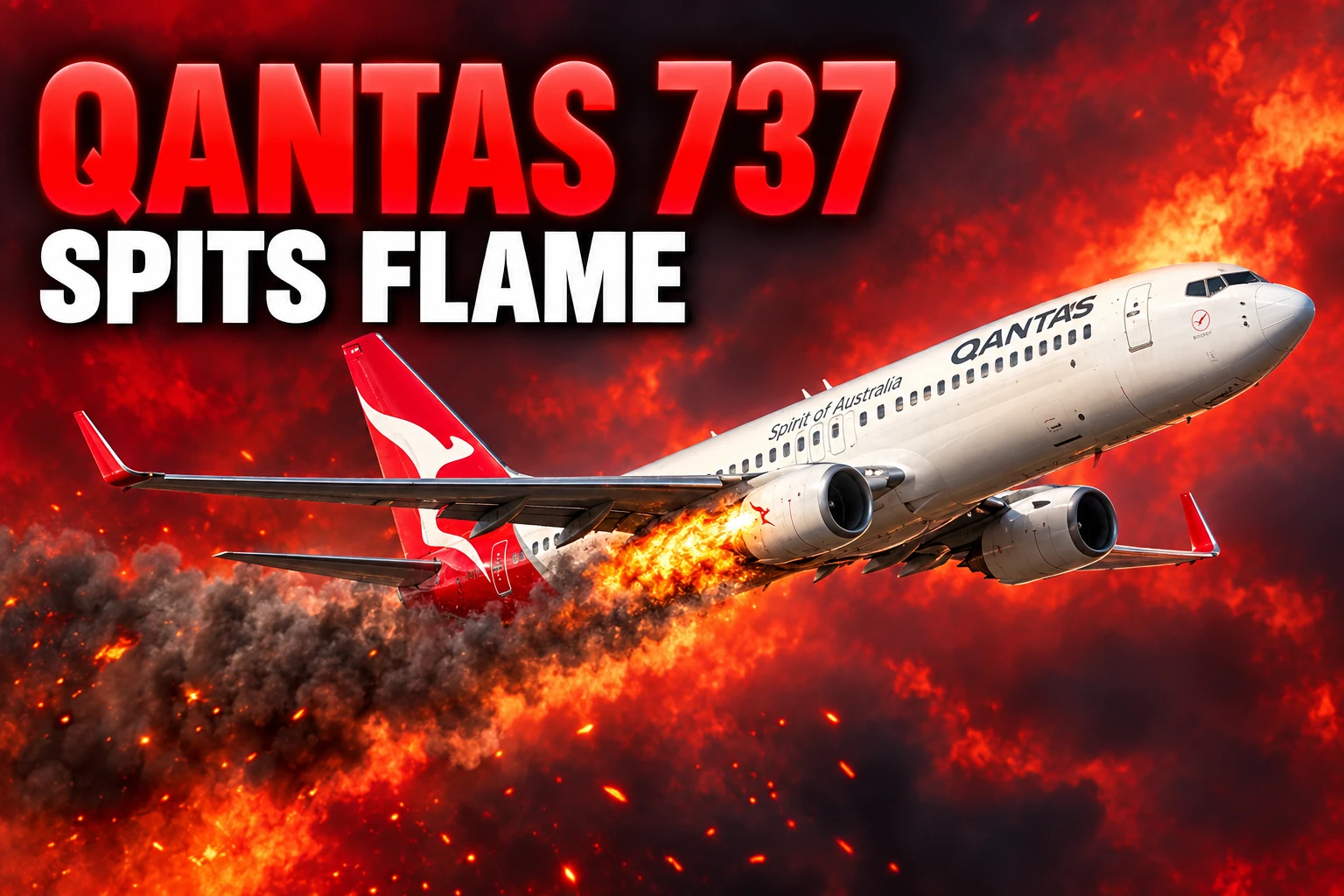
QF122 left Queenstown with pulsed flames from the left CFM56, then New Zealand’s CAA withdrew a bird-strike claim as the 737 sat in Christchurch.

A Qantas Boeing 737-800 bound for Sydney diverted to Christchurch on 5 September after its left engine spat orange flame bursts over Queenstown. Flight QF122 had been airborne only minutes when bangs rolled across the basin and the crew turned away from the Tasman.
Qantas called it a suspected engine issue and said the landing was not an emergency. Ground video, a same-day bird-strike claim that did not hold, and a 15-year-old CFM56 still running on both sides sit beside that wording.
Flame Bursts Over Queenstown on a Sydney-Bound 737
QF122 was the afternoon Queenstown-Sydney service, scheduled off the ground at 3.25pm local time. The jet, VH-VZQ, a Boeing 737-838 named Belconnen, rolled at 4.05pm, 40 minutes late. AirNav Radar timed the landing at Christchurch at 4.58pm, 53 minutes after take-off, with both engines still producing thrust.
QF122 AT A GLANCE
- The aircraft: VH-VZQ, a 737-838 first flown on 6 August 2011, fitted with two CFM56-7B26 engines.
- The load: About 160 people were on board the Sydney service.
- The path: Queenstown to Sydney, turned inland to Christchurch after a brief plan for Invercargill.
- The landing: 4.58pm at Christchurch, with fire crews and five ambulances waiting.
Flightradar24 diverted to Christchurch after take-off on that 5 September sector and then showed other tails covering QF122 in the days that followed. Queenstown Airport said the field stayed open. No injuries were reported.
Kriti Sethi Counted Five Bursts From the Left Engine
Kriti Sethi, flying home from a holiday, was seated toward the back on the left. She said the bangs and the fire came in a set.
It happened around five times, so we hear bang, bang, bang and there was five times fire coming out. And then the people were screaming; people were like, ‘Oh my god.’ It was quite scary.
Kriti Sethi, passenger on QF122
Cabin crew first talked about the landing gear, she said, until people looking out the left windows pushed back. The aircraft was shaking. Sari-Elle Kraemer, on the right side, could not see the engine but watched the lights go off and heard the talk of fire. “I’ve never experienced something like that,” she said. After a few minutes she felt the pilots had it in hand.
Sethi said the captain told the cabin the jet had had a chemical failure with the engines and would land in Christchurch. Fire engines met the aircraft. “The cabin crew were amazing, and the captain was amazing,” she said. “Once we landed, everyone was clapping.”
From the ground the same pulses were obvious. Nic Chamberlain, watching from Queenstown, described “shoots of orange flames shooting out the back” of the left engine, then a delayed string of noise: “rapid succession boom, boom, boom, boom, boom, boom.” Luke Pace, another resident, said he heard four or five explosions and saw “fireballs” timed with each bang, then the aircraft steady after about a minute.
The Same-Day Bird-Strike Walk-Back
New Zealand’s Civil Aviation Authority first told local reporters a bird strike had caused the engine event. By evening it had replaced that line. The updated statement said only that QF122 had an engine issue after take-off, diverted to Christchurch, and landed safely, and that questions about the flight should go to Qantas.
Qantas never adopted the bird claim. A spokesperson said: “One of our flights to Sydney experienced a suspected engine issue after take-off from Queenstown this afternoon and the aircraft diverted to Christchurch. Our pilots are highly trained to manage situations like this and the aircraft landed safely. We know this would have been a distressing experience for passengers and will be contacting all customers to provide support.”
The airline also said the arrival was not classed as an emergency and that both engines were still operating. Fire and Emergency New Zealand still logged an aircraft emergency at Invercargill Airport at 4.12pm, seven minutes after take-off, with Invercargill and Kingswell crews sent. Hato Hone St John was notified at 4.25pm that the flight was coming to Christchurch. Multiple ambulances rolled as standard procedure, treated no one, and stood down.
WHAT WE KNOW
- The divert: QF122 left Queenstown at 4.05pm and landed at Christchurch at 4.58pm with no reported injuries.
- The hardware: Left engine, Boeing 737-800 VH-VZQ, both engines still running on arrival.
- The regulator: CAA withdrew a same-day bird-strike explanation and has not named a cause.
WHAT IS UNCONFIRMED
- The trigger: Bird ingestion, a mechanical fault, or disrupted intake air have all been offered, none proven.
- The damage: Qantas has not said whether the left CFM56 will be repaired, changed, or torn down.
Under Civil Aviation Rule 12.55, a pilot must report a collision between birds and an aircraft as soon as practicable when it is a serious incident. That duty still applies. It does not make a withdrawn first statement into a finding.
What a Compressor Stall Looks Like From the Cabin
The pictures do not look like a fuel fire eating a nacelle. They look like short orange tongues coughing out the back of a running engine, timed with bangs, then a pause, then another burst. That pattern is how a compressor stall announces itself when airflow through the fan and compressor breaks down and, for a moment, goes the wrong way.
Former Qantas captain David Evans, reading the footage, said the flames and popping sounds point to disrupted airflow, a surge and stall that can follow a bird hitting the fan, or air that no longer hugs the blades. Geoff Tonkin, managing director of Aviation Projects, put the same event more broadly: something disturbed the intake, a part failed, the nacelle was damaged, or a bird went through. International aviation consultant Neil Hansford floated a liberated blade hitting a fuel line. That last picture does not match a landing with both engines still running and no shutdown called out to the cabin.
SKYbrary, the industry safety library, describes the stall in those physical terms. Smooth flow stops, pressure buckles, and air can reverse. The engine may make a backfire sound and send flame from the inlet and the exhaust while still turning. A stall can clear on its own or it can damage the core if it holds.
STALL SIGNATURES ON QF122
- Pulsed flame: Orange bursts from the left exhaust, not a steady fire on the cowling.
- Bangs on the ground: Four to six reports, described as explosions or gunshots from the valley.
- Thrust still there: The crew kept both engines running to Christchurch instead of shutting the left one down.
- Known triggers: Bird strike or other debris, worn compressor parts, icing, or air the engine was not built to swallow.
A stall can still wreck an engine. It is also a condition 737 crews train for, and it is why a cabin full of people can watch fire and still land on two engines. The official phrase “suspected engine issue” covers that. It also sanded off what the valley heard.
The Crew Could Not Turn Back Into the Remarkables
Queenstown sits in a mountain basin. A jet that has just lifted off does not have a wide, flat circuit to turn into. The airport’s own history records that a 1,911m runway overlay was completed in 2001 so jets could use the field, that Qantas began direct Australian services in July 2005, and that Airways brought in required navigation performance procedures in 2012 so airliners could snake through the valleys on curved tracks.
Those tracks are the point. A missed approach or an engine problem at low height is written toward Invercargill, down a valley, not back over the field. Fire and Emergency’s 4.12pm Invercargill call fits that first plan. The crew then kept going to Christchurch, the South Island’s main jet airport, once the left engine was still making thrust and a longer, better-equipped runway was in range.
THE AFTERNOON ON THE SOUTH ISLAND
- 3.25pm, 5 September 2026: QF122 is scheduled to leave Queenstown for Sydney.
- 4.05pm: VH-VZQ takes off, 40 minutes late.
- 4.12pm: Fire and Emergency logs an aircraft emergency at Invercargill, the first divert.
- 4.25pm: St John is told the flight is coming to Christchurch and sends ambulances.
- 4.58pm: The 737 lands at Christchurch. Passengers clap. No one is treated.
Crossing the Tasman on a rough left engine was the option the crew refused. Christchurch meant customs, hotels, and a Qantas engineering presence. Passengers spent the night there and moved to Sydney the next day on other metal.
Qantas Has Already Lost a CFM56 Engine on Takeoff
VH-VZQ is not a new jet. It first flew in August 2011 as ZK-ZQH with Jetconnect, Qantas’s New Zealand arm, and joined the Australian register in November 2018. Its CFM56-7B26 engines are the same family that has already bitten this fleet on the record.
On 8 November 2024, Qantas flight QF520, another 737-838, reached decision speed on Sydney’s runway 34R when the right engine failed with a bang. Fragments hit the grass and started a fire. The crew continued the take-off, declared an emergency, and landed on one engine about 30 minutes later. All 175 passengers and six crew got off unhurt. The Australian Transport Safety Bureau’s final report, issued on 29 April 2026, found a fatigue crack in a high-pressure turbine blade on a CFM56-7B24E. That engine had 17,656 cycles and was due for removal on 21 November 2024 under a manufacturer threshold of 17,900 cycles. Borescope checks could not see the crack under the blade platform.
On 18 January 2023, 737-838 VH-XZB lost a CFM56-7B26E over the Tasman after a radial driveshaft in the inlet gearbox separated. The crew could not restart it and landed at Sydney on one engine.
QANTAS 737-800 ENGINE EVENTS ON THE RECORD
| Date | Aircraft | Engine event | How it ended |
|---|---|---|---|
| 18 January 2023 | VH-XZB, CFM56-7B26E | Radial driveshaft split, uncommanded shutdown | Single-engine landing at Sydney |
| 8 November 2024 | VH-VYH, CFM56-7B24E | HPT blade fatigue at V1, contained failure, grass fire | Emergency return to Sydney, 181 on board unhurt |
| 5 September 2026 | VH-VZQ, CFM56-7B26 | Left-engine flame bursts after Queenstown take-off, cause open | Both engines running, divert to Christchurch |
Those three events are not one defect. They are the same narrow-body, the same engine house, and the same airline training that treats a bad engine as a procedure rather than a catastrophe. QF122 is the one that still has no teardown on the public record.
Two Engineers Flew to Christchurch the Next Morning
Qantas sent two engineers to Christchurch on Sunday, 6 September, to inspect VH-VZQ. The airline said the aircraft would stay there until it was cleared. Tracking of the Queenstown-Sydney service in the following days showed other 737-800s on the QF122 number, not Belconnen.
Passengers were put in hotels and moved the next day. Sethi, back in Sydney, said her onward captain told the cabin he understood the day before had been traumatic. The people who had watched the left engine cough fire were no longer on that airframe. The airframe was still in Christchurch, waiting on a cause the CAA had already declined to name.
The crew flew a damaged climb out of a basin that does not give you a second circuit, kept the engine running, and put 160 people on a Christchurch stand with the fire trucks already in place. The language around them got simpler than the video, then had to be rewritten before the day was over.

Hurricane Nolo Hits a Big Island Still Digging Out

Gaza Families Remain in Buildings Already Cleared to Fall

Sony Polls Publishers Who Cannot Press PlayStation Discs Elsewhere

UN Settlement List Hits 214 as Investors Take Notice

Fuel Pushes UK Inflation to 3.1% With Core Unchanged

Thameslink Will Pad 60,000 Ironing-Board Seats From 2027

Micron Sells the Memory Shortage as Five-Year Contracts

Royal Caribbean Sends Los Angeles Ships to Singapore and Brisbane

Burger King Rebuilds Chicken Nuggets After Calling Them Rubbery

U.S. Forces Clear Hormuz Mines, Then Hit Minelayers Again
-
 NEWS1 month ago
Thameslink Will Pad 60,000 Ironing-Board Seats From 2027
-
 NEWS1 month ago
Micron Sells the Memory Shortage as Five-Year Contracts
-
 NEWS1 month ago
Royal Caribbean Sends Los Angeles Ships to Singapore and Brisbane
-
 BUSINESS1 month ago
Burger King Rebuilds Chicken Nuggets After Calling Them Rubbery
-
 BUSINESS1 month ago
U.S. Forces Clear Hormuz Mines, Then Hit Minelayers Again
-
 NEWS1 month ago
Twenty Controllers Closed Norwich Airport for a Bank Holiday
-

 BUSINESS1 month ago
Sweetmore Bakeries Buys Fantasy Baking for Bar Work
-

 NEWS1 month ago
Frontier Miles Cuts Basic Fares After the Barclays Pact