
NEWS
North Korea Mixes Drones and Missiles in Wonsan Firepower Drill
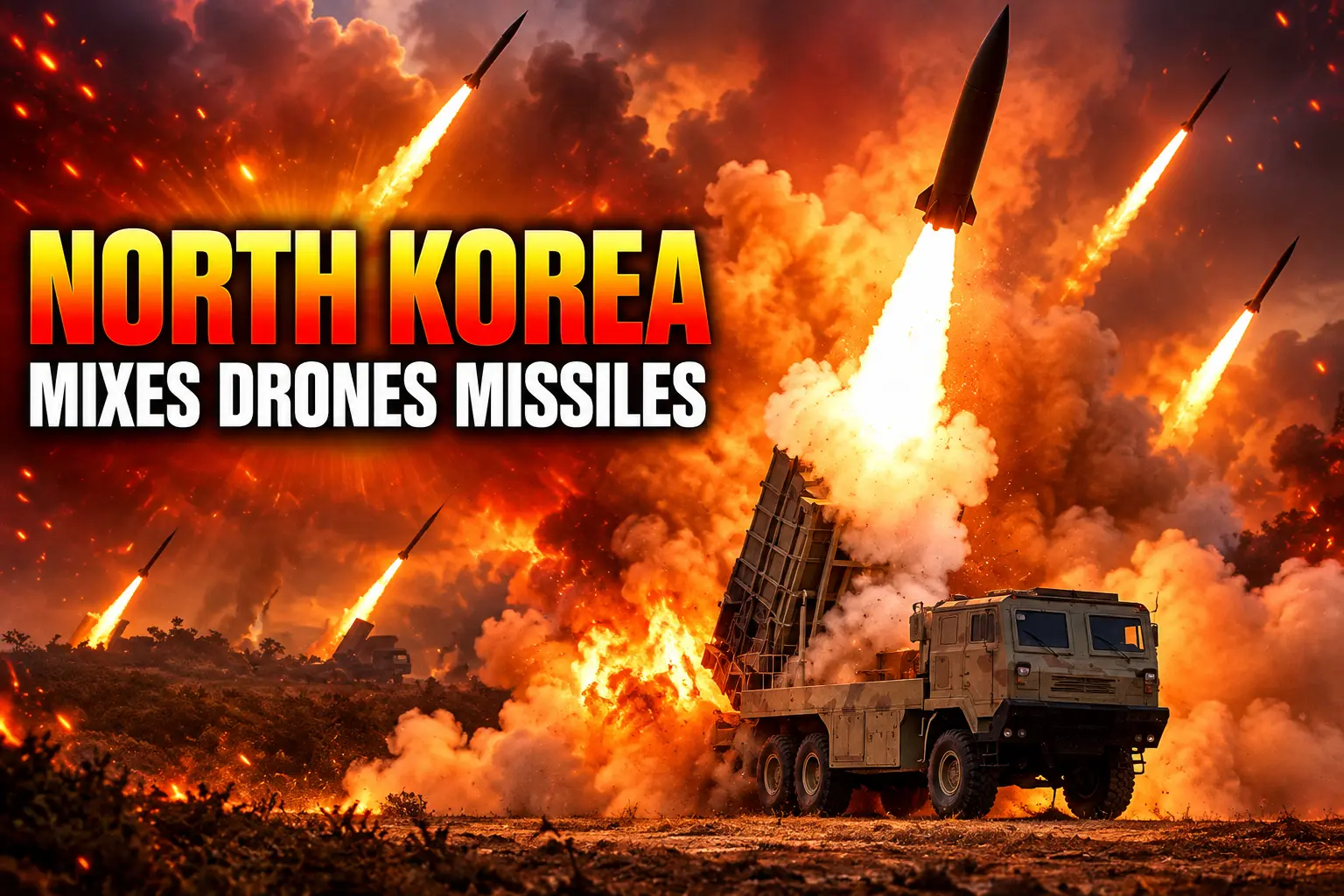
North Korea’s Wonsan firepower drill mixed attack drones, cruise missiles, thermobaric rockets and ballistic missiles under one command net after Freedom Edge.

North Korea fired a mixed strike of missiles, rockets and attack drones from Wonsan on Sept. 12, then waited two days to call it a firepower drill. The Korean Central News Agency said subunits from five artillery and missile joint units took part, and it listed attack drones, a tactical cruise missile, a large-caliber thermal-pressure rocket launcher and a tactical ballistic missile in the same shoot.
Kim Jong Un did not go to the range. The artillery bureau said the work was the integrated fire-control net that is supposed to make those systems land together.
The Mixed Salvo From Wonsan
KCNA on Sept. 14 described a joint firepower attack drill on Sept. 12 by long-range artillery and missile units of combined units at all levels of the Korean People’s Army. The agency said selected subunits from the five artillery and missile joint units joined the live fire, and it presented the mix as new combat systems rather than a single test article.
All strike weapons “demonstrated the huge destructive power of concentration fire by hitting the targets with 100 percent hit accuracy,” KCNA said, and it framed the point as “unity and simultaneity of firepower attack.” That is a command claim. It is the difference between proving one rocket flies and proving several kinds of weapons can be aimed as one volley.
Joseph Dempsey, a research associate at the International Institute for Strategic Studies, posted KCNA stills of the new combat systems after the delayed confirmation, matching the agency’s own list of drones, cruise missiles, thermal-pressure rockets and tactical ballistic missiles.
THE SYSTEMS KCNA PUT IN THE AIR
| System | What KCNA named | What Seoul’s military sources assessed |
|---|---|---|
| Attack drones | Attack drones of various kinds | Not named in the Saturday JCS notice |
| Cruise missile | Tactical cruise missile | Not named in the Saturday JCS notice |
| Rocket artillery | Large-caliber thermal-pressure multiple rocket launcher | 600-millimeter super-large multiple rocket launchers |
| Ballistic missile | Tactical ballistic missile | Hwasong-11 series short-range ballistic missiles |
Those two columns are not the same list. KCNA sold a four-system package that included drones and a cruise missile. Seoul’s public notice on Saturday was narrower, and the Hwasong-11 and 600-millimeter read came from military sources, not from the Joint Chiefs of Staff statement itself.
Seoul Clocked 250 Kilometers at Dawn
South Korea’s Joint Chiefs of Staff said it detected multiple ballistic missiles leaving the Wonsan area, on the east coast, toward the East Sea. The military said South Korean and U.S. intelligence had tracked the activity from the first stage and had shared the ballistic-missile information with Japan.
WHAT SEOUL MEASURED SATURDAY
- Launch time: Multiple ballistic missiles left the Wonsan area at about 5:20 a.m.
- Flight: The missiles flew about 250 kilometers (155 miles) before coming down in the sea.
- Readiness: The JCS said it had stepped up surveillance for further launches and was holding a combined defense posture with the United States.
- Year count: Saturday’s activity was assessed as North Korea’s 13th ballistic missile launch event of 2026.
The presidential Office of National Security convened an emergency review. Seoul urged Pyongyang to stop ballistic missile launches and called them a serious violation of U.N. Security Council resolutions. U.S. Pacific Command said it was aware of the launches, was consulting allies, and judged that the events did not pose an immediate threat to U.S. personnel or territory, or to allies.
Why the Artillery Bureau Ran the Show
Pak Jong Chon, vice chairman of the Workers’ Party Central Military Commission, watched the drill. Yu Chang Son directed it. Yu is director of the Artillery Bureau of the KPA General Staff, which puts the army’s gun-and-rocket shop, not a missile design bureau, in charge of the talking points.
Pak’s line was short. He said the purpose was “to ensure that the military does what it is supposed to do.” Yu went longer, and he named the machinery the pictures were meant to advertise.
Mastering the operation procedures of the integrated firepower command system, which is a component of the strategic weapon comprehensive management system, enhancing the professionalism in realizing the integrated automated firepower command of various combat systems, and increasing the efficiency of destroying targets against hostile firing are among our valued training tasks.
Yu Chang Son, director of the KPA Artillery Bureau, KCNA
He added that joint drills of missile and long-range artillery units raise the chance that, if orders come, the force can “completely collapse the enemy’s armed forces in terms of organizational structure.” The audience for that sentence is a staff officer who has to time drones, cruise missiles, rockets and ballistic missiles so they arrive as one problem, not four.
A Five-Day Close Near Jeju Island
The United States, South Korea and Japan had just finished the five-day trilateral Freedom Edge 26 exercise on Sept. 11. The run took place in international waters and airspace south and east of Jeju Island, with related work at bases and command posts in Japan. It was the fourth Freedom Edge since the series began.
Lt. Col. Matthew McNeal, exercise control group director for U.S. Pacific Command, said the 2026 iteration built on earlier ones with harder trilateral training. What started as a maritime-focused effort, he said, now folds in air, maritime, missile defense, cyber and medical work in a more connected training environment. Capt. Daeik Kim, the ROK Joint Chiefs control-group director, said the drill was meant to raise the level of security cooperation among the three countries.
On Sept. 7, the day Freedom Edge opened, Kim Song Gi, minister of National Defence, issued a press statement denouncing the “provocative tripartite multi-domain joint military exercises.” He said that if the United States and its allies attempt a new military confrontation, North Korea would take strong corresponding countermeasures “from the standpoint of power.” He also pointed at planned U.S.-Japan-Australia work and at a U.S. plan, as he described it, to put a Typhon mid-range fires system in Japan.
The trilateral series went ahead even after Washington cut the bilateral Ulchi Freedom Shield exercise in August. That annual South Korea-U.S. drill had been planned for Aug. 17-27 and ended Aug. 21, six days early, after President Donald Trump ordered a reduction and called the larger run a hostile signal. Trump has said he wants to meet Kim this year. The Wonsan salvo still went out at dawn the morning after Freedom Edge closed.
Kim Jong Un Was Not on the Range
Kim usually shows up when the state wants a weapons event to feel like a leadership decision. He was not listed among those at the Sept. 12 firepower drill. Pak and Yu carried the optics, and the report itself sat on KCNA, which is aimed at foreign readers.
The same day’s KCNA calendar placed Kim at the construction site of Ryonggang County Hospital, with Pak listed among those accompanying him. Ryonggang sits on the west side of the country. Wonsan sits on the east. KCNA did not explain the split, and it did not have to. The pictures the neighbors were meant to study were of tubes and drones, not of the leader in a white smock on a building site.
Six days earlier, Kim had been in Wonsan for a different show of force. On Sept. 6 he attended the commissioning of the destroyer Kang Kon at Wonsan Port, the second Choe Hyon-class ship, with Pak reading the Central Military Commission order. The army then used the same coastal zone as a firing ground without him. The hardware calendar kept moving. The leader’s public schedule did not have to move with every salvo.
How a Combined Strike Overloads Defenses
Lim Eul-chul teaches at Kyungnam University’s Institute for Far Eastern Studies in Seoul. He said the Sept. 12 event “was not a test of a single weapon system but a demonstration of an integrated strike network.” That reading fits Yu’s fire-control language, and it fits the kit list better than a simple protest shot.
Japan’s defense ministry keeps a public catalog of North Korean missile types that already treats the Hwasong-11 family and the 600-millimeter “super-large multiple rocket launcher” as separate short-range problems with overlapping jobs. Pairing them in one dawn window, then adding drones and a cruise missile in the state write-up, is how you turn a radar track into several tracks that do not behave the same way.
THE MIXED-PROFILE PROBLEM
- Different clocks: A ballistic missile, a cruise missile and a drone do not occupy the same minutes of flight, so a defender has to hold a picture that stays live while the slowest inbound is still in the air.
- Different paths: A 600-millimeter guided rocket sits in a gray zone between artillery and a short-range ballistic missile, which is why Seoul’s sources could file it next to the Hwasong-11 without calling it the same weapon.
- Drones in the same order: Attack drones of various kinds, if they were actually in that salvo, add low, cheap inbounds that compete for the same magazines used against faster missiles.
- Thermal-pressure warheads: A large-caliber thermal-pressure rocket is built to punch at structures and troops with blast and heat, which is a different damage problem from a kinetic ballistic shot at a point target.
The mix is a first-hour problem for the people Freedom Edge is supposed to train. A trilateral missile-defense drill practices sharing tracks. A combined strike practices making those tracks disagree with each other. Open-source chatter that treated Saturday as another protest round missed that the interesting part was the stacking, not the fact of a launch after an allied exercise.
Thirteen Ballistic Events and a Silent Party Paper
Saturday was the 13th ballistic missile launch event of the year, and it was the fourth such event since Aug. 6. On Aug. 6 the JCS reported one short-range ballistic missile from the Wonsan area, then the 10th event of 2026. On Aug. 12 another Wonsan shot flew about 700 kilometers. On Aug. 20, during the shortened Ulchi Freedom Shield period, the North fired more than 10 short-range ballistic missiles from the Pyongyang area about 300 kilometers into the East Sea. Sept. 12 closed that cluster.
Pyongyang has often reported a launch the next day. In recent months it has sometimes skipped the report. This time the write-up came two days later, and it stayed off the party newspaper Rodong Sinmun and off Korean Central Broadcasting, according to the Seoul read of the domestic file. Foreign desks got the drill. The home audience did not get a front page.
THE WEEK AROUND THE SALVO
- Sept. 6, 2026: Kim attends the commissioning of the destroyer Kang Kon at Wonsan Port, with Pak reading the order that puts the ship in the East Sea Fleet.
- Sept. 7, 2026: Freedom Edge 26 opens near Jeju, and Kim Song Gi issues his press statement promising corresponding countermeasures.
- Sept. 11, 2026: The three countries close the five-day exercise at Yokota Air Base and at sea.
- Sept. 12, 2026: At about 5:20 a.m., Seoul detects the Wonsan salvo; KCNA later dates the joint firepower drill to this day.
- Sept. 14, 2026: KCNA publishes the drill report and photographs for the foreign file, without a matching Rodong Sinmun splash.
The delayed, outward-facing dump is a way to show the neighbors a networked shoot while keeping the domestic volume down. The rockets still flew. The party paper still stayed quiet.
Frequently Asked Questions
What Does a Thermal-Pressure Rocket Warhead Do?
A thermal-pressure round, the phrase KCNA uses in English, is a thermobaric or fuel-air warhead: it spreads a combustible cloud and then ignites it, producing a long blast wave and a sudden drop in pressure that is meant to crush bunkers, trenches and troops in the open. That is a different job from a fragmenting high-explosive rocket, and it is why the large-caliber launcher in the Sept. 12 write-up sits in the “new combat systems” list rather than in a generic artillery note.
What Is the Hwasong-11 Series?
The Hwasong-11 family is North Korea’s current short-range ballistic line, a set of road-mobile missiles built to hit targets on the peninsula on a steep, fast track. Japan’s public catalog already records several Hwasong-11 variants with test histories stretching back years and with ranges in the few-hundred-kilometer class, which is why Seoul’s sources could file Saturday’s ballistic piece under that name without waiting for a new designation.
Where Did the Sept. 12 Missiles Come Down?
They came down in the East Sea about 250 kilometers from the Wonsan launch area, according to the Joint Chiefs of Staff. South Korean military sources said the rounds were fired toward Al Island, a small East Sea target North Korea has used before for live-fire work, which would explain a flight that stopped well short of the 600-millimeter rocket’s advertised upper range.
Which Ships Took Part in Freedom Edge 26?
The naval piece of the five-day run was built around six surface combatants and no U.S. aircraft carrier, the second year in a row without a carrier. Identified hulls included South Korea’s Sejong the Great-class destroyers ROKS Yulgok Yi I and ROKS Seoae Ryu Seong-ryong, Japan’s JS Atago and JS Asahi, and the U.S. Navy destroyer USS Benfold, which had arrived in Busan on Sept. 3 before the exercise opened.
Rodong Sinmun did not put the drill on the domestic front page. The neighbors still got the stills, the four-system list, and a dawn track from Wonsan that stopped 250 kilometers out in the East Sea.

Hurricane Nolo Hits a Big Island Still Digging Out

Gaza Families Remain in Buildings Already Cleared to Fall

Sony Polls Publishers Who Cannot Press PlayStation Discs Elsewhere

UN Settlement List Hits 214 as Investors Take Notice

Fuel Pushes UK Inflation to 3.1% With Core Unchanged

Thameslink Will Pad 60,000 Ironing-Board Seats From 2027

Micron Sells the Memory Shortage as Five-Year Contracts

Royal Caribbean Sends Los Angeles Ships to Singapore and Brisbane

Burger King Rebuilds Chicken Nuggets After Calling Them Rubbery

U.S. Forces Clear Hormuz Mines, Then Hit Minelayers Again
-
 NEWS1 month ago
Thameslink Will Pad 60,000 Ironing-Board Seats From 2027
-
 NEWS1 month ago
Micron Sells the Memory Shortage as Five-Year Contracts
-
 NEWS1 month ago
Royal Caribbean Sends Los Angeles Ships to Singapore and Brisbane
-
 BUSINESS1 month ago
Burger King Rebuilds Chicken Nuggets After Calling Them Rubbery
-
 BUSINESS1 month ago
U.S. Forces Clear Hormuz Mines, Then Hit Minelayers Again
-

 NEWS1 month ago
Twenty Controllers Closed Norwich Airport for a Bank Holiday
-

 BUSINESS1 month ago
Sweetmore Bakeries Buys Fantasy Baking for Bar Work
-

 NEWS1 month ago
Frontier Miles Cuts Basic Fares After the Barclays Pact