
NEWS
Four Ministers Call Gaza’s Shelter Crisis Entirely Reversible
Australia, Canada, Italy and the UK say 150,000 tents waiting outside Gaza make the winter crisis reversible, while attaching no new pressure to the demand.

Australia, Canada, Italy and the United Kingdom urged Israel on 15 November 2026 to allow 150,000 tents into Gaza, saying the winter shelter crisis is entirely reversible. Their foreign ministers, among them Penny Wong of Australia and Antonio Tajani of Italy, wrote that the recent floods had brought further suffering and that this was only the first storm of the winter.
The same tent count had already been published by the United Nations aid office a week earlier, with a warning that stocks inside Gaza were virtually exhausted. The ministers’ text names no deadline, no extra funds, and no consequence if the crossings stay slow.
Four Ministers Call the Crisis Entirely Reversible
Global Affairs Canada posted the joint statement from Ottawa on 15 November. Italy’s foreign ministry carried the same English text. The ministers said people in Gaza desperately need shelter and that 150,000 tents and other vital supplies are being held at the border and prevented from entering.
So we today urge the Government of Israel to stop the delays now and allow immediate, rapid and unimpeded humanitarian access throughout Gaza. The crossings must be opened, and the tents allowed in. Dual-use items necessary for humanitarian operations and early recovery must be granted entry before it is too late.
Foreign ministers of Australia, Canada, Italy and the United Kingdom, 15 November 2026 statement
They also told all parties to implement the Comprehensive Plan for Gaza, respect the ceasefire, and meet their duties under international humanitarian law. That plan is the one the UN Security Council endorsed on 17 November 2025 in Resolution 2803, adopted 13-0 with China and Russia abstaining, after a ceasefire took effect on 10 October 2025.
The published appeal is the thing it appears to be: a request that Israel stop the delays now. It does not set a date by which the tents must move, and it does not say what the four capitals will do if they do not.
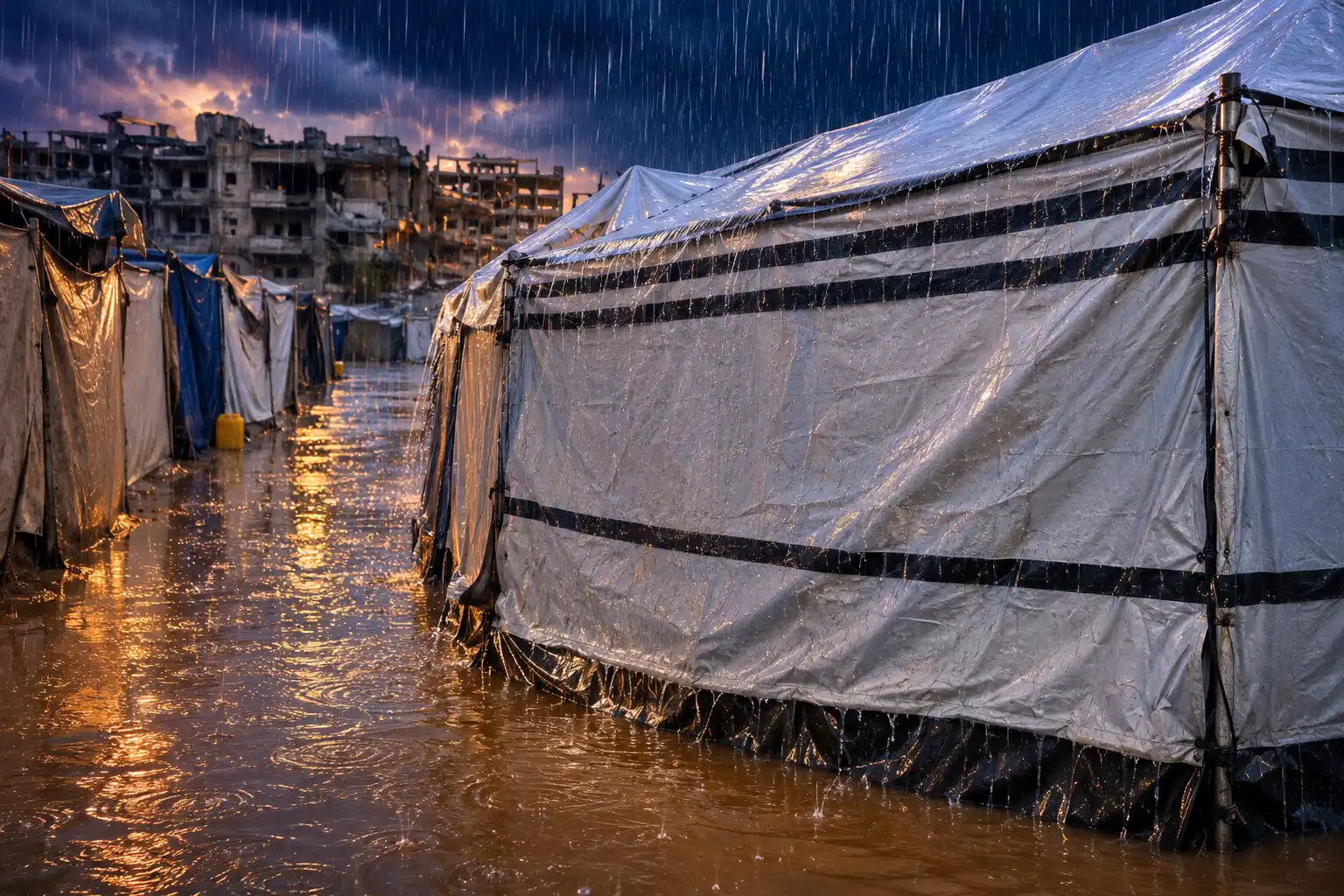
Worn Tents and a Collapsed Sand Hill
Heavy rain and strong winds hit Gaza from the evening of 6 November. The UN aid office, OCHA, said most Palestinians there remain displaced and that an estimated 65 percent, 1.4 million people, live in tents or makeshift shelters. Those shelters were already worn. Many sit in low ground that floods, or beside damaged buildings that can come down in a storm.
An infant drowned at a displacement site. At Al Berka Reservoir, west of Deir al-Balah, a sandy hill collapsed onto tents and killed five displaced people, three children and two women, and injured one, OCHA reported, citing Civil Defense crews who answered the calls. On 7 November, Civil Defense logged 2,166 distress calls and reached 218 of them. Water rose to 1.5 metres in some places.
THE FIRST STORM IN NUMBERS
- Households hit: By 9 November the Site Management Cluster counted about 46,000 households, 226,000 people, in weather alerts, including more than 5,000 households sleeping outside a shelter.
- Shelter loss: Those alerts listed more than 40,000 shelters damaged and more than 9,000 destroyed beyond repair, plus 960 damaged latrines and nine damaged health facilities.
- Inside stocks: Humanitarian stocks of tents, tarpaulins, blankets and clothes inside Gaza were virtually exhausted when the rain began, OCHA said on 8 November.
- Health strain: Gaza’s health ministry, which operates under the de-facto authorities, had about 90 pediatric inpatient beds in Gaza and North Gaza against about 350 before the war’s escalation.
The Humanitarian Country Team in the Occupied Palestinian Territory put the deaths in a harder frame two days before the four ministers wrote. It said children and adults were killed and thousands of family shelters flooded, swept away, or torn apart, not by the storm alone but by policy decisions, and that the devastating impact of the latest rainstorm was preventable.
Between 3 and 9 November, the same health ministry listed 22 Palestinians killed in conflict-related incidents, bringing reported deaths since the October 2025 ceasefire to 1,613, with 5,833 injured. The rain did not arrive in a quiet strip.
Why 150,000 Tents Are Still Outside Gaza
About 150,000 tents bought by aid groups and governments are packed outside Gaza, including about 117,000 from the Egyptian Relief Committee in Al-Arish, while stocks of tents and tarpaulins inside the enclave were virtually exhausted when the rain began, according to the UN aid office. The Humanitarian Country Team added that most of that waiting stock is in Al-Arish, 50 kilometres from Khan Younis.
OCHA’s 8 November report said the humanitarian community had spent months preparing for the rainy season and that more than 150,000 tents ready to be dispatched were already outside, alongside 300,000 tarpaulins and 500,000 blankets. Israeli restrictions on supplies and equipment, and funding shortfalls, limited what was actually inside when the clouds broke, the office said. Israeli limits on Palestinian movement across large parts of Gaza also left families with fewer dry places to go.
WHAT IS WAITING OUTSIDE GAZA
- Tents: 150,000 in total, about 117,000 of them with the Egyptian Relief Committee in Al-Arish.
- Tarpaulins and blankets: 300,000 tarpaulins and 500,000 blankets listed as ready for dispatch on 8 November.
- The kit the winter plan named: The country team’s 13 November appeal also listed cement, warm clothes, sandbags, safe heaters, pumps, generators, fuel, engine oil, spare parts, debris and explosive-ordnance gear, and medicines.
That pile is not all sitting against a single Israeli booth. OCHA said that between 2 and 8 November, 262 UN and partner trucks were listed for entry and 228 were offloaded on the Israeli side of Kerem Shalom, a drop of about 42 percent from the previous week. The lower figure was due mainly to a halt of the Egyptian corridor, which Israeli authorities tied to smuggling concerns, with no trucks offloaded from that route between 3 and 8 November. Funding cuts also shrank the volumes partners had on hand. A large share of the 150,000 tents is on the Egyptian side of that broken hop, 50 kilometres from Khan Younis and still not in the camps that flooded.
Israel’s Winter Tally Already Counts 93,000
Israel’s account is that winter kit is already moving. On 13 November the Israel Defense Forces said that, with the Coordinator of Government Activities in the Territories, it had coordinated a winter plan with the Board of Peace, the UN, international groups and donors. Since that work began, the military said, more than 93,000 tents and more than 8,600 trucks carrying winter supplies had entered Gaza, along with 16 sewage vacuum trucks and repairs to sewage, drainage and water lines.
❄️ WINTER PREPARATIONS IN GAZA: The IDF and COGAT continue coordinating humanitarian efforts alongside the Board of Peace, the UN, international organizations & donor countries.
Since winter preparations began:
• 93,000+ tents and 8,600+ trucks carrying winter supplies have… pic.twitter.com/auuy7CZ5pz— Israel Defense Forces (@IDF) November 13, 2026
The same statement said Hamas still exploits humanitarian infrastructure and incoming aid, including winter supplies, and that Gaza’s rehabilitation will not be possible as long as Hamas does not disarm. That is the condition Israel has attached to reconstruction throughout the ceasefire year. It is also why dual-use rules still sit on timber, cement, metal sheeting and the better class of shelter kit.
TWO TENT COUNTS, TWO CLOCKS
| Measure | Figure | Whose clock |
|---|---|---|
| Tents packed outside Gaza | 150,000 | OCHA, 8 November; four ministers, 15 November |
| Share of that stock in Al-Arish | about 117,000 | OCHA, Egyptian Relief Committee |
| Tents Israel says entered under the winter plan | more than 93,000 | IDF and COGAT, 13 November |
| Winter-supply trucks Israel says entered | more than 8,600 | IDF, 13 November |
| Dual-use trucks from Jordan | 15 per week, one offload day at Kerem Shalom | Norwegian Refugee Council, 5 October |
Those figures can stand together. The 93,000 are what Israel says has already crossed under a winter plan. The 150,000 are what the UN says is still parked outside, much of it in Al-Arish. One does not cancel the other. The argument is over the gap that remained when the first storm arrived, and over how fast the rest can move while Hamas remains armed and while Israel still classifies core shelter kit as dual-use.
Fifteen Dual-Use Trucks a Week From Jordan
A month before the rain, the Norwegian Refugee Council had already described the pipe. On 5 October it said Israeli authorities allowed just 15 trucks carrying items they designate as dual-use to enter Gaza from Jordan each week, across all aid sectors, and that those loads could be offloaded at Kerem Shalom, then the only open aid crossing, one day a week. Tents and tarpaulins sit on that list, with timber, cement, tools, rope and duct tape.
A minimum of 500 truckloads of those dual-use shelter items were already in the pipeline. At that pace, NRC said, it would take more than seven months to bring in the materials even under the best conditions. Secretary General Jan Egeland called it a manmade crisis because life-saving shelter aid is blocked by the occupying power, and said UN member states have a duty to press for all crossings to be opened for all aid.
The money was short on that date too. Almost 294,250 families would need shelter help through the winter, NRC said, citing the Palestine Shelter Cluster. Donors had provided or pledged 96.2 million USD of the 283 million USD required for a minimum winter response, 34 percent of the target, leaving a 186.6 million USD hole. Stocks and pipeline goods were enough for only partial help to about 52,000 families. Two-thirds of Gaza’s population was already in tents and makeshift shelters that wear out after a few months, which traps agencies in a loop of replacing torn canvas instead of building anything that lasts.
NRC also said about 950,000 people were living in sites at medium or high risk of flooding, and that Palestinians were restricted to about 35 percent of Gaza, leaving little dry ground to move to. The 15-truck Jordan figure is not a rebuttal of Israel’s later 93,000-tent tally, which counts other routes and weeks. It is the description of one choke point that was already in place before the forecast rain.
Ahmed Fouad Alkhatib, a Gaza-born analyst, has argued that Hamas also blocked sturdier housing and flood-risk demolition work, and that Palestinian Authority staff inside Gaza were pressured to halt projects without the group’s approval. That account is his, and it is contested. It belongs beside Israel’s disarmament condition, not in place of the dual-use queue or the Al-Arish stockpile.
October’s Seven-Month Warning
By the time Wong, Tajani and their counterparts wrote, the winter file had already been opened by the body created to police the Comprehensive Plan, by a much larger diplomatic group, and by the aid system on the ground.
THE WARNING CALENDAR
- 5 October 2026: The Norwegian Refugee Council warns that dual-use rules will keep winter shelter on a seven-month clock and that 1.65 million people face a fourth winter in worn tents and damaged buildings.
- 6 November 2026: The first heavy rains of the season begin in the evening and run through the weekend, flooding displacement sites in all five governorates.
- 9 November 2026: OCHA records the infant drowning and the Al Berka collapse. The US-backed Board of Peace, set up under the Comprehensive Plan, says Israel’s response remains insufficient and that delays in approving supplies exacerbated the consequences of a foreseeable humanitarian challenge. It also presses Hamas to disarm.
- 12 November 2026: At the United Nations, the United Kingdom, Qatar and Jordan lead a Call to Action on humanitarian access, asking for rapid access through all crossings, approval of dual-use shelter and health items, and winterisation support, and recalling that the plan requires aid at levels no lower than those agreed on 19 January 2025.
- 13 November 2026: The Humanitarian Country Team issues its preventable-storm appeal. The IDF posts the 93,000-tent winter tally the same day.
- 15 November 2026: Australia, Canada, Italy and the United Kingdom publish the four-minister statement.
UN humanitarian coordinator Ramiz Alakbarov had already said, after the weekend storm, that 150,000 tents were stuck outside Gaza, that stocks of essential shelter and winter items were exhausted, that Israeli authorities must lift restrictions, and that the aid system had run out of time. The January 2025 aid protocol, which the later ceasefire plan treats as a floor, called for at least 600 trucks a day and 4,200 a week, including shelter materials in the first phase. Those are all-goods figures. They should not be stacked against the 228 UN-partner trucks offloaded in one early-November week, which is a narrower count.
The Statement Adds No New Pressure
Three days after the Call to Action, and two days after the country team’s appeal, the four ministers repeated the 150,000-tent number and the demand that dual-use gear move before it is too late. They did not announce money to close the 186.6 million USD winter-shelter gap NRC had flagged in October. They did not name a date. They did not say what would change in their own military, trade, or legal posture if the crossings stayed as they were on 15 November.
That does not make the tent count false, and it does not make Israel’s 93,000-tent claim disappear. It does mean the most quoted line in the statement, the claim that the situation is entirely reversible, was already true on the terms the ministers themselves used: the canvas is packed, a short drive from Khan Younis in the Al-Arish case, and the first storm of winter has already shown what a worn tent does in a 1.5-metre flood. Reversing it is a clearance, routing, funding, and security-review problem, not a mystery about whether the supplies exist.
Inside Gaza, between 2 and 9 November, Shelter Cluster partners reached 10,690 households with mixed kits and got 173 tents into families’ hands. More than 9,000 shelters from the same storm were listed as destroyed beyond repair. The ministers said there is still time to act before the winter fully sets in. The next rain will test that sentence on the ground, not in another joint text.

Josh Sinn Draws the Heaviest AFL Betting Ban Since 2019

Rolapp Shuts the PGA Door as DeChambeau Heads to Europe

Apple TV Renews Slow Horses Past the Last Novel

Oasis Lifts UK Music to £8.4 Billion as Venues Shrink

Beyoncé Hits 100 Grammy Nominations on a Vault Track

Thameslink Will Pad 60,000 Ironing-Board Seats From 2027

How Tall Was Adolf Hitler?

U.S. Forces Clear Hormuz Mines, Then Hit Minelayers Again

Micron Sells the Memory Shortage as Five-Year Contracts

Royal Caribbean Sends Los Angeles Ships to Singapore and Brisbane
-
 NEWS3 months ago
Thameslink Will Pad 60,000 Ironing-Board Seats From 2027
-
 HISTORY3 years ago
How Tall Was Adolf Hitler?
-
 BUSINESS3 months ago
U.S. Forces Clear Hormuz Mines, Then Hit Minelayers Again
-
 NEWS3 months ago
Micron Sells the Memory Shortage as Five-Year Contracts
-
 NEWS3 months ago
Royal Caribbean Sends Los Angeles Ships to Singapore and Brisbane
-

 BUSINESS3 months ago
Sweetmore Bakeries Buys Fantasy Baking for Bar Work
-

 NEWS3 months ago
Twenty Controllers Closed Norwich Airport for a Bank Holiday
-

 BUSINESS3 months ago
L Catterton Installs a Kraft Heinz Operator at Kettle Cuisine