
BUSINESS
Canada and the EU Launch an Alliance Without the Seat
Ottawa and Brussels launched an Alliance for the Future, but their joint statement omits associate membership and waits until 2027 to define it.

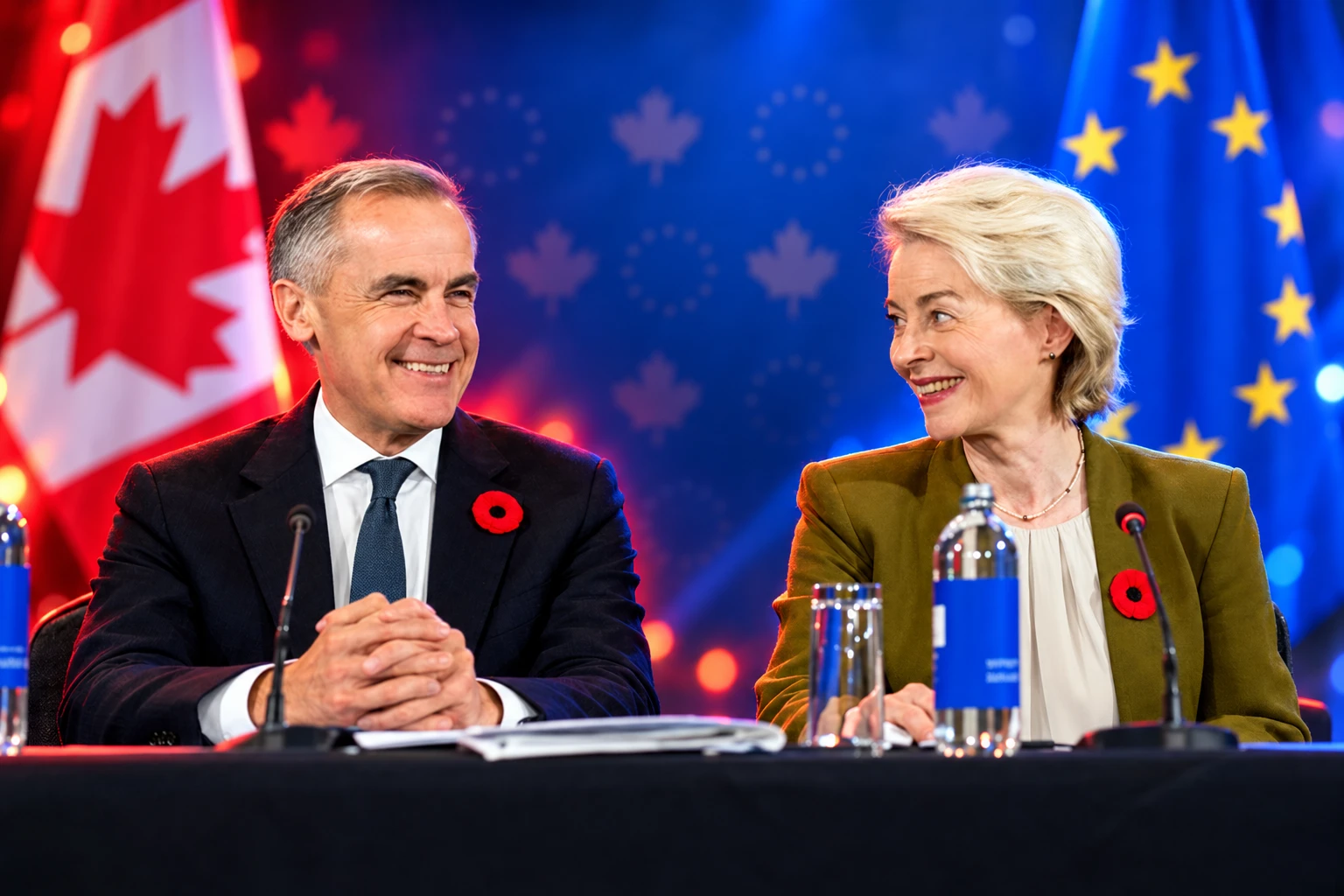
Canada and the European Union launched an Alliance for the Future on Friday in Montreal. The signed joint statement does not call Canada an associate member.
Prime Minister Mark Carney and European Commission President Ursula von der Leyen used that title anyway at the close of a two-day summit, then pushed any definition of a new status to 2027. What moved on paper is narrower, and more usable: a Canadian stake in an AI firm, a ticket into Europe’s supercomputing club, mineral financing, and a pledge into a European loan for Ukraine.
The Joint Statement Never Uses the Word Ottawa Wanted
Canada hosted the 21st Canada-EU summit in Montreal on October 29 and 30, with European Council President António Costa attending alongside von der Leyen. In the Council’s own readout, the leaders agreed on a joint statement that launches the Alliance for the Future as a common prosperity and economic security space, open in principle to other like-minded countries.
The published text commits both sides to define an ever-closer association of Canada to the EU, short of full membership, by the 2027 EU-Canada summit. Associate member does not appear. Ottawa’s own release still says Canada is becoming the European Union’s first Associate Member, with the substance, scale, and scope to be worked out in the coming months.
That split is the product of a week of arm-wrestling in Brussels, not a drafting slip. Von der Leyen floated associate membership in her State of the Union speech in September, with Carney in the room at the European Parliament in Strasbourg. Several national governments spent October trying to keep the phrase out of a political declaration, arguing the Union was naming a status that does not exist in the treaties and had not been defined.
HOW THE LABEL FELL OUT OF THE TEXT
- June 2025: Canada and the EU announce a Strategic Partnership of the Future and a Security and Defence Partnership at a summit in Brussels.
- February 2026: Canada becomes the first non-European country to join the EU’s Security Action for Europe (SAFE) instrument.
- September 2026: Von der Leyen proposes Canada as the first associate member; Carney addresses the European Parliament on a deeper partnership.
- October 27, 2026: Germany, France, Italy, and Greece break a no-objection deadline on a draft that still uses the term, forcing a rewrite.
- October 30, 2026: The issued statement speaks of an ever-closer association to be defined by 2027; Carney and von der Leyen keep saying associate member in public.
German Chancellor Friedrich Merz, travelling in Asia during the summit, wrote that the EU and Canada were beginning a new chapter in their relations and again avoided the membership label. Von der Leyen called the idea an association without accession, and said it could include closer coordination of policy and administrative structures, plus exchanges between parliaments and courts. Costa, in Montreal, called Canada “by far the most European of the non-European countries” and said the two sides would pursue the closest association the Union has ever built with a country outside Europe.
Carney repeated the stripped title on his own account after the close.
Canada and the EU are working towards the deepest possible partnership — short of full membership — with Canada becoming the European Union’s first Associate Member.
Today in Montréal, we took a major step forward with more than twenty new measures that will create greater…
— Mark Carney (@MarkJCarney) October 30, 2026
Associate membership was never on a Canadian ballot. It is also missing from the paper both sides signed, which has not stopped Ottawa from selling it as the destination.
Concluded Talks, Signed Contracts, and a Pile of Studies
Leaders announced more than twenty new measures they grouped under affordability, opportunity, and sovereignty, and they opened talks on several more. The EU is already Canada’s second-largest trading partner for goods and services, with a total value of about $178 billion Canadian in 2025. The existing Comprehensive Economic and Trade Agreement is still going through ratification in member states, a fact the joint statement itself records.
International Trade Minister Maninder Sidhu said Canadian firms already exported nearly $15 billion in digitally deliverable services to the EU in 2024, from a digital sector of roughly 800,000 workers. The new Digital Trade Agreement is meant to sit beside CETA and set rules for electronic contracts, software sales, and commercial data flows.
WHERE THE MAIN FILES STAND
| File | What it does | Status on October 30 |
|---|---|---|
| Digital Trade Agreement | Online commerce rules beside CETA | Negotiations concluded |
| Competition Cooperation Agreement | Joint work on cross-border antitrust cases | Negotiations concluded |
| EuroHPC Joint Undertaking | Shared access to machines including JUPITER | Canada has joined |
| European Investment Bank treaty | Lets the EIB finance Canadian critical minerals | Signed |
| Erasmus+ | Study, training, and youth exchanges | Negotiations begun |
| Next Horizon Europe (2028-2034) | Research money, including dual-use technology | Work toward joining |
| Instant payments | Link Canada’s Real-Time Rail to the EU’s TIPS system | Work to support |
| LNG exports | Feasibility of more Canadian gas to Europe | Joint study |
| Transatlantic data cable | Compare routes for a joint cable | Market study, first steps |
| Ukraine Support Loan | Share of a €90 billion EU facility | Canada intends to join; Carney pledged €500 million |
Two trade files are finished as talks, compute access is on, and the energy and cable files are studies. None of that required a new membership category. A host-country agreement will raise the EU delegation in Canada toward the treatment Ottawa already gets in Brussels, and a Canadian Industry Office is to open in Brussels at the initiative of a business coalition. A joint working group on banks, insurers, and fintechs is still to be launched, and it will have to bring in provinces and territories as well as EU regulators.
Ottawa Takes a Stake in Cohere
The industrial move that Carney put next to the summit is not in the joint statement at all. On Thursday in Montreal he said the government plans to invest up to $1.6 billion Canadian in Cohere, the Toronto AI company, on commercial terms beside private backers including NVIDIA, Bell, and Germany’s Schwarz Group.
We’re not waiting for the future of AI to be decided somewhere else by those we don’t know or those we don’t trust. We are building it right here, the right way.
Mark Carney, Prime Minister of Canada, Montreal, October 29, 2026
Under the deal, Cohere stays incorporated and headquartered in Canada and will put at least $1.7 billion into new computing infrastructure in the country by 2030. The government said the company will create at least 1,000 new Canadian technical jobs by that year. Carney said Cohere has partnered with Germany’s Aleph Alpha to combine Canadian and European AI work, a tie-up planned with dual headquarters in Toronto and Berlin.
He framed the stake as a way to keep data and models under Canadian law, and he said the federal public service is already using the company’s tools. He also said, without naming a firm, that supposedly global companies too often prove national when it counts. That line sits one day before the alliance launch, and it is the clearest statement of why Ottawa is paying for a domestic AI champion while it hunts for European compute.
Helmets, Waterbombers, and a Loan Kyiv Can Spend in Canada
Defence industrial cooperation is the other place the summit produced invoices rather than adjectives. Canada already joined SAFE in February, and Montreal-based Marconi Technologies has a contract to build ORION tactical radios for Poland’s Cyber Command. The new hardware track is broader, and it is aimed as much at Canadian plants as at European depots.
THE HARDWARE TRACK
- Latvia helmets: Montreal-based Galvion will supply ballistic helmet systems under a contract worth more than $44 million, paid through SAFE, to Latvia, where Canada keeps its largest military presence abroad.
- Waterbombers: Ottawa intends to provide up to $2.5 billion in Export Development Canada financing for Alberta-based De Havilland to raise aerial firefighter production, including for EU customers, after member states bought DHC-515 aircraft in March 2024.
- Ukraine loan: Canada intends to take part in the EU’s €90 billion Ukraine Support Loan, which would let Kyiv buy military equipment from Canadian firms with EU funds; Carney told reporters the first Canadian pledge is €500 million.
- Satellites: Ottawa will explore an administrative arrangement on the EU’s IRIS² secure satellite network and will formalise a geodetic partnership with Galileo’s High Accuracy Service, including in the Arctic.
Von der Leyen tied the economic half of the pitch to household prices. “When trade becomes a tool of economic pressure, it’s the families that pay the price, from the supermarket shelf to the cost of a new car,” she said, arguing that once-trusted suppliers of energy, critical minerals, or semiconductors are being used as leverage.
Space-based communications sat on Carney’s sovereignty list for a reason that landed in mid-October. Ukrainian officials said Starshield connections, the military-grade cousin of Starlink, were capped at about 160 km/h, which grounded or slowed some drone work, then restored by October 24 to speeds above 400 km/h. Elon Musk, a dual Canadian citizen, said Ukraine had used the service for offensive drone strikes and that the loophole was closed. The joint statement does not mention him. It does put satellite connectivity, hybrid threats, and Canada’s interest in EU Common Security and Defence Policy missions into the same basket as minerals and AI.
On minerals, Canada and the EU have already signed 28 deals under a Critical Minerals Production and Resilience Alliance. The new EIB treaty is meant to let European public finance into exploration, mining, processing, and recycling on Canadian ground. A separate track will map rare earths, permanent magnets, and batteries for possible joint stockpiling. Since May 2025 Ottawa has also signed long-term LNG supply arrangements with Germany’s SEFE and Uniper and with France’s TotalEnergies, which is why the new LNG work is a feasibility study rather than a first conversation.
Quebec’s Premier Skipped the Montreal Summit
The meeting was held in Montreal, and the provincial government did not treat that as a courtesy. Parti Québécois Premier Paul St-Pierre Plamondon, who leads a minority government, stayed away after Ottawa refused to let him speak in public at the summit.
The federal government would have us believe that the premier of Quebec being granted permission to serve shrimp cocktails at a reception constitutes an acceptable and sufficient form of influence for representing Quebec’s interests.
Paul St-Pierre Plamondon, Premier of Quebec
He wrote that an invitation to sit at the head table was a demand that Quebec get back in line, in exchange for better seats to watch the party. For a summit that talks about people-to-people ties and youth mobility, the snub is a domestic bill. Any deeper Erasmus-style access, and any financial-services opening that needs provincial regulators, will have to go through the same federation that would not give the host premier a microphone.
The louder Canadian objection beyond Quebec is simpler. A closer alignment of policy, courts, and parliaments, which is how von der Leyen described associate membership, sounds to critics like importing rules from a bloc that still has not fully ratified CETA. Carney’s answer is that sovereignty now means secure access to minerals, chips, payment systems, energy, vaccines, satellites, and AI, and that Europe, with more than 450 million consumers, is the partner with matching values and complementary scale. The statement both sides signed is more cautious than that speech.
What Associate Membership Would Even Mean
There is still no treaty article for it. Commission material continues to describe a path toward making Canada the first associate member to the EU, with closer alignment on climate, energy, AI, and the Arctic, deeper Horizon Europe work, fuller Erasmus+ access, and institutions that meet more often, starting with a government-to-college meeting. That is the Commission’s brochure. It is not the Council legal order, and it is not what Germany would put in the communiqué.
ASSOCIATE MEMBERSHIP
- The pitch: Von der Leyen’s association without accession, a partnership she said is “not against anyone else, but for our common strength.”
- The paper: An ever-closer association, short of full membership, with the concept to be defined by the 2027 EU-Canada summit.
- The worry in capitals: A label that was never in the treaties, was not defined before it was offered, and could confuse countries that already have association deals or want full accession, including Ukraine, for which Merz had floated a similar status.
Carney said the two sides are working toward the deepest possible partnership short of accession. Costa promised the strongest association the Union has ever offered a non-European country. Those are political sentences. They do not tell a customs officer, a student-visa clerk, or a defence procurement board what extra right Canada has on Monday morning.
They also do not settle how far Canada would move its own rules. Instant payments, capital-markets access, and digital-trade clauses can be written as technical annexes. Court-to-court and parliament-to-parliament language cannot. That is why Berlin wanted the work specified first and the name later, and why von der Leyen and Carney keep using the name anyway: it is the one phrase the cameras understand.
A Supercomputer Now, a Status Later
The file Canadian labs can use without waiting for 2027 is compute. Canada has joined the European High Performance Computing Joint Undertaking, which pools public and private money for machines, AI, and quantum research. Ottawa says that includes access to JUPITER, one of the world’s most powerful supercomputers. Horizon Europe’s next programme, running 2028 to 2034, is still a negotiation, with a stated interest in semiconductors and dual-use technology and in getting smaller firms onto European digital infrastructure.
A transatlantic cable remains a market study. IRIS² remains an arrangement to talk. LNG remains a joint study of markets and pipes. The Alliance for the Future is already a name, and it already has a Ukraine pledge, a minerals treaty, two concluded trade talks, and a Canadian cheque to Cohere. The associate member seat is the part that several EU governments would not put in writing, and that both leaders still recited in Montreal as if the draft had survived.
The next Canada-EU summit is where they promised to define the concept. Until then, the working relationship is the one in the table: contracts, studies, and a supercomputer login, under a title the signed statement would not bear.

Josh Sinn Draws the Heaviest AFL Betting Ban Since 2019

Rolapp Shuts the PGA Door as DeChambeau Heads to Europe

Apple TV Renews Slow Horses Past the Last Novel

Oasis Lifts UK Music to £8.4 Billion as Venues Shrink

Beyoncé Hits 100 Grammy Nominations on a Vault Track

Thameslink Will Pad 60,000 Ironing-Board Seats From 2027

How Tall Was Adolf Hitler?

U.S. Forces Clear Hormuz Mines, Then Hit Minelayers Again

Micron Sells the Memory Shortage as Five-Year Contracts

Royal Caribbean Sends Los Angeles Ships to Singapore and Brisbane
-
 NEWS3 months ago
Thameslink Will Pad 60,000 Ironing-Board Seats From 2027
-
 HISTORY3 years ago
How Tall Was Adolf Hitler?
-
 BUSINESS3 months ago
U.S. Forces Clear Hormuz Mines, Then Hit Minelayers Again
-
 NEWS3 months ago
Micron Sells the Memory Shortage as Five-Year Contracts
-
 NEWS3 months ago
Royal Caribbean Sends Los Angeles Ships to Singapore and Brisbane
-

 BUSINESS3 months ago
Sweetmore Bakeries Buys Fantasy Baking for Bar Work
-
 NEWS3 months ago
Twenty Controllers Closed Norwich Airport for a Bank Holiday
-

 BUSINESS3 months ago
L Catterton Installs a Kraft Heinz Operator at Kettle Cuisine