
BUSINESS
The AI Buildout Wiped a Trillion Off Tech Stocks
AI cash burn wiped more than $1 trillion off tech stocks on October 30, even as energy, healthcare and small caps held up.

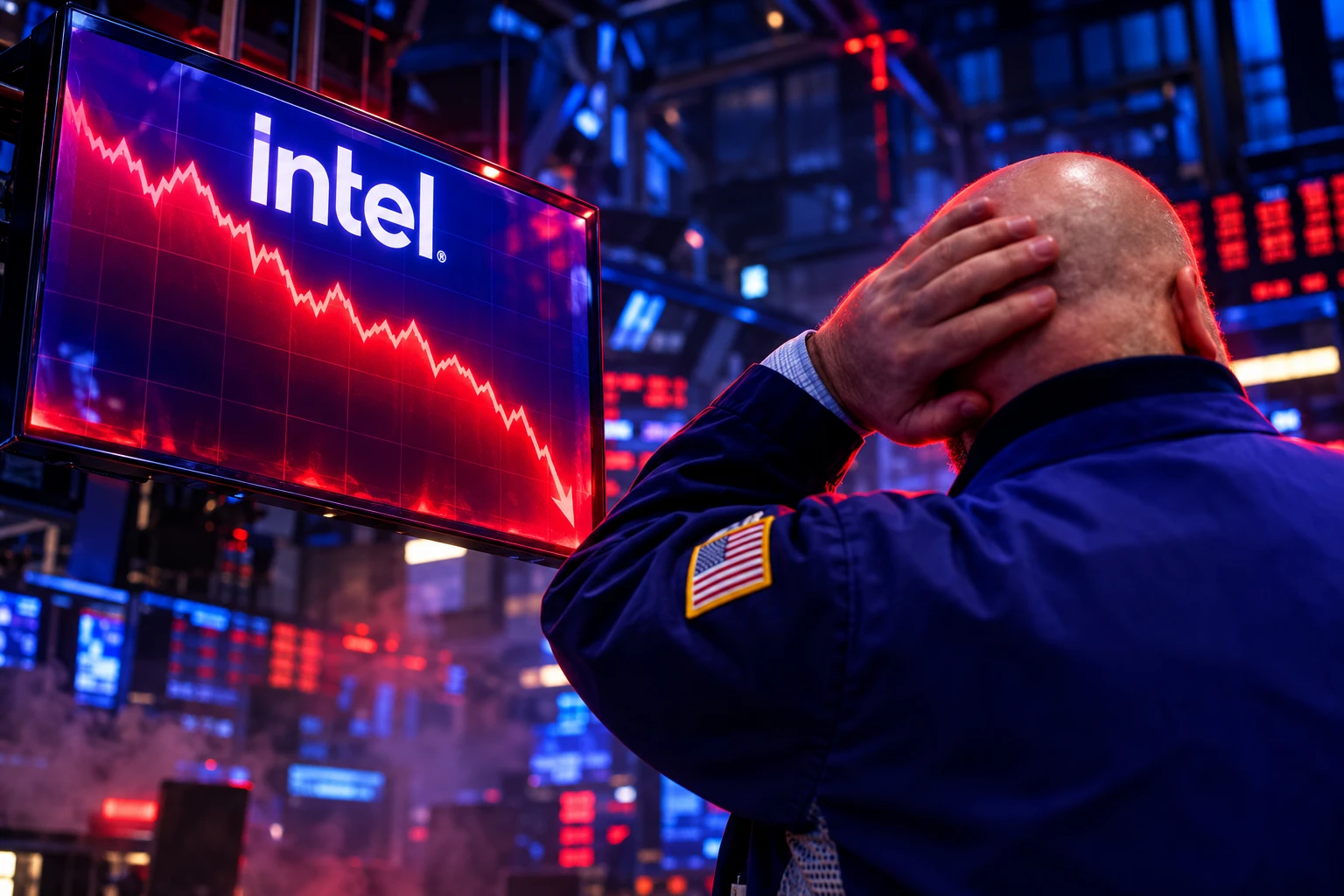
Tech stocks erased more than $1 trillion on Friday, October 30, as investors punished the same AI spending that had lifted those shares. The Nasdaq Composite fell 2.86% to 25,437.00, its largest one-day drop since June 5. Intel closed down 28.6%.
The rest of the tape did not fall in a heap with them. Energy, healthcare and financials finished higher. The Russell 2000 actually gained for the week. The S&P 500 still sits only 3.05% below its October 6 record of 7,818.93.
A Trillion-Dollar Hit in a Handful of Names
JJ Kinahan, a Cboe senior vice president, wrote that the tech selloff erased more than $1 trillion in value. That is a Friday figure for the tech complex, not a verdict on every share a 401(k) holds. The Nasdaq 100, a different basket, was on course to shed more than $2 trillion across October as a whole.
The S&P 500 dropped 140.32 points, or 1.82%, to 7,580.07, its worst session since June 5 and a third straight losing week. The Dow Jones Industrial Average lost 572.25 points, or 1.09%, to 51,770.31. The Nasdaq Composite lost 747.73 points. The Russell 2000 fell 47.37 points, or 1.7%, to 2,811.84, then still finished the week up 1.3%.
FRIDAY, OCTOBER 30
| Index | Close | Friday | Week |
|---|---|---|---|
| S&P 500 | 7,580.07 | -1.82% | -0.6% |
| Dow Jones | 51,770.31 | -1.09% | -0.9% |
| Nasdaq Composite | 25,437.00 | -2.86% | -2% |
| Russell 2000 | 2,811.84 | -1.7% | +1.3% |
The Nasdaq Composite is 7.8% below the all-time closing high it set on October 6, and it just posted its worst month since March 2025. The S&P 500 is down 0.93% for October. The Dow still left the month higher. For the year the S&P 500 is up 10.7%, the Nasdaq 9.4%, and the Dow 7.7%.
The Nasdaq 100 dropped about 3.4%, its worst day since mid-June, and the S&P 500’s technology sector fell more than 4.2%. LSEG data showed 299 S&P 500 companies had reported, with 82% beating estimates, and analysts still looking for 31.6% year-on-year earnings growth. The bill was concentrated. The earnings calendar was not a washout.
Amazon’s Cloud Grew While Cash Walked Out
Amazon reported third-quarter net sales of $201.9 billion, up 12%, and operating income of $28.1 billion. Operating margin hit 13.9%, which the company called its highest ever. AWS sales rose 39.3% to $46.0 billion, a $184 billion annualized run rate and the fastest growth in nearly five years. AWS operating income was $17.8 billion.
Then the cash line. Trailing-twelve-month free cash flow swung to an outflow of $42.4 billion from an inflow of $14.8 billion a year earlier. Amazon said that was driven by a $94.8 billion year-over-year increase in purchases of property and equipment, net of sales and incentives, and that the increase primarily reflects investments in artificial intelligence. It still expects 2026 cash capital expenditures of about $220 billion, and it said it will spend more in 2027.
Our AWS investment in functionality and infrastructure is working, with over 39% year-over-year revenue growth in Q3 ($184 billion revenue run rate) and projected revenue growth rates of over 40% both in 2027 and in 2028.
Andy Jassy, President and CEO, Amazon Q3 2026 release
That is the bind. The cloud is filling up, and the spending required to keep it full is the number the stock could not carry. Shares finished lower after paring losses. Net income was $20.7 billion, or $1.89 a share, down from $21.2 billion, or $1.95, a year earlier, a comparison Amazon tied to $9.5 billion of 2025 gains on its Anthropic stake. Fourth-quarter sales were guided to $240.0 billion to $247.0 billion, with operating income of $28.5 billion to $33.5 billion.
Alphabet had already set the week’s tone on Thursday. Revenue rose 25% to $127.6 billion and still missed estimates, the first top-and-bottom miss in nearly four years. Google Cloud more than doubled to $30.7 billion. Search and other advertising rose 12% to $63.3 billion, short of what the Street wanted. Free cash flow was negative $9.1 billion after $51.4 billion of capital spending. The company kept 2026 capex at $195 billion to $205 billion and said 2027 would be significantly higher. Class A shares fell more than 12% on Thursday and shed nearly $500 billion of value in that session.
The same spending cycle is the other side of cash that has already reached chip suppliers. Hyperscalers are still writing the checks. The market is now asking when those checks turn into cash the shareholders can keep.
Intel Beat the Quarter and Lost 28.6%
Intel’s own print was the day’s detonator, and it was not a simple miss. Third-quarter revenue was $16.5 billion, up 21%. GAAP earnings were $0.60 a share; non-GAAP earnings were $0.52. Data Center and AI revenue jumped 78% to $7.3 billion. CFO David Zinsner called it the strongest data center revenue growth in 15 years. Cash from operations was $5.1 billion. The stock still had its worst drop since 1974.
Client Computing and Physical AI Group revenue fell 5% to $8.1 billion. For the fourth quarter Intel forecast revenue of $15.0 billion to $16.0 billion, against a Street number around $17.1 billion, and non-GAAP earnings of $0.25 a share against about $0.43. Non-GAAP gross margin is seen sliding from 44.1% to 38%, including a hit from a temporary shutdown at a factory in Israel that the company told analysts would take about $300 million of fourth-quarter revenue.
Looking ahead, we see the PC slowdown continuing at least through the first half of next year, but we remain optimistic about the opportunities across our broader portfolio, and we will continue making disciplined investments in capacity and working capital to increase supply and support future growth.
David Zinsner, Intel CFO, October 29 earnings release
CEO Lip-Bu Tan said demand for CPUs remains robust and that the immediate priority is unlocking supply for Xeon. That is the other half of the joke on the ticker. Servers are selling faster than Intel can build them. PCs are being crushed by memory shortages and price spikes that make a new machine harder to ship. Management told analysts it expects the PC unit market to shrink about 12% in 2026, with the second half down more than 20%, and to plan for another decline of about 10% in 2027. The company also completed a $23 billion public equity offering. The quarter beat. The stock priced the next year.
Why a PC Warning Took Down the Chip Stack
A PC warning should have been Intel’s problem. It became everyone’s, because the same memory squeeze that is stalling boxes is the boom that has been feeding AI servers, and because Friday was a day for dumping the whole crowded trade. The PHLX semiconductor index fell 7.2% and was on track for a monthly loss of more than 15%.
THE CHIP STACK ON FRIDAY
- Intel: Down 28.6%, its worst drop since 1974, after the weak fourth-quarter guide.
- SanDisk: Down 13.8% as memory names that had run hard gave it back.
- AMD: Down 10.9%, pulled with the group ahead of its own report next week.
- Marvell: Down 10% with the data-center names around it.
- Nvidia: Down 4.2%, and it slipped back under a $5 trillion market value.
Qualcomm and Arm were off around 10% as well. Kinahan’s point still stands: the session does not prove the AI boom is over, or that demand is fading. It shows the tape is now weighing spend against returns, and that no one on the Street has a clean answer. Nvidia did not blow up an earnings print on Friday. It got marked with the rest of the crowded trade after Intel and Amazon made the cash question impossible to ignore.
Binance Covered a $6.3 Billion Hot-Wallet Theft
Crypto added a second shock on the same tape. Binance said that at around 20:05 UTC on October 29 its hot wallets were compromised, with a loss of about $6.3 billion in tokens. Co-CEOs Yi He and Richard Teng said the exchange will absorb the hit through its Secure Asset Fund for Users and corporate treasury, not through customer balances. They have set aside more than $6.34 billion of company funds, with $5 billion already held in the same assets that were taken, covering about 80% of the impact, and are buying the rest in the market and over the counter.
WHAT WE KNOW
- The loss: About $6.3 billion left Binance hot wallets on October 29, and the firm says customer funds were not used.
- The reserve: More than $6.34 billion of company money has been set aside, $5 billion of it already in the stolen token types.
- The freeze: About $3 billion has been frozen on-chain with issuers and partners, and withdrawals remain paused while deposits run.
- The next proof: Binance plans a proof-of-reserves result by Monday, November 2, and a later technical post-mortem.
WHAT IS UNCONFIRMED
- The full attack path: Early work pointed at a compromised laptop; later work found more breach points, and Binance says it has found no private-key leak.
- Withdrawal timing: The firm is targeting a phased restart after security checks, not a hard public hour.
Blockchain analytics firm Elliptic put the haul at the largest single theft of any kind on record, more than four times the $1.46 billion taken from Bybit in 2025. Coinbase, Strategy and Robinhood slid with the complex. Bitcoin traded lower. The equity close did not need the hack to fall. It did not help anyone who still had to own risk into the weekend.
Energy, Hospitals and Bonds Took the Inflow
If the trillion left a handful of tickers, it showed up in the places that look like a hedge. Kinahan noted that financials, healthcare and energy on the S&P 500 all ended solidly in the green. Healthcare climbed to a 52-week high after drug and biotech prints. ExxonMobil and Chevron both hit all-time highs during the session and finished about 2% higher. That is a rotation, not a liquidation.
THE SAFETY TRADE
- VIX: The Cboe Volatility Index neared 24 in the day, then closed 12.91% higher and still just below 20.
- Treasuries: The 10-year yield fell to 4.92% and the 30-year to 5.31% as bond prices rose.
- Oil: WTI climbed above $104 a barrel, up 2.2%, and Brent rose 2.45% to just below $118.
- Fed: The Federal Reserve had left rates unchanged earlier in the week, so Friday was not a policy shock.
Oil and yields moved in opposite directions, which is the tell. Traders bought duration because they wanted less equity risk, not because a growth scare had suddenly arrived in the energy pit. Crude was firmer on Middle East supply risk. The S&P 500 is still up 10.7% on the year. A 1.82% down day off a record is a bruise. It is not 2008.
Small-caps making a weekly gain while the Nasdaq logs its worst month since March 2025 is the same split in another wrapper. Money left the names that had to keep spending to stay in the AI race, and it went looking for earnings that do not require a new data hall.
Tuesday’s Midterms Meet a Market Off Its High
The session closed four days before Election Day on Tuesday, November 3. President Donald Trump has long treated the stock market as a public scoreboard. A 3.05% drawdown from the S&P 500’s October 6 high is not a collapse, and it is large enough to show up in a campaign ad. Sen. Bernie Sanders used the same Friday to draw a harder line on who should eat an AI miss.
Companies like Microsoft, Meta, Google, Amazon, SpaceX, Oracle & Nvidia have racked up $3 trillion in debt on a high-stakes gamble on AI.
Big Tech Oligarchs: If your AI bet fails, don’t come begging to taxpayers. You won’t be bailed out — period. End of Discussion.
— Sen. Bernie Sanders (@SenSanders) October 30, 2026
Sanders said companies including Microsoft, Meta, Google, Amazon, SpaceX, Oracle and Nvidia have racked up $3 trillion in debt on an AI gamble, and that they should not expect a taxpayer rescue. That $3 trillion figure is his claim, not a ledger total from those firms’ filings. Replies treated it as a midterm argument about taxes and federal debt as much as about chips. The useful point is narrower. These companies are funding a buildout so large that free cash flow at Amazon and Alphabet has already gone negative, and the public is already arguing about who pays if the bet slips.
Monday, November 2, Apple reports after the close, with AMD due after the vote on Tuesday. Kinahan’s question for the reopen is whether buyers step in the way they have on every sharp down day for a decade. The receipts from this week are already on the page. AWS is growing 39.3%. Google Cloud doubled. Intel’s data center book is up 78%. The stocks that sold off are the ones writing the checks to keep those lines rising.
Disclaimer: This article is news reporting and market analysis for information only. It is not investment advice, a recommendation to buy or sell any security or cryptocurrency, or a forecast of election or market outcomes. Readers should consult a licensed financial adviser or investment professional who can review their own holdings, time horizon and risk tolerance before making any decision. Index levels, company figures and incident totals reflect the cited company releases, exchange commentary and filings as of the dates in this piece and can change in later sessions.

Josh Sinn Draws the Heaviest AFL Betting Ban Since 2019

Rolapp Shuts the PGA Door as DeChambeau Heads to Europe

Apple TV Renews Slow Horses Past the Last Novel

Oasis Lifts UK Music to £8.4 Billion as Venues Shrink

Beyoncé Hits 100 Grammy Nominations on a Vault Track

Thameslink Will Pad 60,000 Ironing-Board Seats From 2027

How Tall Was Adolf Hitler?

U.S. Forces Clear Hormuz Mines, Then Hit Minelayers Again

Micron Sells the Memory Shortage as Five-Year Contracts

Royal Caribbean Sends Los Angeles Ships to Singapore and Brisbane
-
 NEWS3 months ago
Thameslink Will Pad 60,000 Ironing-Board Seats From 2027
-
 HISTORY3 years ago
How Tall Was Adolf Hitler?
-
 BUSINESS3 months ago
U.S. Forces Clear Hormuz Mines, Then Hit Minelayers Again
-
 NEWS3 months ago
Micron Sells the Memory Shortage as Five-Year Contracts
-
 NEWS3 months ago
Royal Caribbean Sends Los Angeles Ships to Singapore and Brisbane
-

 BUSINESS3 months ago
Sweetmore Bakeries Buys Fantasy Baking for Bar Work
-

 NEWS3 months ago
Twenty Controllers Closed Norwich Airport for a Bank Holiday
-

 BUSINESS3 months ago
L Catterton Installs a Kraft Heinz Operator at Kettle Cuisine