
NEWS
Big Tech Earnings Face a Cash Test After Meta’s Print
Meta grew sales 26% and still fell 7% after cash went negative, so Microsoft, Alphabet and Amazon will be judged on AI spending, not the earnings beat.

Microsoft, Alphabet and Amazon report earnings on October 28 and October 29. Together the three are worth more than $10 trillion. Investors will judge those prints on how much cash is still going into artificial intelligence.
Meta already ran that test. Sales rose 26% and the stock still fell 7% on October 22 after free cash flow flipped negative. That is the bar for the next two sessions.
Meta Beat on Sales and Still Dropped 7%
Meta’s October 21 release showed revenue of $64.60 billion, up from $51.24 billion a year earlier. Diluted earnings were $3.83 a share. Strip out a $9.89 billion legal charge tied to an August deal with 52 state attorneys general, and earnings would have been $7.40. None of that held the stock.
Capital spending, including finance-lease principal, hit $34.91 billion. Operating cash flow was $32.79 billion, which left negative $2.12 billion in free cash flow. A year earlier the same line was $10.63 billion. It is the first negative free cash flow quarter of Meta’s public life.
We hit major milestones this quarter toward delivering personal superintelligence for everyone – including launching Muse and Muse Wonder, our first frontier model. Our investments are paying off, the core business is strong, and we’re seeing velocity across the board.
Mark Zuckerberg, founder and CEO, Meta third-quarter results
The ads engine did what it usually does. Family daily active people averaged 3.64 billion in September, up 3%. Ad impressions rose 10% and the average price rose 14%. Operating margin still halved to 20% from 40%, because costs and expenses jumped 68% to $51.61 billion once the legal charge was in.
THE PRINT THAT REPRICED THE TRADE
- August 2026: Meta records a $9.89 billion charge toward an agreement of up to $18.59 billion with 52 attorneys general.
- October 21, 2026: Third-quarter results show $34.91 billion of capex and negative free cash flow, and the board approves non-voting Class C stock.
- October 22, 2026: The shares fall 7% and the Nasdaq drops about 2%.
- January 19, 2027: The new Class C class is set to take effect, with a one-for-one stock dividend that acts like a two-for-one split and leaves voting power unchanged.
Full-year capex is now $135 billion to $145 billion, with the floor lifted $5 billion and the ceiling left alone. Through September the company had already spent $85.83 billion, so the new range implies about $49 billion to $59 billion in the fourth quarter. Future spending commitments, mostly data-center leases and cloud contracts, were reported near $825 billion. Cash and marketable securities were still $82.45 billion, and headcount was 66,775, down 15% from a year earlier.
Microsoft, Alphabet and Amazon Report This Week
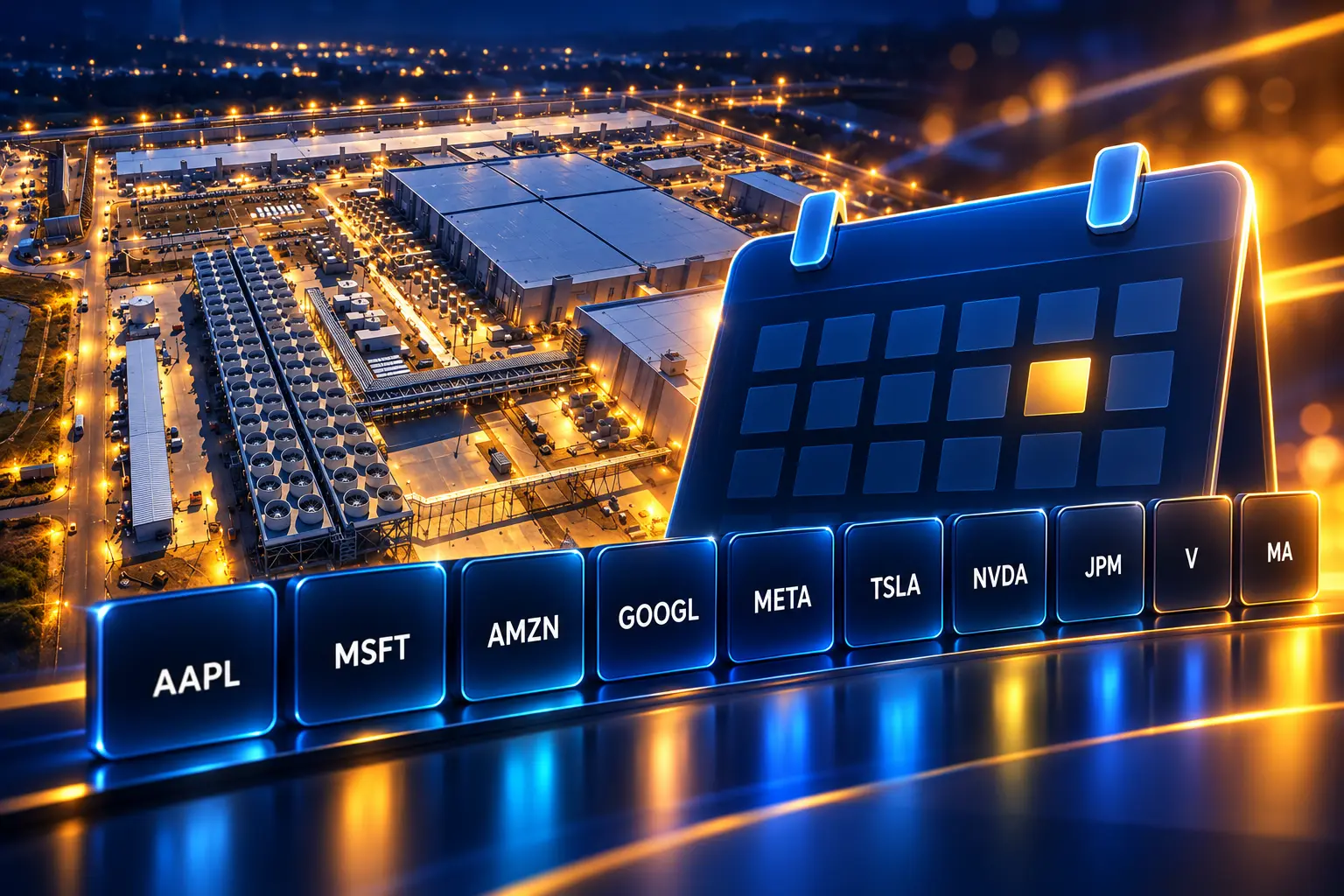
Microsoft will publish fiscal 2027 first-quarter results after the close on Oct. 28, with a call at 2:30 p.m. Pacific Time. Alphabet will post third quarter 2026 financial results the same afternoon and hold its call at 4:30 p.m. Eastern Time. Amazon is due October 29 after the close.
Analysts look for Microsoft sales of about $90.6 billion and $4.71 a share, Alphabet sales of about $127.9 billion and $3.03 a share, and Amazon sales of about $202 billion and $1.96 a share. Those beats, if they arrive, will not be the trade. The trade is whether capex, leases and free cash flow still look like a growth plan or like a bill that has to be refinanced.
THIS WEEK’S THREE PRINTS
| Company | Report | Sales view | EPS view | 2026 capex plan |
|---|---|---|---|---|
| Microsoft | October 28, after the close | $90.6 billion | $4.71 | About $175 billion |
| Alphabet | October 28, 4:30 p.m. ET | $127.9 billion | $3.03 | $195 billion to $205 billion |
| Amazon | October 29, after the close | $202 billion | $1.96 | About $220 billion |
Microsoft has already told investors that fiscal first-quarter capex will run over $50 billion, including a lease reclassification, and that Azure growth should be about 45% in constant currency. Alphabet does not give a numeric sales guide. Amazon’s watch item is whether AWS can keep the pace it showed when second-quarter cloud sales rose 37% to $42.23 billion.
Four Spenders Now Guide $725 Billion to $745 Billion
Add the latest 2026 plans and the four largest spenders land on $725 billion to $745 billion. Microsoft is about $175 billion for the calendar year. Alphabet is $195 billion to $205 billion. Amazon is about $220 billion in cash capex. Meta is $135 billion to $145 billion. The definitions do not match, and Amazon’s number also covers fulfillment, robotics and satellites, so the total is a budget size, not a clean AI invoice.
SPEND SO FAR AGAINST THE 2026 PLANS
| Company | Q1 2026 | Q2 2026 | 2026 plan |
|---|---|---|---|
| Microsoft | $31.9 billion | $41 billion | About $175 billion |
| Alphabet | $35.7 billion | $44.9 billion | $195 billion to $205 billion |
| Amazon | $44.2 billion | $54.2 billion | About $220 billion |
| Meta | $19.84 billion | $31.08 billion | $135 billion to $145 billion |
Microsoft’s $175 billion figure fell from about $190 billion because some leases moved off the capex line, not because the build shrank. CFO Amy Hood said on the July 29 call that, outside a useful-life change, calendar 2026 investment expectations “remain unchanged.” About two-thirds of Microsoft’s June-quarter spend went into short-lived assets, mostly chips. Alphabet has raised its plan twice this year, from $175 billion to $185 billion in February, and about 60% of its second-quarter outlay went into servers rather than buildings. Amazon lifted its plan from about $200 billion after memory prices jumped, and CEO Andy Jassy said even $220 billion will not cover 2026 demand.
S&P Global Market Intelligence, in its Hyper 5 work on Amazon, Alphabet, Microsoft, Meta and Oracle, puts those firms at $1.1 trillion on capital spending over the past five years, with another $5.3 trillion in analyst estimates through 2030. Liam Hynes and Drew Bowers, who led that research, wrote that the risk is “the transition from cash to debt-funded investment before returns validate the spending.”
Cloud Tenants Can Split the GPU Bill
Microsoft, Alphabet and Amazon sell the capacity they build. Meta mostly uses it. That is why the same dollar of capex reads as a product at one company and as a bet at the other.
Google Cloud grew 82% in the second quarter. Azure is guided to about 45% this quarter. AWS, in the June quarter, booked its fastest growth in 18 quarters and a backlog of $496 billion. Dan Ives, the Yorkville Ives tech analyst, has argued the group is short of capacity rather than customers, and that cloud backlog sits above $2 trillion. Meta has no outside cloud tenant to share the depreciation on a rack that trains Muse.
HOW THE BUILD IS BEING PAID
- Microsoft: Heavy finance leases, a useful-life shift that lowered reported capex, and a pledge that fiscal 2027 free cash flow stays positive even as the quarterly bill tops $50 billion.
- Alphabet: Two capex raises in 2026 plus an $84.75 billion equity sale in June, listed on its investor site as a raise to expand AI compute, after a proposed $80 billion deal a few days earlier.
- Amazon: A $220 billion cash plan and trailing free cash flow of negative $7.6 billion for the 12 months ended June 30, as equipment purchases jumped.
- Meta: Negative free cash flow in the third quarter, a higher capex floor, paused buybacks after $26.25 billion of repurchases in the year-earlier nine months, and a new non-voting share class meant to raise capital without cutting the founder’s vote.
The Yield Theory tracker that follows those plans, company by company, is blunt about what the dollars buy: servers, data centers, and chips, on four different accounting measures. Amazon’s line is the least AI-specific. Meta’s line is the one that already outran cash.
What Microsoft, Alphabet and Amazon Have to Clear
John Belton, a portfolio manager at Gabelli Funds, said investors have “absolutely no patience right now for higher capex.” He added that the market can “whistle past the graveyard for some time,” but that the spend will hit, or at least make the market more fragile. Last week’s Meta tape is what that impatience looks like in a single session.
THE LINES THAT HAVE TO HOLD
- Microsoft: Azure near the 45% constant-currency guide, capex that does not blow past the “over $50 billion” bill without a booked-demand explanation, and free cash flow that still points to a positive fiscal 2027.
- Alphabet: Google Cloud growth that does not roll over after 82% in the second quarter, a 2026 capex range that does not get lifted a third time without a matching backlog, and some sign that the June equity raise is funding sold capacity rather than empty halls.
- Amazon: AWS that holds the 37% pace, a $220 billion cash plan that is not raised again on memory costs alone, and a free-cash-flow hole that at least stops getting deeper.
The demand case is not what cracked on October 22. Cash timing did. If these three show that new racks are already rented, the Meta reaction can stay a Meta story. If they show another step-up in 2027 spending with thinner cash, the veto travels.
Credit Markets Moved on Cash, Not on the Beat
S&P Global’s digital-infrastructure head, Mark Habib, said it is “safe to assume that there is more (debt) out there that we are not seeing,” pointing at guarantees around data-center builds and smaller AI firms. S&P has said the six largest U.S. hyperscalers, a group that includes these names plus Oracle and SpaceX, are on track to spend more than $7 trillion on data centers and related capex from 2025 through 2030, with negative free cash flow into next year. Habib has not called for rating cuts on that basis. He has said the rating risk is still whether the profits show up.
WHERE EXPERTS DISAGREE
- Dan Ives: The prints so far “do not support the fear,” and Alphabet, Microsoft and Amazon should confirm a large capex path, with monetization the tell into 2027.
- John Belton: There is no patience for a higher capex print, and extra spend will either hit results or leave the market more fragile.
- Mark Habib: Extra, hard-to-see liabilities sit around the build, and the credit question is still whether expected profits arrive, not the headline spend alone.
That split is the week. One side reads reserved cloud capacity as proof the money is already sold. The other side reads negative free cash flow as proof the money is no longer optional.
Class C Shares Let Meta Raise Cash Without Extra Votes
Meta’s board approved a publicly listed, non-voting Class C common stock, following a special committee of independent directors advised by Moelis. Shareholders are due one Class C share for each Class A or Class B share. The company said the class “will provide Meta the ability to finance its growth,” and that the scale of investment required “to compete, sustain growth, expand infrastructure, and pursue new strategic initiatives” is large. It also said the structure keeps Mark Zuckerberg in a founder-led model. Meta’s own release notes the stock is up more than 1,700% since the IPO, against about 495% for the S&P 500 over the same span.
That is a capital-markets answer to a cash-flow problem. Reality Labs lost $4.13 billion in the quarter; the company now sees 2026 losses there at $18 billion to $19 billion and about $15 billion in 2027 as money moves toward AI. Fourth-quarter sales are guided at $73 billion to $76 billion. None of those lines stopped the October 22 sale, because the market had already switched from asking whether AI ads work to asking who pays for the next rack.
Ives put the other side of that argument on October 22, after Meta’s session, and still wants the next three names to confirm the spending path.
The prints so far do not support the fear, it’s the opposite as it increases our bullish conviction on AI thesis into year-end and 2027 despite the market jitters. We expect Alphabet, Microsoft, Amazon to confirm the massive Capex spending path next week Monetization key🎯🐂
— Dan Ives (@DivesTech) October 22, 2026
Microsoft and Alphabet speak on October 28. Amazon follows on October 29. If those calls show cash holding while capacity stays tight, last week’s Meta drop stays a one-name shock. If they show another year of heavier spend with thinner cash, the veto that hit Meta becomes the rule for the $10 trillion club.
Disclaimer: This article is news reporting and analysis of company results, guidance and market prices, and it is for information only. It is not investment advice, a recommendation to buy or sell any stock, or a forecast of returns on Microsoft, Alphabet, Amazon, Meta or any other security. Readers should consult a licensed financial adviser or other qualified investment professional who can weigh their own objectives and risk limits before making any decision. Revenue, capex, cash-flow and share-price figures here reflect the company releases, filings and market data cited in the piece and can change with later reports, restatements or trading.

Josh Sinn Draws the Heaviest AFL Betting Ban Since 2019

Rolapp Shuts the PGA Door as DeChambeau Heads to Europe

Apple TV Renews Slow Horses Past the Last Novel

Oasis Lifts UK Music to £8.4 Billion as Venues Shrink

Beyoncé Hits 100 Grammy Nominations on a Vault Track

Thameslink Will Pad 60,000 Ironing-Board Seats From 2027

How Tall Was Adolf Hitler?

U.S. Forces Clear Hormuz Mines, Then Hit Minelayers Again

Micron Sells the Memory Shortage as Five-Year Contracts

Royal Caribbean Sends Los Angeles Ships to Singapore and Brisbane
-
 NEWS3 months ago
Thameslink Will Pad 60,000 Ironing-Board Seats From 2027
-
 HISTORY3 years ago
How Tall Was Adolf Hitler?
-
 BUSINESS3 months ago
U.S. Forces Clear Hormuz Mines, Then Hit Minelayers Again
-
 NEWS3 months ago
Micron Sells the Memory Shortage as Five-Year Contracts
-
 NEWS3 months ago
Royal Caribbean Sends Los Angeles Ships to Singapore and Brisbane
-

 NEWS3 months ago
Twenty Controllers Closed Norwich Airport for a Bank Holiday
-

 BUSINESS3 months ago
Sweetmore Bakeries Buys Fantasy Baking for Bar Work
-

 BUSINESS3 months ago
L Catterton Installs a Kraft Heinz Operator at Kettle Cuisine