
BUSINESS
SpaceX Closes $40 Billion GPU Debt as Neocloud Credit Shuts
SpaceX closed $40 billion of GPU debt because Starlink and launches still open credit markets that have shut for AI-only neoclouds.

Elon Musk said Sunday that SpaceX closed $40 billion of debt to buy GPUs, citing its investment-grade rating and cash from Starlink and rocket launches. He said the notes are mostly callable and that the chips are due in the first and second quarters of 2027.
The size is the headline. The split underneath it is the story: lenders are still writing paper for a borrower with satellite bills and launch contracts, and they have all but stopped for companies whose only business is renting AI data centers.
SpaceX Says the $40 Billion GPU Loan Is Done
Musk posted the close on X on Oct. 25, 2026, in a reply to investor Chamath Palihapitiya about unfinished computer halls. He did not name banks, coupons, or a vehicle, and he said the package would not be a major factor in the current quarter.
Pretty much.
As of the past few weeks, debt markets have almost entirely shut off access to money for any company that doesn’t have substantial revenue independent of AI data centers.
SpaceX closed $40B of debt for GPUs, but we’re investment grade and have Starlink & launch…
— Elon Musk (@elonmusk) October 25, 2026
A second post filled in the structure he was willing to describe.
This is primarily callable debt for GPU purchases that will arrive in Q1 and Q2. Not a major factor this quarter.
— Elon Musk (@elonmusk) October 25, 2026
This is primarily callable debt for GPU purchases that will arrive in Q1 and Q2.
Elon Musk, chief executive, SpaceX, on X, Oct. 25, 2026
Talks for a package of this size first surfaced around Oct. 6, when people involved described a mix of about $10 billion of bank loans and $30 billion of investment-grade debt to buy Nvidia chips, with the processors themselves as collateral. Apollo Global Management was said to be in a leading role. By late October, bankers led by Goldman Sachs were discussing a three-tranche private 144A sale, including a subordinated slice of $25 billion to $30 billion, through a special purpose vehicle meant to keep the borrowing off SpaceX’s own books.
WHAT WE KNOW
- The size: Musk said SpaceX closed $40 billion of debt tied to GPU purchases.
- The timing: He said the chips arrive in the first and second quarters of 2027 and that the loan is not a major factor this quarter.
- The reason he gave: SpaceX is investment grade and collects revenue from Starlink and launches, unlike AI-only data-center firms.
WHAT IS UNCONFIRMED
- Final coupons: People in the talks had put a chip-backed slice near 7.75% and the lowest-rated slice near 8.3% before the close; Musk did not repeat those figures.
- The vehicle: An off-book special purpose vehicle was the structure under discussion, and Musk did not confirm it was used.
- The names: Goldman Sachs, Apollo, Apollo-backed Atlas SP, and PIMCO appeared in pre-close talk; none was named in the Sunday posts.
Callable, in this setting, means the notes can be redeemed early and are timed to hardware that is not even on site yet. That is a bet on deliveries in 2027, booked against cash SpaceX already earns from dishes and rockets.
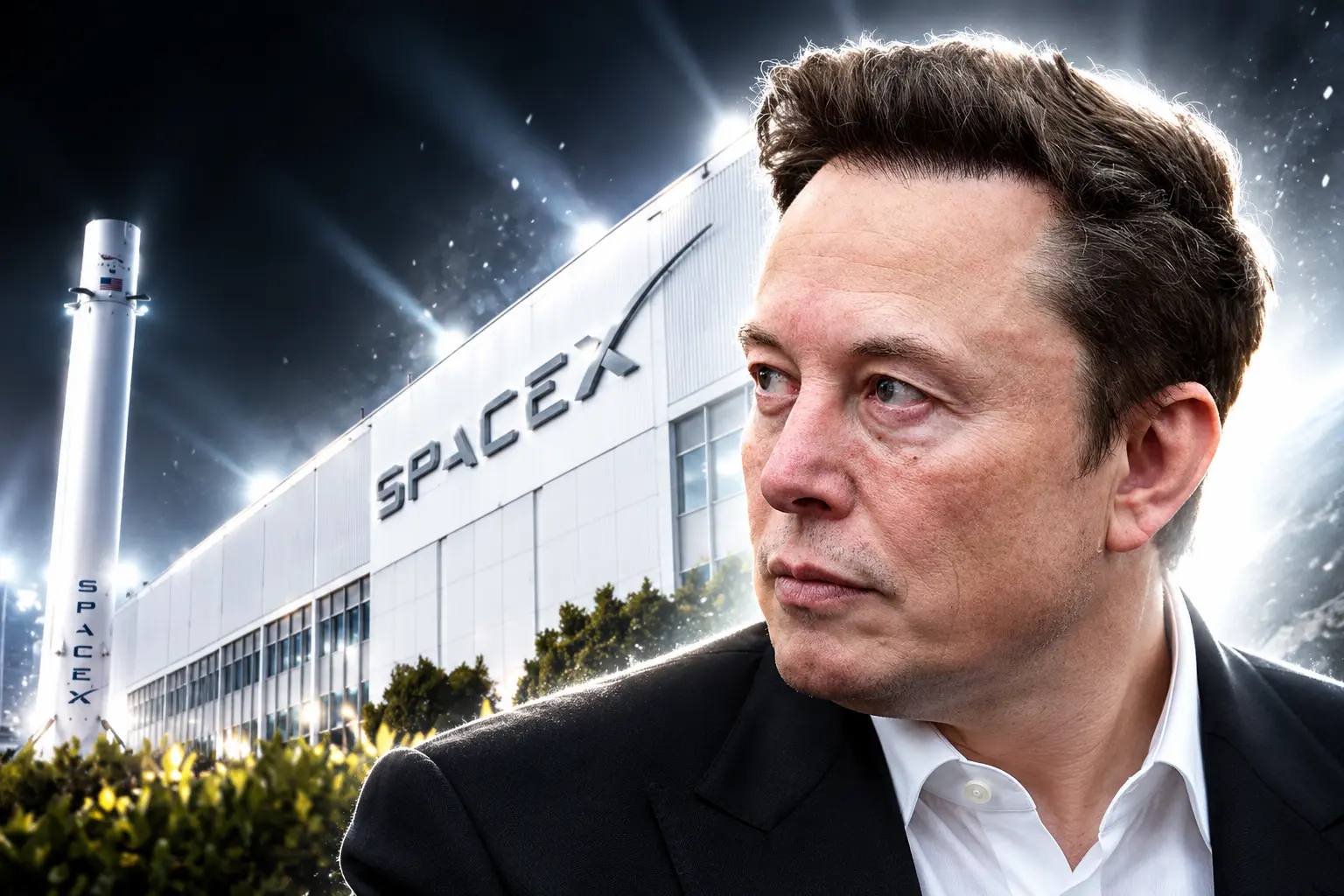
The Credit Window That Starlink Bought
Musk put the market turn in one run of posts. “As of the past few weeks, debt markets have almost entirely shut off access to money for any company that doesn’t have substantial revenue independent of AI data centers,” he wrote. SpaceX, he added, closed $40 billion “but we’re investment grade and have Starlink & launch revenue.”
That is a credit screen, not a product pitch. A lender who can look through a GPU rack to 13.6 million Starlink consumer customers and a launch pad is still showing up. A lender who can look only at a hall full of chips, and at other AI firms as the paying customers, is not.
The screen showed up in prices before Musk said it out loud. SpaceX’s own 6.6% notes due 2046 cheapened after the Oct. 20 earnings dump, as investors weighed a bigger build against a still-new public balance sheet. Even so, the company could still raise. Pure GPU clouds could not raise on terms that look like going concerns.
Late Saturday, before the close, Musk had written that “we’re going to see a lot of stranded compute in partially complete data centers.” Palihapitiya, who said he holds energized land, answered that neoclouds are “disorganized and poorly capitalized,” that hyperscalers will keep scarce power for themselves in 2027, and that the year “will clear out a bunch of wrong/bad bets.” Musk’s reply was the $40 billion post.
Lending against a satellite bill and a launch contract is still a bond. Lending against a box of GPUs whose only tenant is another AI company is equity with a coupon cap, and the coupon is no longer high enough to clear. SpaceX just demonstrated which side of that line still gets a cheque.
Two Hundred Neoclouds Sit Outside That Window
Musk’s forecast was blunt. “That means the 200+ neoclouds are going to see guppy-level death and consolidation. Some will make it through, but not many.” Guppy, in that sentence, is the small fish that gets eaten when the tank is drained.
CoreWeave, the largest independent GPU cloud, is already trading like the test case. The company says it has $35.6 billion of debt principal, a $104 billion revenue backlog at the end of the second quarter, and another $25 billion of commitments early in the third. Principal repayments stay low through 2030, then jump to $14.9 billion in 2031 and after. Its unsecured notes have been changing hands at yields around 15% to 16%, a zone credit desks treat as distress, and default insurance has traded through 1,000 basis points.
CoreWeave says most of those facilities are matched to take-or-pay contracts with large, rated customers, and that contract cash is meant to pay the associated debt without a renewal. That is a coherent story if the customers keep taking the power and if the next round of borrowing still exists. Bernstein has estimated the firm would need tens of billions more to fund the backlog it has already sold. The bond market is no longer assuming that round arrives cheap.
THE NEOCLOUD CREDIT SQUEEZE
- CoreWeave paper: Unsecured notes have yielded about 15% to 16%, with five-year default swaps through 1,000 basis points.
- The backlog: $104 billion at the end of the second quarter, plus $25 billion of new commitments, against $35.6 billion of principal.
- The 2031 wall: CoreWeave has said principal due in 2031 and beyond rises to $14.9 billion.
- The Gartner cut: The research firm said over 80% of neoclouds will cease independent operations by 2030.
Will Sommer, a senior director analyst at Gartner, said on Oct. 14 that AI providers are on course to spend nearly $1 trillion on infrastructure in 2026 and another $6 trillion from 2027 through 2030. Covering that build, the financing cost, and a 12% return would take about $8.5 trillion of revenue through 2030, he said. Gartner’s own forecast for enterprise and consumer AI revenue tied to those data centers is no more than $3.6 trillion. More than $3.5 trillion of infrastructure spending, on that math, could be exposed to write-downs. AI-optimized infrastructure-as-a-service is seen rising from $66 billion in 2027 to $174 billion in 2030, which Sommer called too low for most providers to recover their chips before the next generation replaces them.
We take the position that 80% of neoclouds will cease independent operations by 2030. That doesn’t mean that compute assets are just going to disappear. Ceasing independent operations may include acquisition, it may include partnerships, or it may include outright failure.
Will Sommer, senior director analyst, Gartner
Gartner’s neocloud consolidation by 2030 line is milder than Musk’s guppies. It still describes the same sorting: hyperscalers can fund a long wait out of other businesses, and GPU specialists cannot. The assets do not vanish. The independent equity often does. A buyer with Starlink cash and a live GPU order book is sitting in the obvious seat.
Super Intelligence Already Out-Earns Starlink
SpaceX’s third-quarter 2026 results release, filed Oct. 20 for the three months ended Sept. 30, is why lenders still take the name. Group revenue was $14.58 billion, up 161% from $5.58 billion a year earlier. Net income was $4.40 billion, against a $1.05 billion loss. Adjusted EBITDA was $8.81 billion, up 306% from $2.17 billion.
The Super Intelligence segment, the AI unit, took in $7.56 billion, up 830% from $813 million, and for the first time outsold Starlink. That is more than half of group sales. Almost all of it sat in SI solutions and infrastructure at $7.02 billion, with $608 million from Cursor after the Aug. 14 close and $538 million from advertising.
Q3 2026 BY SEGMENT
| Segment | Revenue | Operating income | Capital spending |
|---|---|---|---|
| Super Intelligence (AI) | $7.56B | $431M | $16.4B |
| Connectivity (Starlink) | $5.25B | $2.37B | $1.54B |
| Space (launch) | $1.77B | -$7M | $1.61B |
| Group | $14.58B | $2.79B | $19.6B |
Starlink is still the unit that funds the argument Musk made on Sunday. Connectivity ran a 45% operating margin and spent $1.54 billion. Super Intelligence made $431 million at a 5.7% margin and spent $16.4 billion, about 84% of group capital spending. Nameplate compute ended September at 1.7 gigawatts, up from 1.4 gigawatts in June and 0.6 gigawatts a year earlier. Management has pointed to 2.5 to 3 gigawatts by year-end and to 20,000 Nvidia GB300 units a month as the current install rate.
The cash gap is already large. In the first nine months SpaceX produced $13.10 billion of operating cash flow and spent $48.07 billion on property and equipment, a hole of about $35 billion filled mainly by $85.7 billion of net IPO proceeds and about $12 billion of net new borrowing. It ended September with $51.3 billion of cash and $38.6 billion of marketable securities, against $38.8 billion of debt and finance leases. Guidance for the fourth quarter is another $35 billion to $40 billion of capital spending. Q1 2027 revenue was guided to $33 billion to $37 billion, with a $63 billion backlog, $42 billion of it due inside 12 months.
Chief Financial Officer Bret Johnsen told investors on the Oct. 20 call that SpaceX intends to stay investment grade as it borrows. The $40 billion GPU package is the next test of that promise, and it is sized to a unit that is already spending more than twice what it takes in.
June Ratings Opened a Door Most Rivals Lack
SpaceX went public in mid-June and, two weeks later, sold $25 billion of bonds in five tranches that drew about $89 billion of orders. Coupons ran from 5.350% on the shortest notes to 6.650% on the longest. Proceeds were earmarked to repay a $20 billion bridge loan.
The agencies stamped the debut investment grade. Fitch assigned a BBB+ rating on SpaceX notes on June 22, with a Stable outlook, citing launch share, scaling connectivity and AI compute, and more than $100 billion of pro forma liquidity against elective negative free cash flow. Moody’s published a first-time Baa1 issuer rating on June 18, also Stable, tied to launch and Starlink, and said it might revisit the method if AI became a larger cash-flow fact. S&P Global Ratings assigned BBB. Those three letters are the entire difference between a $40 billion close and a shut window.
THE PATH TO SUNDAY’S CLOSE
- June 18-22, 2026: Moody’s, Fitch, and S&P assign Baa1, BBB+, and BBB, and SpaceX prices $25 billion of bonds.
- Oct. 6-7, 2026: Talks surface for about $40 billion to buy Nvidia GPUs, with Apollo in a leading role and chips as collateral.
- Oct. 20, 2026: SpaceX reports Q3, with Super Intelligence at $7.56 billion and group capex at $19.6 billion.
- Oct. 22-23, 2026: Pre-close talk puts coupons near 7.75% and 8.3%, more than a point above the June long bond, as AI credit sells off.
- Oct. 25, 2026: Musk says the $40 billion GPU debt has closed and that AI-only borrowers are cut off.
If those pre-close coupons held, SpaceX paid up to stay in the market. 7.75% on a chip-backed slice sits more than a percentage point above the 6.650% long end of the June sale. That is the price of arriving in the same month CoreWeave’s bonds were yielding mid-teens. It is still a price an investment-grade issuer with satellite cash can print. It is not a price a GPU rental shop can print and still call itself a going concern.
Bankers had been trying to park the new debt in a vehicle so SpaceX’s own ratios, and those three letters, would not take a direct hit. Musk never said they succeeded. He said the money closed, the chips show up next year, and the current quarter does not move much. The rating is the asset he was protecting either way.
What the $40 Billion Buys in 2027
The package is a 2027 hardware order, not a 2026 earnings event. Musk said the GPUs arrive in the first and second quarters and that the debt is not a major factor in the current quarter. On the Oct. 20 call he also said the constraint is compute itself: “I think we’re going to face a shortage of super intelligence compute. And that shortage is going to remain for a long time.”
THE BUILD THE LOAN IS MEANT TO FEED
- Nameplate now: 1.7 gigawatts at Sept. 30, with a 2.5 to 3 gigawatt target by the end of 2026.
- Install rate: 20,000 GB300 units a month, per the earnings call.
- Fourth-quarter spend: $35 billion to $40 billion of capex, on top of $19.6 billion in the third quarter.
- Near-term sales: $33 billion to $37 billion of Q1 2027 revenue guided against a $63 billion backlog.
If 2027 does leave half-built halls and crates of chips that weaker borrowers cannot power or finance, the same company that just borrowed $40 billion against Starlink cash is also the one that can take those assets in. Replies under Musk’s post reached that point in one line: SpaceX does not only want new GPUs from Nvidia. It can buy the guppies.
The chips are due in the first half of 2027. The credit test for everyone without a second business is already running, and Musk has now said which side of it SpaceX is on.
Disclaimer: This article is news reporting and analysis of SpaceX’s announced $40 billion GPU debt, related earnings figures, and public comments about AI infrastructure credit. It is informational only and is not investment advice, a solicitation, or a recommendation to buy or sell SpaceX stock, bonds, Nvidia securities, CoreWeave securities, or any other instrument. Readers who are considering any investment, loan, or allocation tied to these companies or to AI data-center credit should consult a licensed financial adviser or credit professional who can review their own situation. Figures, ratings, coupons, and deal terms reflect the company filings, rating actions, and statements cited here as of Oct. 26, 2026, and may change as documents are filed or as markets reprice the debt.

Josh Sinn Draws the Heaviest AFL Betting Ban Since 2019

Rolapp Shuts the PGA Door as DeChambeau Heads to Europe

Apple TV Renews Slow Horses Past the Last Novel

Oasis Lifts UK Music to £8.4 Billion as Venues Shrink

Beyoncé Hits 100 Grammy Nominations on a Vault Track

Thameslink Will Pad 60,000 Ironing-Board Seats From 2027

How Tall Was Adolf Hitler?

U.S. Forces Clear Hormuz Mines, Then Hit Minelayers Again

Micron Sells the Memory Shortage as Five-Year Contracts

Royal Caribbean Sends Los Angeles Ships to Singapore and Brisbane
-
 NEWS3 months ago
Thameslink Will Pad 60,000 Ironing-Board Seats From 2027
-
 HISTORY3 years ago
How Tall Was Adolf Hitler?
-
 BUSINESS3 months ago
U.S. Forces Clear Hormuz Mines, Then Hit Minelayers Again
-
 NEWS3 months ago
Micron Sells the Memory Shortage as Five-Year Contracts
-
 NEWS3 months ago
Royal Caribbean Sends Los Angeles Ships to Singapore and Brisbane
-

 BUSINESS3 months ago
Sweetmore Bakeries Buys Fantasy Baking for Bar Work
-

 NEWS3 months ago
Twenty Controllers Closed Norwich Airport for a Bank Holiday
-

 BUSINESS3 months ago
L Catterton Installs a Kraft Heinz Operator at Kettle Cuisine