
BUSINESS
Abbott Spins Off Nutrition After Costly Formula Settlements
Abbott will list its $8.5 billion nutrition arm by the end of 2027, after formula settlements, while devices and diagnostics keep the higher margins.

Abbott said on Oct. 21, 2026 that it will separate its Nutrition business into a standalone public company with about $8.5 billion in annual sales. The tax-free split is aimed at the end of 2027.
The remaining company would keep medical devices, diagnostics, and established medicines, with about $42 billion in sales. The announcement landed weeks after infant-formula settlements that together exceed $1 billion, and on the same morning Abbott cut its 2026 comparable sales-growth outlook to about 6.0 percent.
The Spin Isolates a Legally Scarred Franchise
Chairman and chief executive Robert B. Ford cast the move as a clean-up of mismatched clocks. Nutrition, he said, has “different investment identities and requirements, growth profiles, and innovation cycles” from the rest of Abbott. Shareholders would own stock in both companies. The combined dividend is supposed to match Abbott’s payout at the time of the split.
The still-unnamed nutrition company would employ about 16,000 people at 14 plants. Abbott, which now counts 122,000 colleagues, would keep about 106,000. Daniel Salvadori, executive vice president and group president for established pharmaceuticals and nutritional products, would become chief executive of the new company. He joined Abbott in 2014 and took his current post in 2021, after jobs at CFR Pharmaceuticals and Sandoz.
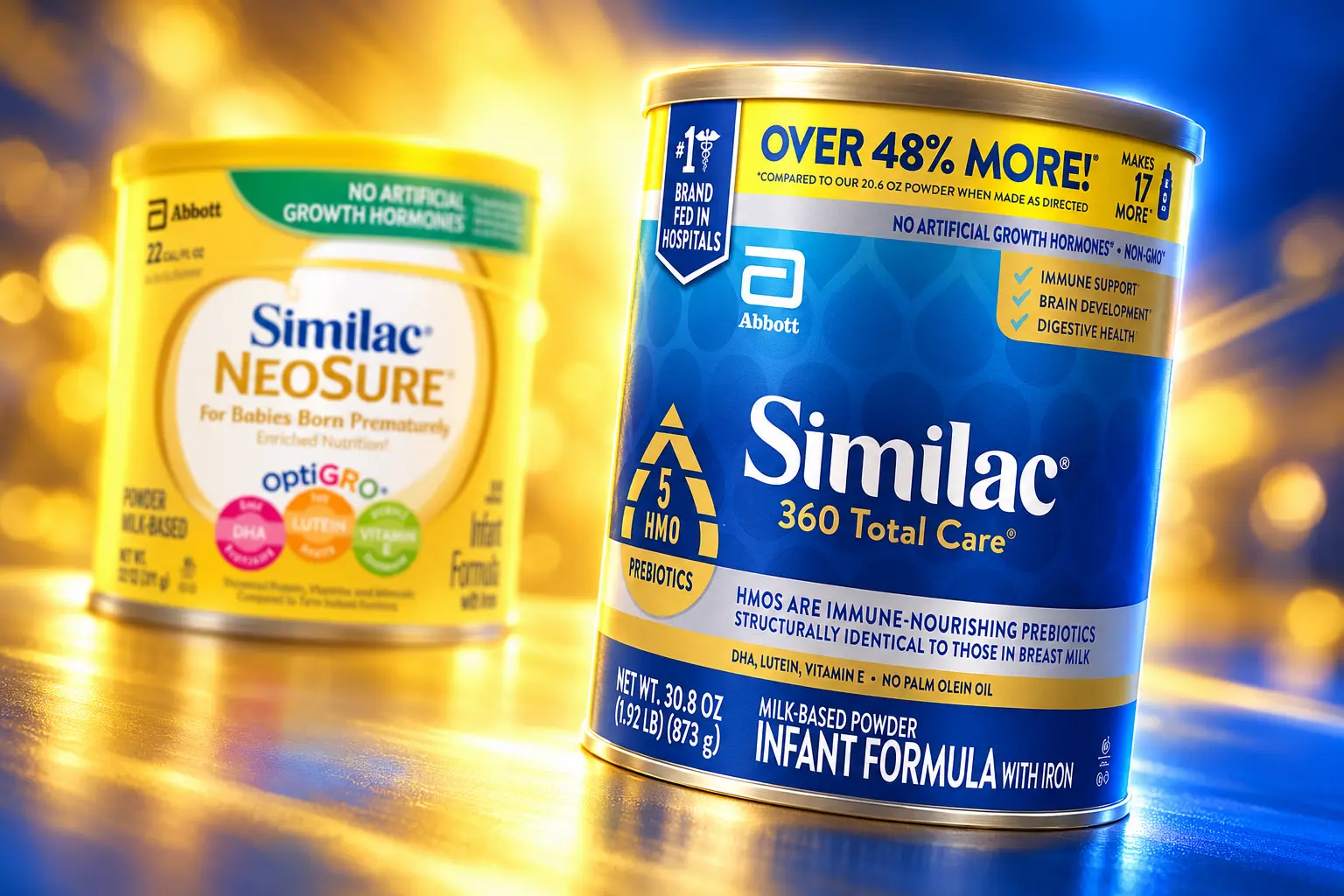
The brands leaving with him are the ones on American shelves: Similac infant formula, which Abbott calls the No. 1 U.S. formula; PediaSure; Pedialyte; Glucerna; and Ensure, which Abbott calls the world’s leading adult nutrition drink. In the first half of 2026 the unit launched 10 products, including an Ensure shake with 42 grams of protein, a ready-to-feed Similac liquid made with whole milk, and dye-free Pedialyte.
Ford ruled out a sale on the earnings call. “We have no interest in selling the business, have no intention to selling, not even looking at selling it, and just think that spinoff is the better value creation for shareholders here,” he said. A sale, he added, could bring tax issues and a timetable Abbott would not fully control. Goldman Sachs is the financial adviser. Wachtell, Lipton, Rosen & Katz is counsel. The deal still needs regulatory approvals, an effective Form 10, and a final board vote.
Who Keeps the Formula Liability?
Ford also said the company does not have to finish the infant-formula lawsuits before the split. “It’s not a prerequisite for completing the separation,” he told analysts. “I’d say both Abbott and the new company are going to be well capitalized” to pursue growth “and also well capitalized to continue to defend the legal positions here.” He did not say which balance sheet would carry the claims.
You saw we took meaningful step back in August when we settled 2,000 claimants. But that settlement in no way reflects any change to the position that I’ve made here about these products, which is continue to stand behind their efficacy and safety. They remain essential component to neonatal care.
Robert B. Ford, chairman and CEO, Abbott third-quarter earnings call
On Sept. 14, 2026, Abbott agreed to pay $384,999,040 to resolve allegations that it caused false claims to federal and state programs between Jan. 1, 2018, and Dec. 31, 2022. The Justice Department said powdered formula and nutritional therapy made at Sturgis, Michigan, and Casa Grande, Arizona, did not meet statutory, regulatory, and contractual rules. Abbott will pay $348,700,868 to the United States and $36,298,172 to states for Medicaid and WIC claims. Three former employees who filed the whistleblower case, Scott Millard, Kristine Cooper, and Loren Cooper, will share $69 million of the federal recovery. The department said the claims are allegations only, with no finding of liability.
The complaint describes roof leaks as common at Sturgis, with water running over equipment, and says Abbott used “roof leak umbrellas” instead of a lasting fix. It alleges spray dryers ran with cracks and pits, that cleaning cycles were stretched to raise output, and that the company at times skipped bacterial testing or withheld results from FDA inspections in 2019 and 2022. Abbott said government tests of unopened distributed formula tested negative for Cronobacter sakazakii, that no unopened, distributed Abbott infant formula has ever tested positive, and that the criminal inquiry is closed.
THE PATH FROM STURGIS TO A SPIN
- Feb. 17, 2022: Abbott recalls selected Similac, Alimentum, and EleCare powders from Sturgis after FDA follow-up on infant illnesses. The plant shuts. Four infants in the investigation were hospitalized with Cronobacter infections and two died, according to the FDA. A nationwide formula shortage follows.
- July 2024: A St. Louis jury awards $495 million in Gill v. Abbott over specialty formula for preterm infants and necrotizing enterocolitis, or NEC.
- Aug. 20, 2026: Abbott agrees to pay about $670 million to resolve Gill and NEC claims for about 2,000 other infants, without admitting liability. It says about 1,700 lawsuits remain, covering claims on behalf of about 12,700 infants, a total that includes dual-defendant filings, duplicates, and cases in which NEC was diagnosed before any formula was given.
- Sept. 14, 2026: The $384,999,040 civil settlement with the Justice Department and states is announced.
- Oct. 21, 2026: Abbott says nutrition will become its own listed company by the end of 2027. Litigation, Ford says, need not be finished first.
The docket that remains is the part the Form 10 will have to spell out. Until that filing, the new company’s risk profile is a blank.
A Third-Quarter Bounce After a Weak Nine Months
Nutrition did not look like a business in free fall in the quarter ended Sept. 30, 2026. Worldwide sales were $2,262 million, up 5.1 percent as reported and 4.9 percent on a comparable basis. U.S. pediatric sales, the line that broke in 2022, rose 11.0 percent to $577 million. Ford said WIC contract wins earlier in 2026 helped Abbott take back market leadership in both WIC and non-WIC segments. Sequential nutrition sales rose $118 million from the second quarter.
The nine-month record is the one the spin still has to live with. Abbott’s exhibit to the SEC shows nine-month Nutrition sales of $6,423 million, down 1.3 percent as reported and 2.1 percent comparable. U.S. pediatric sales for the same stretch fell 4.8 percent to $1,613 million. Group sales for the nine months were $36,770 million, up 11.9 percent as reported and 5.2 percent comparable, lifted by devices and by Exact Sciences, the cancer-diagnostics company Abbott closed on March 23, 2026. Operating earnings for the nine months fell 24.2 percent to $4.39 billion. Net earnings fell 38.4 percent to $2.92 billion, with litigation costs and deal expenses in the mix.
NUTRITION SALES, TWO CLOCKS
| Line | Q3 2026 | Q3 change | Nine months 2026 | Nine-month change |
|---|---|---|---|---|
| Worldwide nutrition | $2,262 million | +5.1% reported | $6,423 million | -1.3% reported |
| U.S. pediatric | $577 million | +11.0% | $1,613 million | -4.8% |
| Worldwide pediatric | $1,063 million | +8.8% | $3,041 million | -1.0% |
| Worldwide adult | $1,199 million | +2.0% | $3,382 million | -1.6% |
Those two clocks are why Ford can talk about “growing demand for healthy nutrition” and still take the unit public on its own. The third quarter is a rebound. The year-to-date still shows a consumer business that had to raise prices, reset promotions, and win WIC back after a long stretch of lost volume.
Higher Margins Stay With Devices and Diagnostics
Abbott’s investor deck is blunter than the press release. Nutrition, on 2026 pro forma figures that allocate some corporate costs, is sketched at a gross margin of about 45 percent of sales and an operating margin of about 18 percent. The company that remains is sketched at about 60 percent gross and about 25 percent operating. Stripping nutrition out is projected to add about 100 basis points of operating margin to Abbott, more than 200 basis points of gross margin, and 50 to 100 basis points of sales growth, assuming nutrition itself grows in the low-to-mid single digits.
TWO COMPANIES AFTER THE SPLIT
| Measure | Nutrition company | Remaining Abbott |
|---|---|---|
| Annual sales | about $8.5 billion | about $42 billion |
| Employees | about 16,000 | about 106,000 |
| Gross margin profile | about 45% of sales | about 60% of sales |
| Operating margin profile | about 18% of sales | about 25% of sales |
| Sales mix | about 47% pediatric, 53% adult; 42% U.S. | 33% devices, 27% diagnostics, 40% established medicines |
Almost half of nutrition’s sales sit in international emerging markets, 47 percent on the deck, with 11 percent in international developed markets. That is a different map from the device business, and a different buyer. In the third quarter, medical devices did $5,826 million, up 6.9 percent as reported, and diagnostics did $3,305 million, up 46.7 percent as reported because Exact Sciences is now inside the number. Comparable diagnostics growth was 6.4 percent. Established pharmaceuticals did $1,614 million, up 6.8 percent.
Group third-quarter sales were $13,013 million, up 14.5 percent as reported and 7.0 percent comparable. GAAP diluted earnings were $0.53 a share. Adjusted earnings were $1.42. Abbott tightened full-year adjusted EPS guidance to $5.50 to $5.55 and said the split will not change 2026 guidance, or the 2027 guide it plans to give in January. One-time separation charges will be counted later. Both companies are expected to keep investment-grade credit.
More Than Half of U.S. Formula Runs Through WIC
Infant formula is not a normal grocery category. The Justice Department, in the September settlement, noted that more than half of all infant formula bought in the United States is paid for with USDA funds through WIC, the Special Supplemental Nutrition Program for Women, Infants, and Children. States award exclusive rebate contracts. Winning one contract can refill a state’s shelves with a single brand. Losing one hands that volume to a rival overnight.
WHAT A STANDALONE FORMULA COMPANY WALKS INTO
- WIC as the volume switch: More than half of U.S. formula purchases are paid with USDA WIC funds, so a handful of state rebate awards still set national share.
- A two-player aisle: Abbott’s Similac and Reckitt’s Mead Johnson Enfamil have long split most of the U.S. market, with Nestlé’s Gerber a distant third, a structure the 2022 shortage exposed when Sturgis went down.
- A near-term state loss: Michigan’s Department of Health and Human Services awarded a five-year WIC formula contract to Mead Johnson beginning Nov. 1, 2026. Abbott’s current Michigan contract runs through Oct. 31, after which WIC benefits there move from Similac to Enfamil products.
- A peer trying to leave: Reckitt named Mead Johnson non-core in 2024 and has been working toward a sale. On Sept. 1, 2026 a federal jury in Illinois sided with Mead Johnson in the Inman NEC bellwether. Mead Johnson said the verdict “affirms” its view that the science does not support the claims.
That last point cuts both ways for Salvadori’s company. A weaker rival on the block could invite a bid for Similac later. It also shows how hard it is to put a multiple on a formula franchise while NEC cases are still live. Abbott’s August statement left about 1,700 lawsuits standing. Mead Johnson is trying to exit the same category Abbott is about to list.
Adult nutrition is a different fight. Ensure still carries a clinical halo, but the U.S. protein-shake shelf is now a grocery contest on grams of protein and price, not a doctor’s note. The new company will have to fund that retail slog from its own P&L, without Abbott’s device cash coming in behind it.
WHAT WE KNOW
- The structure: A tax-free distribution of a new nutrition company’s shares to Abbott holders, targeted for the end of 2027, with nutrition still run inside Abbott until then.
- The leadership: Salvadori is named chief executive. No company name, ticker, or exchange has been announced.
- The settled bills: About $670 million for a slice of the NEC docket in August, and $384,999,040 to the United States and states in September, both without an admission of liability.
WHAT IS UNCONFIRMED
- Who holds the remaining lawsuits: Ford said both entities would be well capitalized to defend claims. He did not assign the 1,700 remaining cases, or any indemnity, to one side.
- The new company’s balance sheet: The deck says both groups should stay investment grade. It does not publish the debt, cash, or stranded-cost split.
- Whether the company stays public: Nothing in the Oct. 21 materials commits the nutrition company to remain independent after listing.
Those blanks are not a sideshow. They are the valuation. A nutrition stock that keeps the NEC docket will not trade like a protein-shake brand. A nutrition stock that Abbott indemnifies will look more like the consumer story Ford is selling.
Salvadori Inherits Brands Built for Doctors
Salvadori’s brief is to run a company whose best-known products were built for hospitals, WIC clinics, and dietitians, in a market that now rewards retail execution. Ford told analysts that over the next decade “there’s going to be a lot of segments in this nutrition business” that will be “very differentiated and kind of high growth.” The deck lists metabolic health, prevention, and wellness as the demand story. The nine-month comparable decline of 2.1 percent is the starting point that story has to beat.
He takes a portfolio Abbott still describes as backed by “evidence-based scientific research and healthcare professional recommendation.” That language is an asset in a NICU. It is slower money in a protein aisle already crowded with Fairlife-style drinks that never needed a pediatrician. The 10 launches of early 2026, including the 42-gram Ensure shake, are a first turn of that wheel. They are also a reminder that innovation at this company has been a feature add on old trademarks, not a new trademark.
Abbott Has Until the End of 2027 to File the Split
For the next year and more, nothing on a formula can changes. Abbott said the nutrition business “will continue to operate as part of Abbott throughout the separation process.” Parents still buy Similac. Hospitals still buy specialty preterm formulas. WIC still writes rebate checks. The Sturgis plant is a going factory again, not a closed one. The legal cases that were not in the August package keep their captions.
The document that will make the spin real is the Form 10, which has to describe the new company’s business, its capital, and its lawsuits. Ford’s line that unfinished litigation is not a bar to closing means Abbott intends to complete the paperwork with that docket still open. How the risk is drawn between the two stocks is the fact the Oct. 21 release left out, and the fact the next filing cannot.
Disclaimer: This article is news reporting and analysis of Abbott’s planned separation and related financial and legal disclosures. It is for information only and is not investment advice, a recommendation to buy or sell any security, or a prediction of the spin-off’s completion, terms, or trading value. Readers who may act on the announcement should consult a licensed financial adviser or attorney who can review the Form 10, the tax treatment of the distribution, and the allocation of remaining infant-formula claims once those documents exist. Sales figures, margin sketches, settlement amounts, and case counts are taken from company and Justice Department statements dated in 2026 and can change as the separation and the lawsuits move.

Kering’s Growing Houses Cannot Outrun a Shrinking Gucci

Studio Staff and Bitcoin Buyers Built the Eminem Leak Case

A Mutated H1N1 Strain Is Hitting Younger Immunity First

Albert Heijn Returns at One-Third as Rivals Take Share

Art Basel Paris Ends After One Public Day

Thameslink Will Pad 60,000 Ironing-Board Seats From 2027

How Tall Was Adolf Hitler Really? Debunking the Myth of his Height

Micron Sells the Memory Shortage as Five-Year Contracts

Royal Caribbean Sends Los Angeles Ships to Singapore and Brisbane

U.S. Forces Clear Hormuz Mines, Then Hit Minelayers Again
-
 NEWS2 months ago
Thameslink Will Pad 60,000 Ironing-Board Seats From 2027
-
 SCIENCE3 years ago
How Tall Was Adolf Hitler Really? Debunking the Myth of his Height
-
 NEWS2 months ago
Micron Sells the Memory Shortage as Five-Year Contracts
-
 NEWS2 months ago
Royal Caribbean Sends Los Angeles Ships to Singapore and Brisbane
-
 BUSINESS2 months ago
U.S. Forces Clear Hormuz Mines, Then Hit Minelayers Again
-

 BUSINESS2 months ago
Sweetmore Bakeries Buys Fantasy Baking for Bar Work
-

 BUSINESS2 months ago
L Catterton Installs a Kraft Heinz Operator at Kettle Cuisine
-

 NEWS2 months ago
CISA’s 100 Water System Hacks Hit One-Operator Plants