
ENTERTAINMENT
Studio Staff and Bitcoin Buyers Built the Eminem Leak Case
Joseph Strange pleaded guilty after Ferndale staff and Bitcoin buyers led the FBI to unreleased Eminem files copied years before the sales.

Joseph Strange, a former Ferndale studio engineer, pleaded guilty on October 22 to selling unreleased Eminem recordings after buyers and studio staff led the FBI to him. The 48-year-old from Holly, Michigan, admitted one count of criminal copyright infringement in Detroit federal court and is due to be sentenced on January 27, 2027.
He worked for Marshall Mathers from 2007 to 2021, one of four people who could open the password-protected drives in the rapper’s private studio. The Justice Department says he sold 10 or more audio files in July and August 2024 for about $50,000. By November 2025 those files had been accessed more than 8 million times on streaming services, a reach the department values at least at $750,000.
Ferndale Staff Called the FBI With a Screenshot
The case did not start with a forensic sweep of a famous catalog. It started with people who still work in the building.
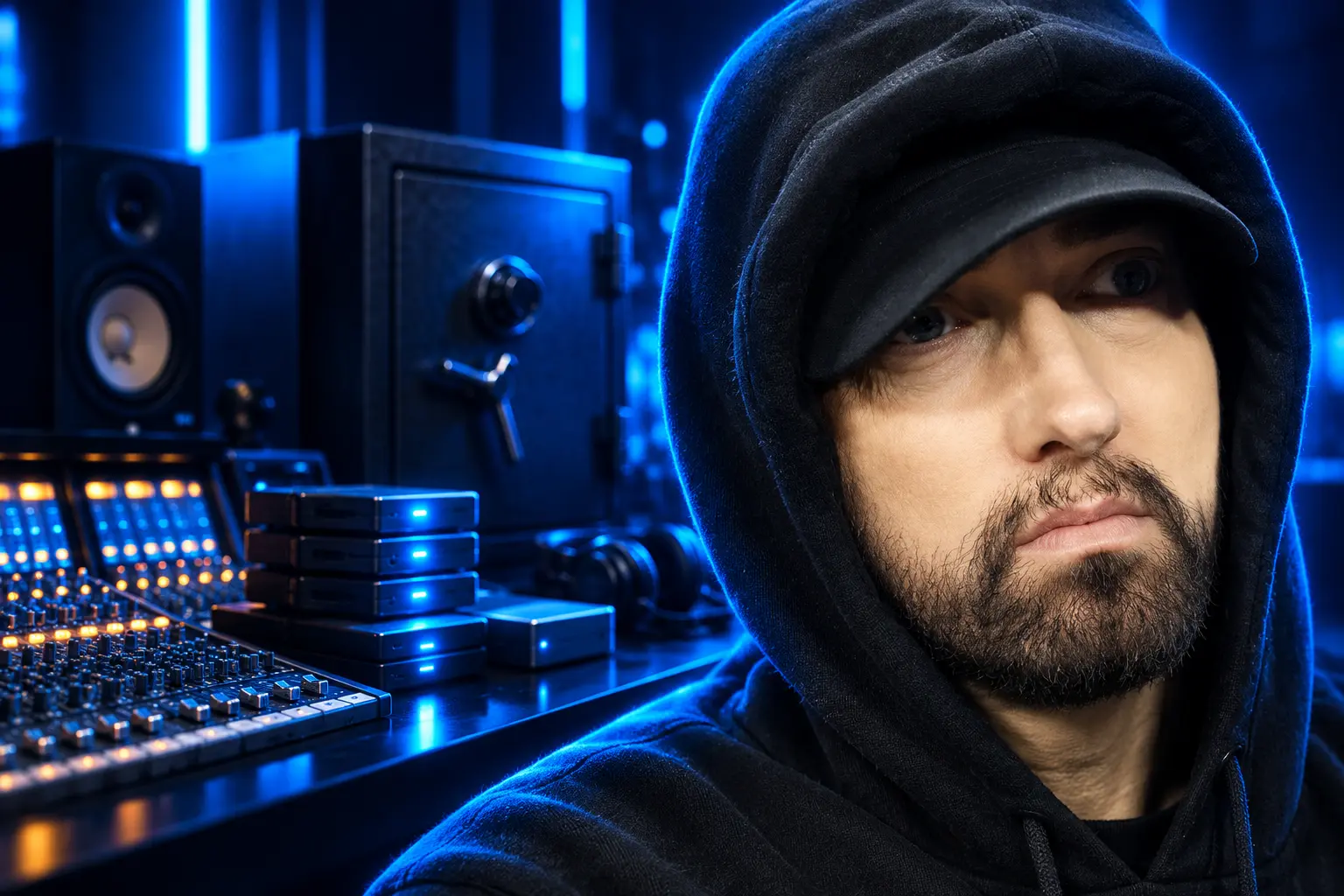
On or about January 16, 2025, employees at Mathers’s Ferndale studio told Detroit FBI agents that unfinished songs were turning up on Reddit, YouTube, and leaked.cx. They had an image of a track list being offered for sale. They recognized it as a shot taken from a hard drive inside the studio, a private room closed to the public and used to make music for later release.
The recordings are owned by Interscope Capital Labels Group under contract with Mathers. Staff told agents they knew the songs on sight, and that the files lived on drives kept off the internet for security. Those drives sat in a safe when they were not in use.
Agents went to the studio that same day. Manager John Fisher and the current engineers said the leak could only have come from someone with physical access to that room. Fisher later told them Strange had no right to keep the audio.
Bitcoin Buyers Walked Agents to the Seller
Mathers asked business associate Fred Nasser for help once the songs were circulating. Nasser posted a warning to fans not to spread the files. A listener in the United Kingdom answered that post and handed over chats with a seller using the name Doja Rat.
Those chats named Joseph Strange, a former studio employee, as the man with the music. Doja Rat, later identified as a 31-year-old man in Ontario, told the FBI he had first found Strange through a YouTube page called Dope Edit that posted rare and remixed Eminem cuts. Private messages followed. Then Bitcoin.
THE CHAIN THAT NAMED HIM
- UK tipster: A British fan contacted Nasser after the public warning and turned over Instagram and message threads that pointed at the seller.
- Doja Rat: The Ontario buyer told agents he paid about $50,000 in Bitcoin, starting with four songs for $8,500, then raising more from other fans over roughly six months for about 25 tracks.
- ATL: A Connecticut user by that screen name bought a couple of songs for about $1,000, according to the same affidavit, and was shown an image of an unreleased video tape.
Doja Rat said Strange claimed to hold over 300 songs and original handwritten lyric sheets, and that he needed money after surgery. That 300-song figure is the buyer’s account of what Strange told him, not a court finding. He also said Strange was trying to sell some of the lyric sheets.
Doja Rat sent an image of a file tree with about 50 subfolders, song titles in alphabetical order, that looked like an older computer directory. Studio staff said that tree matched the drives in Ferndale. Fisher gave agents the access log from a drive labeled RAID 1.
The Copies Left the Safe in 2019
RAID 1 had sat in the safe and had not been opened for several years. The log showed files coming off it after someone plugged in an external drive on October 16, 2019, and again on January 16, 2020. Strange was still on staff both days. Fisher told agents those pulls were not ordinary studio work and that the files were unpublished Mathers recordings.
The FBI agent’s sworn affidavit puts a short list of names on that vault. From 2007 through 2021, only four employees could open the drives: sound engineers Anthony Campana, Mike Strange, and Joseph Strange, and manager John Fisher. They shared one password.
Four Employees Shared One Password
Campana and Mike Strange still work there. Both told agents the leaked audio could only have come from someone who stood in front of those machines. Mike Strange is Joseph’s uncle; they were raised together and describe themselves as brothers. He said Joseph helped build and run the offline computer system, later worked as a dispensary delivery driver, and was deep into Bitcoin. Campana said Joseph had mined Bitcoin while he was still on the payroll.
Strange was let go in 2021. On January 12, 2021, as part of a severance package, he signed a nondisclosure deal that barred him from disclosing information about Mathers and other artists working with him.
Drive Logs Flagged October and January
The copy dates sit years before the sales. The Justice Department says the files moved to buyers in July and August 2024, about three years after Strange left the building. Over 25 songs created between 1999 and 2018 had already been played or passed around online without consent from Mathers or the label, the complaint said, some of them mastered as if a commercial release might one day be possible.
FROM THE SAFE TO THE PLEA
- October 16, 2019: An external drive is attached to the RAID 1 studio disk and files come off it.
- January 16, 2020: The same kind of pull is logged again while Strange is still employed.
- January 12, 2021: Strange signs the severance nondisclosure papers after he is let go.
- July to August 2024: He sells and sends 10 or more audio files for about $50,000, the Justice Department said.
- January 16, 2025: Ferndale staff contact the FBI after unfinished songs appear online.
- January 28, 2025: Agents search the Holly house and seize drives, lyric sheets, and a VHS tape.
- March 19, 2025: A criminal complaint is filed in the Eastern District of Michigan.
- August 28, 2026: Prosecutors file a felony information charging one copyright count.
- October 22, 2026: Strange pleads guilty before Judge Brandy R. McMillion.
- January 27, 2027: Sentencing is set in Detroit.
Special Agent Brian Max of the FBI’s Oakland County Resident Agency signed the affidavit. The complaint charged criminal copyright infringement and interstate transportation of stolen goods.
Prosecutors Drop a 10-Year Stolen-Goods Count
Strange entered a not-guilty plea on March 24, 2025, then spent the next year and a half in the case. The March 2025 criminal complaint carried both the copyright count, with a maximum of five years and a $250,000 fine, and a stolen-goods count that carried up to 10 years.
He pleaded guilty only to the copyright count. Prosecutors dropped the stolen-goods charge as part of the deal. The August 2026 felony information charges willful infringement for commercial advantage from July 2024 to January 2025, a wider window than the July and August 2024 sales described in the department’s plea announcement.
That charge sits in the federal criminal copyright statute, which makes it a felony to reproduce and distribute 10 or more copies of one or more copyrighted works in a 180-day period without the owner’s authority, for commercial advantage or private financial gain.
WHAT THE PLEA ADMITS
| Item | Figure |
|---|---|
| Files he sold, per the Justice Department | 10 or more audio files |
| Money he took in | About $50,000 |
| Streams of the leaked files as of November 2025 | More than 8 million |
| Department’s infringement estimate | At least $750,000 |
| Maximum prison term on the remaining count | Five years |
| Maximum on the dropped stolen-goods count | 10 years |
The $750,000 figure is 15 times the about $50,000 he collected. Assistant Attorney General A. Tysen Duva of the Justice Department’s Criminal Division said Strange abused a position of trust and sold work that was not yet cleared for the public.
Joseph Strange abused a position of trust to unlawfully copy and sell unreleased music belonging to Eminem, profiting from works that were not yet authorized for public distribution. His conduct undermined both legal and artistic rights.
A. Tysen Duva, Assistant Attorney General, Justice Department Criminal Division
FBI Detroit posted the same core facts the day of the plea: the 2007 to 2021 employment, the copied files, and the July and August 2024 sales.
Former Eminem Employee Pleads Guilty to Criminal Infringement of Copyright
According to court documents, Joseph Strange was an employee of Mathers from approximately 2007 until 2021. Without authority, Strange copied 10 or more audio files of music and material in various stages… pic.twitter.com/YibdIg72qs
— FBI Detroit (@FBIDetroit) October 22, 2026
U.S. Attorney Jerome F. Gorgon Jr. said the office would punish people who steal physical or intellectual property. Jennifer Runyan, special agent in charge of FBI Detroit, thanked Mathers Music Studio for staying with the investigation.
What Agents Pulled From the Holly Safe
The January 28, 2025, search at Strange’s house is where the paper trail met cardboard boxes and a home safe. Agents already had buyer statements and studio logs. They came out with the physical leftovers of a catalog that was never supposed to leave Ferndale.
INSIDE THE HOLLY SEARCH
- Lyric sheets: Original handwritten notes by Mathers, stored in a safe, matching images that had been offered to buyers.
- VHS tape: An unreleased music video; Strange had sent a picture of the tape to Doja Rat and to ATL.
- Audio archive: Numerous hard drives, including one that held about 12,000 audio files, some by Mathers and some by other artists working with him.
- Payment records: Financial documents showing money going to Strange for the music he sold.
The complaint said some of those 12,000 files were songs in various stages of development. John Fisher identified more than 100 Mathers songs in screenshots that had been shown to Doja Rat, ATL, and another contact using the name Kali Kush, and played one of the tracks for agents.
Acting U.S. Attorney Julie Beck, who announced the original charges, said protecting intellectual property meant stopping people who try to cash in on someone else’s work. Cheyvoryea Gibson, then the FBI’s special agent in charge in Michigan, credited the studio’s cooperation for how fast agents moved from the January 16 call to the January 28 raid.
Mathers’s Camp Wants the Full Penalty
Dennis Dennehy, a longtime spokesman for Eminem, did not wait for a plea to describe the harm. After the March 2025 charges he said a trusted employee had damaged the rapper’s artistic legacy and creative integrity, and had inflicted large financial losses on the writers and collaborators behind decades of work.
The significant damage caused by a trusted employee to Eminem’s artistic legacy and creative integrity cannot be overstated, let alone the enormous financial losses incurred by the many creators and collaborators that deserve protection for their decades of work. We will continue to take any and all steps necessary to protect Eminem’s art and will stop at nothing to do so.
Dennis Dennehy, spokesman for Eminem, March 2025 statement
When a plea deal was first reported in September, Dennehy said it was satisfying to see Strange held to account and that the camp hoped he would be punished to the fullest extent of the law. After the October 22 hearing, Dennehy said there was nothing to add.
Wade Fink, Strange’s lawyer, has been arguing the opposite tone since the complaint landed. He called the original charges untested allegations. After the plea he said his client had taken responsibility and felt remorse for what the case had done to his family, and that commentary from the Justice Department did not match the facts.
“Joe Strange is a good man whose children have suffered greatly in all of this,” Fink said. “The hyperbolic commentary from the Justice Department and others bear little resemblance to the actual facts of the case.” He added that the matter was more complicated than a man simply stealing, and that he trusted the Detroit judges to see the case as it is.
Judge McMillion will set the term on January 27, 2027, after looking at the federal sentencing guidelines and the usual statutory factors. The leaked recordings are already in the wild. More than 8 million accesses cannot be pulled back at a hearing, and the people trading those songs still talk about them as listening material, which is the control loss Mathers’s camp cannot reverse in January.

Kering’s Growing Houses Cannot Outrun a Shrinking Gucci

Studio Staff and Bitcoin Buyers Built the Eminem Leak Case

A Mutated H1N1 Strain Is Hitting Younger Immunity First

Albert Heijn Returns at One-Third as Rivals Take Share

Art Basel Paris Ends After One Public Day

Thameslink Will Pad 60,000 Ironing-Board Seats From 2027

How Tall Was Adolf Hitler Really? Debunking the Myth of his Height

Micron Sells the Memory Shortage as Five-Year Contracts

Royal Caribbean Sends Los Angeles Ships to Singapore and Brisbane

U.S. Forces Clear Hormuz Mines, Then Hit Minelayers Again
-
 NEWS2 months ago
Thameslink Will Pad 60,000 Ironing-Board Seats From 2027
-
 SCIENCE3 years ago
How Tall Was Adolf Hitler Really? Debunking the Myth of his Height
-
 NEWS2 months ago
Micron Sells the Memory Shortage as Five-Year Contracts
-
 NEWS2 months ago
Royal Caribbean Sends Los Angeles Ships to Singapore and Brisbane
-
 BUSINESS2 months ago
U.S. Forces Clear Hormuz Mines, Then Hit Minelayers Again
-

 BUSINESS2 months ago
Sweetmore Bakeries Buys Fantasy Baking for Bar Work
-

 BUSINESS2 months ago
L Catterton Installs a Kraft Heinz Operator at Kettle Cuisine
-

 NEWS2 months ago
CISA’s 100 Water System Hacks Hit One-Operator Plants