
LIFESTYLE
Dietz & Watson’s Cleaner Ham Still Relies on Nitrite
Dietz & Watson is rebuilding cold cuts with celery powder, but USDA rules still require an uncured label on nitrite-cured ham.

Dietz & Watson is close to putting cleaner cold cuts across almost its full deli line, using celery powder, cherry powder, and cooler cooking to limit nitrosamines. The Philadelphia company says 99 percent of that meat will meet the new standard by 2027. The pink slice in the sandwich is still a nitrite cure, and federal labeling rules still make many of those packs say uncured.
Influencers have been filming lunch meat going into the trash. Federal dietary advice now tells Americans to cut highly processed foods. Circana’s scanner data show shoppers already buying fewer pounds of it.
Inside the Philadelphia Plant That Wants Cleaner Ham
Dietz & Watson’s headquarters sit in a 350,000-square-foot plant just north of the Delaware River in northeast Philadelphia, a city that still treats the hoagie as official business. Louis Eni Jr. is president and CEO. He has worked there more than 50 years and now talks about “multistep prepared meats,” a phrase meant to keep ham out of the ultra-processed bin.
We need to desperately make sure that we message properly so that consumers don’t associate what’s been for years called processed meats as ultra-processed foods.
Louis Eni Jr., president and CEO, Dietz & Watson
Gregory Yingling, who handles operations and procurement, walks the cure as a long marinade, not a 30-minute spin. Microneedles inject a salt solution with celery juice powder and acerola cherry powder. Celery is naturally high in nitrite. Cherry powder, Yingling said, steadies color and helps control “the nitrous elements that come out of the cure.”
HOW THE PHILADELPHIA PLANT NOW CURES HAM
- The injection: Hundreds of microneedles push a salt brine with celery juice powder and acerola cherry powder into whole cuts.
- The wait: The meat marinates at least 24 hours so the natural cure can move through the muscle.
- The tumble: Vacuum drums toss the cuts until salt draws myosin up and the surface turns tacky, a texture the plant calls meat glue.
- The bath: A water cooker holds about 175 to 180 degrees, then the meat drops into ice so the heat does not keep climbing.
- The dose: Since 2022 the team has cut the natural cure toward the smallest amount that still keeps the product safe, aiming for few or no residual nitrites.
Eni, asked whether a child could eat the company’s ham every day, answered, “Every day.” The Naturals line lists no nitrates or nitrites, no antibiotics, no artificial preservatives, and no gluten, a set of claims the company has used since it began selling its own uncured ham in the early 2000s. Its Organic Uncured Beef Franks still list celery powder. One frank is a 48 gram serving, about the daily portion size cancer researchers use when they talk about processed meat.
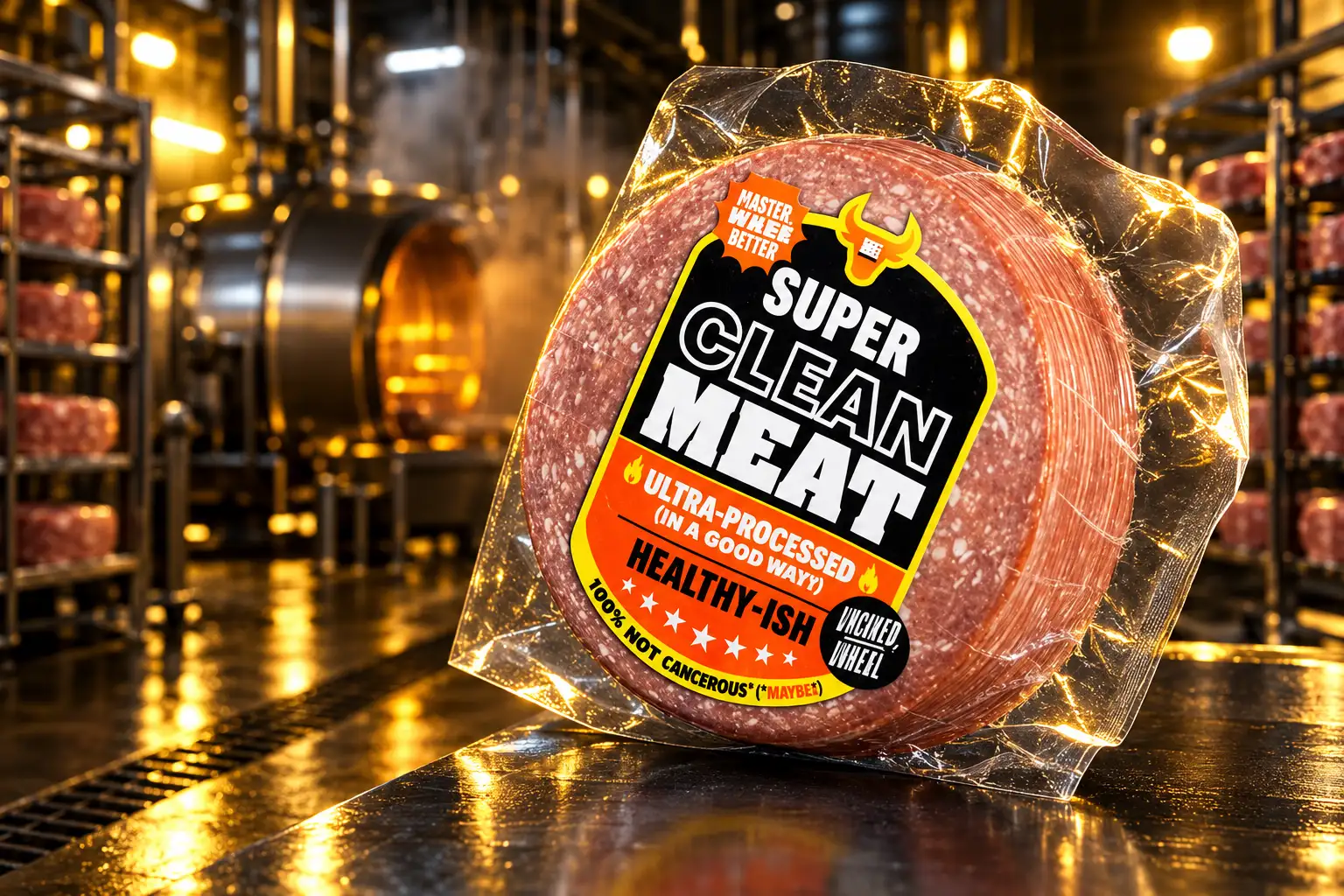
Celery Powder Still Wears an Uncured Label
The chemistry is not a secret on the factory floor. Celery powder is there because it becomes nitrite. Nitrite still does the jobs plants need: it blocks Clostridium botulinum, it keeps the slice pink, and it stretches shelf life. Cherry powder is the plant’s stand-in for a cure accelerator, the same role sodium erythorbate plays in a conventional formula.
USDA’s Food Safety and Inspection Service is why the package language sounds like the opposite. Agency sausage-operations guidance still says celery powder is not approved as a curing agent under 9 CFR 424.21(c). Products that would normally have to be cured, then, must be labeled uncured under 9 CFR 319.2. They also have to carry “no nitrates or nitrites added,” qualified by “except for those naturally occurring in” the vegetable source, so the label is not treated as misbranded. The same guidance says plants should not print “naturally cured” or “alternatively cured.”
WHAT THE LABEL SAYS VERSUS WHAT THE CURE DOES
| Package language | Why FSIS requires it | What is actually in the meat |
|---|---|---|
| Uncured | Celery powder is not on the approved curing-agent list | Nitrite formed from celery powder |
| No nitrates or nitrites added | Required wording under 9 CFR 317.17 | The same nitrite molecule used in a conventional cure |
| Except those naturally occurring in celery powder | Fine-print qualifier so the claim is not ruled false | Residual nitrite from that vegetable source is not capped like synthetic sodium nitrite |
That last cell is the quiet regulatory hole. Limits written for sodium nitrite attach to an approved curing agent. Celery powder is filed as a flavoring and an antimicrobial, so those numeric caps do not travel with it. Dietz says it now uses a minimal dose and checks leftovers in its meat lab. USDA does not set limits for those natural agents and does not test them. The companies police themselves.
FSIS said in December 2020 that it intended to rewrite the words cured and uncured and to approve non-synthetic nitrites as curing agents. Celery powder is still not on that approved list, so the compelled uncured line remains the law of the deli case.
Tests Already Caught the Last Health Halo
Dietz is not the first plant to swap a lab chemical for a vegetable. In the early 1990s it helped make uncured meats and hot dogs for Applegate Farms. Hormel’s Natural Choice line arrived in 2006 and was relaunched in 2015. Oscar Mayer widened Deli Fresh in 2014. The aisle filled with “no nitrates or nitrites added” banners. Third-party tests later found that halo did not hold.
Consumer Reports and the Center for Science in the Public Interest told USDA in 2019 that the labels were misleading. CR tested 31 packaged deli meats, name brands and store brands, including chicken, ham, roast beef, salami, and turkey.
WHAT THOSE 2019 TESTS AND POLLS FOUND
- The residues: Nitrate and nitrite levels in meats labeled uncured or no nitrate or nitrite added were similar to levels in meats made with sodium nitrite.
- The shopper habit: In an April 2019 telephone survey of 1,000 U.S. adults, 46 percent of deli-meat eaters said they look for a no-nitrates-added claim.
- The fine print: 42 percent said the asterisk about nitrates “naturally occurring” in an ingredient left them confused about what had been added.
- The ask: The groups wanted “uncured” and “no nitrate or nitrite added” reserved for meat made with no nitrate or nitrite from any source, plus steps to cut residual nitrite and nitrosamines.
The ‘Uncured’ and ‘No Nitrate or Nitrite Added’ labels could make people think these meats are healthier, but our tests show they are not. Deli meats carrying these labels pose the same health risks as traditionally cured meats because the nitrate and nitrite levels are essentially the same.
Charlotte Vallaeys, senior policy analyst, Consumer Reports
Those tests measured the last generation of celery-cured lunchmeat, not Dietz’s 2022-onward minimal-dose recipes. Yingling says the new line is different because the plant now uses just enough cure to leave few or no nitrites behind. No independent lab has published a residue table for that reformulation. Until someone does, the claim sits next to a decade of “uncured” packs that did not beat conventional nitrite levels.
Lunchmeat Pounds Keep Sliding in the Meat Case
The business case for a cleaner label is already on the sales tape. The global deli meat category is estimated at $217 billion. In U.S. stores the sliced stuff is shrinking.
THE SLIDE IN THE LUNCHMEAT CASE
- Twelve-month deli meat: Circana tallied $8.4 billion from June 2024 through June 2025, down 8.3 percent in dollars and 6.7 percent in pounds from a year earlier.
- Latest processed-meat pounds: In August 2026, Circana’s Integrated Fresh data showed processed-meat pound sales down 5.6 percent versus August 2025.
- Frankfurters: That same August, frankfurter pounds fell 10.5 percent year over year, the steepest drop in the processed-meat set Circana flagged.
Political language is moving the same way. HHS Secretary Robert F. Kennedy Jr. and Agriculture Secretary Brooke Rollins issued the Dietary Guidelines for Americans, 2025-2030 on January 7, 2026. The 10th edition tells households to return to basics “with a dramatic reduction in highly processed foods laden with refined carbohydrates, added sugars, excess sodium, unhealthy fats, and chemical additives.” Kennedy’s line at the White House briefing was shorter: “Eat real food.”
Pete Sulack, a chiropractor and holistic influencer with 960K Instagram followers, puts the same pressure in a louder register: “They’re packed with nitrates, nitrites, preservatives, and emulsifiers. Lunch meat is like rocket fuel for inflammation. Start cleaning your fridge now.” Eni’s answer is to keep the sandwich and change the process. The louder problem in the aisle is not whether the nitrite came from a drum or a celery field. It is that the required word on the pack still tells a shopper the meat was not cured.
How Nitrosamines Form After You Swallow
Nitrosamines are the unstable compounds tied to the cancer worry, and they are not only a factory problem. They can form when nitrite meets protein under heat, which is why frying bacon draws extra warnings, and they can form in the stomach after a person swallows nitrate from food.
The International Agency for Research on Cancer, the cancer arm of the World Health Organization, classified processed meat as carcinogenic to humans (Group 1) on October 26, 2015. Processed meat, in that definition, is meat transformed by salting, curing, fermentation, smoking, or other processes that enhance flavor or preservation, including ham, hot dogs, sausages, and corned beef. The working group of 22 experts from 10 countries reviewed more than 800 studies. It found sufficient evidence that eating processed meat causes colorectal cancer. An analysis of 10 studies estimated that every 50 gram portion of processed meat eaten daily increases colorectal cancer risk by about 18 percent.
IARC is blunt that Group 1 measures the strength of the evidence, not the size of the danger. Tobacco and asbestos sit in the same bucket. They are not equal risks. The Global Burden of Disease Project has put deaths from diets high in processed meat at about 34,000 cancer deaths a year worldwide, against about 1 million from tobacco smoking. Dr. Kurt Straif, then head of the IARC Monographs Programme, said the individual risk remains small and rises with the amount eaten.
Norman Hord, director of the School of Human Environmental Sciences at the University of Arkansas, notes that the same reactive chemistry can start after a swallow. “When you swallow nitrate from any food, some of it is converted into nitrite, and the acid in your stomach turns that into the same reactive chemicals that build nitrosamines.” Leafy greens and celery are loaded with nitrate. Hord’s caution is moderation while the dose at real-world amounts is still being pinned down, not a purge of the fridge.
THE LONG FIGHT OVER UNCURED LABELS
- October 26, 2015: IARC classifies processed meat as a Group 1 carcinogen for colorectal cancer, with about an 18 percent relative-risk rise per 50 grams a day.
- August 29, 2019: Consumer Reports and CSPI petition USDA to stop uncured and no-nitrate-added claims on meats processed with celery powder or other non-synthetic nitrites.
- December 2020: FSIS says it intends to prohibit those claims on any nitrite-processed product and to approve non-synthetic nitrites as curing agents.
- January 7, 2026: HHS and USDA publish the 2025-2030 Dietary Guidelines, telling Americans to cut highly processed foods and chemical additives.
- 2027 target: Dietz & Watson says 99 percent of its deli meat will follow the low-residue celery-and-cherry standard.
A separate camp around food and nitric-oxide research argues the scare is overdrawn, because most dietary nitrate comes from vegetables and vitamin C can block nitrosamine formation. That is, in commercial form, the bet Dietz is placing on cherry powder. It is also why a lower cook and a fast ice bath matter in Philadelphia. Heat still makes nitrogen compounds less stable. Scientists have not nailed the exact temperature where nitrosamines take off. They agree that cooler is safer.
Pair the Ham With Fiber, Not Panic
Gunter Kuhnle is a professor of food and nutritional sciences at the University of Reading and has spent years on nitrosamines. He splits the practical advice in two. Eat meat with little or no residual nitrite, or eat less of the kind that still carries it, and keep the pan on low heat if you cook it. Then put fruit, vegetables, and other fiber on the same plate, because antioxidants can limit nitrosamine formation both in production and in the gut.
The same thing is true if you consume high amounts of nitrite with high amounts of fiber. It also reduces the amount of nitrosamines that form. So even without changing the products, changing the diet can already do a lot of good.
Gunter Kuhnle, professor of food and nutritional sciences, University of Reading
Deli meat has no fiber and almost no antioxidants of its own. Kuhnle’s line is a varied diet: fruit and vegetables, beans, fish, and some cold cuts now and then. “The only dietary recommendation I know that most people in nutrition can agree on is the idea of a balanced diet,” he said. “This is very, very boring, the one thing which will never get you any headlines.”
That is a less cinematic ending than a factory claiming a revolution. Dietz still has to sell pink, sliceable ham that does not grow botulism in the pack. Celery powder is how it keeps doing that without synthetic sodium nitrite. Cherry powder and a 175 to 180 degree bath are how it says the leftovers, and the nitrosamines, will be lower. By 2027 it wants that true for 99 percent of the line. The package, under rules written for a different curing agent, will still have to call a lot of that meat uncured.
Disclaimer: This article is news reporting and analysis of company claims, labeling rules, and published nutrition research. It is informational only and is not medical advice, a diet plan, or a recommendation to eat or avoid any food. Readers who have cancer-risk concerns, heart disease, diabetes, or questions about processed meat should speak with a registered dietitian or physician before changing what they eat. Figures, product formulas, and label rules reflect the cited company statements, Circana tallies, IARC reviews, Consumer Reports tests, and USDA guidance as used here and may change as recipes, surveys, and regulations are updated.

Kering’s Growing Houses Cannot Outrun a Shrinking Gucci

Studio Staff and Bitcoin Buyers Built the Eminem Leak Case

A Mutated H1N1 Strain Is Hitting Younger Immunity First

Albert Heijn Returns at One-Third as Rivals Take Share

Art Basel Paris Ends After One Public Day

Thameslink Will Pad 60,000 Ironing-Board Seats From 2027

How Tall Was Adolf Hitler Really? Debunking the Myth of his Height

Micron Sells the Memory Shortage as Five-Year Contracts

Royal Caribbean Sends Los Angeles Ships to Singapore and Brisbane

U.S. Forces Clear Hormuz Mines, Then Hit Minelayers Again
-
 NEWS2 months ago
Thameslink Will Pad 60,000 Ironing-Board Seats From 2027
-
 SCIENCE3 years ago
How Tall Was Adolf Hitler Really? Debunking the Myth of his Height
-
 NEWS2 months ago
Micron Sells the Memory Shortage as Five-Year Contracts
-
 NEWS2 months ago
Royal Caribbean Sends Los Angeles Ships to Singapore and Brisbane
-
 BUSINESS2 months ago
U.S. Forces Clear Hormuz Mines, Then Hit Minelayers Again
-

 BUSINESS2 months ago
Sweetmore Bakeries Buys Fantasy Baking for Bar Work
-

 BUSINESS2 months ago
L Catterton Installs a Kraft Heinz Operator at Kettle Cuisine
-

 NEWS2 months ago
CISA’s 100 Water System Hacks Hit One-Operator Plants