
BUSINESS
Kering’s Growing Houses Cannot Outrun a Shrinking Gucci
Kering’s third-quarter sales slipped 1% as Gucci stores emptied, while Saint Laurent, jewelry and eyewear covered a flagship that is still 39% of the group.

Kering’s third-quarter sales slipped 1% to €3,345 million ($3.76 billion), as Gucci fell 6% and the rest of the group did the work. On a reported basis the French luxury house was stable against €3,331 million a year earlier, helped by a 1 point currency lift.
Shares in Paris still dropped 16% on Friday, October 23, after the Thursday release. Luca de Meo, chief executive since September 15, 2025, called Gucci’s recovery the defining priority. The brand’s own stores fell 9%.
Gucci Still Makes Up Nearly 40% of Sales
Kering’s own third-quarter revenue of €3,345 million is a 1% like-for-like decline, after a 2% drop in the second quarter. Fashion and leather goods, which include Gucci, Saint Laurent, Bottega Veneta, Balenciaga, Alexander McQueen and Brioni, brought in €2,743 million, down 3% comparable. Gucci alone was €1,291 million, or 39% of the group.
THE Q3 MIX
| Line | Q3 2026 | Q3 2025 | Comparable |
|---|---|---|---|
| Fashion and leather goods | €2,743 million | €2,774 million | -3% |
| of which Gucci | €1,291 million | €1,343 million | -6% |
| Kering Jewelry | €239 million | €214 million | +11% |
| Kering Eyewear | €373 million | €352 million | +4% |
| Kering total | €3,345 million | €3,331 million | -1% |
Nine-month sales were €10,565 million, down 2% as reported and flat on a comparable basis. Figures for 2025 were restated to strip out Kering Beauté. In 2025 the group employed 44,000 people and posted €14.7 billion in sales.
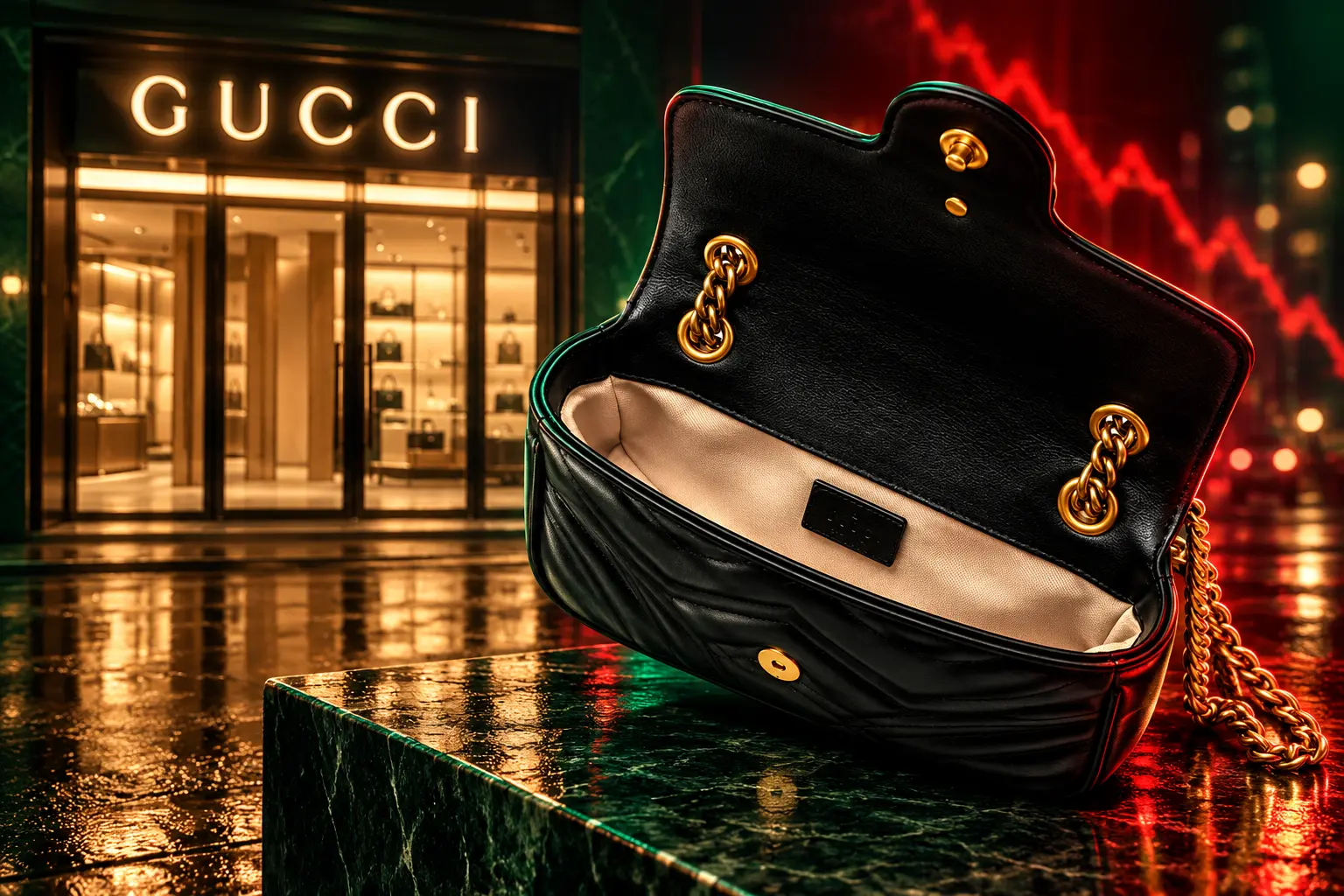
Empty Stores and a 45% Wholesale Jump
Gucci’s quarterly sales were down 6% on a comparable basis and 4% as reported, after a 2% comparable decline in the second quarter. Traffic was the constraint, the group said, especially in mainland China and Japan. Conversion, average price and average ticket improved as new collections reached shops.
Sales in Gucci’s own stores, including e-commerce, fell 9%. Wholesale, at €120 million, was 9% of the brand’s quarter and jumped 45% like-for-like on a weak comparison and order-book effects. Wholesale and other together rose 35%. North America was Gucci’s steadiest region. Handbags led the product work; ready-to-wear and shoes remain the weak spots.
A 45% wholesale bounce on a tenth of the brand cannot cover a 9% hole in the stores that still mint most of the cash. Shoppers who walked in spent more. Too few walked in. That is why a 1% group miss produced a 16% share drop: Gucci is still large enough that jewelry, glasses and Saint Laurent cannot re-rate the stock on their own.
On July 7, Gucci and L’Oréal signed a fifty-year exclusive license agreement for fragrance and beauty, due to start on July 1, 2027 after the Coty deal is redeemed early. That is a long fuse. It does not fill a Gucci floor in Shanghai this quarter.
What Offset Gucci in Fashion and Leather?
Excluding Gucci, retail sales in fashion and leather rose 2%, Kering said, while the segment’s own stores overall fell 4%. Wholesale and other in the division rose 4%. Armelle Poulou, chief financial officer, told analysts that Saint Laurent, Bottega Veneta and Brioni had the momentum, and that Bottega Veneta posted high single-digit growth.
THE HOUSES THAT GREW IN RETAIL
- Saint Laurent: Growth came from North America and Western Europe, with heavy buying from very important clients and core clients.
- Bottega Veneta: Leather goods stayed strong, new products landed, and ready-to-wear is being built out; Romain Spitzer became chief executive on September 1.
- Brioni: Bespoke work and a tight client list kept the house in strong growth.
Balenciaga held up in leather goods, while ready-to-wear and shoes stayed under pressure. Alexander McQueen kept trimming its shops and pushing British tailoring. Poulou called the quarter more challenging for both of those houses. Group retail, including e-commerce, fell 3%; wholesale and other rose 3%.
Jewelry Climbed 11% With Fashion Stuck
Kering Jewelry, which groups Boucheron, Pomellato, DoDo and Qeelin, took in €239 million, up 12% as reported and 11% comparable, after an 18% comparable rise in the second quarter. Sales in its own stores jumped 18%. Wholesale and other in jewelry fell 6%.
Boucheron leaned on Quatre and Serpent Bohème in Japan and South Korea. Pomellato found demand in Japan for Nudo, Iconica and Together. DoDo and Qeelin were mixed; Qeelin did launch Wulu Purple Jade. The same Japan that starved Gucci of traffic still bought jewels.
Kering Eyewear added €373 million, up 6% as reported and 4% comparable, with growth in every region. Maui Jim’s fall-winter 2026 line and Lindberg’s 40th anniversary work were the named pushes. Together, jewelry and eyewear were €612 million, a fifth of Gucci’s take and rising. Charlotte Fournet became Pomellato chief executive and Krizia Cucurachi took DoDo, both from September 15, reporting to Jean-Marc Duplaix.
Two Houses Are Waiting on New Designers
The houses covering Gucci are the ones that just lost their designers. Saint Laurent, which Poulou said had traction with core clients, confirmed Anthony Vaccarello’s exit on October 9 after ten years. Alexander McQueen said on October 15 that Seán McGirr will be leaving; he had been creative director since 2023. Both houses said new creative leadership would be named soon.
THE YEAR THAT LED TO THIS PRINT
- September 15, 2025: Luca de Meo starts as chief executive, arriving from Renault.
- April 16, 2026: In Florence he presents ReconKering, the group overhaul built around Gucci’s appeal and a tighter operating platform.
- July 7, 2026: Gucci and L’Oréal lock the 50-year beauty license, due to start in mid-2027.
- October 9, 2026: Saint Laurent and Vaccarello part; the house says a successor will follow soon.
- October 15, 2026: McQueen and McGirr part, less than a month after the house’s London show.
- October 22, 2026: Third-quarter sales land at €3,345 million, down 1% comparable.
Poulou said the successions were planned and that more indication should come very shortly. Saint Laurent, she said, starts from strong momentum; McQueen is to be repositioned with British tailoring. Asked about reports of changes at Balenciaga, she declined to comment. Gucci’s creative lead, Demna, is still in his first stretch in Florence, with Francesca Bellettini as brand chief executive.
Why Kering Is Closing at Least 125 Stores
De Meo’s other lever is the map. After 75 net store closures in 2025, Kering completed 105 net closures in the first nine months of 2026, made up of 128 closures and 23 openings. That already passed the old full-year goal of 100. The group now plans at least 125 net closures for 2026, which implies about 20 more net by year end.
Fewer doors only help if the ones that remain are full. Gucci’s own-store drop of 9% says they are not, at least in Asia. Poulou said the plan is being carried out with discipline and that marketing and client spend will rise to pull people back in. The group still says it will improve recurring operating margin in 2026 even as sales stay soft. It did not restate a return to sales growth this year.
North America Grew While Asia-Pacific Slid
Kering’s own-store sales by region tell the same split as Gucci. North America grew 1%. Western Europe was flat. Asia-Pacific excluding Japan fell 8%. Japan rose 4%. The rest of the world, including the Middle East, fell 5%, though Poulou said the Middle East posted positive growth in the quarter and had been recovering step by step.
RETAIL BY REGION IN Q3
- North America: Up 1%, the least bad large market, and Gucci’s most resilient one.
- Western Europe: Flat, with Saint Laurent still drawing clients there.
- Asia-Pacific ex-Japan: Down 8%, with mainland China still the traffic problem.
- Japan: Up 4% for the group, even as Gucci traffic there weighed on the brand.
Luxury peers had a hard quarter too. LVMH’s fashion and leather goods sales fell 5%, Moncler’s brand sales fell 1%, and Prada Group slowed to 1% growth. Richemont reports on November 13. Poulou said October was broadly in line with third-quarter trends in most regions.
The recovery of Gucci remains our defining priority. We are steadily strengthening desirability and advancing our product development at pace. Reflecting the complementarity of our portfolio, Saint Laurent, Bottega Veneta and Brioni, as well as Kering Eyewear and Kering Jewelry, continue to extend their strong trajectory and we are doubling down on the renewal of Balenciaga and Alexander McQueen.
Luca de Meo, CEO, Kering third-quarter statement, October 22, 2026
He also said the overhaul is a multi-season job that still needs Gucci’s momentum, better product, the China plan, the group platform, and a culture of getting things done. The houses that already have momentum are the ones now casting designers. Gucci is still 39% of sales, and its shops are still short of people.
Disclaimer: This article is news reporting and analysis of Kering’s published third-quarter sales and related company statements, and it is for information only. It is not investment advice, a recommendation to buy or sell Kering shares or any other security, and it is not a forecast of future results. Readers should consult a qualified financial adviser or licensed broker before making any investment decision. Sales figures, store counts, margin goals and creative-director seats are those given by the companies named as of the dates in this piece and can change with later filings, trading and appointments.

Kering’s Growing Houses Cannot Outrun a Shrinking Gucci

Studio Staff and Bitcoin Buyers Built the Eminem Leak Case

A Mutated H1N1 Strain Is Hitting Younger Immunity First

Albert Heijn Returns at One-Third as Rivals Take Share

Art Basel Paris Ends After One Public Day

Thameslink Will Pad 60,000 Ironing-Board Seats From 2027

How Tall Was Adolf Hitler Really? Debunking the Myth of his Height

Micron Sells the Memory Shortage as Five-Year Contracts

Royal Caribbean Sends Los Angeles Ships to Singapore and Brisbane

U.S. Forces Clear Hormuz Mines, Then Hit Minelayers Again
-
 NEWS2 months ago
Thameslink Will Pad 60,000 Ironing-Board Seats From 2027
-
 SCIENCE3 years ago
How Tall Was Adolf Hitler Really? Debunking the Myth of his Height
-
 NEWS2 months ago
Micron Sells the Memory Shortage as Five-Year Contracts
-
 NEWS2 months ago
Royal Caribbean Sends Los Angeles Ships to Singapore and Brisbane
-
 BUSINESS2 months ago
U.S. Forces Clear Hormuz Mines, Then Hit Minelayers Again
-

 BUSINESS2 months ago
Sweetmore Bakeries Buys Fantasy Baking for Bar Work
-

 BUSINESS2 months ago
L Catterton Installs a Kraft Heinz Operator at Kettle Cuisine
-

 NEWS2 months ago
CISA’s 100 Water System Hacks Hit One-Operator Plants