
ENTERTAINMENT
Jordan and Butler Open Kosinski’s 1985 Miami Vice Bet
First-look photos put Jordan and Butler in 1985 as Kosinski wagers IMAX scale on a period Miami Vice ’85.

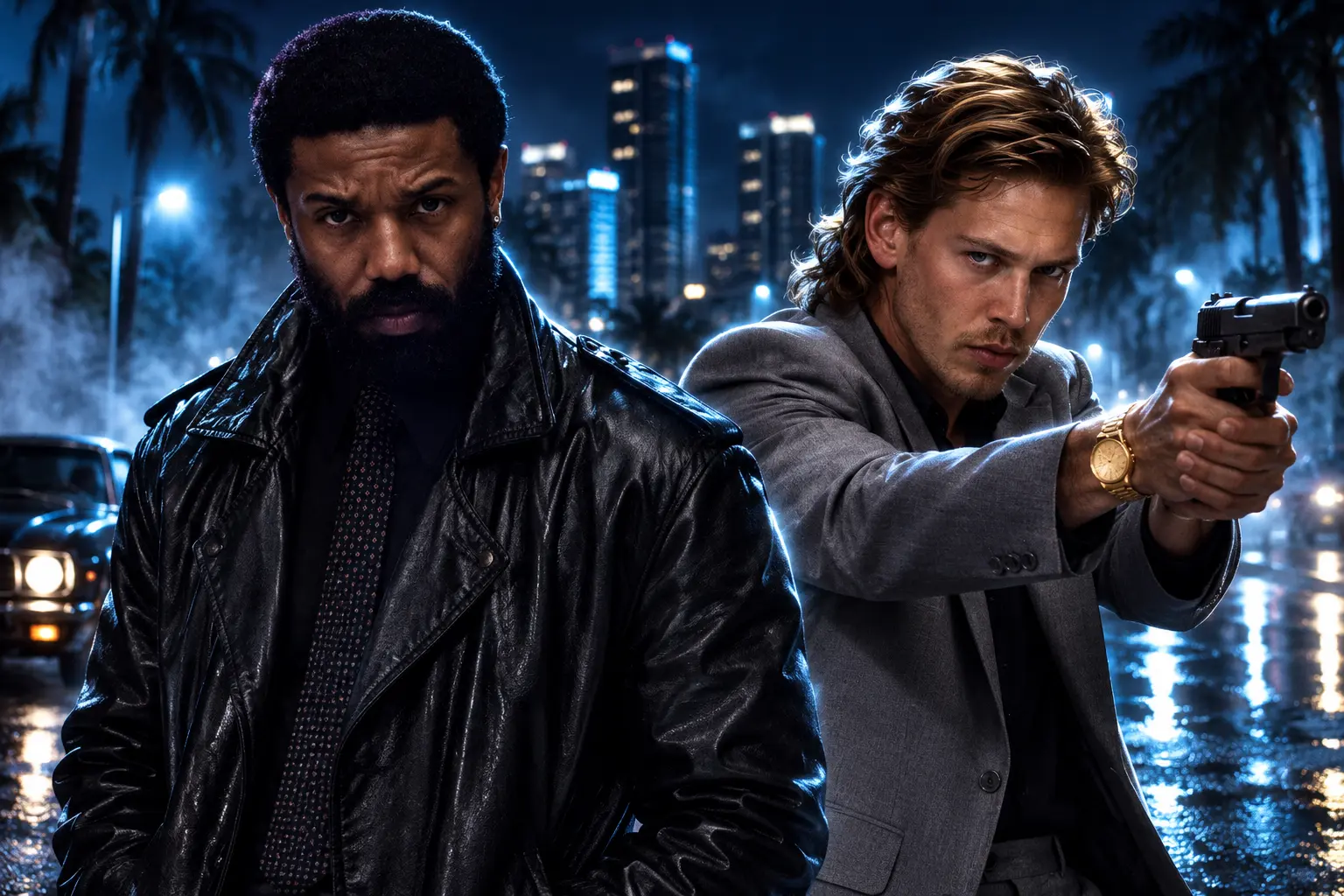
Universal posted first-look photos of Michael B. Jordan and Austin Butler as Tubbs and Crockett on October 12, with Miami Vice ’85 in production. Joseph Kosinski is shooting the film for IMAX from a Dan Gilroy script, for a May 19, 2028 theatrical date.
The stills do more than introduce a cast. They freeze the property in 1985, the opposite of what Michael Mann did when he brought Crockett and Tubbs back in 2006.
The First Stills Plant Vice in 1985
Jordan plays Ricardo Tubbs in all black: leather jacket, dotted tie, beard, a hard stare into the lens. Butler plays Sonny Crockett in a fitted gray blazer and pants, gold watch catching the light, gun raised at someone off camera. Universal shared both frames on the film’s Instagram as cameras started to roll.
The original Crockett uniform was a white jacket over a T-shirt, sleeves shoved up because Miami was hot. Don Johnson said he dropped the belt and the socks for the same reason. Jordan’s leather-and-tie Tubbs is a heavier stack than that heat-driven wardrobe. Butler’s gray suit skips the white jacket people still picture when they hear the title.
The lighting on those frames is cooler and harder than the TV show’s peach-and-teal postcard Miami. It reads closer to a night-city thriller than a daytime vice squad. That is the wager in a single costume choice: sell 1985 as spectacle, not as a museum of pastels.
Mann Wanted a Show That Felt Like Now
Anthony Yerkovich created Miami Vice after reading that 20 percent of unreported income in the United States came from Dade County, which then had half of 1 percent of the nation’s population. He first pitched the idea as a movie called Gold Coast. Universal Television already had Scarface in the works, so the studio asked him to write it as a series. The pilot, “Brother’s Keeper,” aired on September 16, 1984.
Michael Mann came on as executive producer and asked for creative control. He also asked to change the title. In a Television Academy oral history he said he wanted to give it the same sensibility as a contemporary feature film. The show ran on NBC from 1984 to 1989, drew 20 Emmy nominations, and won 4.
I wanted to invert how Black Americans were represented in series television. The character of Tubbs was always going to be a Black man. But I didn’t want him to be Crockett’s assistant, the Black Tonto to his Lone Ranger. I wanted him to be erudite, bilingual, have sophistication.
Michael Mann, executive producer, Television Academy oral history
Mann recalled Miami as war-surplus beige before the crew arrived. He used pastels to generate a feeling of heat. Yerkovich’s cops dressed like the people they hunted because seized cars and clothes went to local departments for undercover work. That is why Crockett drove a Ferrari and Tubbs looked expensive.
WHAT THE ORIGINAL SHOW ACTUALLY MOVED
- The music: Jan Hammer’s theme hit No. 1 on the Billboard Hot 100 on November 9, 1985, held the top for one week, and was the last instrumental to do so until Baauer’s “Harlem Shake” in 2013.
- The UK chart: The same theme reached No. 5 on the UK singles chart after its October 1985 debut.
- The album: The first soundtrack spent 11 weeks at No. 1 in the United States, and Phil Collins’s “In the Air Tonight” became the needle drop still tied to the pilot’s night drive.
- The city: Production helped recast South Beach from worn retirement hotels into the image the city still sells.
The show’s power was that it felt like the week it aired. Fashion, stereo pop, and Miami’s drug money were current events, not period dressing. Kosinski’s title, Miami Vice ’85, does the reverse. It treats 1985 as a world you rebuild, the way he rebuilt carrier decks and Formula One paddocks.
A Digital Vice That Barely Broke Even
Mann’s 2006 film, with Colin Farrell as Crockett and Jamie Foxx as Tubbs, was the last wide theatrical version. He wrote, directed, and produced it, and he declined to remake the TV look. Jan Hammer was not asked to score it. Pastels were out. Most of the movie was shot on the Thomson Viper digital camera, with Super 35 for high-speed and underwater work, and the palette sat at permanent midnight.
Universal released it in North America on July 28, 2006. It grossed $164.2 million worldwide on a production budget of $135 million to $150 million. Rotten Tomatoes lists a 47 percent score from 226 reviews. Metacritic has a 66 from 37 critics. The consensus at the time was that it looked striking and that the leads lacked the TV pair’s easy charisma. A later cult grew around the digital textures and the doomed romance with Gong Li’s Isabella, but the theatrical math was thin for a summer brand.
THREE VERSIONS OF CROCKETT AND TUBBS
| Version | Leads | Visual bet | Public result |
|---|---|---|---|
| NBC series, 1984 to 1989 | Don Johnson, Philip Michael Thomas | Pastel heat, stereo pop, weekly feature pace | 4 Emmys; theme song No. 1 |
| Mann film, 2006 | Colin Farrell, Jamie Foxx | Digital night, no TV theme, contemporary setting | $164.2 million worldwide |
| Kosinski film, dated 2028 | Austin Butler, Michael B. Jordan | Period 1985, filmed for IMAX | Shooting as of October 2026 |
Audiences who bought tickets in 2006 thought they were getting the TV show’s gloss. They got a Mann crime picture instead. Kosinski is walking back into the look Mann walked away from, with a 19-month gap between the start of filming and opening day.
Kosinski’s Last Two Films Paid Off
The director’s recent work is why Universal can date this as a large-format event and live with a 2028 slot. Top Gun: Maverick took in $1.50 billion worldwide in 2022. F1, released in the United States on June 27, 2025, took in $634 million at the worldwide box office, including $189.6 million domestic, per Box Office Mojo.
THE IMAX PATTERN HE IS REUSING
- The camera team: Claudio Miranda, who shot Maverick and F1 with him, is back as cinematographer.
- The producers: Kosinski is producing with Dylan Clark of Dylan Clark Productions. Monolith Pictures is also listed on the film.
- The script path: Gilroy wrote the screenplay after an earlier draft by Eric Warren Singer, using characters created by Yerkovich.
- The date move: Universal first set August 6, 2027, then shifted the film to May 19, 2028.
Gilroy’s name is a tell. Nightcrawler is a present-tense crime movie about hunger and cameras, not a nostalgia object. Pairing that writer with a director who sells speed on IMAX screens is how the studio wants 1985 to play: pretty, loud, and dangerous, not ironic. Glen Powell, who played Hangman for Kosinski in Maverick, was also considered for Crockett before Butler locked the role.
Who Else Is on This Call Sheet?
Jordan and Butler were confirmed in April 2026, when the project took the ’85 title. Supporting names filled in through early October, some with jobs attached and most still sealed.
THE ROLES THAT ARE ON THE RECORD
- John Leguizamo: The film’s villain, a cartel boss. He played Orlando, son of Calderone, in two episodes of the original series, though this part has not been described as a reprise.
- Michael Irby: Lt. Lou Rodriguez, the desk job Gregory Sierra held in the early episodes before Edward James Olmos arrived as Castillo.
- The closed names: Alden Ehrenreich, Whitney Peak, Camila Morrone, Danny Ramirez, Andrew Schulz, Edi Gathegi, Walton Goggins, André Holland, and Dominic Sessa.
Gathegi has been described as a small-time crook with large plans. Peak has been billed in some studio materials as a female lead. Goggins’s job is still unannounced. Sessa’s casting landed the same week as the first-look stills. That is a deep bench for a cop picture, and it is also a lot of faces the marketing will have to explain before 2028.
New Jersey Is Pretending to Be Miami
Filming began in October 2026 in Wayne, New Jersey, where crews turned part of the Preakness Shopping Center into a mid-1980s Miami street. Production is also due in New York City and in Miami itself. Set photographs from October 13 show Butler in the gray Crockett clothes working a street scene with Ramirez, which is the movie past the poster stage.
HOW THE BET GOT TO CAMERA
- April 2025: Universal puts a new Miami Vice film in development with Kosinski directing and Gilroy writing.
- October 2025: Jordan and Butler enter talks as Tubbs and Crockett; Powell is also in the Crockett mix.
- April 2026: The stars are confirmed, the title becomes Miami Vice ’85, and the date later moves from August 6, 2027, to May 19, 2028.
- August and September 2026: Ehrenreich, Peak, Morrone, Ramirez, Leguizamo, Schulz, and Gathegi join.
- October 2026: Goggins, Holland, Irby, and Sessa join; filming starts in Wayne; first-look stills post on October 12.
Building 1985 Miami in a New Jersey mall is the practical version of the title. The original series shot in a city that still looked like itself. This film has to manufacture the year, then photograph it for IMAX, then wait.
The Movie Does Not Arrive Until 2028
Nineteen months separate the October 2026 start of photography from the May 19, 2028 date. That gap will test people who liked the stills on sight. The first trailer will be judged on a single cue: whether Kosinski dares to use “In the Air Tonight,” the needle drop the 2006 film only grazed with a cover, or whether he treats the year as sound design instead of a jukebox.
Mann’s show worked because it felt like the week you watched it. His 2006 film worked, for the people it worked for, because it refused that week. Kosinski is betting a third way: lock the calendar at 1985, put Jordan and Butler in the clothes, shoot it like Maverick, and ask a summer crowd in 2028 to pay for a year that no longer exists. The gray blazer and the black leather are the first chips on the table.

Kering’s Growing Houses Cannot Outrun a Shrinking Gucci

Studio Staff and Bitcoin Buyers Built the Eminem Leak Case

A Mutated H1N1 Strain Is Hitting Younger Immunity First

Albert Heijn Returns at One-Third as Rivals Take Share

Art Basel Paris Ends After One Public Day

Thameslink Will Pad 60,000 Ironing-Board Seats From 2027

How Tall Was Adolf Hitler Really? Debunking the Myth of his Height

Micron Sells the Memory Shortage as Five-Year Contracts

Royal Caribbean Sends Los Angeles Ships to Singapore and Brisbane

U.S. Forces Clear Hormuz Mines, Then Hit Minelayers Again
-
 NEWS2 months ago
Thameslink Will Pad 60,000 Ironing-Board Seats From 2027
-
 SCIENCE3 years ago
How Tall Was Adolf Hitler Really? Debunking the Myth of his Height
-
 NEWS2 months ago
Micron Sells the Memory Shortage as Five-Year Contracts
-
 NEWS2 months ago
Royal Caribbean Sends Los Angeles Ships to Singapore and Brisbane
-
 BUSINESS2 months ago
U.S. Forces Clear Hormuz Mines, Then Hit Minelayers Again
-

 BUSINESS2 months ago
Sweetmore Bakeries Buys Fantasy Baking for Bar Work
-

 BUSINESS2 months ago
L Catterton Installs a Kraft Heinz Operator at Kettle Cuisine
-

 NEWS2 months ago
CISA’s 100 Water System Hacks Hit One-Operator Plants