
BUSINESS
L’Oréal Luxe Outruns LVMH Beauty After the Kering Deal
L’Oréal’s Q3 sales rose 7.7% as Luxe outsold mass brands and left LVMH’s perfume arm at 1%, while Mexico’s makeup crunch cut Latin America.

L’Oréal posted third-quarter sales of €11.56 billion, up 7.7% on an adjusted like-for-like basis, pulling further ahead of a beauty market growing about 5%. That is about $13.1 billion at the €1 = $1.1355 rate the group cited on Sept. 30. Nine-month sales reached €35.34 billion, up 6.9% like-for-like and 7.7% as reported.
The mix did the damage to rivals. L’Oréal Luxe outsold Consumer Products in the quarter, after the March close of Kering Beauté, while LVMH’s perfume and cosmetics arm grew 1%.
L’Oréal Beat a 5% Beauty Market
Figures published on Oct. 22 showed sales of €11,561.4 million for the three months, versus €10,333.7 million a year earlier. Like-for-like growth was 7.2%. Adjusted like-for-like, which strips out the timing of an IT overhaul, was 7.7%. Reported growth was 11.9%, helped by newly folded-in brands. A Visible Alpha poll had looked for 5.9% on the adjusted measure.
Nicolas Hieronimus, chief executive, put the quarter against a market he again pegged at about 5%. Growth came mainly from mix and volume. Online sales rose about 17%, ahead of the online beauty market. In the first half the group had already posted a first-half operating margin of 21.3%. The Oct. 22 release is a sales update, not a new profit print, and he said the first nine months give him confidence in another year of sales and profit growth.
THE NINE-MONTH SCOREBOARD
- Group sales: €35,337.6 million, up 6.9% like-for-like and 7.7% reported, from €32,807.0 million.
- Scope and currency: Net bolt-ons added 2.0%; constant-currency growth was 8.9%; currency cut 1.2%.
- Q2 to Q3: Adjusted like-for-like stepped up from 6.3% in the second quarter to 7.7% in the third.
- Full-year base: 2025 sales were €44.05 billion, with more than 95,000 staff and 40 international brands.
Hieronimus used the stronger measure in his prepared line, and he tied it to hair, fragrance, and a skincare book he said is now beating the market after a weak 2025.
L’Oréal delivered an exceptional third quarter as adjusted like-for-like growth accelerated to +7.7%.
Nicolas Hieronimus, CEO, L’Oréal sales call, Oct. 22, 2026
On the rest of 2026 he told analysts the beauty market should grow around 5%, and that L’Oréal would keep beating it at a slightly more moderate pace, while still meeting the top-line plan set last year.
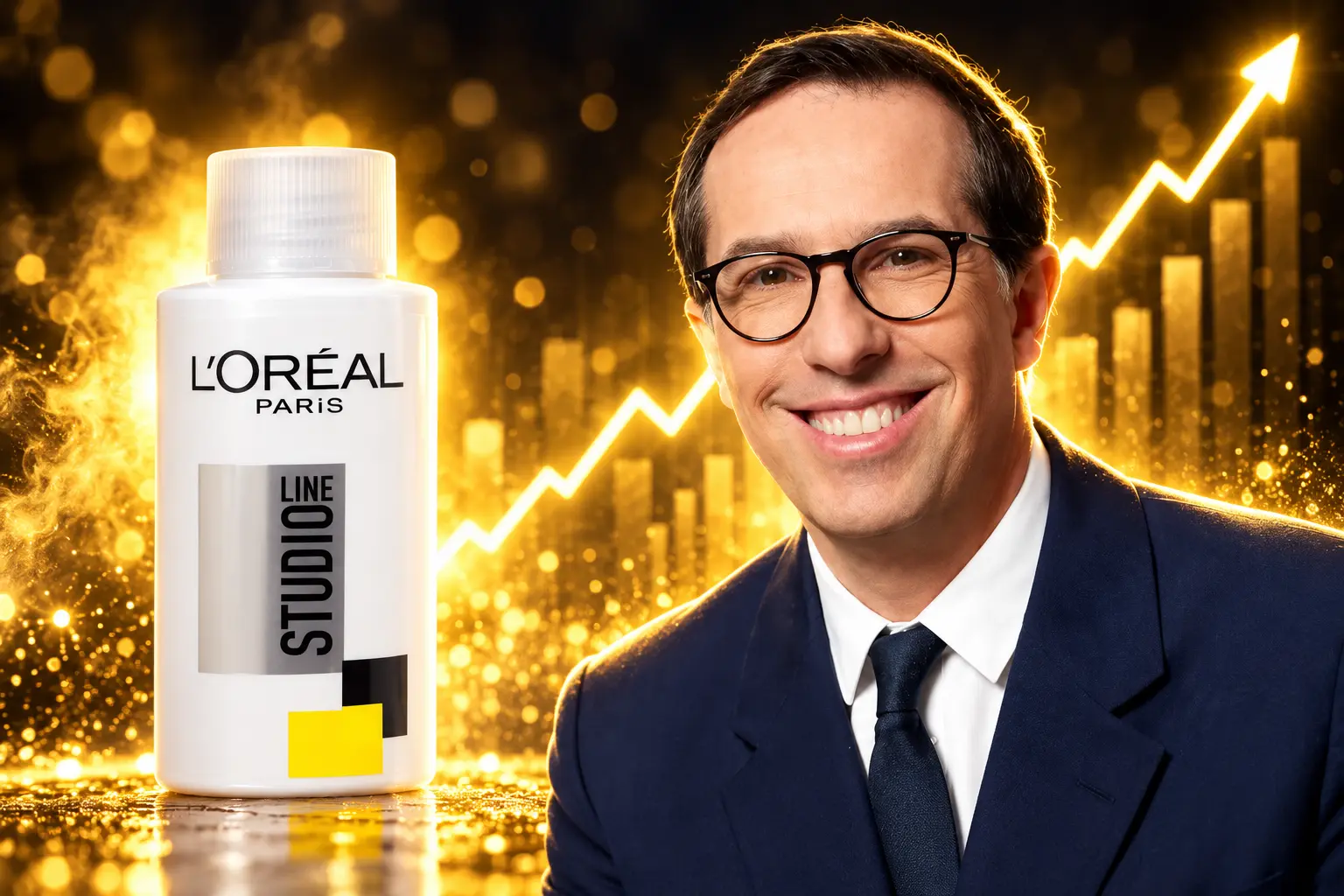
Luxe Outsold the Mass Brands This Quarter
For the first time in this cycle, L’Oréal Luxe was the largest division in a single quarter. Luxe sales were €4,176.6 million. Consumer Products, home to L’Oréal Paris, Maybelline New York, Garnier and NYX Professional Makeup, were €4,044.3 million. The gap was €132.3 million. Over nine months Consumer Products is still bigger, at €12,687.1 million against Luxe at €12,173.3 million.
Reported Luxe growth of 12.3% ran well ahead of the 6.4% like-for-like rate because House of Creed and the new licences sat in the numbers. Consumer Products grew 4.3% like-for-like and 3.8% on the adjusted measure, the slowest of the four divisions. Professional Products and Dermatological Beauty both posted 13.9% adjusted like-for-like growth.
Q3 SALES BY DIVISION
| Division | Q3 sales (€m) | Like-for-like | Adjusted LFL | Reported |
|---|---|---|---|---|
| L’Oréal Luxe | 4,176.6 | +6.4% | +7.0% | +12.3% |
| Consumer Products | 4,044.3 | +4.3% | +3.8% | +7.5% |
| Dermatological Beauty | 1,871.6 | +12.2% | +13.9% | +15.7% |
| Professional Products | 1,469.1 | +12.1% | +13.9% | +19.1% |
| Group | 11,561.4 | +7.2% | +7.7% | +11.9% |
Hieronimus said on the call that hair care is driving growth, that the salon market looks a bit more positive than it did at the start of 2026, and that L’Oréal has become the world’s number-one hair care group from a number-two or number-three spot about three years ago. That claim sits on Professional Products, Consumer Products hair, and Vichy’s Dercos line inside Dermatological Beauty, not on Luxe.
Salon Hair and CeraVe Did the Heavy Lifting
Professional Products delivered €1,469.1 million in the quarter, up 12.1% like-for-like and 19.1% as reported. The salon channel is showing signs of recovery, the group said, and premium hair care did the work. North America was the largest contributor. Europe was brisk in the DACH cluster, Spain and Portugal, and Poland-Baltics. Brazil, India and the Gulf were strong in emerging markets.
Dermatological Beauty added €1,871.6 million, up 12.2% like-for-like. La Roche-Posay, CeraVe and SkinCeuticals, the three brands the group calls its billionaire names, each grew in double digits. Sun care sped up on La Roche-Posay Anthelios and the CeraVe Sun launch. Vichy held up on Dercos. North America and North Asia were in double digits; Europe was high single digits.
THE BRANDS THAT MOVED THE NEEDLE
- Kérastase: Double-digit growth on Gloss Absolu, Genesis and Chronologiste, with Redken Acidic Grow Full and L’Oréal Professionnel Keratin Alpha Sleek adding lift.
- La Roche-Posay: Core franchises plus Mela B3 Double-Dose and Anthelios UV Air, with a Walmart expansion in the United States.
- CeraVe: Still firm in North America and faster in SAPMENA-SSA, with the new sun range on top of the moisturisers.
- Yves Saint Laurent: Libre and MYSLF in double digits; makeup led by Lovenude, All Hours and Make Me Blush.
- Prada and Armani: Paradigme and Emporio Armani Stronger With You called out as fragrance blockbusters; Valentino Vendetta and Giorgio Armani I Will had a promising start.
Consumer Products was not in reverse. Every global brand grew. L’Oréal Paris and NYX were the standouts. Hair care there was in double digits on Elsève Collagen Lifter and Garnier Fructis Diamond Sleek. Makeup had Infaillible, Maybelline Sky Tubes mascara and NYX Fat Matte lipstick. The lag is relative: 4.3% like-for-like is below the group, below the market-beating salon and skin arms, and below the 5% market rate Hieronimus used as his yardstick.
Why LVMH’s Perfume Arm Grew 1%
The beauty print that landed 10 days earlier at LVMH is the other half of this story. Perfumes and cosmetics, the house of Parfums Christian Dior and Guerlain, grew 1% organically in the third quarter to €2.01 billion and was flat organically over nine months at €5.92 billion. L’Oréal Luxe alone, at €4.18 billion in the quarter, is already more than twice that arm. Sephora, booked in selective retailing, grew 8% and is where LVMH is still taking beauty share. Fashion and leather goods, the bag engine, fell 5%.
Shoppers who still spend are spending in the bathroom, not only in the leather-goods queue. Perfume and clinical skin are compounding while couture leather stalls. L’Oréal owns that shift inside one group. LVMH’s beauty brands grew 1%, and its bags went backwards.
Q3 BEAUTY, SIDE BY SIDE
| Company | Q3 sales | Q3 growth | Basis |
|---|---|---|---|
| L’Oréal Group | €11.56 billion | +7.7% | Adjusted like-for-like |
| L’Oréal Luxe | €4.18 billion | +6.4% | Like-for-like |
| LVMH Perfumes & Cosmetics | €2.01 billion | +1% | Organic |
| Puig | €1.39 billion | +5.6% | Like-for-like |
| Hermès Perfume and Beauty | €128 million | +7.5% | Constant currency |
Puig, owner of Carolina Herrera, Rabanne and Charlotte Tilbury, posted a record quarter of €1.39 billion, up 5.6% like-for-like and 7.2% as reported, with makeup up 16.1% like-for-like. That is a real beat against a 5% market. It is still slower than L’Oréal’s adjusted like-for-like growth of 7.7%.
Hermès is the awkward comparison. Group sales were €4.10 billion, up 4.3% at constant rates, short of a 5.2% consensus. Leather goods rose 10.8%. Ready-to-wear fell 2.0%. Perfume and beauty sales of €128 million rose 7.5% at constant rates, from €118 million, after a nine-month slip of 0.7%. The line is tiny next to L’Oréal Luxe, and it rebounded in a quarter when Hermès leather, not beauty, still paid the bills.
Estée Lauder Companies, the other global prestige house, reports its fiscal first quarter on Nov. 2. Its year to June 30 showed net sales of $15.05 billion, up 5% as reported and 3% organically, after a long repair job in China and North America.
The Kering Beauté Deal Reaches Luxe Sales
Luxe’s 6.4% like-for-like rate, versus 2.5% in the third quarter of 2025, is the first clean look at life after Kering. The group said Creed delivered a strong performance in the luxury collection segment, and that the recently integrated Kering Beauté brands did well in North America. Fragrances remained the primary engine and, the group said, cemented L’Oréal Luxe as global number one in the category. Skincare strengthened on Helena Rubinstein’s Re-Plasty line, Medik8, and Yue-Sai in China. China Luxe was up in low double digits.
THE KERING BEAUTÉ CALENDAR
- October 19, 2025: L’Oréal and Kering announce the beauty alliance, covering Creed and long licences on Kering house names.
- March 31, 2026: The purchase closes. L’Oréal takes Kering Beauté, including House of Creed, and signs fifty-year exclusive licences for Bottega Veneta and Balenciaga fragrance and beauty.
- March 31, 2026: Kering’s statement files a cash deal valued at 4 billion euros, plus royalties on the licensed names.
- July 1, 2027: Rights to a fifty-year Gucci beauty licence begin once Coty’s current deal expires, as set out in the first-half release.
Hieronimus welcomed the houses into the group on closing day and said the step reinforces L’Oréal as number one in beauty and in luxury beauty. Cyril Chapuy, president of L’Oréal Luxe, called it a defining milestone for the division. Luca de Meo, Kering’s chief executive, said the pact opens a new phase for those houses’ fragrances and cosmetics. The two groups are still looking at a wellness and longevity joint venture. For this quarter the visible result is simpler: Luxe accelerated, reported growth jumped on scope, and Creed is already in the fragrance charts L’Oréal likes to read out.
Europe and SAPMENA Carried the Map
Europe was the largest region at €4,043.2 million, up 9.9% like-for-like and 13.2% as reported. Adjusted like-for-like was 8.9%. Spain and Portugal, and Poland and the Baltics, led. The UK and Southern Europe stood out inside Consumer Products. North America was €3,151.1 million. Raw like-for-like growth there was only 2.2%, but the adjusted rate was 5.6%, another IT-timing gap. Over nine months North America is healthier, at 6.3% like-for-like.
North Asia reached €2,229.0 million, up 7.8% like-for-like and 14.1% as reported. China was the driver. The group said the local beauty market grew in low single digits, still led by selective brands, and that L’Oréal advanced almost three times faster, online and off. Japan grew despite weak tourism. Korea was helped by a rebound in travel. Travel retail in the region returned to positive growth. Aesop sat with Helena Rubinstein in the Luxe skin recovery. Dr.G, the Korean mass skin brand, is in the regional mix and is due in the United States in the fourth quarter.
SAPMENA-SSA, South Asia Pacific, the Middle East, North Africa and Sub-Saharan Africa, remains the growth engine: €1,222.7 million, up 19.2% like-for-like, 19.5% adjusted and 21.0% reported. India and Indonesia accelerated on hair and skin. Vietnam stayed outstanding. The Gulf grew in double digits even with customs-clearance problems and the regional security situation. Australia and New Zealand kept a strong pace. South Africa led Sub-Saharan Africa. All four divisions grew in double digits in SAPMENA, led by Dermatological Beauty and Professional Products.
Hieronimus said in early October that India sales were rising about 18%, against market growth of about 10%, and that India had become the group’s seventh-largest contributor to growth. The regional 19.2% rate in the third quarter fits that picture.
Mexico’s Makeup Shortage Dragged Latin America
Latin America was the only region in decline on a like-for-like basis. Sales were €915.5 million, down 1.0% like-for-like and 3.0% adjusted, though reported sales rose 11.0% on currency. Over nine months the region is still up 2.4% like-for-like, at €2,728.9 million.
The group described two realities. Brazil grew in every division, led by Professional Products and Dermatological Beauty, and beat the local market. Mexico went the other way. Consumer Products there hit what the company called a serious air pocket, from commercial issues and a temporary supply-chain disruption in makeup, made worse by retailer inventory cuts. The Andean countries were strong. E-commerce was the growth channel across the region. Market growth in both Brazil and Mexico, the group said, had slowed to the mid-single digits.
That Mexico makeup crunch is the bill for a quarter otherwise built on premium hair, fragrance, and pharmacy skin. Mass makeup is still a volume machine, and when the truck does not arrive, Latin America’s like-for-like rate turns negative even as Brazil fires.
Innovist Closes as India Outgrows Its Market
Since the half-year, L’Oréal closed a majority stake in Innovist, a digital-first Indian personal-care house whose brands include Bare Anatomy, Chemist at Play, SunScoop and Anecdote. The brands are slated for Consumer Products, the division that needs local names if 4.3% group-rate growth is going to speed up. L’Oréal BOLD, the corporate venture fund, also announced a partnership with Nykaa, India’s largest beauty retailer, to take minority stakes in high-growth Indian brands. A separate memorandum with Cosmax, the Korean manufacturer, covers next-generation formulas.
Consumer Products is still the volume engine, and it is the division most exposed to Mexico’s shortage and to mass-market price fights. The India close, Dr.G’s Western rollout, and hair care inside L’Oréal Paris are the levers Hieronimus can pull without waiting for Luxe licences. Gucci beauty does not arrive until July 1, 2027. Creed is already on the shelf.
The fourth-quarter market, in his telling, should again grow around 5%. L’Oréal will try to beat that rate at a slower clip than 7.7%. Estée Lauder’s Nov. 2 print will show whether US prestige is healing on the other side of the aisle. For the nine months just counted, the winner is the group that sells salon hair, CeraVe, and a newly bought niche perfume house. The loser is the perfume arm that grew 1% while its parent’s handbags fell 5%.
Disclaimer: This article is news reporting and analysis of published sales figures and company statements, and it is for information only. It is not investment advice, a recommendation to buy or sell L’Oréal, LVMH, Hermès, Puig, Estée Lauder or any other security, and it is not a forecast of fourth-quarter or full-year profit. Readers who may act on these figures should consult a qualified financial adviser or licensed broker and should read each company’s own filings. Sales rates, currencies and brand line-ups reflect the releases dated Oct. 22, 2026 and earlier, and they can change with later statements, restatements or the next quarterly print.

Kering’s Growing Houses Cannot Outrun a Shrinking Gucci

Studio Staff and Bitcoin Buyers Built the Eminem Leak Case

A Mutated H1N1 Strain Is Hitting Younger Immunity First

Albert Heijn Returns at One-Third as Rivals Take Share

Art Basel Paris Ends After One Public Day

Thameslink Will Pad 60,000 Ironing-Board Seats From 2027

How Tall Was Adolf Hitler Really? Debunking the Myth of his Height

Micron Sells the Memory Shortage as Five-Year Contracts

Royal Caribbean Sends Los Angeles Ships to Singapore and Brisbane

U.S. Forces Clear Hormuz Mines, Then Hit Minelayers Again
-
 NEWS2 months ago
Thameslink Will Pad 60,000 Ironing-Board Seats From 2027
-
 SCIENCE3 years ago
How Tall Was Adolf Hitler Really? Debunking the Myth of his Height
-
 NEWS2 months ago
Micron Sells the Memory Shortage as Five-Year Contracts
-
 NEWS2 months ago
Royal Caribbean Sends Los Angeles Ships to Singapore and Brisbane
-
 BUSINESS2 months ago
U.S. Forces Clear Hormuz Mines, Then Hit Minelayers Again
-

 BUSINESS2 months ago
Sweetmore Bakeries Buys Fantasy Baking for Bar Work
-

 BUSINESS2 months ago
L Catterton Installs a Kraft Heinz Operator at Kettle Cuisine
-

 NEWS2 months ago
CISA’s 100 Water System Hacks Hit One-Operator Plants