
BUSINESS
EU Organic Logo Tightens After Court Ruling on Imports
A 20 October 2026 EU deal writes a 2024 court ruling into organic labelling, gating the EU leaf while extending 11-country equivalence to 2036.

EU lawmakers reached a provisional deal on organic farming on 20 October 2026 to rewrite labelling after a 2024 court barred the EU leaf on equivalent imports.
The Irish presidency and Parliament doubled a small-shop certification exemption to €40,000 and 10,000 kg a year and extended 11-country equivalence until 31 December 2036.
🌱#DEAL to support the future of 🇪🇺 organic farming@EUCouncil & @EN_Parliament have agreed on simpler rules for farmers and businesses, greater certainty for international trade & safeguards for consumer trust in the EU organic label.#OrganicFarming
👇https://t.co/mxku8EO09w— EU Council Press (@EUCouncilPress) October 20, 2026
A Bavarian Juice Case Forced the Logo Rewrite
The rewrite follows the Court of Justice of the European Union in Herbaria Kräuterparadies GmbH v Freistaat Bayern, case C-240/23. A Grand Chamber ruling on the EU organic logo on 4 October 2024 held that a food imported under equivalence cannot wear the EU leaf, or in principle the word organic, when it does not meet the production rules in Regulation (EU) 2018/848.
The German fight was about a fruit-juice and herb mix that also held vitamins and ferrous gluconate from outside organic farming. The court said the EU leaf tells shoppers a product meets full Union rules, not a foreign system treated as close enough. A third-country organic mark can still appear on those packs, even if that mark itself uses organic wording.
Regulation (EU) 2018/848 has applied since January 2022. The Commission’s late-2025 proposal, part of its Organic rulebook fit for the future roadmap, was the political answer to that judgment. The Council locked its mandate on 11 May 2026. Irish agriculture minister Martin Heydon said the Irish presidency had “delivered a strong result for farmers, consumers and the agri-food sector.”
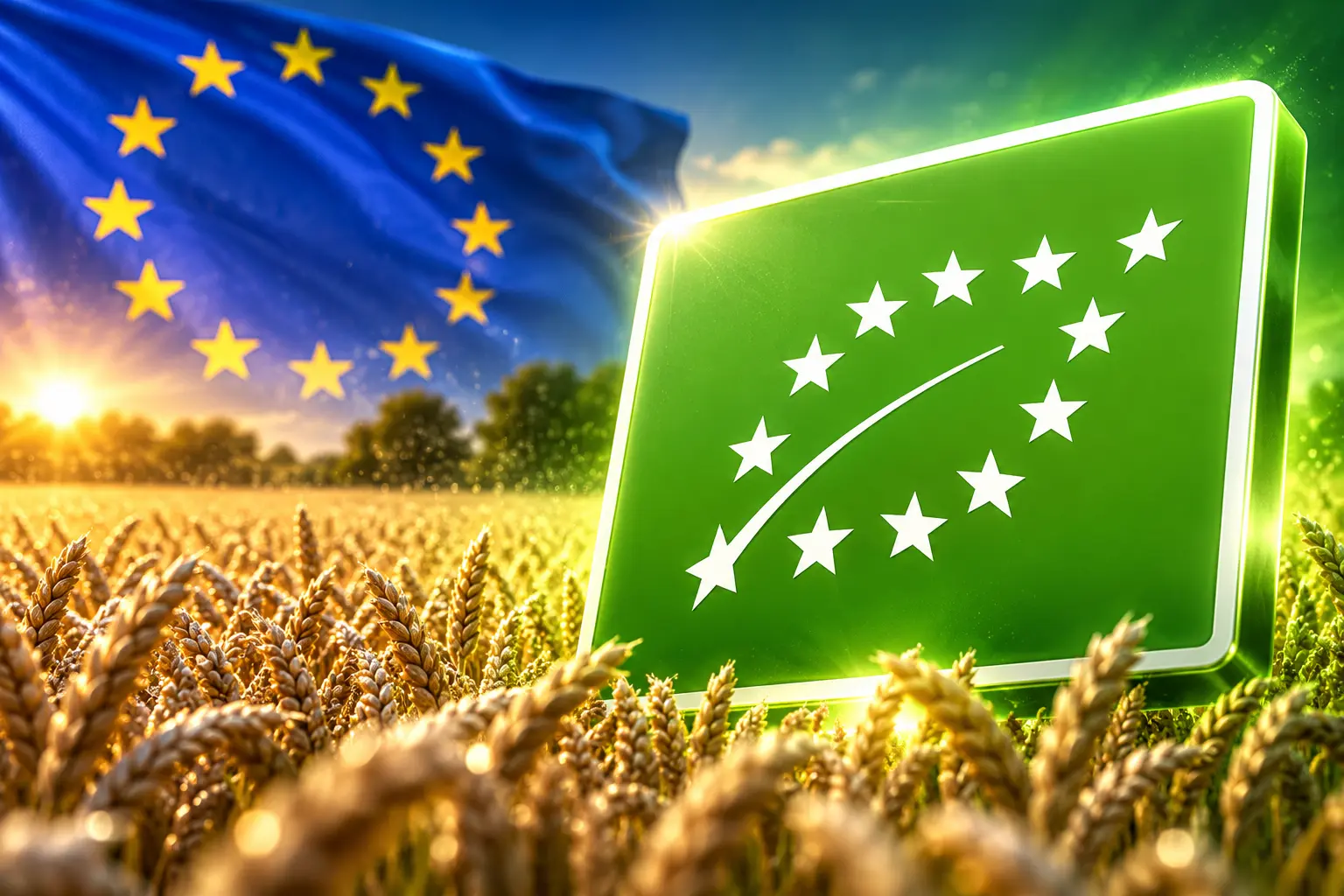
Why the EU Organic Logo Rules Are Changing
Equivalent imports may still be sold as organic and may carry the organic logo of the country they come from. They may use the EU leaf only if they meet additional EU production and control requirements beyond equivalence, for instance on living soil, animal welfare and processing methods. That split is the whole point of the file: the word stays open, the leaf does not.
Christophe Hansen, the commissioner for agriculture and food, tied the change to a level playing field between EU farms and imports.
Today, we delivered a swift and simplified agreement in the interest of both producers and consumers. This agreement will provide the clarity the organic sector needs to continue growing. Our producers need predictable rules and a level playing field. By adapting our regulatory framework, we are supporting the competitiveness of European organic production while maintaining its high standards. And we are strengthening consumers’ trust in the EU organic label, regardless of the origin of the product they buy.
Christophe Hansen, Commissioner for Agriculture and Food, 20 October 2026
A political deal is not a packaging approval. Import route and logo eligibility are now separate checks, and the adopted regulation is not yet in the Official Journal. Goods already labelled under the old rules may be sold until stocks run out. The Commission says the new regulation will enter into force on the day after it is published.
THREE WAYS AN IMPORT CAN REACH THE SHELF
| Path | What the pack may show | What the operator must meet |
|---|---|---|
| Equivalence import | The word organic, plus the origin-country organic logo | The home country’s rules, recognised as equivalent |
| EU leaf on an import | The EU organic logo | Extra production and monitoring, including living soil, animal welfare and processing |
| Mix with non-qualifying ingredients | No EU leaf under a small-share carve-out | The Commission’s under-5-percent idea was dropped |
IFOAM Organics Europe, the Brussels organic lobby, said the extra leaf rules will mean more traceability and controls for operators, with a transition period to adapt. Copa and Cogeca, the EU farm organisations, said the deal “avoids potential disruption to international trade” by keeping equivalence alive through 2036.
Small Shops Can Sell Twice as Much Without Certification
Under current rules, small operators who sell unpackaged organic goods direct to shoppers, such as loose fruit and vegetables, are exempt from certification. The new ceilings double both tests, and the turnover test uses a five-year average.
CERTIFICATION EXEMPTION CEILINGS
| Test | Current ceiling | New ceiling |
|---|---|---|
| Annual turnover | €20,000 | €40,000, as the annual average over the previous five years |
| Annual sales volume | 5,000 kg | 10,000 kg |
| Who can use it | Direct sales of unpackaged organic goods | The same shops, and, under conditions still to be spelled out, small online retailers of pre-packed organic goods |
The Commission also said the text streamlines certification for groups of operators and their members. The Council’s public note does not list the online-retailer conditions, so those details wait on the legal text and on later implementing rules.
Eleven Countries Keep Equivalence Until 2036
Eleven non-EU countries are recognised as equivalent under Commission Implementing Regulation (EU) 2021/2325, a holdover from the older 834/2007 system. That recognition expires on 31 December 2026. The deal moves the date to 31 December 2036, a ten-year extension, while the Commission keeps negotiating organic trade agreements with the same partners.
THE 11 EQUIVALENT COUNTRIES
- Americas: Argentina, Canada, Costa Rica and the United States.
- Asia-Pacific: Australia, India, Japan, New Zealand and the Republic of Korea.
- Mediterranean: Israel and Tunisia.
Product scope is not the same in every capital. Some recognitions cover live animals and processed food; others are narrower, as in plant products only. The Council named Argentina, Canada, New Zealand and the United States in its announcement and referred to the full set of 11.
THE ROAD FROM THE COURT TO 2036
- January 2022: Regulation (EU) 2018/848 takes effect for organic production, certification and labelling.
- 4 October 2024: The Court of Justice, in C-240/23, bars the EU leaf on equivalent imports that do not meet full Union production rules.
- Late 2025: The Commission tables a targeted amendment of the basic act.
- 11 May 2026: The Council agrees its negotiating mandate on simpler organic rules.
- 20 October 2026: The Irish presidency and Parliament strike the provisional deal.
- 31 December 2026: Current equivalence recognition expires unless the new regulation is adopted in time.
- 31 December 2036: The extended equivalence date in the political deal.
The institutions want formal adoption before the end of 2026 so that trade does not fall off a legal cliff. Endorsement by both the Council and Parliament still has to happen, then the lawyer-linguist pass.
Lawmakers Drop the Five Percent Ingredient Exception
The Commission had wanted the EU leaf on products that contain less than 5 percent of ingredients from non-EU countries that fail the extra tests. Parliament and the Council struck that idea out. IFOAM Organics Europe welcomes the removal of the proposed exception, saying it helps protect the coherence and credibility of the EU organic logo.
To strengthen the competitiveness of the organic sector, we need clear, stable and predictable rules, while safeguarding the high organic standards that underpin consumer trust.
Eduardo Cuoco, Director, IFOAM Organics Europe
Cuoco also thanked Camilla Laureti, the Parliament rapporteur, Hansen and the Irish presidency, and asked for a fast formal vote plus a practical roadmap for secondary legislation. That secondary layer is where extra monitoring for the leaf will have to be written in usable form for certifiers.
What Organic Farmers Did Not Get in the Deal
Copa and Cogeca welcomed a derogation that lets organic pig and poultry farms use non-organic protein feed for a time. The Council text also covers aquaculture juveniles. Those flexibilities will be phased out. The Commission listed further production tweaks on poultry, feed, conversion periods, veterinary treatments and soil fertility in greenhouses.
PRODUCTION CHANGES IN THE POLITICAL DEAL
- Protein feed: Temporary use of non-organic protein feed for poultry and pigs, to be phased out.
- Aquaculture: Temporary flexibility for juveniles, also to be phased out.
- Grazing: IFOAM says negotiators kept the requirement that ruminants graze, a line German organic groups had feared would be softened.
- Plant breeding: IFOAM says co-legislators did not write more detailed rules for organic plant varieties.
- Greenhouses: The Commission says soil-fertility rules in greenhouses are being adapted.
Copa said the final legal text still has to be “carefully assessed” and called on the institutions to make sure the new rules deal with practical problems on farms. IFOAM’s regret on plant breeding is the clearest hole the lobby itself named: varieties bred for organic systems stay outside this targeted rewrite.
EU Organic Farmland Was 11.1 Percent in 2024
The Research Institute of Organic Agriculture (FiBL) counted 18.1 million hectares of EU organic farmland in 2024, 11.1 percent of the total. The Farm to Fork goal is 25 percent by 2030. Austria was already at 27.2 percent of farmland; Estonia was at 22.5 percent. Spain held the largest organic area at 2.9 million hectares, then France at 2.7 million and Italy at 2.5 million.
EU ORGANIC MARKET IN 2024
- Retail sales: €49.5 billion in the EU, up 3.6 percent, and €58.7 billion in Europe, up 4.1 percent, per FiBL.
- Largest markets: Germany at €17.0 billion, France at €12.2 billion, Italy at €5.2 billion.
- Producers: 438,447 organic producers in the EU, with Italy the largest at 87,042.
- Imports: 2.64 million tonnes of organic agri-food into the EU; bananas 0.73 million tonnes; Ecuador the top supplier at 0.40 million tonnes.
The Commission still describes organic farming as a core part of the Common Agricultural Policy. Two days after the labelling deal, IFOAM warned that a Council draft on the next CAP had dropped mandatory organic support from Article 10 and asked farm ministers to put it back. The leaf fight and the budget fight are now running on separate tracks.
WHAT WE KNOW
- Political text: Parliament and the Council have a provisional deal on production, labelling, certification and trade.
- Logo split: Equivalent imports keep the word organic and their own logos; the EU leaf needs extra checks.
- Trade clock: Equivalence for the 11 countries is written through 31 December 2036 if the regulation is adopted.
WHAT IS UNCONFIRMED
- Online shops: The extra conditions for small online retailers of pre-packed goods are not in the public Council note.
- Extra leaf tests: Living soil, animal welfare and processing are examples, not a finished control checklist.
- Adoption date: Formal sign-off is planned before the end of 2026, and is not yet done.
If the vote slips past 31 December 2026, the 11-country recognition lapses before the extension exists in law. That is the deadline the Irish presidency was writing against, and it is still the one operators should watch on the calendar.

Kering’s Growing Houses Cannot Outrun a Shrinking Gucci

Studio Staff and Bitcoin Buyers Built the Eminem Leak Case

A Mutated H1N1 Strain Is Hitting Younger Immunity First

Albert Heijn Returns at One-Third as Rivals Take Share

Art Basel Paris Ends After One Public Day

Thameslink Will Pad 60,000 Ironing-Board Seats From 2027

How Tall Was Adolf Hitler Really? Debunking the Myth of his Height

Micron Sells the Memory Shortage as Five-Year Contracts

Royal Caribbean Sends Los Angeles Ships to Singapore and Brisbane

U.S. Forces Clear Hormuz Mines, Then Hit Minelayers Again
-
 NEWS2 months ago
Thameslink Will Pad 60,000 Ironing-Board Seats From 2027
-
 SCIENCE3 years ago
How Tall Was Adolf Hitler Really? Debunking the Myth of his Height
-
 NEWS2 months ago
Micron Sells the Memory Shortage as Five-Year Contracts
-
 NEWS2 months ago
Royal Caribbean Sends Los Angeles Ships to Singapore and Brisbane
-
 BUSINESS2 months ago
U.S. Forces Clear Hormuz Mines, Then Hit Minelayers Again
-

 BUSINESS2 months ago
Sweetmore Bakeries Buys Fantasy Baking for Bar Work
-

 BUSINESS2 months ago
L Catterton Installs a Kraft Heinz Operator at Kettle Cuisine
-

 NEWS2 months ago
CISA’s 100 Water System Hacks Hit One-Operator Plants