AUTO
The Oldest Car in the World: Which Machine Earns the Title
The oldest car in the world splits four ways: Cugnot’s steam fardier, the Grenville carriage, La Marquise, and the 1886 Benz Patent-Motorwagen.

Ask for the oldest car in the world and you will hear more than one answer. A French steam wagon, an English museum carriage, a French steamer and a German petrol three-wheeler can all wear the title.
They are not fighting over one prize, because each machine wins a different test. This guide takes the machines in the order they were built and shows the title each one can hold.
What Makes a Vehicle the First Automobile?
The argument starts with the word car. A self-propelled wagon, a passenger steamer, a petrol vehicle designed as one piece and a car that still runs are four different things, and the history of the automobile contains all four.
FOUR WAYS TO AWARD THE TITLE
- First to move itself: Nicolas-Joseph Cugnot’s fardier, a French steam artillery wagon, with a small trial in 1769 and a full-size machine in 1770 to 1771.
- Passenger steamer that still runs: Robert Neville Grenville’s 1875 carriage at the National Motor Museum, Beaulieu.
- Oldest functioning car on the record books: La Marquise, the 1884 De Dion steamer named by Guinness World Records.
- First practical petrol car: The Benz Patent-Motorwagen, built in 1885 and patented in 1886.
Steam came first and stayed heavy. Mercedes-Benz Group describes the drawback in plain terms: the engine and boiler weighed a great deal, and you had to light the fire well before you could leave. Petrol later won the private carriage because a small engine could live in a light frame and start without a stoking crew.
Combustion did not begin with Benz. The forerunners Mercedes-Benz Group sets out include a hydrogen vehicle drawn up by Isaac de Rivaz in 1807 and a gas-engine vehicle built by Étienne Lenoir in 1863. In 1884 the French pair Édouard Delamare-Deboutteville and Léon Malandin put a combustion engine in a carriage, then stopped after the frame broke. None of those experiments became a product you could order.
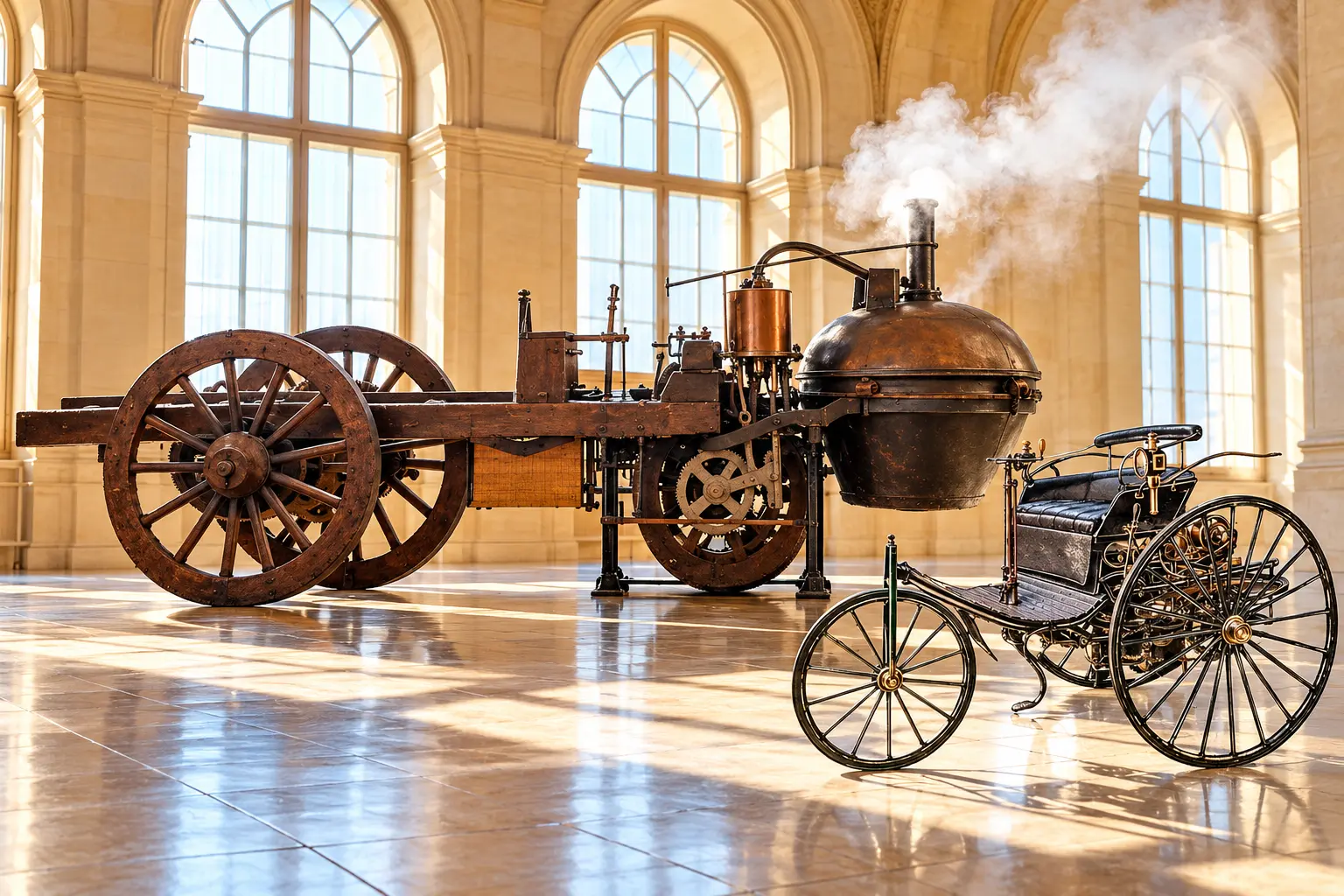
Cugnot’s Fardier, the First Self-Propelled Vehicle
If your test is the first full-size machine that moved on a road without a horse, the search ends in Paris. You can stand in front of the fardier the Paris museum holds, which the Musée des Arts et Métiers dates to 1770 to 1771.
The museum’s own account starts one step earlier. In 1769 the military engineer Nicolas-Joseph Cugnot built the first vehicle able to move without animal traction, a small prototype whose trials justified a second, larger dray. Mercedes-Benz Group dates that first steam cart to 1769 and gives its weight as 4,000 kg, the same mass the museum records for the surviving machine.
The preserved fardier measures 215 by 725 by 225 centimetres. Its materials are wood, copper, iron, cast iron and brass. A steam boiler feeds two cylinders set on either side of a single driving wheel, and a ratchet wheel turns the push of the pistons into rotation. The same ratchet allows reverse, a trick borrowed from clockwork.
The second machine was meant to carry 5 tonnes at 4 km/h, which would have made it an artillery tractor rather than a private carriage. The army wanted cannon moved without a team of horses. The project was abandoned in 1771, and the marquis de Saint-Auban was still scolding the idea in a 1779 letter, calling it a mania for novelty.
Steam Carriages Built for Passengers
Once a boiler could move itself, the next builders tried to move people. Three British machines mark that turn, and only one of them is still a working vehicle you can visit.
Richard Trevithick’s London Steam Carriage
Richard Trevithick’s London Steam Carriage of 1803 is the vehicle counted as the first self-propelled machine built to carry passengers rather than guns. He had already driven an experimental carriage, nicknamed the Puffing Devil, up a hill in Camborne, Cornwall, in 1801.
The London carriage did run on the city’s streets, and then the machine itself was lost. What you can still study is the paper, not the wood and iron.
- What ran: A passenger steam carriage in London in 1803, after the Camborne trial of 1801.
- What remains: The patent drawings, because the carriage was destroyed in a fire.
Trevithick proved that high-pressure steam could haul people on a road. He did not leave a car behind, which is why his name drops off lists that only count survivors.
Walter Hancock and the Enterprise Omnibus
Walter Hancock’s Enterprise, built around 1832, is the steam carriage that turned the idea into a paid ride. Regular service for the London and Paddington Steam Carriage Company began in 1833, running between London Wall and Paddington by way of Islington.
- The driver: Sat at the front and steered with a wheel, unusual when most early vehicles used a tiller.
- The boiler hand: Watched the water level and selected reverse when the road called for it.
- The fireman: Stood on the rear platform, kept the fire in and worked the brake.
Three people had to cooperate to keep one omnibus moving, and nobody recorded how they signalled each other over the noise. That crew is the reason a steam bus could earn fares and still fail as a private car. You could not keep a stoker on the household staff for a trip to the shops.
The Grenville Steam Carriage in Beaulieu
The Grenville steam carriage kept at Beaulieu is the survivor that changes the running-car argument. The National Motor Museum dates it to 1875, credits Robert Neville Grenville as the maker, and records help from his friend, the railway engineer George Jackson Churchward.
The chassis is steel. A vertical water-tube boiler, lagged in mahogany and of the type then used on fire engines, supplies two cylinders with side valves. The original engine was a single cylinder and was replaced by the two-cylinder unit after the first trials. The museum puts its pace at around 15 to 18 mph.
It was never sold. The key facts on the museum page list the price new as not marketed, and the National Motor Museum Trust is the owner. The museum believes this is the oldest self-propelled passenger-carrying road vehicle still in working order, which is a narrower claim than oldest car and a stronger one than a machine that only survives on paper.
What Does Guinness Call the Oldest Car in the World?
Guinness World Records answers with a different car. La Marquise is the vehicle in the Guinness record for the oldest functioning car, a steam-powered four-wheeled four-seater built in France in 1884 by De Dion Bouton et Trépardoux.
The record page says that three years later the car won what Guinness calls the world’s first automobile race, covering 30.5 km, or 19 miles, from Paris to Neuilly. The average on that run is given as 42 km/h, or 26 mph. Other accounts of the 1887 outing add a flat fact Guinness does not stress: La Marquise was the only car that turned up, so the race was an exhibition with a field of one.
The same record page is specific about how you operate it. Coal, wood and paper feed the fire, the boiler needs about 30 minutes to warm up, and the top speed is 61 km/h, or 38 mph.
On 19 August 2007 Gooding & Co sold La Marquise at Pebble Beach for $3,520,000, which Guinness also prints as £1,767,000, buyer’s premium included. The record is tied to that functioning car, not to the oldest design. Beaulieu’s Grenville is older and is also said to run, so the two institutions are using two tests. Guinness wants the oldest functioning car on its record. The National Motor Museum wants the oldest self-propelled passenger vehicle still in working order.
The Benz Patent-Motorwagen of 1885 and 1886
Carl Benz took a different route from the steam builders. His first stationary gasoline engine, a one-cylinder two-stroke, ran for the first time on New Year’s Eve 1879. Sales of that stationary engine gave him time to chase a light vehicle in which the frame and the engine were one design, not a coach with an engine dropped in.
The two-seater he finished in 1885 carried a compact high-speed single-cylinder four-stroke engine lying flat at the rear, a tubular steel frame, a differential and three wire-spoked wheels. Mercedes-Benz Group rates that engine at 0.75 hp (0.55 kW). An automatic intake slide, a controlled exhaust valve, a high-voltage vibrator ignition with a spark plug, and water cooling by thermosiphon were part of the same package.
On 29 January 1886 he applied for a patent on a vehicle powered by a gas engine. The document Mercedes-Benz treats as the birth certificate of the automobile is the patent Carl Benz filed in 1886, number 37435. The German patent office granted it on 2 November 1886, and the specification now sits on UNESCO’s Memory of the World register. In July 1886 newspapers reported the first public outing of model no. 1 in Mannheim.
About 25 of the three-wheelers were built from 1886 to 1893. That is a workshop run, not a factory flood, and it is why a reconstructed or preserved example is a museum piece rather than something a family kept in a shed.
In August 1888 Bertha Benz took an improved car and, without telling her husband, drove with their sons Eugen, then 15, and Richard, then 14. The road ran from Mannheim to Pforzheim, her birthplace, with detours. Mercedes-Benz Group puts that journey, including the return, at 180 kilometres. The trip showed that the motorwagen could do a real errand, and the firm later grew on the back of that proof.
A Deutsche Welle travel film follows the three-wheeler from the Mercedes-Benz Museum through Mannheim and Ladenburg and out along the road Bertha drove.
A Benz motorwagen went to the Deutsches Museum in Munich on 13 March 1906 and is shown in the transport centre on Theresienhöhe. London’s Science Museum, in South Kensington, holds an early Benz three-wheeler as well. If you want the petrol car you have read about, those two rooms are the places to start, and you should expect a three-wheeler with a tiller rather than a steering wheel.
Daimler’s Carriage and the Petrol Cars After It
The same year, about 100 kilometres away in Stuttgart, Gottlieb Daimler and Wilhelm Maybach presented a motor carriage. Mercedes-Benz Group calls it the world’s first four-wheeled automobile. It was a light coach with a more powerful version of their grandfather-clock engine fitted into it, not a chassis drawn from a blank sheet. Benz and Daimler never met.
That coach is easy to over-rank. Because the body was bought as a horse carriage and then motorised, later counts often refuse it the word automobile and save that word for a vehicle designed as one. Benz had chosen three wheels for a practical reason: a safe way to steer a four-wheeler was not in hand yet.
Siegfried Marcus, working in Vienna, is the name that scrambles old lists. In 1870 he put an atmospheric engine on a handcart and used the engine’s two flywheels as the rear wheels. His second vehicle, with a four-stroke petrol engine, a surface carburettor and electric ignition, belongs to 1888 or 1889.
For years that second Marcus car was dated to 1875, which placed it ahead of Benz. Mercedes-Benz Group notes that the 1875 date was not disproved until 1968. Books and posters printed before that correction are why some family stories still name Marcus as the man who beat Mannheim.
Daimler and Maybach’s Stahlradwagen of 1889 was their first car that was not a converted coach. They showed it at the Paris exhibition in October 1889, failed to build it in series at home, and founded Daimler-Motoren-Gesellschaft the next year. Their first car sale came in 1892. French makers licensed the idea, which is how Panhard et Levassor and Peugeot enter the early-car lists a few years after the German prototypes.
Benz met the steering problem in 1893 with the Victoria, the first of his cars to use the double-pivot steering he patented that year. The Benz Velo, put on the market in 1894, was the model that became a commercial success. If the question is the first petrol car you could treat as a catalogued product rather than a pioneer’s own machine, the Velo is the Benz to name, and the three-wheeler remains the one with the 1886 patent.
Frequently Asked Questions
Is the Ford Model T the Oldest Car in the World?
No. The Model T is the petrol car that sold in very large numbers, not the first car. The Curved Dash Oldsmobile was already being built on a mass-production line in 1901, and Ford’s own first production car was the 1903 Model A.
How Much Did a Benz Patent-Motorwagen Cost?
The series Patent-Motorwagen No. 3 was offered for 3,000 gold marks. Benz kept improving the car while it was on sale, so two examples from that run need not match each other part for part.
Are the Oldest Car Companies the Same as the Oldest Cars?
No. A company can be decades older than any motor vehicle it sold, because many firms began with steel, tools or horse carriages and only later built a car. When you want the oldest car, ask for a machine and a year, not a brand birthday.
Which Early Steam Carriage Was Never Sold?
The Grenville steam carriage was not marketed. Robert Neville Grenville and George Jackson Churchward built the one machine, and that single carriage is the vehicle at Beaulieu. La Marquise was a commissioned steamer for Count de Dion, not a model you could order from a catalog either.
Where Did Bertha Benz Find Fuel on the Journey?
On the way to Pforzheim she bought ligroin, the light petroleum spirit the engine burned, at a pharmacy in Wiesloch. The stop was a supply problem on a car with a small tank, and it is one reason the route is still marked as a drive rather than only as a story.
The fardier entered the national collection in Paris in 1799, years after the army had dropped it, and that iron and timber wagon is still the object that starts the line. The petrol three-wheeler patented in 1886 is the one that left a price, a buyer and a firm.


Kering’s Growing Houses Cannot Outrun a Shrinking Gucci

Studio Staff and Bitcoin Buyers Built the Eminem Leak Case

A Mutated H1N1 Strain Is Hitting Younger Immunity First

Albert Heijn Returns at One-Third as Rivals Take Share

Art Basel Paris Ends After One Public Day

Thameslink Will Pad 60,000 Ironing-Board Seats From 2027

How Tall Was Adolf Hitler?

U.S. Forces Clear Hormuz Mines, Then Hit Minelayers Again

Micron Sells the Memory Shortage as Five-Year Contracts

Royal Caribbean Sends Los Angeles Ships to Singapore and Brisbane
-
 NEWS2 months ago
Thameslink Will Pad 60,000 Ironing-Board Seats From 2027
-
 HISTORY3 years ago
How Tall Was Adolf Hitler?
-
 BUSINESS3 months ago
U.S. Forces Clear Hormuz Mines, Then Hit Minelayers Again
-
 NEWS3 months ago
Micron Sells the Memory Shortage as Five-Year Contracts
-
 NEWS2 months ago
Royal Caribbean Sends Los Angeles Ships to Singapore and Brisbane
-

 NEWS2 months ago
Twenty Controllers Closed Norwich Airport for a Bank Holiday
-

 BUSINESS2 months ago
Sweetmore Bakeries Buys Fantasy Baking for Bar Work
-

 BUSINESS2 months ago
L Catterton Installs a Kraft Heinz Operator at Kettle Cuisine