
LIFESTYLE
Indian Picnic Food Ideas: Five Recipes That Travel
Indian picnic food ideas built for the ride: methi thepla, lemon rice, samosas, chickpea chaat, and chicken tikka, with a clear rule for what has to stay cold.

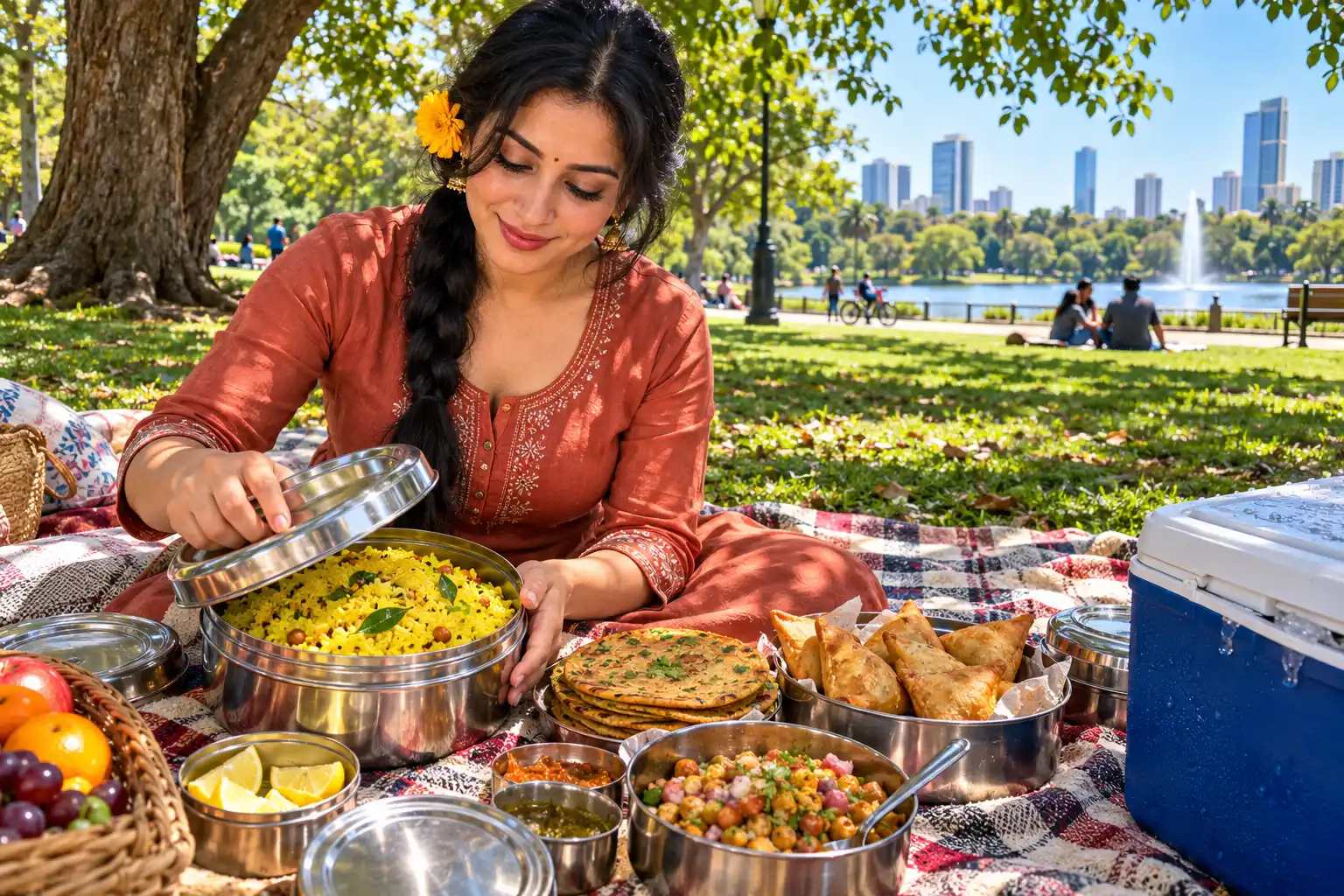
You are standing in the kitchen with a basket, a stack of boxes, and a park plan, and the curry you love at the table is the wrong thing to drop in. Indian picnic food ideas are the dishes that still taste like themselves after a car ride and an hour on a blanket: dry flatbreads, tangy rice, a crisp pastry, a chaat you mix on the spot, and grilled meat that never leaves the cold.
The five that earn a place are methi thepla, lemon rice, potato samosas, chickpea chaat, and chicken tikka. Dry and tangy foods keep their texture. Meat, yogurt, fresh cheese, and herb chutney only stay pleasant if they stay cold. This page gives you those five recipes, a way to sort the other dishes people pack, and the time limit that decides what you throw out.
What Makes a Dish Picnic Food?
A picnic dish has to do three jobs at once. You eat it with your hands or a spoon, it still tastes right when it is no longer hot, and it does not soak the box on the way. Gravy fails all three. A dry, spiced flatbread, a rice tossed in a hot oil tempering, and a fried pastry pass them.
Salt, oil, lemon, and tamarind are why so many Indian journey foods taste bright without a stove. They do not cancel the clock on cooked food. A flatbread mixed with yogurt or buttermilk, a pot of rice, and anything with chicken still count as perishable once they leave the fridge.
Picture a leave time of 11 and a meal at 1. That gap is two hours, so the cold dishes ride in a cooler the whole way. The clock for food on the blanket starts when you take the lid off, not when you left the house.
Which Indian Dishes Belong in the Cooler?
Sort the basket before you cook. The left column is the dish people actually pack. The middle column is how it rides. The right column is the limit that matters more than how good it tasted at home.
| Dish | How to pack it | The limit |
|---|---|---|
| Methi thepla | Cool, then foil | Buttermilk in the dough, so a hot day means the cooler |
| Aloo paratha or a kathi roll | Foil, chutney in its own cup | Moist potato filling, so eat it the same day |
| Lemon rice or tamarind rice | Airtight box, rice cooled first | Cooked rice follows the time window below |
| Samosa, kachori, or pakora | One layer, after the crust cools | A closed box on hot fritters turns them soft |
| Chickpea chaat or bhel | Parts separate, mix at the blanket | Cut onion, tomato, and fresh chutney stay cold |
| Chicken tikka or seekh kebab | Fridge until you leave, then the cooler | Poultry and ground meat stay at 40°F or below |
| Curd rice, raita, paneer, coconut chutney | Cooler only | Yogurt, fresh cheese, and moist chutney |
| Pickle, mathri, crackers | With the blanket gear | These match foods that do not need a cold source |
The cold line and the hot line are a pair. Food sitting between 40°F and 140°F (4.4°C to 60°C) is in the band where bacteria grow fast. Keep the cooler in the passenger seat, not a hot trunk, and keep drinks in a second cooler so the food lid stays shut.
Slide in at least two frozen gel packs, each one no smaller than 5 by 3 inches, one above the food and one below. Pack only what you will finish. Perishable leftovers from a bag lunch get thrown out, not saved for the ride home.
The potluck rules for perishable food give that food 2 hours in the warm band, then you discard it. On a day above 90°F (32.2°C), the same rules cut the window to 1 hour. Whole fruit, crackers, peanut butter, and pickles are the items those rules leave off the ice.
Five Indian Picnic Food Ideas
Methi Thepla With Fenugreek and Oil
Methi thepla is the Gujarati flatbread people carry on trains and day trips because the fenugreek and spices are in the dough, so you do not need a wet side to make it taste finished. One home recipe built for travel keeps the cooked flatbreads at room temperature for a couple of days, and the writer notes she had not tested longer than that. Treat that as a texture note. On a hot afternoon the buttermilk still puts them in the cooler.
THEPLA FOR TWELVE
- The dough: 1.5 cups wheat flour, 3/4 cup fresh methi leaves, 1 teaspoon red chilli powder, 1/2 teaspoon coriander powder, 1/4 teaspoon turmeric, 3/4 teaspoon garam masala, 1 teaspoon cumin seeds, salt, and 2 tablespoons oil.
- The liquid: Buttermilk as needed, made by whisking plain yogurt with water, or warm water if you skip dairy.
- A longer-keeping dough: Up to 3 tablespoons of oil in the dough, and an optional 1/4 cup of besan if you reduce the wheat flour to match.
Strip the methi off the stems, wash it, and chop it. Saute the wet leaves in a little oil until they shrink, which takes the edge off the bitterness. Mix the leaves with the flour, spices, salt, and oil, then add buttermilk until the dough feels like chapati dough. Roll it at once into thin rounds. You do not need a rest.
- Cook: Heat a tava, oil it lightly, and toast each side the way you toast a chapati, about 20 minutes of cooking after 15 minutes of prep.
- Cool: Spread the theplas in one layer until the steam is gone, then stack them with a square of paper between each one and wrap the stack in foil.
- Hold the dough: Wrapped dough keeps in the fridge for 2 to 3 days if you would rather roll it in the morning.
Pickle is the right partner, because an oil pickle can sit outside the ice. Curd and boondi raita taste right with thepla and belong in the cooler with the gel packs.
Lemon Rice Cooled Before the Box
Lemon rice is the South Indian box that does not spill. Mustard, peanuts, curry leaf, and lemon cling to the grains, so you are not chasing a sauce across a plate. Tamarind rice, packed the same way and often wrapped in a banana leaf, is the tangier cousin. Both are still cooked rice, so both follow the two-hour window once they are out of the cold.
LEMON RICE FOR TWO
- The rice: 2 cups freshly cooked plain rice, or leftover rice, spread out so it cools and the grains stay separate.
- The tempering: 2 tablespoons oil, 2 tablespoons peanuts, 1.5 teaspoons mustard seeds, 1 teaspoon urad dal and 1 teaspoon chana dal each soaked 20 minutes, 3 slit green chillies, and 7 or 8 curry leaves.
- The finish: 1 teaspoon turmeric, 1 teaspoon salt, a pinch of hing, and 2 to 3 teaspoons lemon juice.
Fry the peanuts in the oil for 5 minutes and lift them out. Let the mustard crackle, add the drained dals for a few seconds, then the chillies and curry leaves until they change color. Stir in turmeric and salt for a minute, add the hing, and fold in the rice without mashing it. Return the peanuts, add the lemon juice, cover, and leave the pan on low heat for 2 minutes. For four people, cook a second batch rather than crowding the pan. Cool the rice before it goes into a leakproof box, and pack a dry podi or a pickle beside it instead of curd.
Potato Samosas With the Chutney Aside
A samosa is a South Asian filled pastry, fried or baked, traditionally a triangle, with a filling that runs from potato with ginger and garlic to cauliflower, spiced lamb, minced fish, or chicken. In South Asia it is often eaten with fresh mint or coriander chutney. That chutney is what wrecks a picnic samosa if it shares the box. The pastry wants to stay dry. The chutney rides in a jar.
This batch makes 10, with 30 minutes of prep and 25 minutes of cooking. For the dough, rub 2 cups (250 grams) all-purpose flour with 1/4 cup (60 ml) oil or melted ghee, then add 3/4 teaspoon ajwain, 3/4 teaspoon salt, and 6 tablespoons (90 ml) water. Knead a stiff dough and keep it covered while the filling cools. For the filling, boil 4 medium potatoes (500 grams) until they are fork tender, and boil 1/2 cup of peas with them. Crumble the potatoes. Do not mash them into a paste.
- Season: Heat 1 tablespoon oil, add 3/4 teaspoon cumin seeds, then 1 tablespoon minced ginger and 1 or 2 chopped green chillies. Stir in 3/4 teaspoon red chilli powder, 1/2 teaspoon cumin powder, and 3/4 to 1 teaspoon garam masala.
- Finish the filling: Fold in the potatoes and peas with 1/2 teaspoon salt, 1 teaspoon lemon juice, and 4 tablespoons chopped coriander. A pinch of hing is optional. Spread the filling out until it is cool.
- Shape and fry: Divide the dough, roll it, cut rounds in half, and form each half into a cone. Fill, seal the edge with a dab of water, and fry in oil deep enough to cover the samosas until the crust is a deep gold. Cool them on a rack in one layer before they go into a box.
Hot filling sealed inside raw dough, or hot samosas sealed in a box, leaves you with a soft crust. Baked samosas are a real version of the same pastry. They follow the same cooling step, and they dry out faster, so eat them the day you bake them.
Chickpea Chaat Mixed on the Blanket
Chickpea chaat is the no-stove plate. This version serves 4 and takes about 15 minutes once the chickpeas are boiled. A US cup here is 240 ml. You need 1 3/4 cups boiled chickpeas (one 15 ounce can, drained), 2/3 cup boiled potato cubes, 1/3 cup chopped red onion, 1/3 cup chopped tomato, 1 chopped green chilli, and 2 tablespoons chopped coriander.
MIX AT THE BLANKET
- The spices: 1/2 teaspoon black salt, 3/4 teaspoon salt, 1 teaspoon chaat masala, and 1/2 teaspoon red chilli powder, shaken over the chickpeas and potato.
- The wet parts: 2 tablespoons green chutney and 1 tablespoon tamarind chutney, carried in the cooler and stirred in when you sit down.
- The crunch: Nylon sev, in its own bag, scattered on after the mixing so it does not go soft in the car.
Keep the boiled chickpeas and potatoes cold from the night before. Cut the onion and tomato at the park if you can, or keep them in the cooler if you cut them at home. Bhel works the same way: puffed rice, onion, potato, and chutneys travel apart and meet on the plate. Yogurt on either one is a cooler item, and it shortens the time the bowl can sit in the sun.
Chicken Tikka Skewers From a Cooler
Chicken tikka is the meat dish that eats like a snack, as long as it never sits in the warm band. Cube 500 grams of boneless chicken. Stir it with 1/2 cup yogurt, 1 tablespoon ginger-garlic paste, 1 tablespoon lemon juice, 1 teaspoon red chilli powder, 1 teaspoon garam masala, 1 teaspoon cumin powder, 1/2 teaspoon turmeric, and salt to taste.
- Marinate: Coat the cubes and leave them for at least 2 hours. Overnight in the fridge is the easier plan if you are cooking before you leave.
- Grill: Thread the chicken on skewers and cook over medium heat for 10 to 12 minutes, turning so each side colors.
- Chill, then pack: Cool the skewers in the fridge in a shallow box. Move them straight into the cooler when you leave. Do not close a lid on meat that is still hot.
Mint chutney and onion are the usual plate, and both the chutney and the cut onion go in the cooler. Tofu or paneer can take a yogurt marinade in place of the chicken. Paneer is fresh cheese, and the marinade still has yogurt, so that box is a cold box too. Seekh, shammi, and chapli kebabs follow the same rule as the tikka: cooked meat, cold until you eat.
Foods That Go Soggy or Spoil Outside
Butter chicken, paneer tikka masala, and a wet biryani are the dishes that look like a feast and travel like a spill. The gravy soaks the rice, the cream is a cold-food problem, and you end up chasing it with a piece of bread. If you want rice with meat, keep it in the cooler and eat it inside the one-hour or two-hour window, not on a sunny cloth for the whole afternoon.
Curd rice is a real picnic memory in a lot of South Indian families, and it is also yogurt mixed into rice. It belongs in the cooler, next to raita, not in the stack of foil. Dhokla stays pleasant when it is plain. Carry any sweetened tempering apart and pour it on when you serve, or the cake sits in liquid the whole way.
Pakoras, cutlets, and sandwiches go into the box only after they cool. A thin coat of butter on the bread, under the chutney or the vegetables, slows the moisture that makes a sandwich collapse. A kathi roll wants the same split: a dry potato or grilled filling inside the paratha, and the chutney in a cup you open at the park.
Fresh mint, coriander, and coconut chutneys are perishable. An oil pickle, a dry podi, and a jar of mustard can live with the plates. Wash your hands before you pack and again before you eat, and keep the cooler in the shade with the lid down between servings.
Frequently Asked Questions
Can You Cook Indian Picnic Food the Night Before?
Yes for the cooking, and no for the packing. Chill thepla dough, boiled potatoes, chickpeas, lemon rice, and tikka in the fridge overnight, then move the perishable boxes into the cooler right before you leave. Fry the samosas in the morning if you can, so the crust has less time to soften.
What Drink Belongs Next to These Dishes?
Plain water, a bottled drink, or tea from a flask can sit with the blanket gear. Mango lassi, chaas, and buttermilk contain dairy, so they ride in the drink cooler and come out when you eat. A second cooler for drinks keeps you from opening the food cooler every time someone is thirsty.
Which Picnic Dishes Skip the Wheat?
Lemon rice, tamarind rice, and chickpea chaat do not use wheat flour, and chicken tikka does not need a naan beside it. Thepla, samosa pastry, and kathi rolls are wheat dishes. If you are avoiding gluten rather than only wheat bread, check the chaat masala and the hing, because some blends are processed near wheat.
Can You Bake Samosas Instead of Frying Them?
Yes. A samosa can be fried or baked, and a baked crust is simply drier. Cool either kind in one layer before you box it, keep the chutney separate, and eat baked ones the day you make them because the pastry toughens as it sits.
How Should You Pack Mint Chutney?
Put fresh mint or coriander chutney in a small sealed jar inside the cooler, and spoon it on at the blanket. A thin chutney poured over samosas or thepla before you leave the house soaks the crust and the bread. An oil pickle can travel outside the ice if you want a tangy bite that does not need a gel pack.
Foil the thepla once it is cool, box the lemon rice only after the grains stop steaming, give the samosas a rack and a separate jar of chutney, keep the chaat in parts until you sit down, and leave the tikka on ice until the plates are out. Pickle can live in the side pocket. Anything with meat, yogurt, or a fresh herb paste cannot.
Disclaimer: This is an educational cooking guide and it is informational only. It is not personal food-safety, medical, or dietary advice, and it does not replace guidance for your own kitchen. If you are pregnant, cooking for a young child or an older adult, or feeding someone who is already ill, check the plan with a qualified health professional or a food-safety specialist before you rely on it. Temperatures, time limits, and recipe amounts reflect the sources reviewed here and can change.

Kering’s Growing Houses Cannot Outrun a Shrinking Gucci

Studio Staff and Bitcoin Buyers Built the Eminem Leak Case

A Mutated H1N1 Strain Is Hitting Younger Immunity First

Albert Heijn Returns at One-Third as Rivals Take Share

Art Basel Paris Ends After One Public Day

Thameslink Will Pad 60,000 Ironing-Board Seats From 2027

How Tall Was Adolf Hitler?

U.S. Forces Clear Hormuz Mines, Then Hit Minelayers Again

Micron Sells the Memory Shortage as Five-Year Contracts

Royal Caribbean Sends Los Angeles Ships to Singapore and Brisbane
-
 NEWS2 months ago
Thameslink Will Pad 60,000 Ironing-Board Seats From 2027
-
 HISTORY3 years ago
How Tall Was Adolf Hitler?
-
 BUSINESS2 months ago
U.S. Forces Clear Hormuz Mines, Then Hit Minelayers Again
-
 NEWS2 months ago
Micron Sells the Memory Shortage as Five-Year Contracts
-
 NEWS2 months ago
Royal Caribbean Sends Los Angeles Ships to Singapore and Brisbane
-

 BUSINESS2 months ago
L Catterton Installs a Kraft Heinz Operator at Kettle Cuisine
-

 NEWS2 months ago
Twenty Controllers Closed Norwich Airport for a Bank Holiday
-

 BUSINESS2 months ago
Sweetmore Bakeries Buys Fantasy Baking for Bar Work