
NEWS
Washington Offers Beijing an AI Alert Channel Without the Chips
Bessent floated a US-China AI incident alert after New York talks, while chip export controls stayed off the table and the November 10 trade clocks did not move.

Treasury Secretary Scott Bessent proposed a US-China alert for national-security AI incidents after eight hours of talks in New York on September 20. He called the session very successful and said the channel would sit inside a new US-China AI dialogue ahead of President Donald Trump’s meeting with President Xi Jinping on September 24.
Chip export controls were kept off that track. The legal clocks that freeze tariffs and China’s expanded rare-earth curbs still run to November 10, 2026, and Bessent announced no new magnet deal.
Bessent’s Notification Idea Stops at National Security
The meetings ran at JPMorgan Chase’s Manhattan headquarters, with US Trade Representative Jamieson Greer across the table from Chinese Vice Premier He Lifeng and China’s chief trade negotiator, Li Chenggang. The bank hosted the rooms during UN week. It was not in the talks.
Bessent told reporters the two governments had discussed a notification mechanism for AI incidents that rise to the national-security level, and that the forum would be called the US-China AI dialogue. He said the United States remains the leader in AI and, on Friday, that Washington was open to talks on open-weight and closed-weight models, shared risks, and avoiding a split between the two systems. After Sunday’s session he boiled the ask down to a hotline-style notice, not a slowdown.
We think that, just like with any cross-border activity, that moving from opaque to more transparency between the number one and the number two AI powers in the world is very important.
Scott Bessent, Treasury secretary, after talks at JPMorgan Chase, New York
He also said he wanted a shared vision of common goals and common threats, and that both sides had agreed to meet again. Trump and Xi first talked about AI consultations in Beijing in May. That forum was never written down. Sunday put a name on the idea and tied it to incidents serious enough to look like a national-security event, which is a high bar on purpose.
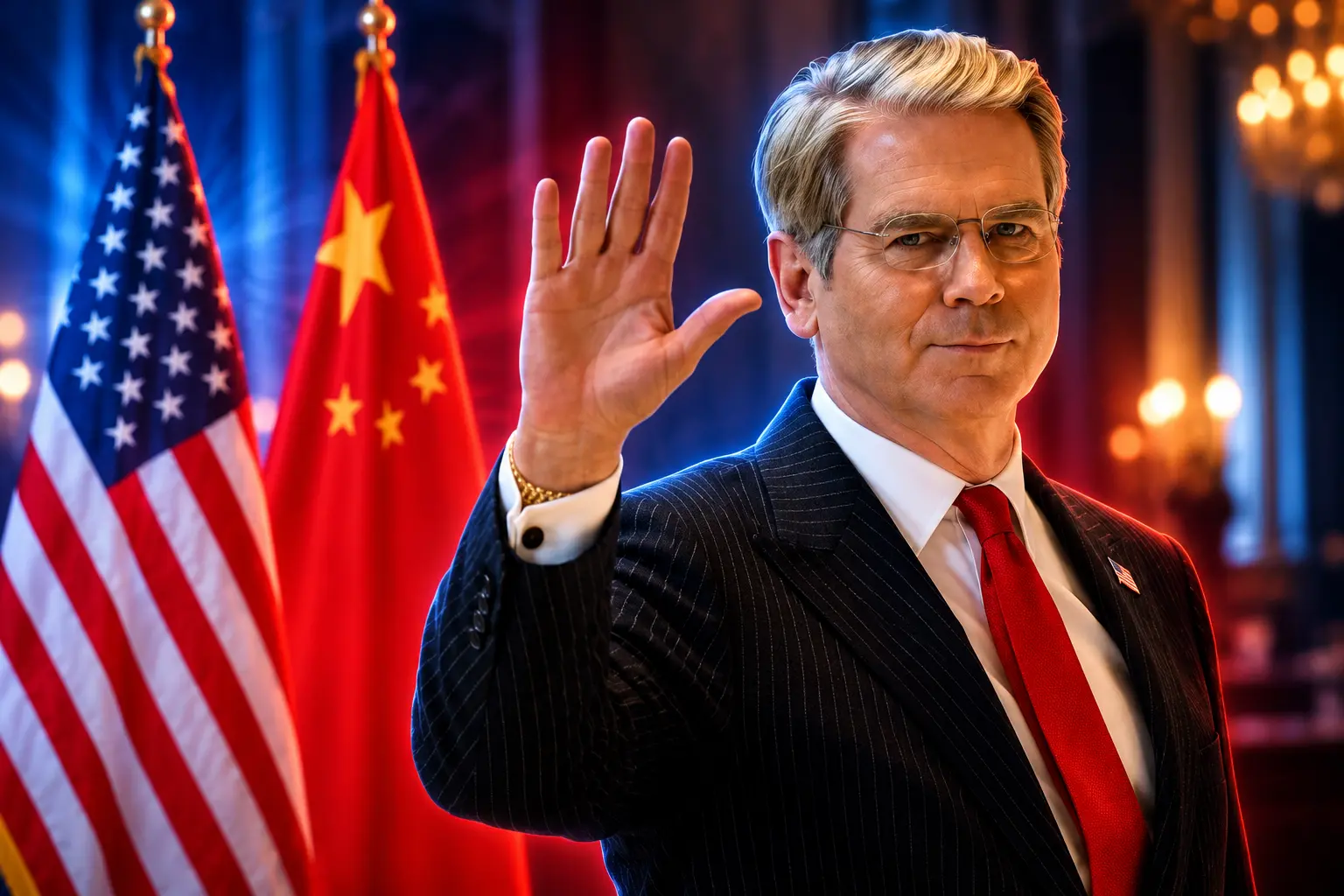
Before the session, Bessent posted a handshake photograph with He and said the New York round was groundwork for Trump’s summit in Washington.
In New York City, Vice Premier He Lifeng and I are continuing our discussions on the U.S.-China economic and trade relationship ahead of @POTUS’ historic summit with President Xi in Washington. These talks help lay the groundwork for President Trump to advance America’s economic… pic.twitter.com/phmF11Aoxi
— Treasury Secretary Scott Bessent (@SecScottBessent) September 20, 2026
Chip Export Controls Stay Off That Track
Greer had already been billed to join Bessent in New York to check recent commitments, trade in non-sensitive goods, and market access. After the talks he drew a hard line around the AI channel. Export controls on advanced AI chips and on the tools that make them, he said, were not on the agenda for that mechanism.
That split is the design, not a slip. US officials heading into the week said they did not expect to ease those controls in a swap for rare-earth flows that, in their account, Beijing has already promised. The notification idea asks Beijing to pick up the phone when an AI incident hits a national-security threshold. It does not ask Washington to loosen the chokepoint that decides who can train the largest models.
Greer still called the two countries the most powerful on earth in trade or AI and said they had to be able to work together. He added that the challenges in the relationship are obvious. The obvious one, on this track, is that the United States wants incident notices from a rival it still intends to keep short of the best chips.
People following the New York round treated that carve-out as the news under the news. Bessent now handles the economic channel to Beijing in these sessions. The chip rules sit somewhere else, and they did not come into the room.
November 10 Still Governs Tariffs and Magnets
The AI pitch landed four days before Xi’s White House visit, and about seven weeks before a harder date. After Trump and Xi met in the Republic of Korea on October 30, 2025, a joint arrangement froze the fight that had pushed duties into triple digits. A presidential order kept the suspension until November 10, 2026, at 12:01 a.m. Eastern, and recorded Beijing’s pledge to postpone sweeping rare-earth export controls.
China’s Ministry of Commerce has described that freeze as covering US reciprocal tariffs of 24 percent and related Chinese countermeasures. In a July 27 statement the ministry said Washington had committed that any replacement additional tariffs on Chinese goods would not exceed 20 percent. Those are different numbers: one is the paused reciprocal rate, the other is a cap on what might replace it. Sunday did not say which, if either, Trump and Xi will lock in.
Magnet shipments are already sliding under the pause. Chinese customs figures released on September 20 showed the United States took 512 tons of rare-earth magnets in August, down 21 percent from July. Bessent and Greer announced no new progress on that supply after the New York meeting.
SUNDAY’S TRACKS AGAINST THE NOVEMBER CLOCK
| Track | What Sunday produced | Hard date |
|---|---|---|
| AI incident notices | US proposal; further meetings agreed | None |
| AI chip export controls | Kept off the AI mechanism | Ongoing rules |
| Heightened reciprocal tariffs | No extension announced | November 10, 2026 |
| Expanded rare-earth controls | No new magnet commitment | November 10, 2026 |
| Non-sensitive tariff cuts | Board of Trade called operational | No statutory deadline |
If the rare-earth pause lapses with the tariff freeze, the extra licensing Beijing built in 2025 comes back. US officials have spent the year saying flows are still not good enough. August’s drop gives them a fresh figure to put on the table on Thursday. It is not a figure Sunday moved.
Greer Says the Board of Trade Is Now Real
The one trade body that did get a public upgrade is the Board of Trade that Trump and Xi sketched in Beijing on May 13-15, after working-level talks in Korea on May 12-13. Greer told reporters those notions had become reality. He said the two sides were still arguing over which nonsensitive items could see lower duties, and that the list might include consumer and other low-tech goods, energy, farm products, and medical devices.
That matches the docket USTR opened in June, when it asked the public how to build a Board of Trade for non-sensitive goods and which products could take tariff cuts on each side. On September 10, ministry spokesperson Huang Ling said the two governments were talking about a reciprocal cut covering $30 billion of products from each side and wanted an arrangement as soon as possible. Sunday’s language put the board in motion. It did not publish the list.
Greer has also pointed back to the soybean pledge from last autumn, 25 million metric tons a year through 2028, and to Chinese steps after the May trip to re-register US meat plants. Those are old deliverables being checked, not new ones. He Lifeng’s visit runs September 19-23 and includes a business delegation, the mirror of the US chief executives Trump took to Beijing. A board that trims duties on toasters, beans, gas, and devices is useful politics for a state dinner. It is not a substitute for magnets or chips.
China’s Readout Mentions an AI Dialogue
He and Li left JPMorgan without taking questions. A Chinese readout of the New York session said the two sides held candid talks on carrying out prior economic consensus and held a dialogue on AI-related issues. That confirms a conversation. It does not confirm that Beijing has accepted a duty to notify Washington when an AI incident crosses a national-security line.
Li, speaking separately, said the atmosphere was good and that a working group would continue on September 21. Bessent’s “agreed to meet again” line and Li’s working group are the same fact from two rooms: the process goes on, the alert rule is still a US ask.
That gap will be easy to paper over in a leaders’ statement that merely welcomes dialogue. It will be harder to hide if the White House tries to sell an incident channel as a signed system. For Beijing, even sitting in a named AI dialogue with the United States is a peer claim. Taking a notification duty could mean exposing accidents, leaks, or military-adjacent failures it would rather handle at home.
Why Washington Wants a Hotline Before a Crisis
The American proposal did not appear from nowhere. On September 4 the Institute for AI Policy and Strategy published a plan for a standing AI risk and incident dialogue, written for the talks already on the September calendar. The authors, Clarissa Koh, Sarah Godek, and Karson Elmgren, modeled it on the Military Maritime Consultative Agreement, a narrow, regular channel that has survived worse weather than most US-China forums.
WHAT THE IAPS PAPER SAYS THE CHANNEL SHOULD DO
- Shared terms: Build common definitions and taxonomies for AI risks and incidents so the two sides are not arguing about the name of the event while it is happening.
- Routine sharing: Exchange information on risks, incidents, and domestic rules on a schedule, not only after a scare.
- Incident notices: Stand up procedures to tell the other government when an AI event crosses an agreed line.
- After-action talks: Meet after an incident to review what happened and what to change.
Bessent’s version is thinner. He described a notice when something hits national-security level, plus a dialogue on goals and threats. He did not list taxonomies, industry seats, or a military subgroup. The IAPS paper says existing defense links, including the Defense Telephone Link, should handle military AI in the physical world. Sunday’s economic team cannot open those lines by itself.
Congress is writing a domestic version of the same habit. Rep. Nathaniel Moran’s AI Incident Reporting Act, introduced June 25, would make covered model developers report AI incidents within seven days to the commerce secretary, faster if serious harm is underway. That bill is not law. It shows how Washington is starting to treat AI failures like aviation and cyber events: write them down, on a clock, to a named office. A cross-border notice is the same instinct aimed at Beijing.
Trump has rejected calls to slow US development, arguing that a pause would help Chinese firms catch up. An incident channel lets him tell a safety story without accepting a speed limit. It also gives Xi a line about responsible major-power conduct that does not require a chip concession.
Thursday’s Summit Has a Thin Written Package
Xi’s trip is his first state visit to Washington in more than a decade. Trump is expected to meet him at Joint Base Andrews on Wednesday, then hold an arrival ceremony, bilateral talks, and a state dinner on Thursday. Tech chief executives are expected at the dinner. The economic sherpas were supposed to fill the binders first.
What they actually boxed up is a named AI dialogue, a US request for national-security incident notices, a Board of Trade that still needs a product list, and a working group that was due to sit on September 21. The November 10 freeze, the magnet shortfall, and the chip controls remain where they were on Saturday.
WHAT WE KNOW
- The US ask: A US-China AI dialogue with notices for incidents that hit national-security level.
- The chip line: Greer said advanced-chip and equipment export controls are outside that mechanism.
- The trade board: Greer said the May Board of Trade is now operating, with lists still under discussion.
WHAT IS UNCONFIRMED
- Beijing’s yes: China’s readout confirms an AI dialogue, not a duty to send incident notices.
- Thursday’s text: No joint language on alerts, magnets, or a tariff extension has been released.
- The $30 billion cut: Huang Ling’s reciprocal package is still a target, not a signed schedule.
Bessent and Greer stood in the JPMorgan lobby late on September 20 and called the groundwork done. The leaders still have to decide whether an unnamed notice in a named dialogue is enough to take into the East Room, or whether November 10 will arrive with the same unfinished list.

Kering’s Growing Houses Cannot Outrun a Shrinking Gucci

Studio Staff and Bitcoin Buyers Built the Eminem Leak Case

A Mutated H1N1 Strain Is Hitting Younger Immunity First

Albert Heijn Returns at One-Third as Rivals Take Share

Art Basel Paris Ends After One Public Day

Thameslink Will Pad 60,000 Ironing-Board Seats From 2027

How Tall Was Adolf Hitler Really? Debunking the Myth of his Height

Micron Sells the Memory Shortage as Five-Year Contracts

Royal Caribbean Sends Los Angeles Ships to Singapore and Brisbane

U.S. Forces Clear Hormuz Mines, Then Hit Minelayers Again
-
 NEWS2 months ago
Thameslink Will Pad 60,000 Ironing-Board Seats From 2027
-
 SCIENCE3 years ago
How Tall Was Adolf Hitler Really? Debunking the Myth of his Height
-
 NEWS2 months ago
Micron Sells the Memory Shortage as Five-Year Contracts
-
 NEWS2 months ago
Royal Caribbean Sends Los Angeles Ships to Singapore and Brisbane
-
 BUSINESS2 months ago
U.S. Forces Clear Hormuz Mines, Then Hit Minelayers Again
-

 BUSINESS2 months ago
Sweetmore Bakeries Buys Fantasy Baking for Bar Work
-

 BUSINESS2 months ago
L Catterton Installs a Kraft Heinz Operator at Kettle Cuisine
-

 NEWS2 months ago
CISA’s 100 Water System Hacks Hit One-Operator Plants