HISTORY
How Tall Was Adolf Hitler?
How tall was Adolf Hitler? The 1924 Landsberg form lists 175 cm, doctors later said 175 to 177 cm, and taller guards explain the short look.

How tall was Adolf Hitler is a file question, and the files that name a number sit close together. Cartoons and trivia cards still draw a tiny man. The notes with a date, a place, and a doctor’s hand land in a narrow band instead.
Three records do the useful work: the prison form from the fortress sentence after the failed Munich coup, the heights his doctors gave US interviewers near the end of the war, and a wartime US bulletin on the minimum for his bodyguard. You also get the feet and inches split, a way to test a photograph, and a short account of the man those files describe.
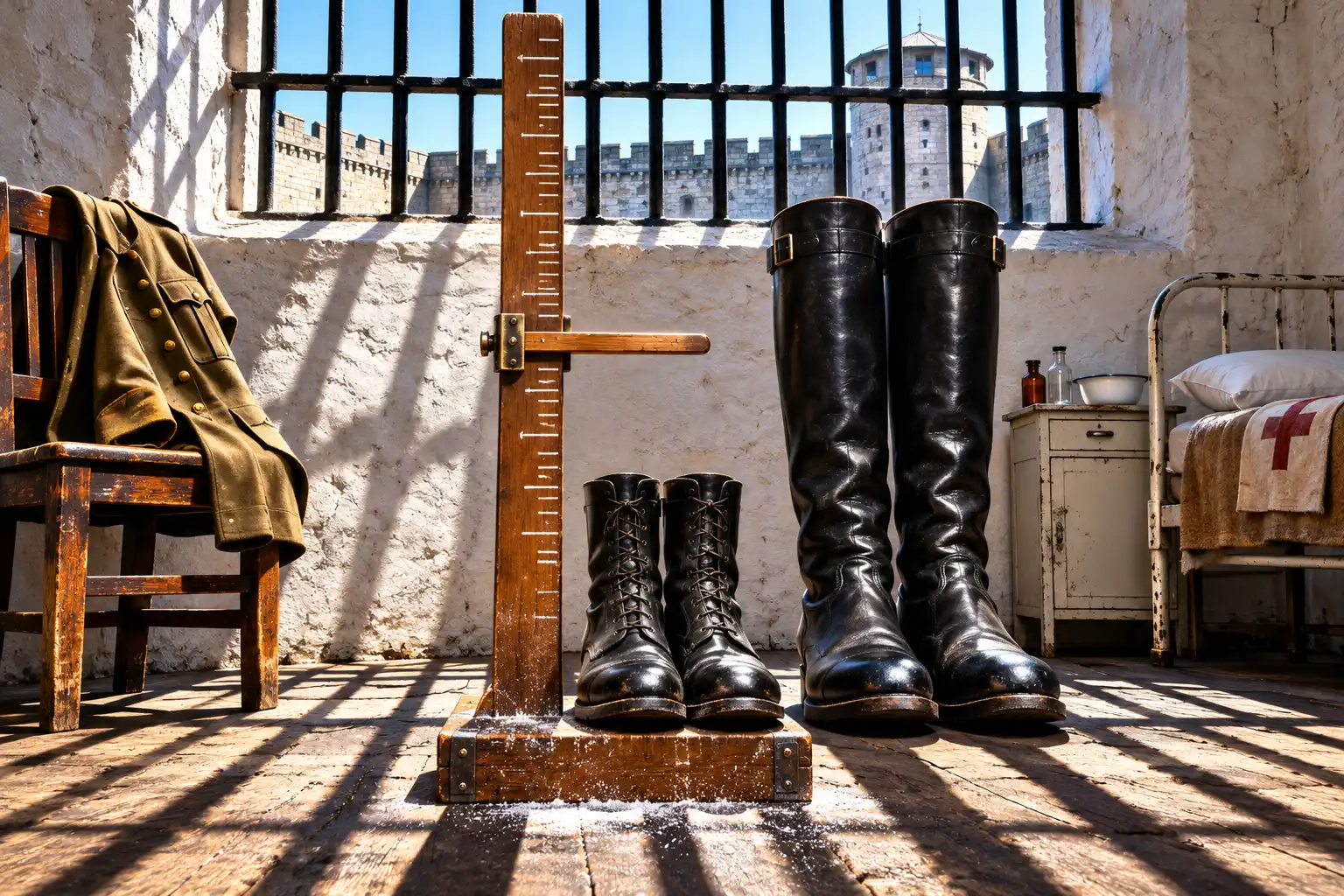
What Does the Landsberg Form Say About His Height?
On November 9, 1923, Hitler and other Nazi leaders tried to overthrow the Bavarian government in the Beer Hall Putsch. The coup collapsed, a Munich court convicted him of high treason, and the court gave him a light sentence for that crime. He then entered fortress detention at Landsberg am Lech.
The admission order is dated April 1, 1924. With that paperwork is a general practitioner’s report on the prisoner Adolf Hitler, signed by the prison physician, Dr. Brinsteiner. He was 34 that spring, because his birthday fell later in April.
THE APRIL 1924 PRISON FORM
- The admission: April 1, 1924, fortress detention for high treason, filed as Land Registry No. 21.
- The term: Five years, with four months and two weeks of earlier detention credited toward the sentence.
- The height: The physician’s report lists 175 cm.
- The weight: The same report lists 77 kg.
- The condition: English readings of the form call him healthy and of average or moderate build.
- The signature: Dr. Brinsteiner, the prison physician, with fitness for work marked and solitary confinement marked as suitable.
That 175 cm line is the measurement to cite when someone asks for one height with a date on it. Published readings of the same intake agree on the centimeters and on the 77 kg. They do not agree word for word on the build line, which is why that line is safer as “healthy, ordinary build” than as one frozen English adjective.
The Holocaust Encyclopedia account of his life says he was released after serving just one year, and that he used the detention to begin the book later published as Mein Kampf. After his release he sought power through elections rather than another coup. The political turn is a separate record from the tape.
What Did Hitler’s Doctors Report in 1944?
A US military compilation dated October 15, 1945, prints separate interviews with doctors who had treated him. The report says the medical detail was gathered to identify him or his remains, to check myths, and to expose anyone who later claimed to be him. The doctors were questioned apart from one another, and some answers came from memory.
Dr. Karl Brandt had been on the personal medical staff since 1934 and was relieved in October 1944. His impression of Hitler in 1944 was a height of 175 to 177 cm and a weight of about 72 to 74 kg. The interviews were gathered in the report titled Hitler as Seen by His Doctors.
| Doctor | Height given for 1944 | Weight given for 1944 |
|---|---|---|
| Karl Brandt | 175 to 177 cm | About 72 to 74 kg |
| Erwin Giesing | 175 or 176 cm | Numeral unclear in the scan |
| Hanskarl von Hasselbach | Could not recall | Could not recall |
Giesing was the ear, nose, and throat specialist called in after the July 20, 1944 bombing at Hitler’s headquarters. His height sits inside Brandt’s range, so the two men are not offering rival statures. The spread you have to live with is Brandt’s, from 175 cm up to 177 cm.
Von Hasselbach, an accompanying surgeon from the mid-1930s, could not recall a height or a weight at all. A blank from a doctor who had traveled with Hitler for years is a reason to ignore undated memoir numbers. Memory is not a tape.
The same report describes a stoop in the upper back, linked in part to lack of exercise, and says he disliked walking even short distances. A stoop changes a silhouette in a late photograph. It does not replace the standing heights, which still cluster on the prison figure from twenty years earlier. Brandt’s weight is also lighter than the prison form, by about 3 to 5 kg, which is a change in mass, not a new height.
How Tall Was Adolf Hitler in Feet and Inches?
English guides split because 175 cm does not land on a whole inch that matches a round label. Divide 175 by 2.54 and you get 68.9 inches. That is 5 feet and 8.9 inches, a hair under the exact 5 foot 9 mark.
An exact 5 feet 9 is 69 inches, which is 175.26 cm. The prison form is 0.26 cm under that mark. Writers who round up say 5 feet 9. Writers who refuse the round-up are still above an exact 5 feet 8, and they do not have a file that records that lower label as his height.
| Mark | Inches | Centimeters |
|---|---|---|
| Landsberg form, April 1, 1924 | 68.9 | 175 |
| Exact 5 feet 9 | 69 | 175.26 |
| Exact 5 feet 8 | 68 | 172.72 |
| Bodyguard minimum in the 1943 bulletin | 70 | 177.8 |
| Ordinary SS division minimum in that bulletin | 67 | 170.18 |
Use the first row when you need his measured height in either system. Use the next two rows only as labels people argue about, not as extra exams. The last two rows are recruiting floors, and they belong to the photograph problem in the next section, not to a second measurement of Hitler.
Why Does Hitler Look Short Beside the SS?
A US War Department bulletin dated October 7, 1943, reported height floors for Waffen-SS recruiting. Inside Germany, the Adolf Hitler Bodyguard, the Leibstandarte, was listed at a minimum of 5 feet 10 inches. The bulletin says those standards “are reported,” so this is US intelligence on recruiting practice, not a captured German order with Hitler’s signature on it.
The floors are set out in an October 1943 bulletin on SS recruiting. Five feet 10 inches is 177.8 cm. Set beside the prison form, the bodyguard floor is the taller mark.
REPORTED SS HEIGHT FLOORS IN OCTOBER 1943
- The bodyguard: Leibstandarte recruiting inside Germany was reported at a minimum of 5 feet 10 inches, or 177.8 cm.
- Ordinary divisions: The same bulletin lists 5 feet 7 inches, or 5 feet 6 inches for men under 21.
- Mountain troops: The listed minimum is 5 feet 5 and 3/4 inches.
- Outside Germany: The bulletin says standards were lower, including a Norway recruiting floor of 5 feet 5 inches.
On those conversions, the prison height of 175 cm sits 2.8 cm under the bodyguard floor and 4.82 cm over the ordinary division floor of 170.18 cm. He clears the ordinary bar in the bulletin. He misses the bodyguard bar. A tight group photo with those guards can show a gap of about an inch, which the eye reads as “short” when every man beside him was hired to be taller.
Apply the bodyguard floor only when the men in the frame are that unit, recruited under the inside-Germany standard the bulletin describes. A photograph with foreign volunteers follows the lower floors in the same bulletin, and it does not prove anything about the Leibstandarte minimum. Lists that drop him to 170 cm, or to a flat 5 feet 8, are passing around a label. They are not quoting the April 1924 form.
How to Check a Photograph of Hitler
A photograph is a comparison, and a comparison needs a known second height, a shared floor, and a year. Without those three, the picture cannot correct the files. It can only illustrate them.
- Match the year. A standing picture from the 1920s sits next to the prison form, while a picture from 1944 or 1945 also has to carry the stoop described in the doctor report.
- Name the other people. Bodyguards recruited to the 1943 inside-Germany floor are a taller group by design, and men from a foreign SS unit are not that group.
- Look at the floor and the pose. A step, a platform, a bow, or a camera set below the chest can fake a gap the tape never recorded.
- Keep one dated file. When two websites disagree, cite the April 1924 form for a single height, and cite Brandt’s 175 to 177 cm when the argument is about 1944.
That order stops the usual slide from a rally picture to a new “official” stature. The files already contain the range. The picture explains why the range feels wrong when you look at it.
Where Does Adolf Hitler’s Height Sit in His Life?
He was born on April 20, 1889, in Braunau am Inn, Austria. The family later lived in Linz. He lived in Vienna from February 1908 to May 1913, then moved to Munich, and the war gave him a German army job as a dispatch runner.
He was wounded in 1916 and again in 1918. In October 1918, near Ypres, a mustard gas attack left him temporarily blinded, and he was in a hospital at Pasewalk when the November 11, 1918 armistice arrived. He joined the small party that became the Nazis in October 1919 and was its leader by 1921.
The height on the prison form belongs to the sentence for the 1923 coup, not to his years as head of government. President Paul von Hindenburg appointed him chancellor on January 30, 1933, after backroom deals, once the Nazi Party was the largest in the Reichstag. He had run for president against Hindenburg in 1932 and lost. A museum guide explains how Hitler was appointed chancellor, and it is explicit that he was not voted in as head of government.
After Hindenburg’s death in August 1934, Hitler combined the chancellor’s powers with the president’s and took the title Führer. Germany’s attack on Poland in September 1939 opened the European war. Under his rule the state murdered six million European Jews, and it also killed Roma, people with disabilities, political opponents, and Soviet prisoners of war.
He killed himself on April 30, 1945, in Berlin, as Soviet troops reached the government quarter. The October 1945 doctor report came after that death and looks back at 1944. Cite 175 cm from April 1, 1924, when you need one measured height. Cite 175 to 177 cm when the question is how tall his doctors remembered him in the last full year of the war.
Frequently Asked Questions
Was Adolf Hitler Measured in Shoes?
The Landsberg form does not say, and the 1945 doctor interviews do not say either. You cannot subtract a guessed shoe thickness from the prison height and call the result a corrected figure. A memoir line that claims the tape was taken in socks needs its own document before it replaces the form.
Did Hitler Wear Lifts in His Shoes?
The prison form and the October 1945 doctor report do not describe lifts or built-up boots. The short look in photographs already follows from the taller bodyguard floor and, late in the war, from the stoop. A lift story has to come from a source other than those two records.
Where Can You Read the Landsberg Height?
The intake sits in the Landsberg prison file. A scholarly edition by Peter Fleischmann, published in 2015, reprints that file, including the intake book kept by the prison doctors. The height and the weight on the April 1924 admission agree across the published readings of the form.
Can You Compare Hitler With Other Leaders by Height?
Only when each man was measured the same way and you have both files in front of you. Popular lists give Churchill, Stalin, and Mussolini a new height from one site to the next, so a ranking built from those lists is not a measurement. For Hitler, stay with the dated prison form and the 1944 doctor range.
Did Later Photographs Mean He Had Become Much Shorter?
The later doctor estimates still sit in the same band as the prison form. What changes in the last photographs is the stoop in the upper back, which the report ties in part to lack of exercise. Posture can make him look shorter without a new tape in a much lower band.
When you need a single figure, the signed prison report of April 1, 1924, still reads 175 cm and 77 kg. When the argument is his last year, Brandt’s memory of 175 to 177 cm is the range the interviews actually gave, and the bodyguard floor of 5 feet 10 inches is what makes the photographs look like a different man.


Kering’s Growing Houses Cannot Outrun a Shrinking Gucci

Studio Staff and Bitcoin Buyers Built the Eminem Leak Case

A Mutated H1N1 Strain Is Hitting Younger Immunity First

Albert Heijn Returns at One-Third as Rivals Take Share

Art Basel Paris Ends After One Public Day

Thameslink Will Pad 60,000 Ironing-Board Seats From 2027

How Tall Was Adolf Hitler?

U.S. Forces Clear Hormuz Mines, Then Hit Minelayers Again

Micron Sells the Memory Shortage as Five-Year Contracts

Royal Caribbean Sends Los Angeles Ships to Singapore and Brisbane
-
 NEWS2 months ago
Thameslink Will Pad 60,000 Ironing-Board Seats From 2027
-
 BUSINESS2 months ago
U.S. Forces Clear Hormuz Mines, Then Hit Minelayers Again
-
 NEWS2 months ago
Micron Sells the Memory Shortage as Five-Year Contracts
-
 NEWS2 months ago
Royal Caribbean Sends Los Angeles Ships to Singapore and Brisbane
-

 NEWS2 months ago
Twenty Controllers Closed Norwich Airport for a Bank Holiday
-

 BUSINESS2 months ago
L Catterton Installs a Kraft Heinz Operator at Kettle Cuisine
-

 BUSINESS2 months ago
Sweetmore Bakeries Buys Fantasy Baking for Bar Work
-

 NEWS2 months ago
CISA’s 100 Water System Hacks Hit One-Operator Plants