
NEWS
Hurricane Nolo Hits a Big Island Still Digging Out
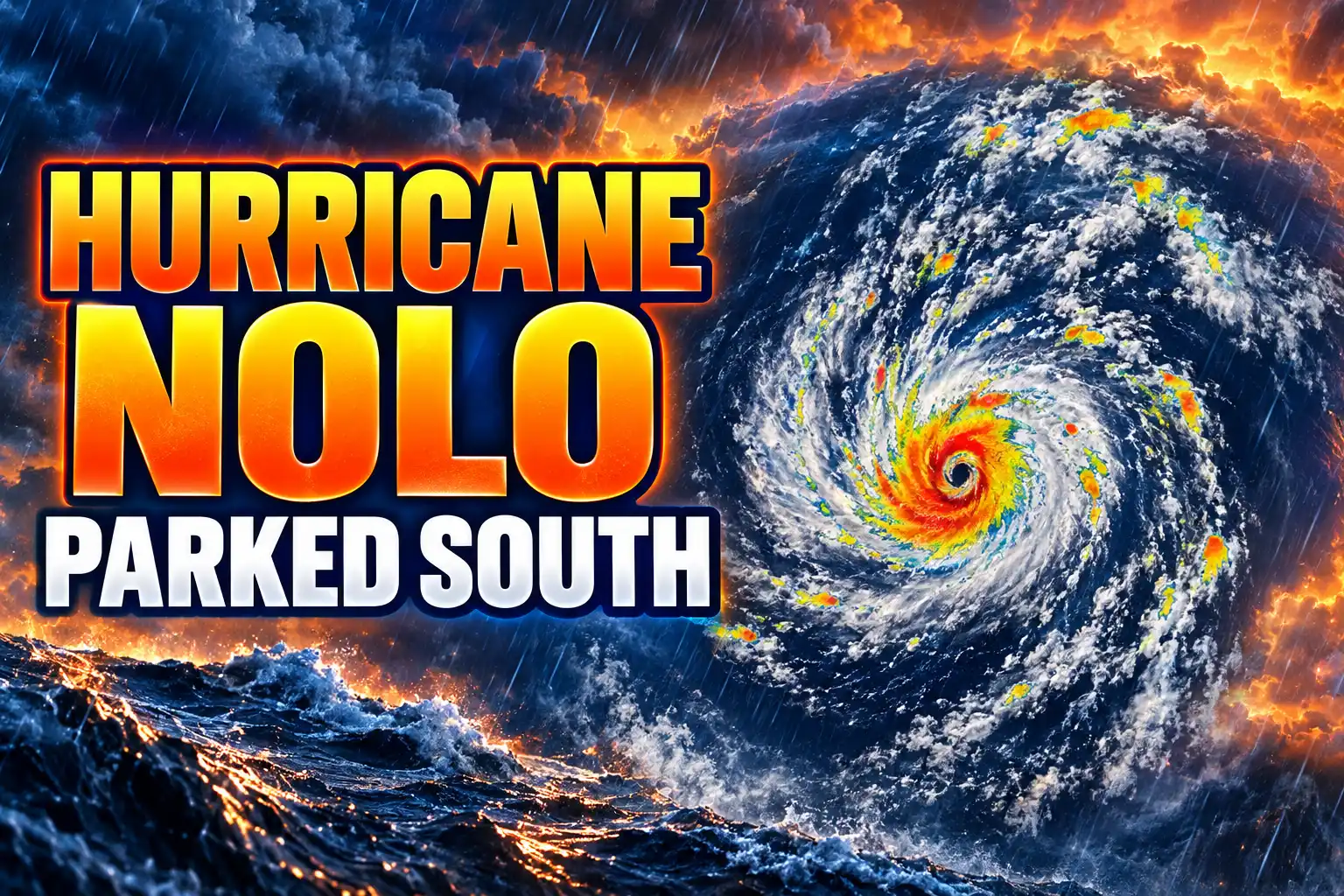
Hurricane Nolo is stalled 145 miles south of Hawaii’s Big Island, loading rain onto Kaʻū communities still clearing debris from Hurricane Lala.

Hurricane Nolo was nearly stationary south of the Big Island at 2 a.m. HST on Saturday, a Category 2 storm with 105 mph winds parked 145 miles off South Point. The National Hurricane Center said the center should stay well south and then turn west, even as rainbands already worked the same Kaʻū slopes Hurricane Lala tore up in August.
That offshore track is the headline every forecast repeats. The problem on the ground is the stall, because a parked hurricane keeps dumping water on towns that have not finished the last storm.
Nolo Is Parked 145 Miles South of South Point
Intermediate Advisory 23A, issued by the Central Pacific Hurricane Center in Honolulu and the National Hurricane Center in Miami, put the center near 16.9 north, 155.3 west, about 350 miles south-southeast of Honolulu. Nolo was not moving. Minimum pressure was 975 mb. Hurricane-force winds reached 45 miles from the center, and tropical-storm-force winds reached 140 miles.
The Honolulu forecast office, in its 9:18 p.m. HST Friday discussion, said outer bands were already on the Big Island’s southeast slopes and that gusts in excess of 50 mph had been reported on the Big Island and Maui. Tropical-storm conditions were occurring on Hawaii County’s steep terrain. Hurricane-force gusts were possible there Saturday morning. Maui County already had tropical-storm gusts in the high country, with a Tropical Storm Watch in effect.
A Hurricane Watch and a Tropical Storm Warning covered Hawaii County. A hurricane watch means hurricane conditions are possible. The warning means tropical-storm conditions are expected. Marine hurricane warnings were in effect around the Big Island, a different product from the land watch. The center was still forecast to remain well south and southwest of the main islands, then move west faster later Saturday and Sunday and turn northwest on Monday. Nolo was expected to become a major hurricane, Category 3 or higher, on Saturday or Saturday night and to peak late Sunday before weakening Monday.
The National Hurricane Center posted the 2 a.m. bulletin as Nolo sat still.
Hurricane #Nolo Advisory 23A (2 AM HST, Sat Sep 26): Nolo Still Nearly Stationary South of the Big Island of Hawaii. Expected to Strengthen During the Next Couple of Days While Remaining Well South of the Hawaiian Islands. https://t.co/NyUGSIFCuo
— NHC Pacific (@NHC_Pacific) September 26, 2026
A Hurricane Hunter transiting to Hawaii on Thursday said the aircraft hit an extended band from Nolo about 300 miles out, a reminder that the rain field is much wider than the 45-mile hurricane-wind core. The core was still tightening Friday even as those bands reached land. When that kind of storm stops moving, the rain does not sweep through. It sits.
Kaʻū Has Not Finished With Lala
Nāʻālehu resident Mark Peters, who has lived in the southern Big Island town for seven years, said Friday that neighbors still needed basics like food and water and that reconstruction had barely begun. “We’re just getting started with our recovery. But to have yet another big storm hit us, and potentially even bigger than the last one, it’s difficult,” he said. He called the work a matter of years. Driving through Waiʻōhinu after Lala, he said, he saw cars and houses moved off their places and buildings sitting in the baseball field at Waiʻōhinu Park.
South Point resident Tess Kala, who grew up in the area, said the run of storms shocked families who had lived there for generations. “Honestly, this is the first like, whoa, what happened? We had a lot of family and friends that have lived here all their lives through generations and never experienced this before,” she said. She was moving gear off houses, tying things down, and taping what she could before Nolo’s rain arrived.
On September 19, more than five weeks after Lala, Big Island Mayor Kimo Alameda said power was back islandwide and the boil-water notice for the Waiʻōhinu-Nāʻālehu system had been lifted, but crews were still replacing water lines and some Kaʻū pockets still had no water. Nāʻālehu and Waiʻōhinu were the target areas.
The debris is just unbelievable. I haven’t seen anything like it. 20 to 30 feet of debris right now that we’re trying to clear up.
Kimo Alameda, Mayor of Hawaii County, September 19, 2026
The Hawaii Emergency Management Agency’s early public-infrastructure figure for Lala was $67 million statewide, with Hawaii County carrying most of it. Those dollars do not include houses. HIEMA counted 267 homes hit statewide.
LALA PUBLIC INFRASTRUCTURE, HIEMA
| Area | Early public cost |
|---|---|
| Hawaii County | $48.5 million |
| Maui County | $9.9 million |
| City and County of Honolulu | $8.6 million |
| Statewide total | $67 million |
Hawaii County Civil Defense separately stacked about $75 million in residential damage, just under $17 million in commercial damage, and about $55 million in public work, or about $147 million in the county before insurance and federal shares are sorted. Gov. Josh Green said Lala’s overall cost would keep rising and would run to several hundred million dollars. Federal repayment, he said, can take months.
HOMES HIEMA COUNTED AFTER LALA
- Destroyed: 29 homes.
- Major damage: 82 homes.
- Minor damage: 102 homes.
- Affected: 54 homes, for 267 statewide.
Pahala resident Deborah Funai Brown, speaking during that same mid-September cleanup, put the season in one line: “This super El Niño is really kicking our butts.” She also said Kaʻū was preparing for the next storm as a when, not an if. Nolo is that storm.
How Much Rain Nolo Is Forecast to Dump
The National Hurricane Center’s Saturday morning rainfall forecast is lower than some Friday briefings that floated much higher island totals, and the Honolulu office said amounts had been adjusted slightly downward. The remaining numbers are still enough, the hurricane center said, for life-threatening flooding and mudslides on steep ground, especially eastern and southern Hawaii Island and Maui.
NOLO STORM-TOTAL RAIN, NHC ADVISORY 23A
| Area | Forecast | Local maximum |
|---|---|---|
| Eastern and southern Big Island | 8 to 12 inches | 16 inches |
| Western Big Island | 1 to 3 inches | 6 inches |
| Eastern Maui | 4 to 6 inches | 8 inches |
| Rest of the Hawaiian Islands | 1 to 2 inches | – |
Hawaii County could also see storm surge of 1 to 3 feet above ground if the peak comes at high tide, with large waves on top of that water. Swells were already hitting east- and south-facing Big Island shores and were expected to spread west through Sunday. The Honolulu office extended a High Surf Advisory for east and southeast shores of the Big Island, Maui, and Molokai through Sunday, and it had a High Surf Advisory up for Kauai, Oahu, and Niihau from Friday night. A Wind Advisory ran from 6 a.m. Saturday to 6 p.m. HST Sunday for large parts of Oahu and Kauai. Nolo could also throw tornadoes and large waterspouts over and near the Big Island, the hurricane center said.
Forecasters still expected a slow improvement Sunday once the storm finally walked west. Until then the rain is aimed at ground that Lala already stripped, where 20 to 30 feet of debris can turn into mobile dams and where water lines are still being dug back in.
Hawaii Already Faces a $1 Billion Recovery Bill
Nolo is the third hurricane in less than two months to whip past Hawaii, after Lala in August and Lowell in early September. On September 23, before Nolo reached hurricane strength, Green said the state faced about $1 billion in disaster recovery and resilience needs from the year’s stacked hits, including Kona lows, an earthquake in May, and the two earlier hurricanes. He said he would ask the Legislature for $300 million from the state’s $1.7 billion rainy-day fund. Those figures were preliminary, he said, and could move as damage surveys and federal eligibility catch up.
THE STORMS STACKED ON HAWAII
- August 2026: Hurricane Lala floods Kaʻū, wrecks homes and public works, and leaves a recovery Green later called several hundred million dollars.
- Early September 2026: Hurricane Lowell rakes the chain; Kauai after Hurricane Lowell’s near miss went mostly dark, another offshore track that still took down the grid.
- September 23, 2026: Green closes Hawaii Island public schools, some state and county offices, and University of Hawaii sites for Nolo; Hawaii County opens shelters; FEMA later dates the Nolo incident from this day.
- September 25, 2026: Nolo is a Category 2 storm, and a presidential emergency declaration is approved for all four counties.
- September 26, 2026: At 2 a.m. HST Nolo is still a stationary 105 mph hurricane 145 miles south of South Point, with major-hurricane strengthening on the table later in the day.
The $1 billion figure is the state’s running tab for 2026 disasters, not a damage estimate for Nolo, which had not yet finished raining. It is the bill Kaʻū and Kauai were already carrying when the third storm stopped offshore and started wringing out.
El Niño Took Down the Old Hurricane Shield
Hawaii’s usual defense is cool water and hostile wind shear that weaken storms as they approach. This year that shield is down. NOAA’s Pacific summary for June through August put the Relative Oceanic Niño Index at +1.4 C, with the weekly Niño 3.4 index at +1.8 C and an El Niño Advisory in effect. The Climate Prediction Center put a greater than 90 percent chance on a very strong El Niño this winter, and it assigned a 75 percent chance to a historic event that would exceed El Niño strength since 1950, meaning a three-month RONI of +2.5 C or more.
Brian McNoldy, a University of Miami hurricane researcher, said the pattern is ramping up to be perhaps the strongest El Niño on record. Matthew Rosencrans, NOAA’s lead hurricane-season forecaster, has said the typical year brings about one storm close to Hawaii. Warm water south and east of the islands, plus wetter air and friendlier winds, are why Lala, Lowell, and Nolo all found the chain in one season. NOAA’s May outlook had already called for an above-normal Pacific season because of this El Niño, including 5 to 13 tropical cyclones in the central Pacific against an average of 4 to 5.
Funai Brown did not need the index numbers. She was living in the rain they help explain, in a district that had already spent August and September on debris piles and water lines.
Highway 11 Floods Still Isolate Kaʻū
Kaʻū sits at the south end of Hawaii Island, tied to Hilo and Kona by Highway 11. Lala showed what happens when that road goes under. Floodwater cut Nāʻālehu off from both sides of the island, and county crews later had to push supplies in by convoy and helicopter. Mayor Alameda, opening shelters as Nolo strengthened, said officials isolate communities in Kaʻū know how fast that highway floods, and he told Nāʻālehu residents to use the Pāhala gym before the water rose again.
Hawaii County began opening pet-friendly shelters at 6 p.m. on September 23 and told people to bring food, water, medicine, and a carrier. A shuttle ran from Nāʻālehu Elementary to Pāhala so southern residents could get to higher ground before bands closed the road.
HAWAII COUNTY SHELTERS OPENED FOR NOLO
- Captain Cook: Yano Hall, 82-6156 Māmalahoa Highway.
- Nāʻālehu: Elementary School gym, 95-5545 Mamalahoa Highway, with a shuttle toward Pāhala.
- Pāhala: Robert N. Herkes Gym, 96-1219 Kamani Street, the site Alameda urged for Kaʻū if hurricane-force winds arrived.
- Keaʻau: Armory, 16-512 Volcano Road.
- Later openings: Honokaʻa Gym, Pāpaʻaloa Park Annex, Puʻuʻeo Community Center in Hilo, Kahilu Town Hall in Waimea, and Ocean View Community Center.
The Hawaii Emergency Management Agency told southeast Hawaii Island residents to consider a safer shelter, to plan for outages, and to watch a track that could still change. Kala’s South Point checklist, moving gear and tying down what Lala had already loosened, is the private version of the same bet: the eye can miss and the water can still take the road.
Trump Approved a Pre-Landfall Emergency Declaration
On September 25 Green announced that President Donald Trump had approved a pre-landfall emergency declaration for Tropical Cyclone 15E, now Hurricane Nolo. It covers the City and County of Honolulu and Hawaii, Maui, and Kauai counties. Help comes under Public Assistance Category B, including Direct Federal Assistance, at a 75% federal cost share. FEMA said the incident began September 23. Hirokazu Toiya was named federal coordinating officer. The package is built for protective work before a storm, search-and-rescue teams, and support to state and Hawaii County emergency operations, not for the multi-year rebuild Lala and Lowell already left behind.
Protecting the people of Hawaiʻi is our highest priority and this approval gives our state and counties the additional federal support needed to act before conditions deteriorate. Hurricane Nolo threatens to bring dangerous flooding, mudslides, damaging waves and disruptions to critical infrastructure, particularly on Hawaiʻi Island and Maui.
Gov. Josh Green, news release, September 25, 2026
Green told residents and visitors to follow official guidance and to be ready to shelter in place or evacuate if directed. That instruction lands in a district where Peters said people are still short of food and water, where Alameda’s crews are still staring at 20 to 30 feet of Lala debris, and where Nolo’s center, 145 miles south and sitting still, does not have to come ashore to test every unfinished repair.
The hurricane center’s next full advisory was due at 5 a.m. HST Saturday, with a west turn and a faster forward speed expected later in the day. Until that motion shows up in the fixes, the rain stays on Kaʻū.

Hurricane Nolo Hits a Big Island Still Digging Out

Gaza Families Remain in Buildings Already Cleared to Fall

Sony Polls Publishers Who Cannot Press PlayStation Discs Elsewhere

UN Settlement List Hits 214 as Investors Take Notice

Southwest Lounges Will Open Behind a New Chase Card

Thameslink Will Pad 60,000 Ironing-Board Seats From 2027

Burger King Rebuilds Chicken Nuggets After Calling Them Rubbery

Royal Caribbean Sends Los Angeles Ships to Singapore and Brisbane

Twenty Controllers Closed Norwich Airport for a Bank Holiday

Micron Sells the Memory Shortage as Five-Year Contracts
-
 NEWS4 weeks ago
Thameslink Will Pad 60,000 Ironing-Board Seats From 2027
-
 BUSINESS4 weeks ago
Burger King Rebuilds Chicken Nuggets After Calling Them Rubbery
-
 NEWS4 weeks ago
Royal Caribbean Sends Los Angeles Ships to Singapore and Brisbane
-
 NEWS4 weeks ago
Twenty Controllers Closed Norwich Airport for a Bank Holiday
-
 NEWS1 month ago
Micron Sells the Memory Shortage as Five-Year Contracts
-
 BUSINESS4 weeks ago
Sweetmore Bakeries Buys Fantasy Baking for Bar Work
-

 BUSINESS1 month ago
U.S. Forces Clear Hormuz Mines, Then Hit Minelayers Again
-

 NEWS4 weeks ago
Frontier Miles Cuts Basic Fares After the Barclays Pact